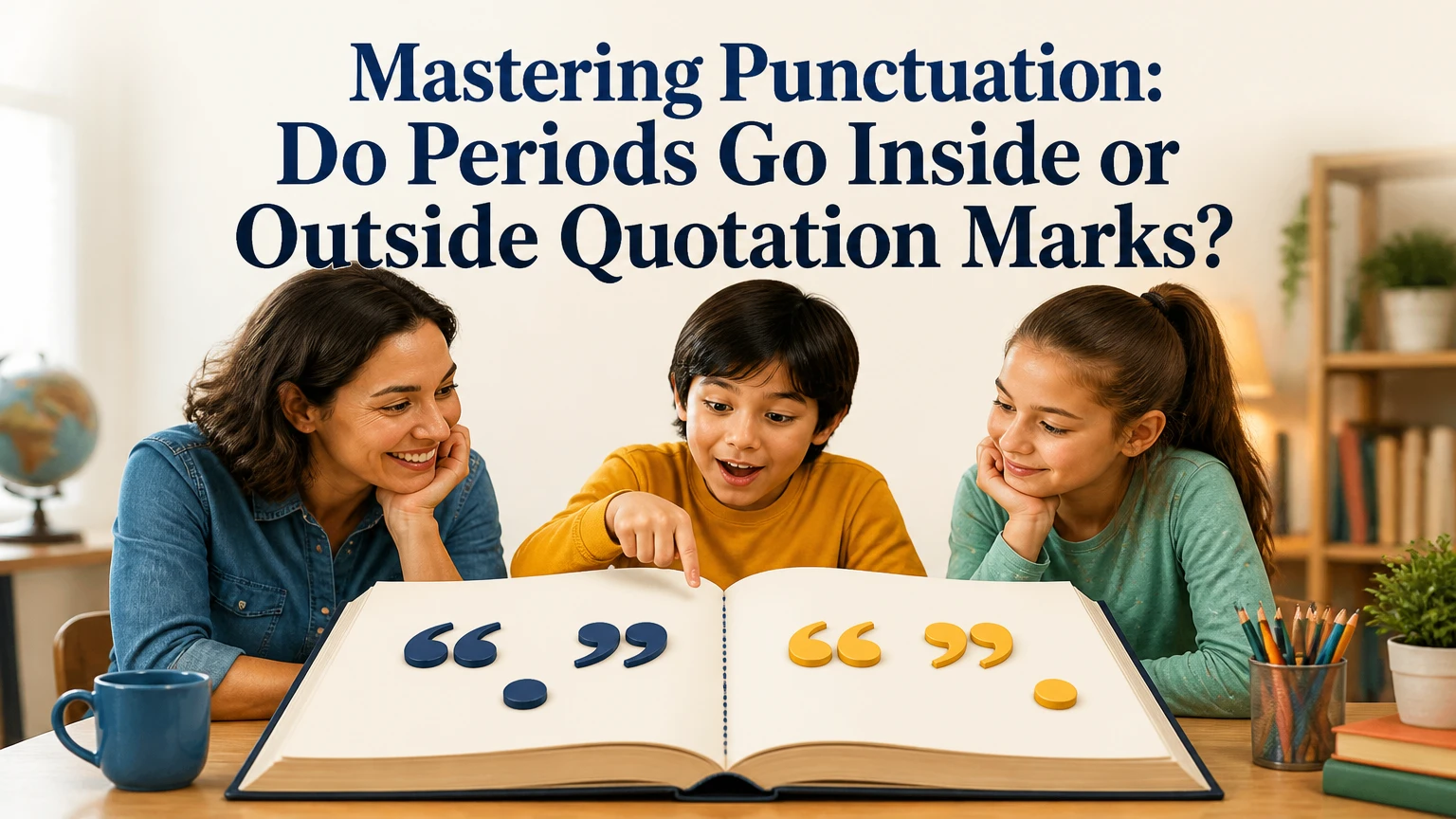
The placement of periods in relation to quotation marks is one of the most frequently debated and misunderstood rules in English grammar, primarily because the “correct” answer depends entirely on which side of the Atlantic Ocean you are standing. In American English, the standard rule is that periods always fall within the closing quotation mark, regardless of whether the quoted material is a full sentence or a single word. This convention applies to various types of quoted content, including “short phrases,” “dialogue,” “article titles,” “nicknames,” and “technical terms.” Understanding these nuances is essential for students, professional writers, and editors who wish to maintain consistency and professional polish in their written communication, ensuring that their work adheres to the specific style guides required by their academic or professional environments.
Table of Contents
- Definition and Overview
- Regional Differences: American vs. British Style
- Structural Breakdown of Quoted Sentences
- Types of Quotations and Punctuation Patterns
- Extensive Example Tables
- Comprehensive Usage Rules and Logic
- Special Cases: Titles, Nicknames, and Technical Terms
- Common Mistakes and How to Avoid Them
- Practice Exercises and Answer Key
- Advanced Topics: Nested Quotes and Digital Media
- Frequently Asked Questions (FAQ)
- Conclusion and Final Tips
Definition and Overview
To understand where a period goes, we must first define the components involved in this grammatical relationship. A period (known as a full stop in British English) signifies the end of a declarative sentence, while quotation marks (also called inverted commas) are used to set off speech, direct quotes, or specific titles. The central conflict arises from the intersection of these two punctuation marks at the end of a sentence.
In the United States, the convention is largely aesthetic. Early printers found that placing the small period inside the “curl” of the quotation mark protected the delicate metal type from breaking and looked more balanced on the page. In the United Kingdom and many other English-speaking nations, the placement is determined by logic: if the period belongs to the quoted material, it goes inside; if it belongs to the main sentence, it goes outside.
This article focuses primarily on the American standard, as it is often the most confusing for learners due to its rigid “inside” rule. However, we will explore the British “logical” system in depth to provide a global perspective. Whether you are writing a research paper, a novel, or a business report, mastering these placements is a hallmark of high-level literacy.
Regional Differences: American vs. British Style
The divide between American and British English regarding punctuation is stark. In American English, the rule is simple and uncompromising: periods and commas always go inside quotation marks. This is the standard followed by the Associated Press (AP) Stylebook, The Chicago Manual of Style, and the MLA Handbook.
British English, however, follows what is often called “logical punctuation.” This system dictates that the period stays outside the quotation marks unless the quoted text is a complete sentence that began with its own capital letter. If you are quoting a fragment or a single word at the end of your own sentence, the period goes outside. This approach is favored by the Oxford University Press and is common in the UK, Canada, and Australia.
The following table illustrates the core differences between these two major systems using various sentence structures.
| Sentence Type | American Style (Inside) | British Style (Logical) |
|---|---|---|
| Direct Speech | He said, “I am coming.” | He said, “I am coming.” |
| Fragment Quote | She called him a “genius.” | She called him a “genius”. |
| Article Title | I read “The Future.” | I read “The Future”. |
| Single Word Quote | The sign said “Stop.” | The sign said “Stop”. |
| Technical Term | This is called “coding.” | This is called “coding”. |
Structural Breakdown of Quoted Sentences
When analyzing the structure of a sentence ending in a quotation, we must look at the hierarchy of the punctuation. In American English, the closing quotation mark acts as a “container” that swallows the period. Even if the sentence is complex, the period remains tucked inside.
Consider the structure: [Main Clause] + [Opening Quote] + [Quoted Content] + [Period] + [Closing Quote]. In the American system, the period is the penultimate character. In the British system, the structure is often [Main Clause] + [Opening Quote] + [Quoted Content] + [Closing Quote] + [Period].
This structural difference affects the visual rhythm of the text. American style creates a cleaner edge at the end of the sentence, whereas British style clearly distinguishes between the speaker’s words and the writer’s sentence structure. Understanding this breakdown helps writers switch between styles if they are writing for international audiences.
Types of Quotations and Punctuation Patterns
Not all quotations serve the same purpose. We can categorize them into direct speech, partial quotes, and “scare quotes” (used to indicate irony or non-standard usage). Each category follows the same primary rule in American English, but the context changes how we perceive the period.
Direct Speech
Direct speech involves reporting exactly what someone said. This is the most common use of quotation marks. In these cases, the period represents the end of the speaker’s thought as well as the writer’s sentence. Example: My mother always said, “Eat your vegetables.”
Partial Quotations
Partial quotations integrate a few words of someone else’s speech into your own sentence. Even though the period technically belongs to your sentence and not the original speaker, American style still pulls that period inside. Example: The CEO described the year as “challenging but rewarding.”
Scare Quotes and Terms
Writers use quotation marks to highlight specific terms or to suggest that a word is being used in a special or ironic sense. Even in these brief instances, the period goes inside. Example: He claimed he was working, but he was actually “resting.”
Extensive Example Tables
To truly master this concept, you need to see it in action across dozens of scenarios. The following tables provide a comprehensive look at how periods interact with quotation marks in American English across different contexts.
Table 1: 25 Examples of Direct Speech and Dialogue
This table demonstrates how full sentences spoken by individuals are punctuated at the end of a sentence. Note that the period is always inside the closing mark.
| No. | Sentence Example |
|---|---|
| 1 | James whispered, “I think we are being followed.” |
| 2 | “I’ll be there in five minutes,” she promised. |
| 3 | The teacher noted, “The exam will cover chapters one through four.” |
| 4 | The doctor said, “You need more sleep.” |
| 5 | “It is a beautiful morning,” remarked the gardener. |
| 6 | The captain shouted, “Abandon ship.” |
| 7 | “I have never seen anything like it,” the detective said. |
| 8 | The waiter asked, “Would you like dessert?” (Note: question mark replaces period) |
| 9 | “The project is complete,” the manager announced. |
| 10 | She sighed and said, “I am so tired.” |
| 11 | “Don’t forget your umbrella,” reminded his father. |
| 12 | The witness testified, “I saw the car turn left.” |
| 13 | “We are winning,” cheered the crowd. |
| 14 | The coach told us, “Keep your eyes on the ball.” |
| 15 | “I’m not sure about that,” he admitted. |
| 16 | The pilot announced, “We are beginning our descent.” |
| 17 | “This is the best pizza in town,” she declared. |
| 18 | The child cried, “I want my toy.” |
| 19 | “Please sit down,” said the librarian. |
| 20 | The scientist explained, “The reaction is instantaneous.” |
| 21 | “I love this song,” he sang along. |
| 22 | The judge stated, “The court is now in session.” |
| 23 | “I’ll do my best,” the student promised. |
| 24 | The actor bowed and said, “Thank you.” |
| 25 | “It’s a secret,” she whispered. |
Table 2: 25 Examples of Partial Quotes and Integrated Phrases
These examples show how short phrases or fragments taken from other sources are punctuated when they end a sentence.
| No. | Sentence Example |
|---|---|
| 1 | The report described the situation as “dire.” |
| 2 | He called the new policy a “disaster.” |
| 3 | The critic praised the performance as “luminous.” |
| 4 | The weather forecast predicted “heavy snow.” |
| 5 | She referred to her dog as her “best friend.” |
| 6 | The contract was described as “legally binding.” |
| 7 | He dismissed the rumor as “pure nonsense.” |
| 8 | The chef called the dish “perfection.” |
| 9 | The article labeled him a “visionary.” |
| 10 | They were living in what they called a “dream house.” |
| 11 | The athlete described the win as “emotional.” |
| 12 | The book was a “page-turner.” |
| 13 | The sky was a shade of “midnight blue.” |
| 14 | He spoke with what she called “brutal honesty.” |
| 15 | The meeting was “short and sweet.” |
| 16 | The lawyer argued the evidence was “circumstantial.” |
| 17 | The city was famous for its “winding streets.” |
| 18 | The technology was considered “state-of-the-art.” |
| 19 | She had a “heart of gold.” |
| 20 | The project was “ahead of schedule.” |
| 21 | The movie was “critically acclaimed.” |
| 22 | The room was “pitch black.” |
| 23 | He was known for his “sharp wit.” |
| 24 | The garden was “full of life.” |
| 25 | The decision was “final.” |
Table 3: 20 Examples of Titles and Terms in Quotation Marks
When short works like poems, articles, or songs are mentioned at the end of a sentence, the period remains inside the quotation marks.
| No. | Sentence Example |
|---|---|
| 1 | Robert Frost wrote the poem “The Road Not Taken.” |
| 2 | My favorite song on the album is “Yesterday.” |
| 3 | She just finished reading the article “The Future of AI.” |
| 4 | The first chapter is titled “The Beginning.” |
| 5 | He quoted a line from “The Raven.” |
| 6 | We analyzed the short story “The Lottery.” |
| 7 | The essay was titled “Nature’s Beauty.” |
| 8 | The band played their hit single “Blue Skies.” |
| 9 | I cited the journal article “Climate Change Impacts.” |
| 10 | The lecture was called “Physics for Poets.” |
| 11 | The blog post was titled “Ten Tips for Travel.” |
| 12 | She recited the poem “O Captain! My Captain!” (Note: exclamation mark replaces period) |
| 13 | The column was titled “The Daily Grind.” |
| 14 | The episode was called “The Big Reveal.” |
| 15 | He wrote a song called “Homecoming.” |
| 16 | The pamphlet was titled “Know Your Rights.” |
| 17 | The short film was titled “The Red Balloon.” |
| 18 | The chapter is “Introduction to Calculus.” |
| 19 | The speech was titled “I Have a Dream.” |
| 20 | The editorial was titled “A Call to Action.” |
Comprehensive Usage Rules and Logic
The rules governing periods and quotation marks can be summarized through three primary lenses: the American Rule, the British Rule, and the Rule of Other Punctuation. Understanding these three perspectives provides a complete toolkit for any writer.
The American Rule (The Aesthetic Rule)
In American English, the period is always placed inside the quotation mark. This rule is absolute and does not change based on the length of the quote or whether the quote is a full sentence. It is a rule of typography rather than logic. The only time a period does not appear inside a quotation mark is when another terminal punctuation mark—like a question mark or exclamation point—is already there and belongs to the quote itself.
The British Rule (The Logical Rule)
In British English, the period’s placement depends on the context of the quote. If the quotation is a complete sentence that stands alone, the period goes inside. If the quotation is a fragment or a piece of a larger sentence, the period goes outside. This rule prioritizes the integrity of the original text and the structure of the host sentence.
The Rule of Other Punctuation
It is important to note that while periods and commas always go inside in American English, colons and semicolons always go outside. Question marks and exclamation points are the “wild cards”—they go inside if they belong to the quote, and outside if they belong to the main sentence. This distinction is crucial because it shows that the “inside” rule for periods is an exception rather than the standard for all punctuation.
Special Cases: Titles, Nicknames, and Technical Terms
There are several specific scenarios where quotation marks are used that might make a writer hesitate. However, the American rule remains steadfast. Let’s look at how these special cases behave at the end of a sentence.
Article and Song Titles
When you mention the title of a short work (like an article, a song, or a poem) at the end of a sentence, the period goes inside. For example: The choir sang “Amazing Grace.” Even though “Amazing Grace” is a title and not a spoken sentence, the period stays tucked inside.
Nicknames
If you are introducing a nickname at the end of a sentence, the same rule applies. For example: He was known to his friends as “The Captain.” The quotation marks here are used to set the nickname apart, yet the period remains inside.
Technical Terms and Definitions
When defining a term or introducing a new concept, writers often use quotation marks to signal the specific word being discussed. For example: In linguistics, the study of meaning is called “semantics.” Again, the period is placed inside the closing quotation mark.
Common Mistakes and How to Avoid Them
Even seasoned writers can fall into traps when dealing with quotation marks. The most common error is applying the “logical” rule in an American context or vice versa. Below is a table highlighting common mistakes and their corrections in American English.
| Incorrect (American Style) | Correct (American Style) | Reasoning |
|---|---|---|
| He said, “I’m tired”. | He said, “I’m tired.” | Period must be inside. |
| The sign said “Open”. | The sign said “Open.” | Even single words follow the rule. |
| I love the song “Halo”. | I love the song “Halo.” | Titles at the end follow the rule. |
| She called it a “scam”. | She called it a “scam.” | Partial quotes follow the rule. |
| “Wait for me”, he cried. | “Wait for me,” he cried. | Commas also go inside. |
Another common mistake is doubling up on punctuation. You should never have a period inside the quotation marks and another period outside. One terminal punctuation mark is sufficient to end the sentence. For example, do not write: He said, “Hello.”. The correct version is: He said, “Hello.”
Practice Exercises and Answer Key
Test your knowledge with the following exercises. These are designed to help you internalize the American English rules for period placement.
Exercise 1: Identify the Correct Sentence
Choose the sentence that follows standard American English punctuation rules.
- A) She told me, “Don’t be late”. / B) She told me, “Don’t be late.”
- A) The article was titled “The New Economy.” / B) The article was titled “The New Economy”.
- A) He described the movie as “boring.” / B) He described the movie as “boring”.
- A) “I’ll see you tomorrow,” said Sarah. / B) “I’ll see you tomorrow”, said Sarah.
- A) My favorite poem is “The Tyger.” / B) My favorite poem is “The Tyger”.
- A) The label on the box said “Fragile.” / B) The label on the box said “Fragile”.
- A) He called his car “The Beast.” / B) He called his car “The Beast”.
- A) “Stop right there,” the officer commanded. / B) “Stop right there”, the officer commanded.
- A) The chef’s secret ingredient was “saffron.” / B) The chef’s secret ingredient was “saffron”.
- A) She whispered, “I’m scared.” / B) She whispered, “I’m scared”.
Exercise 2: Fix the Punctuation
The following sentences follow British or incorrect styles. Rewrite them using American English rules.
- The witness said, “I was at home”.
- He referred to the project as a “work in progress”.
- The name of the chapter is “The Great War”.
- “I’m not going to the party”, she stated.
- The sign indicated that the area was “private property”.
- He always says, “Better late than never”.
- She sang the first verse of “Silent Night”.
- The teacher called him a “scholar”.
- “I can’t wait for summer”, the student sighed.
- The document was marked “Confidential”.
Answer Key
| Ex 1 Question | Correct Answer | Ex 2 Corrected Sentence |
|---|---|---|
| 1 | B | The witness said, “I was at home.” |
| 2 | A | He referred to the project as a “work in progress.” |
| 3 | A | The name of the chapter is “The Great War.” |
| 4 | A | “I’m not going to the party,” she stated. |
| 5 | A | The sign indicated that the area was “private property.” |
| 6 | A | He always says, “Better late than never.” |
| 7 | A | She sang the first verse of “Silent Night.” |
| 8 | A | The teacher called him a “scholar.” |
| 9 | A | “I can’t wait for summer,” the student sighed. |
| 10 | A | The document was marked “Confidential.” |
Advanced Topics: Nested Quotes and Digital Media
As you move into more complex writing, you may encounter “quotes within quotes” (nested quotations). In American English, the primary quote uses double quotation marks (” “), while the internal quote uses single quotation marks (‘ ‘). The rule for the period remains the same: it goes inside both the single and double closing marks.
Example: The professor said, “We will now discuss Frost’s poem ‘The Road Not Taken.'” Note how the period is placed inside the single quote, which is then followed by the double quote.
In the digital age, some argue for a shift toward logical punctuation to avoid confusion in technical contexts. For example, if a computer manual tells you to type a specific code, putting the period inside the quotes might make the user think the period is part of the code. This is why many technical writers and programmers prefer the British style in specific contexts to ensure accuracy.
Example (Technical Context): To start the program, type “RUN”. In this specific case, placing the period inside (“RUN.”) could lead to a syntax error. However, in formal academic or literary writing, the traditional American rule still holds sway.
Frequently Asked Questions (FAQ)
1. Why does American English put the period inside?
The tradition started with early printing presses. Periods and commas are small, thin pieces of metal type. If they were placed at the end of a line outside of quotation marks, they were more likely to break or shift. Placing them inside the quotation marks provided physical protection for the type. Over time, this became the established aesthetic standard in the U.S.
2. Does this rule apply to commas too?
Yes. In American English, commas also always go inside the quotation marks. For example: “I’m ready,” he said, “to go home.” Both commas are tucked inside the closing marks of their respective quoted segments.
3. What about question marks and exclamation points?
These marks follow a logical rule even in American English. If the question or exclamation is part of the quoted material, the mark goes inside. If the whole sentence is a question but the quote is not, the mark goes outside. Example 1: He asked, “Where are you going?” Example 2: Did he really say, “I am going”?
4. If I am writing for a British audience, should I change my punctuation?
Generally, yes. If you are submitting a paper to a UK university or a manuscript to a British publisher, you should adopt their “logical” punctuation style to meet their local expectations and style guides.
5. Is it ever okay to put the period outside in American English?
In formal writing, no. However, in technical writing—such as providing computer commands or passwords—it is increasingly common to put the period outside to avoid confusion about what characters are included in the string. Always check your specific style guide (like the IEEE or a company-specific guide).
6. What if the quote is just one word?
The rule still applies. Whether it is a single word or a fifty-word sentence, the period goes inside the closing quotation mark in American English. Example: The answer was “yes.”
7. How do I handle a quote at the end of a parenthetical statement?
This gets tricky. If the quotation is at the end of a sentence that is also inside parentheses, the period goes inside the quotes and the closing parenthesis goes last. Example: (He said, “I’m leaving.”) If the parentheses are part of a larger sentence, the period goes outside the closing parenthesis. Example: He was known for his “catchphrase” (which was “Bazinga”).
8. Does the MLA style follow the American rule?
Yes, MLA, APA, Chicago, and AP style all require periods and commas to be placed inside the quotation marks.
Conclusion and Final Tips
Mastering the placement of periods and quotation marks is a vital step in becoming a proficient English writer. While the American rule of “always inside” may seem counterintuitive at first, especially compared to the logical British system, it provides a consistent and aesthetically pleasing finish to your sentences. Remember that this rule applies to “dialogue,” “short titles,” “fragments,” and “technical terms” alike. To ensure accuracy, always identify your target audience and the style guide you are required to follow. With practice, placing that period inside the “curl” of the quotation mark will become second nature, allowing your writing to look professional and polished in any academic or professional setting. Keep writing, keep practicing, and always keep your punctuation in its proper place!