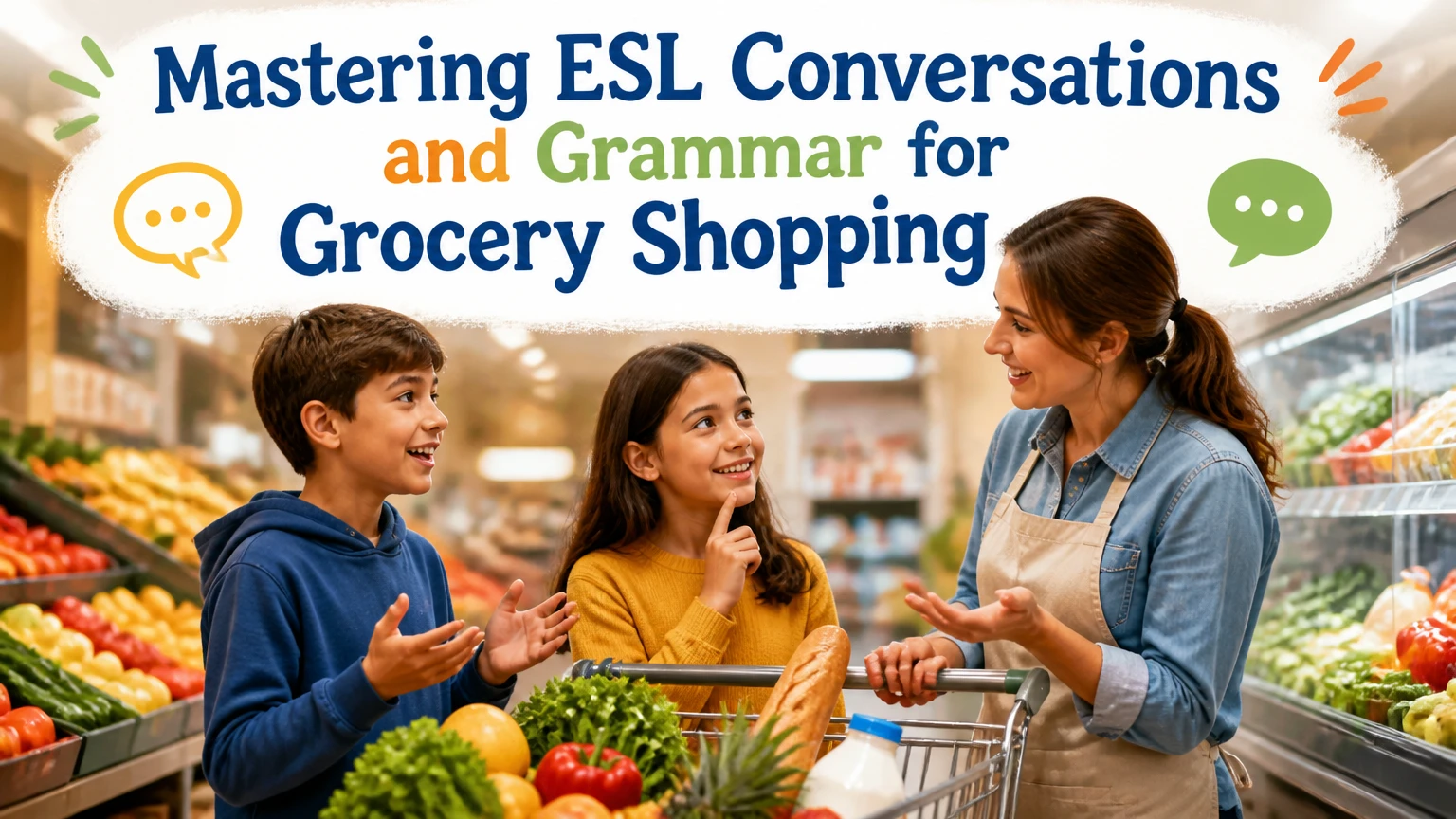
Navigating a supermarket in a foreign language requires a unique blend of functional vocabulary, polite social formulas, and specific grammatical structures that facilitate smooth transactions. When shopping for food, learners must utilize various linguistic tools such as quantifiers, partitives, polite requests, and modal verbs to express their needs effectively. Mastering phrases like “Could I have a dozen eggs?” or “Where can I find the dairy aisle?” allows students to move beyond basic pointing and gesturing toward confident, fluent communication. This guide explores the essential grammar of food shopping, including mass and count nouns, the nuances of asking for help, and the cultural etiquette of checkout counters. By understanding how to use specific terms including a loaf of, a bunch of, a carton of, and a kilo of, learners can transform a stressful chore into a successful real-world language practice session.
Table of Contents
- Definition and Scope of Grocery Shopping English
- Structural Breakdown of Shopping Dialogues
- Noun Categories: Count vs. Non-Count Food Items
- Quantifiers and Partitives: Measuring Your Food
- Polite Requests and Modal Verbs in the Store
- Locational Prepositions and Navigating Aisles
- Comprehensive Examples and Tables
- Usage Rules and Grammatical Nuances
- Common Mistakes to Avoid
- Practice Exercises and Drills
- Advanced Topics: Idioms and Comparative Shopping
- Frequently Asked Questions (FAQ)
- Conclusion and Final Tips
Definition and Scope of Grocery Shopping English
Grocery shopping English refers to the specialized subset of the English language used within the context of food retail environments. This includes supermarkets, local farmers’ markets, specialty delis, and bakeries. It is not merely a list of food names; rather, it is a complex intersection of transactional functional language and specific grammatical rules. When we talk about grocery conversations, we are discussing the ability to ask for information, specify quantities, negotiate prices, and interact with service staff.
The primary function of this language is to facilitate the acquisition of goods. However, the secondary function is social integration. In many English-speaking cultures, the interaction between a customer and a cashier or a butcher involves a level of “small talk” and polite framing. For an ESL learner, understanding the difference between saying “Give me meat” and “I’d like half a pound of ground beef, please” is the difference between appearing rude and appearing proficient. The scope of this topic covers everything from the initial planning stage (making a list) to the final payment at the register.
Furthermore, this topic serves as a practical application for several core grammar concepts. It is perhaps the best environment to practice determiners (this, that, these, those) and quantifiers (some, any, much, many). Because food comes in various states—liquid, solid, bulk, and packaged—it forces the speaker to distinguish between nouns that can be counted and those that cannot. This distinction is fundamental to English syntax and is perfectly illustrated through the items found on grocery shelves.
Structural Breakdown of Shopping Dialogues
Conversations in a grocery store typically follow a predictable structural pattern. Recognizing these patterns helps ESL learners anticipate what will be said next, reducing anxiety and improving response time. Most interactions consist of an opening, a request or inquiry, a clarification phase, and a closing. Each phase utilizes specific grammatical “building blocks” that are essential for clear communication.
The Opening Phase usually involves a greeting or an “excuse me” to get someone’s attention. In a service-oriented culture, the staff might initiate this with a question like “Can I help you find something?” The grammatical structure here is often a modal verb (can, may, could) followed by an infinitive. The customer’s response usually sets the tone for the rest of the interaction, moving quickly into the Inquiry Phase.
The Inquiry Phase is where the core information is exchanged. This is characterized by the use of interrogative pronouns (where, how much, what) and prepositional phrases. For example, “Where is the produce section?” uses the “Where is/are…” structure to locate items. If the customer is looking for a specific quantity, they will use partitive structures, such as “I am looking for a jar of pickles.” This phase requires precision in noun usage and adjective placement.
Finally, the Closing Phase occurs at the checkout. This involves a series of rapid-fire questions from the cashier concerning payment methods, loyalty cards, and bagging preferences. The grammar here shifts to future intentions (“I’ll pay with credit”) and conditional preferences (“If you have paper bags, I’d prefer those”). Understanding this structure allows learners to focus on the specific vocabulary needed for each “slot” in the conversation.
Noun Categories: Count vs. Non-Count Food Items
One of the most challenging aspects of English for many learners is the division of nouns into count and non-count (mass) categories. In the grocery store, this distinction is vital because it dictates which verbs and quantifiers you must use. Count nouns refer to individual units that can be separated and counted. Examples include apples, bananas, eggs, and cans of soup. These nouns have both singular and plural forms.
Non-count nouns, on the other hand, refer to substances, powders, liquids, or abstract masses that cannot be easily separated into individual units without a container. Examples include milk, flour, sugar, rice, and meat. You cannot say “three milks” in a formal sense; you must say “three cartons of milk.” This is where many ESL learners struggle, as they might mistakenly apply plural endings to non-count nouns (e.g., saying “fishes” when referring to the meat or “sugars”).
The grammar rules change based on these categories. For count nouns, we use “many” or “a few”; for non-count nouns, we use “much” or “a little.” Understanding this allows a shopper to ask correctly: “How many apples do we need?” versus “How much flour is left?” Mastery of these categories is the first step toward grammatical accuracy in a retail environment.
Quantifiers and Partitives: Measuring Your Food
Since many items in a grocery store are non-count nouns, we use partitives to “unitize” them. A partitive is a word or phrase that indicates a specific part or quantity of a whole. This is a crucial grammatical tool for ESL students because it provides the structure needed to buy specific amounts of bulk items. Common partitive structures follow the pattern: [Number] + [Unit of Measure] + of + [Noun].
For example, instead of just saying “water,” a shopper asks for “a bottle of water.” Instead of “bread,” they ask for “a loaf of bread.” These units of measure are often specific to the shape or packaging of the item. We use “a head of lettuce” because of its round shape, but “a bunch of bananas” because they grow together in a cluster. Learning these pairings is a matter of both grammar and vocabulary memorization.
Quantifiers like “some” and “any” are also essential. We use “some” in affirmative sentences (“I need some milk”) and “any” in negative sentences or questions (“I don’t have any eggs” or “Do you have any fresh ginger?”). However, in the context of an offer or a specific request where the answer is expected to be “yes,” we can use “some” in a question: “Could I have some help with these bags?”
Polite Requests and Modal Verbs in the Store
In English-speaking countries, the level of politeness used in a grocery store is often higher than in some other cultures. Using imperatives (commands) like “Give me the cheese” can come across as aggressive or rude. Instead, proficient speakers use modal verbs to soften their requests. The most common modals for shopping are can, could, may, and would.
The phrase “I would like…” (often contracted to “I’d like…”) is the standard way to express a desire for an item. It is more formal and polite than “I want.” When asking for assistance, “Could you tell me where…” is the preferred structure. The use of “could” rather than “can” adds a layer of “conditional politeness” that is highly valued in social interactions. It suggests that the speaker is asking for a favor rather than demanding service.
Another important aspect of polite requests is the use of indirect questions. Instead of asking “Where is the milk?”, which is direct, a shopper might say, “Do you know where the milk is?” Note the change in word order: in the indirect question, the subject (“the milk”) comes before the verb (“is”). This subtle grammatical shift makes the speaker sound more sophisticated and polite.
Locational Prepositions and Navigating Aisles
Supermarkets are organized into specific zones, and finding items requires a strong grasp of prepositions of place. When you ask an employee for help, they will likely use a string of prepositions to guide you. Understanding words like between, next to, across from, behind, and at the end of is essential for following these directions accurately.
For instance, an employee might say, “The cereal is in Aisle 5, next to the coffee and across from the baking supplies.” If you don’t understand these spatial relationships, you will find yourself wandering aimlessly. Prepositions also help you describe where an item is if you are pointing it out to someone else, such as “It’s on the top shelf” or “It’s at the bottom of the display.”
Commonly used prepositions in the grocery store include:
- In: Used for aisles or sections (In the frozen food section).
- On: Used for shelves or surfaces (On the third shelf).
- At: Used for specific points (At the checkout, at the deli counter).
- Next to / Beside: Used for items side-by-side.
- Opposite / Across from: Used for items on the other side of the aisle.
Comprehensive Examples and Tables
To help visualize these concepts, the following tables provide categorized lists of essential grocery-related English. These tables are designed to be used as a reference for both vocabulary and grammatical structure.
Table 1: Common Partitives and Containers
This table illustrates how we turn non-count nouns into countable units using partitives. This is essential for writing shopping lists and asking for specific quantities.
| Partitive/Container | Common Food Items | Example Sentence |
|---|---|---|
| A loaf of | Bread, sourdough, rye | I need a loaf of whole wheat bread. |
| A carton of | Milk, eggs, juice, cream | Please pick up a carton of orange juice. |
| A jar of | Pickles, jam, peanut butter, honey | Is there a jar of mayo in the pantry? |
| A can of | Soup, beans, soda, tuna | We should buy three cans of tomato soup. |
| A bag of | Flour, sugar, rice, potatoes, chips | Grab a large bag of frozen peas. |
| A bunch of | Bananas, grapes, celery, parsley | I’ll take a bunch of green grapes. | Lettuce, cabbage, cauliflower | We need a head of iceberg lettuce. |
| A box of | Cereal, crackers, pasta, tissues | Can you find a box of spaghetti? |
| A bottle of | Water, wine, oil, vinegar, ketchup | Get a bottle of olive oil, please. |
| A tub of | Margarine, yogurt, ice cream, hummus | I’d like a tub of Greek yogurt. |
| A stick of | Butter, gum, pepperoni | The recipe calls for a stick of butter. |
| A clove of | Garlic | You only need one clove of garlic. |
| A slice of | Cheese, ham, cake, pizza | Would you like a slice of cheddar? |
| A pound of | Meat, poultry, bulk vegetables | I want two pounds of ground turkey. |
| A dozen | Eggs, donuts, rolls | A dozen eggs is cheaper than a half-dozen. |
| A pint of | Berries, cream, ice cream | Let’s get a pint of blueberries. |
| A pack of | Gum, soda, batteries, meat | Is that a six-pack of cola? |
| A roll of | Paper towels, aluminum foil | We are out of rolls of paper towels. |
| A tin of | Sardines, cookies, mints | He bought a tin of imported sardines. |
| A sprig of | Rosemary, thyme, mint | Garnish the dish with a sprig of mint. |
Table 2: Helpful Phrases for Navigating the Store
These phrases use various grammatical structures, including questions, modals, and prepositions, to help you interact with store staff.
| Function | Example Phrase | Grammar Note |
|---|---|---|
| Asking for Location | Where can I find the spices? | Modal “can” + base verb |
| Asking for Assistance | Could you help me reach that? | Polite modal “could” |
| Checking Availability | Do you have any fresh basil? | “Any” in a question |
| Asking for Price | How much is this per pound? | Non-count “much” |
| At the Deli Counter | I’d like a quarter pound of ham. | “I’d like” for requests |
| Checking Expiry | When does this milk expire? | Present simple for schedules |
| Clarifying Weight | Is this sold by weight or by the piece? | Passive voice structure |
| Expressing Preference | I prefer the organic ones. | Comparative preference |
| Finding the Aisle | Which aisle is the baking soda in? | “Which” for limited choices |
| Asking for a Bag | Could I get a paper bag, please? | Count noun “bag” |
| Asking about Sales | Is this item on sale today? | Prepositional phrase “on sale” |
| Reporting a Spill | There is a spill in Aisle 4. | “There is” for existence |
| Ordering Meat | Can you cut this into smaller pieces? | Request for action |
| Asking for a Raincheck | Do you offer rainchecks for this? | Vocabulary: Raincheck |
| Checking Out | I have my own reusable bags. | Possessive adjective “my” |
| Payment Method | Do you take contactless payment? | Present simple question |
| Asking for a Receipt | May I have a receipt, please? | Formal modal “may” |
| Inquiring about Bulk | Can I buy these in bulk? | Prepositional phrase “in bulk” |
| Looking for a Brand | Do you carry the “Sun-Maid” brand? | Verb “carry” as “to stock” |
| Asking for a Cart | Where are the shopping carts kept? | Passive voice |
Table 3: Count vs. Non-Count Nouns in the Grocery Store
Distinguishing between these categories is vital for using correct verb agreement and quantifiers.
| Noun Category | Examples (Count) | Examples (Non-Count) | Key Rule |
|---|---|---|---|
| Produce | Apples, Oranges, Peppers, Onions | Lettuce, Spinach, Broccoli, Garlic | Count = Use “many” |
| Dairy | Eggs, Individual yogurts | Milk, Butter, Cheese, Cream | Non-Count = Use “much” |
| Bakery | Rolls, Bagels, Muffins, Cookies | Bread, Flour, Dough, Sugar | Count can be pluralized |
| Meat/Deli | Sausages, Hot dogs | Beef, Chicken, Pork, Salami | Non-count needs weights |
| Pantry | Cans, Jars, Boxes, Bottles | Rice, Pasta, Cereal, Oil | Containers are countable |
| Frozen | Popsicles, Ice cream sandwiches | Ice cream, Frozen fruit, Ice | Units vs. Mass |
| Snacks | Pretzels, Crackers, Chips (bags) | Popcorn, Chocolate, Candy (bulk) | Check the packaging |
| Beverages | Cans of soda, Bottles of juice | Water, Tea, Coffee, Wine | Liquids are non-count |
| Condiments | Packets of ketchup | Mustard, Mayo, Salt, Pepper | Powders/Pastes are mass |
| Seafood | Oysters, Clams, Shrimps | Fish, Salmon, Lobster (meat) | Context dependent |
Usage Rules and Grammatical Nuances
When shopping, small grammatical choices can change the meaning of your sentence or your level of perceived politeness. One major rule involves the use of articles (a, an, the). We use “a/an” for non-specific items or the first time we mention something (“I need a lemon”). We use “the” when we are referring to a specific item or a section of the store that everyone knows (“The lemons are near the limes”).
Another nuance is the use of demonstratives (this, that, these, those). These words are determined by physical distance and number. If you are holding a package of meat, you say, “I’ll take this one.” If you are pointing to something behind the glass counter, you say, “I’d like some of that ham.” Using the correct demonstrative helps the employee understand exactly what you are referring to without confusion.
The present continuous tense is often used when you are in the middle of the shopping act. If someone calls you while you are at the store, you might say, “I am looking for the cereal right now.” However, when talking about your general habits, you use the present simple: “I usually buy organic milk.” Mixing these up won’t necessarily cause a misunderstanding, but using them correctly makes your English sound much more natural.
Common Mistakes to Avoid
One of the most frequent errors is treating non-count nouns as count nouns. Students often say “I need three breads” instead of “I need three loaves of bread.” While the clerk will likely understand, it is grammatically incorrect. Similarly, saying “How many milk do we have?” is a common mistake; since milk is a liquid, it should be “How much milk.”
Another mistake involves the word order in indirect questions. A common error is saying “Can you tell me where is the restroom?” The correct form is “Can you tell me where the restroom is?” In English, when a question is embedded inside another sentence, the subject-verb order returns to the standard statement order.
Finally, learners often forget to use politeness markers. In many languages, a direct request is standard. In English, omitting “please” or “could you” can make the speaker seem demanding. Even if your grammar is perfect, failing to use these social softeners can negatively affect the interaction.
| Incorrect Sentence | Correct Sentence | Explanation |
|---|---|---|
| I want three fruits. | I want three pieces of fruit. | Fruit is usually non-count. |
| Where the milk is? | Where is the milk? | Direct question word order. |
| Do you have any sugars? | Do you have any sugar? | Sugar is a mass noun. |
| I’d like a milk. | I’d like a carton of milk. | Needs a container/partitive. |
| How many does it cost? | How much does it cost? | Cost refers to money (non-count). |
| Give me that bag. | Could I have that bag, please? | Imperative vs. Polite Request. |
| The eggs is over there. | The eggs are over there. | Subject-verb agreement (plural). |
| I am buy apples every week. | I buy apples every week. | Habit uses Present Simple. |
| Is there any bananas? | Are there any bananas? | Plural count noun uses “are.” |
| I need a flour. | I need some flour. | Mass nouns don’t use “a/an.” |
Practice Exercises and Drills
Exercise 1: Fill in the Correct Partitive
Complete the sentences below using the correct unit of measure (e.g., loaf, jar, bunch, head).
- I need to buy a ________ of honey for the tea.
- Could you pick up a ________ of lettuce for the salad?
- We only have one ________ of butter left in the fridge.
- I’d like a ________ of grapes, please.
- Can you find a ________ of tomato paste?
- Please grab a ________ of orange juice from the dairy case.
- I need a ________ of bread to make sandwiches.
- Is there a ________ of crackers in the pantry?
- We need a ________ of garlic for this recipe.
- I’ll take a ________ of ham, sliced thin.
Exercise 2: Quantifier Choice (Much vs. Many / Some vs. Any)
Choose the correct word to complete the grocery store dialogue.
- How (much/many) apples are in the bag?
- We don’t have (some/any) milk left.
- How (much/many) does this cheese cost?
- I need (some/any) help finding the spices.
- Are there (much/many) people in the checkout line?
- I have (some/any) coupons I’d like to use.
- How (much/many) rice should I buy?
- There isn’t (some/any) fresh fish today.
- Do you have (much/many) experience with this brand?
- We need (some/any) more paper towels.
Answer Key
| Exercise 1 Answers | Exercise 2 Answers |
|---|---|
| 1. Jar | 1. Many |
| 2. Head | 2. Any |
| 3. Stick | 3. Much |
| 4. Bunch | 4. Some |
| 5. Can/Tin | 5. Many |
| 6. Carton | 6. Some |
| 7. Loaf | 7. Much |
| 8. Box | 8. Any |
| 9. Clove/Bulb | 9. Much |
| 10. Pound/Slice | 10. Some |
Advanced Topics: Idioms and Comparative Shopping
For advanced learners, grocery shopping involves more than just basic transactions. It involves understanding idioms derived from food and shopping. For example, if something is “a dime a dozen,” it means it is very common and cheap. If you are “bringing home the bacon,” you are earning the household income. Understanding these phrases helps you navigate the cultural nuances of English-speaking environments.
Advanced shopping also requires the use of comparatives and superlatives. When choosing between products, you might say, “This brand is cheaper than the other, but the quality is worse.” Or, “This is the most expensive olive oil in the store.” Comparing unit prices (price per ounce or gram) is a high-level skill that requires both math and specific English terminology like “unit price,” “bulk discount,” and “value for money.”
Finally, there is the language of dietary restrictions and labels. Advanced learners should be able to discuss terms like “gluten-free,” “non-GMO,” “locally sourced,” and “fair trade.” These labels involve complex adjectives and compound nouns. Being able to ask, “Is this product processed in a facility that also handles peanuts?” shows a high level of linguistic sophistication and is often necessary for health reasons.
Frequently Asked Questions (FAQ)
1. Is “fruit” always non-count?
Generally, yes. We say “I eat a lot of fruit.” However, in a scientific or botanical context, or when referring to different species, you can use “fruits” (e.g., “The citrus fruits include lemons and limes”). For daily shopping, treat it as non-count.
2. What is the difference between a “grocery store” and a “supermarket”?
The terms are often used interchangeably. However, a “supermarket” is typically a large corporate chain store, while a “grocery store” can refer to any place that sells food, including smaller, independent shops.
3. How do I ask for a specific amount of meat at the deli?
Use the structure: “I’d like [Quantity] of [Item], please.” For example: “I’d like half a pound of turkey breast, sliced thin.” You can also use grams or kilos depending on the country’s measurement system.
4. Why do cashiers ask “Paper or plastic?”
They are asking which type of shopping bag you prefer. However, many places now require you to bring your own bags or pay for them, so you might hear, “Do you need any bags today?”
5. What does “on sale” vs. “for sale” mean?
“For sale” simply means the item is available to be bought. “On sale” means the item is currently being sold at a discounted price.
6. Can I say “a milk”?
In very casual conversation, you might hear someone say “Grab a milk,” but they are implying “a carton” or “a bottle.” For ESL exams and formal speaking, always use a partitive: “a carton of milk.”
7. How do I politely say I don’t want an item after hearing the price?
You can say, “Oh, that’s a bit more than I expected. I think I’ll leave it for today, thank you.” This is a polite way to decline without being awkward.
8. What are “staples” in grocery shopping?
“Staples” are basic food items that you use frequently and usually always keep in your house, such as flour, sugar, milk, and eggs.
Conclusion and Final Tips
Mastering the language of the grocery store is a major milestone for any ESL learner. It moves you from theoretical grammar to practical, everyday survival. By focusing on the distinction between count and non-count nouns, memorizing common partitives, and using polite modal verbs, you can navigate any supermarket with confidence. Remember that the goal is clear communication and social courtesy. Don’t be afraid to ask for help; most store employees are used to assisting customers and will appreciate your effort to use polite English. Keep a small notebook of new food words you see on labels, and try to use at least one new partitive phrase each time you shop. With consistent practice, your grocery store conversations will become a seamless part of your daily life in an English-speaking world.