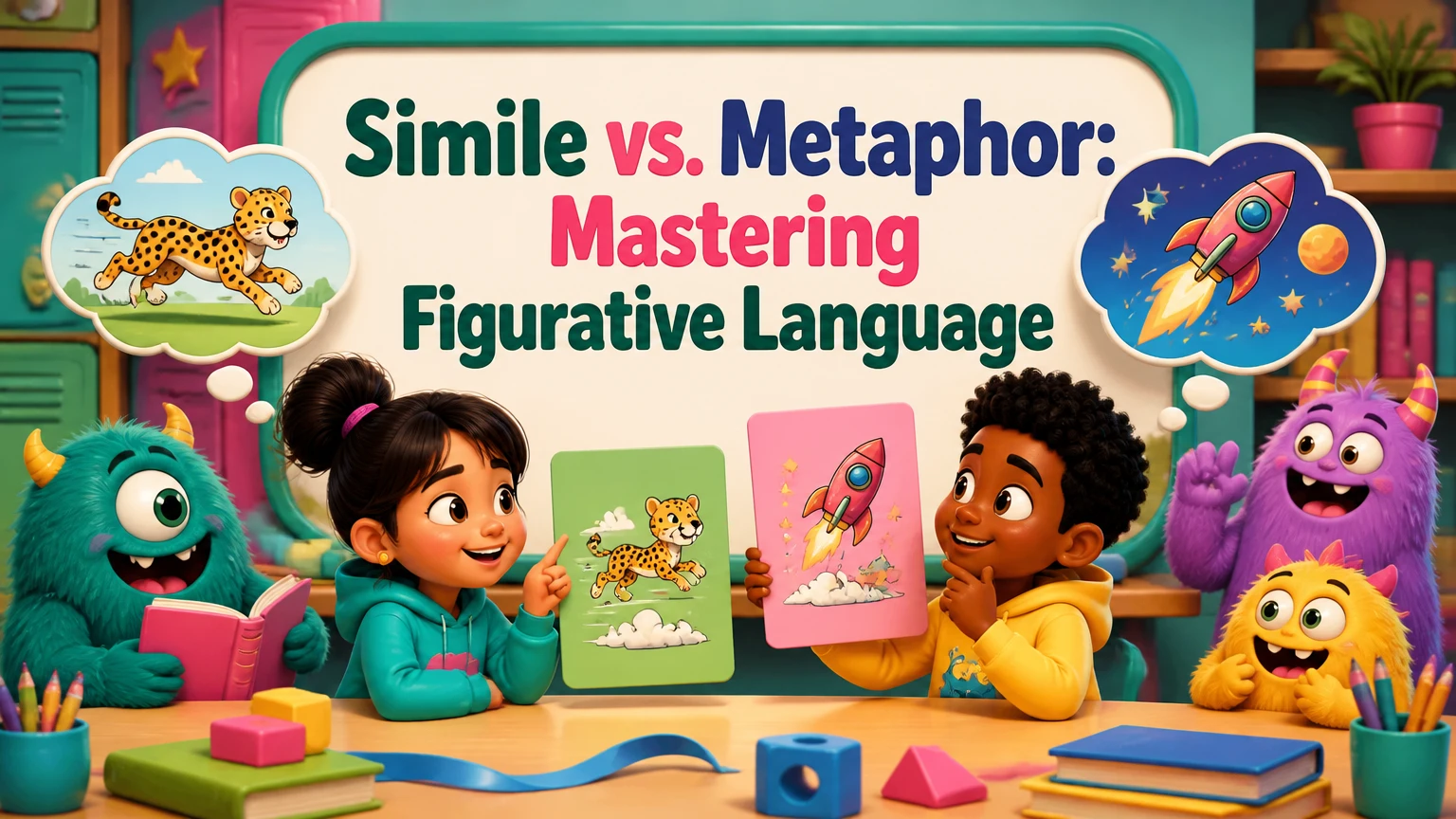
Figurative language enriches our writing and speech by painting vivid pictures and creating deeper meaning. Two common figures of speech are similes and metaphors. Similes make comparisons using words like “like” or “as,” for example, stating something is “as brave as a lion” or “shines like the sun.” Metaphors, on the other hand, directly equate two unlike things, implying a similarity without using “like” or “as,” such as saying “He is a lion in battle” or “She is the sun in my sky.” Understanding the subtle differences between similes and metaphors, including their structure and usage, is crucial for effective communication and creative expression. This article will explore the nuances of each, providing clear explanations, examples, and exercises to help you master their use.
Grasping the difference between similes and metaphors is incredibly beneficial for various reasons. For students, it enhances their analytical skills in literature and improves their writing. For professionals, it aids in crafting compelling presentations and reports. For anyone interested in creative writing or simply improving their communication skills, a solid understanding of similes and metaphors will undoubtedly elevate their ability to express ideas in imaginative and impactful ways.
Table of Contents
- Definition of Simile and Metaphor
- Structural Breakdown
- Types and Categories
- Examples of Similes and Metaphors
- Usage Rules
- Common Mistakes
- Practice Exercises
- Advanced Topics
- FAQ
- Conclusion
Definition of Simile and Metaphor
A simile is a figure of speech that directly compares two different things, usually using the words “like” or “as.” The purpose of a simile is to highlight a shared quality or characteristic between the two things being compared, creating a more vivid or understandable image. Similes help to clarify, emphasize, or add color to descriptions.
A metaphor, on the other hand, is a figure of speech that implies a comparison between two unrelated things without using “like” or “as.” Instead, it states that one thing is another, attributing qualities of the second thing to the first. Metaphors are used to create a deeper understanding and emotional impact by transferring meaning from one concept to another. They offer a more forceful and imaginative way to describe something.
Structural Breakdown
Simile Structure
The structure of a simile generally includes three components:
- The subject: The thing being described.
- The comparative word: “Like” or “as.”
- The object of comparison: The thing the subject is being compared to.
For instance, in the simile “The warrior was as brave as a lion,” “The warrior” is the subject, “as” is the comparative word, and “a lion” is the object of comparison. This structure clearly indicates that the warrior’s bravery is being likened to that of a lion.
Metaphor Structure
The structure of a metaphor is more direct and implicit than that of a simile. It typically involves two main components:
- The subject: The thing being described.
- The object of identification: The thing the subject is being equated to.
In the metaphor “The world is a stage,” “The world” is the subject, and “a stage” is the object of identification. This directly equates the world to a stage, implying that life is a performance with various acts and players, without using any comparative words.
Types and Categories
Types of Similes
Similes can be categorized based on their function and the type of comparison they make. Here are a few types:
- Descriptive Similes: These similes focus on describing a quality or attribute. For example, “He is as tall as a tree.”
- Explanatory Similes: These similes aim to clarify or explain something. For example, “The process is like baking a cake; you need to follow the steps carefully.”
- Emphatic Similes: These similes are used to emphasize a point. For example, “She was as stubborn as a mule.”
Types of Metaphors
Metaphors also come in different forms, each serving a unique purpose:
- Standard Metaphors: These are direct comparisons where one thing is said to be another. For example, “Time is money.”
- Implied Metaphors: These metaphors indirectly suggest a comparison without explicitly stating it. For example, “He brayed his refusal,” implying he is like a donkey.
- Extended Metaphors: These metaphors are developed over several lines or even an entire work. They continue the comparison in multiple ways. For example, a poem comparing life to a journey, exploring various aspects of the journey throughout the poem.
- Dead Metaphors: These are metaphors that have become so common that they are no longer recognized as metaphors. For example, “the leg of a table.”
Examples of Similes and Metaphors
The following tables provide a variety of examples to illustrate the differences and applications of similes and metaphors.
Simile Examples
This table showcases a range of similes, demonstrating how they use “like” or “as” to make comparisons.
| Simile | Explanation |
|---|---|
| The snow was as white as a blanket. | Compares the color of the snow to the whiteness of a blanket. |
| Her smile was like sunshine. | Compares her smile to the warmth and brightness of sunshine. |
| He ran as fast as the wind. | Compares his speed to the speed of the wind. |
| The baby slept like a log. | Compares the baby’s deep sleep to the immobility of a log. |
| She sings like an angel. | Compares her singing voice to the beautiful voice of an angel. |
| The coffee was as bitter as gall. | Compares the coffee’s taste to the extreme bitterness of gall. |
| His words were like a knife. | Compares the sharpness and pain of his words to a knife. |
| The city was as busy as a beehive. | Compares the city’s activity to the bustling nature of a beehive. |
| Her eyes sparkled like diamonds. | Compares the sparkle in her eyes to the brilliance of diamonds. |
| He is as strong as an ox. | Compares his strength to the powerful strength of an ox. |
| The silence was like a thick blanket. | Compares the oppressiveness of the silence to the weight of a thick blanket. |
| The tears flowed like a river. | Compares the continuous flow of tears to a river. |
| His anger flared up like a match. | Compares the sudden burst of anger to the quick ignition of a match. |
| She moved as gracefully as a swan. | Compares her graceful movements to the elegant movements of a swan. |
| The old house stood as still as a statue. | Compares the house’s stillness to the immobility of a statue. |
| He was as nervous as a long-tailed cat in a room full of rocking chairs. | This humorous simile emphasizes extreme nervousness. |
| Life is like a box of chocolates, you never know what you’re gonna get. | A famous simile suggesting life is unpredictable. |
| The internet is like a superhighway of information. | Compares the vastness and connectivity of the internet to a superhighway. |
| Trying to argue with him is like talking to a brick wall. | Compares the futility of arguing with him to the impossibility of talking to a brick wall. |
| The politician’s speech was as dry as toast. | Compares the speech’s lack of interest to the dryness of toast. |
| The detective was as sly as a fox. | Compares the detective’s cunning to the slyness of a fox. |
| The climber ascended the mountain as slowly as a snail. | Compares the climber’s slow pace to the pace of a snail. |
| His memory is like a steel trap. | Compares the strength and reliability of his memory to a steel trap. |
| The crowd roared like a hurricane. | Compares the loud roar of the crowd to the sound of a hurricane. |
Metaphor Examples
This table presents a selection of metaphors, showcasing how they directly equate two different things without using “like” or “as.”
| Metaphor | Explanation |
|---|---|
| Time is a thief. | Implies that time steals away moments and opportunities. |
| He is a shining star. | Implies that he is talented and admired. |
| The world is a stage. | Implies that life is a performance with different roles. |
| Her heart is a stone. | Implies that she is unfeeling or cold. |
| Life is a journey. | Implies that life is a series of experiences and challenges. |
| He is a lion in battle. | Implies that he is brave and fierce in combat. |
| The internet is an ocean of information. | Implies that the internet contains a vast amount of data. |
| She is a walking encyclopedia. | Implies that she has a vast knowledge of many subjects. |
| His words are music to my ears. | Implies that his words are pleasing and delightful. |
| The classroom was a zoo. | Implies that the classroom was chaotic and unruly. |
| Laughter is the best medicine. | Implies that laughter can heal or alleviate suffering. |
| The company is a well-oiled machine. | Implies that the company operates efficiently. |
| He is a night owl. | Implies that he is most active at night. |
| The city is a concrete jungle. | Implies that the city is harsh and unforgiving. |
| Her voice is a velvet song. | Implies that her voice is smooth and pleasant. |
| The test was a breeze. | Implies that the test was easy and effortless. |
| He is a pillar of the community. | Implies that he is a strong and supportive member of the community. |
| The project was a rollercoaster. | Implies that the project had many ups and downs. |
| She is the sun in my sky. | Implies that she is the source of happiness and warmth in his life. |
| His anger was a raging fire. | Implies that his anger was intense and destructive. |
| Ideas are seeds. | Suggests that ideas, like seeds, have the potential to grow and develop into something significant. |
| The lawyer was a shark in the courtroom. | Implies the lawyer is aggressive and predatory in the courtroom. |
| Grief is a heavy burden. | Implies that grief is a weight that is difficult to bear. |
| Technology is a double-edged sword. | Suggests that technology has both positive and negative aspects. |
| Education is the key to success. | Implies that education is essential for achieving success. |
Mixed Simile and Metaphor Examples
This table presents examples that alternate between similes and metaphors, providing a side-by-side comparison.
| Figure of Speech | Example | Explanation |
|---|---|---|
| Simile | The news hit him like a ton of bricks. | Compares the impact of the news to the force of a ton of bricks. |
| Metaphor | The news was a ton of bricks. | Implies that the news was overwhelmingly heavy and shocking. |
| Simile | She was as quiet as a mouse. | Compares her quietness to the silence of a mouse. |
| Metaphor | She was a mouse in the corner. | Implies that she was unnoticed and timid. |
| Simile | His temper was like a volcano. | Compares his explosive temper to the erupting nature of a volcano. |
| Metaphor | His temper was a volcano. | Implies that his temper was inherently volatile and dangerous. |
| Simile | The dancer moved like a feather in the wind. | Compares the dancer’s graceful movements to the lightness of a feather. |
| Metaphor | The dancer was a feather in the wind. | Implies that the dancer was light, free, and easily swayed. |
| Simile | The argument was like a raging storm. | Compares the intensity of the argument to the ferocity of a storm. |
| Metaphor | The argument was a raging storm. | Implies that the argument was chaotic and destructive. |
| Simile | He felt as lost as a ship without a rudder. | Compares his feeling of being lost to a ship without direction. |
| Metaphor | He was a ship without a rudder. | Implies he is without direction or guidance. |
| Simile | Her words were as sweet as honey. | Compares the pleasantness of her words to the sweetness of honey. |
| Metaphor | Her words were honey. | Implies her words are inherently pleasing and delightful. |
| Simile | The project was moving as slow as molasses in winter. | Compares the slow progress of the project to molasses in winter. |
| Metaphor | The project was molasses in winter. | Implies the project is inherently slow and difficult. |
| Simile | The athlete trained like a machine. | Compares the athlete’s rigorous training to the precision of a machine. |
| Metaphor | The athlete was a machine. | Implies the athlete is relentlessly efficient and powerful. |
Usage Rules
Simile Usage Rules
When using similes, keep the following rules in mind:
- Clarity: Ensure the comparison is clear and understandable. The shared attribute between the subject and the object of comparison should be evident.
- Relevance: The comparison should be relevant to the context and contribute to the overall meaning.
- Originality: Strive for originality to make your writing more engaging and memorable. Avoid clichés.
Metaphor Usage Rules
When using metaphors, consider these guidelines:
- Appropriateness: The comparison should be appropriate for the subject and the intended audience.
- Consistency: Avoid mixing metaphors that create conflicting or nonsensical images.
- Subtlety: Use metaphors judiciously to enhance your writing without making it overly complex or confusing.
Common Mistakes
One common mistake is confusing similes and metaphors. Remember that similes use “like” or “as” to make comparisons, while metaphors directly equate two things. Another common mistake is using clichés instead of original comparisons. For instance, instead of saying “as busy as a bee,” try something more unique and descriptive. Also, mixing metaphors can lead to confusion. For example, saying “He nipped that idea in the bud to see if it would fly” combines two unrelated images and doesn’t make sense.
Here are some examples of common mistakes and their corrections:
| Incorrect | Correct | Explanation |
|---|---|---|
| He is a lion as brave. | He is as brave as a lion. | Corrected the simile structure. |
| She is like a rose metaphorically. | She is a rose. | Removed the unnecessary “like” and “metaphorically” to create a direct metaphor. |
| The project was a rollercoaster as a journey. | The project was a rollercoaster. / The project was like a difficult journey. | Avoided mixing a metaphor and a simile in one statement. |
| Time is like a thief metaphor. | Time is a thief. | Removed the unnecessary “like” and “metaphor” to create a direct metaphor. |
| He is as fast as a cheetah metaphorically. | He is as fast as a cheetah. | Removed the redundant “metaphorically” from the simile. |
| She sings like an angel, which is a metaphor. | She sings like an angel. | Removed the unnecessary explanation, as it is clear it’s a simile. |
Practice Exercises
Exercise 1: Identifying Similes and Metaphors
Identify whether each sentence contains a simile or a metaphor.
| # | Sentence | Answer |
|---|---|---|
| 1 | The detective was as sharp as a tack. | |
| 2 | Her voice was a soothing balm. | |
| 3 | The road was like a ribbon winding through the hills. | |
| 4 | He is a rock in times of trouble. | |
| 5 | The computer was as slow as molasses. | |
| 6 | The contract was a minefield. | |
| 7 | His explanation was as clear as mud. | |
| 8 | She is the light of my life. | |
| 9 | The rain fell like tears from the sky. | |
| 10 | The job was a walk in the park. |
Answers: 1. Simile, 2. Metaphor, 3. Simile, 4. Metaphor, 5. Simile, 6. Metaphor, 7. Simile, 8. Metaphor, 9. Simile, 10. Metaphor
Exercise 2: Completing Similes and Metaphors
Complete the following similes and metaphors with appropriate endings.
| # | Sentence | Answer |
|---|---|---|
| 1 | He was as quiet as a __________. | |
| 2 | The classroom was a __________. | |
| 3 | She ran as fast as __________. | |
| 4 | Life is a __________. | |
| 5 | The snow was as white as __________. | |
| 6 | His anger was a __________. | |
| 7 | The music sounded like __________. | |
| 8 | Her smile is the __________ . | |
| 9 | He is as stubborn as a __________ . | |
| 10 | My computer is a __________. |
Answers: 1. mouse, 2. circus, 3. the wind, 4. journey, 5. snow, 6. fire, 7. a dream, 8. sun, 9. mule, 10. dinosaur
Exercise 3: Writing Your Own Similes and Metaphors
Write your own simile and metaphor for each of the following subjects.
| # | Subject | Simile | Metaphor |
|---|---|---|---|
| 1 | Love | ||
| 2 | Fear | ||
| 3 | Time | ||
| 4 | Hope | ||
| 5 | Despair |
Example Answers: 1. Love (Simile: Love is like a warm fire on a cold day; Metaphor: Love is a battlefield), 2. Fear (Simile: Fear is like a dark shadow; Metaphor: Fear is a prison), 3. Time (Simile: Time is like a river flowing endlessly; Metaphor: Time is a relentless thief), 4. Hope (Simile: Hope is like a tiny spark in the darkness; Metaphor: Hope is an anchor), 5. Despair (Simile: Despair is like a heavy weight; Metaphor: Despair is a bottomless pit).
Advanced Topics
Extended Metaphors
An extended metaphor is a metaphor that is developed over several lines or throughout an entire poem or story. It allows for a more complex and nuanced comparison, exploring different aspects of the relationship between the two things being compared. For example, a poem might compare life to a garden, elaborating on the different stages of growth, the challenges of cultivation, and the eventual harvest.
Here’s an example of an extended metaphor:
“Life is a journey, a winding road with unexpected turns. Sometimes you climb steep hills, facing challenges that test your strength. Other times, you stroll through valleys, enjoying moments of peace and beauty. Along the way, you meet fellow travelers, some who guide you, others who hinder your progress. The destination is unknown, but the experiences gathered along the path shape who you become.”
Dead Metaphors
A dead metaphor is a metaphor that has become so commonplace that it is no longer recognized as a metaphor. These expressions have lost their figurative meaning and are used literally. Examples include “the leg of a table,” “the heart of the matter,” and “falling in love.” While they were once vivid comparisons, they are now simply part of everyday language.
Dead metaphors are generally acceptable in writing and speech, but it’s important to be aware of their origins and avoid using them in contexts where a more original or impactful figure of speech is needed.
Mixed Metaphors
A mixed metaphor is the combination of two or more incompatible metaphors in a single expression, which can create a confusing or nonsensical image. For example, “Let’s nip it in the bud and iron out the wrinkles” combines the idea of stopping something early (“nip it in the bud”) with the idea of smoothing out problems (“iron out the wrinkles”), resulting in a jarring and illogical image.
Mixed metaphors should be avoided as they can undermine the clarity and effectiveness of your writing. It’s important to ensure that your metaphors are consistent and create a coherent image.
FAQ
Here are some frequently asked questions about similes and metaphors:
- What is the main difference between a simile and a metaphor?
The main difference is that a simile uses “like” or “as” to make a comparison, while a metaphor directly equates two things without using those words. A simile suggests a resemblance, whereas a metaphor implies that one thing is another.
- Why are similes and metaphors important in writing?
Similes and metaphors enhance writing by making it more vivid, engaging, and memorable. They help to create a deeper understanding and emotional connection with the reader by painting a picture with words and conveying complex ideas in a more accessible way. They can also add layers of meaning and nuance to your writing.
- Can a simile be a metaphor, or vice versa?
No, a simile cannot be a metaphor, and a metaphor cannot be a simile. They are distinct figures of speech with different structures and functions. A simile always uses “like” or “as,” while a metaphor never does.
- How can I avoid using clichés in my similes and metaphors?
To avoid clichés, try to think of original and unexpected comparisons. Instead of using common phrases, consider the unique qualities of the things you are comparing and find a fresh way to express the relationship between them. Brainstorming and experimenting with different ideas can help you come up with more creative and impactful figures of speech.
- What is an implied metaphor?
An implied metaphor is a metaphor that does not explicitly state the comparison but suggests it through the use of descriptive language. For example, instead of saying “He is a wolf,” you might say “He stalked his prey,” implying that he is like a wolf without directly stating it.
- How do I identify a metaphor in a sentence?
To identify a metaphor, look for a statement that equates two unlike things without using “like” or “as.” Ask yourself if the statement is literally true. If not, it may be a metaphor. For example, in the sentence “Her words were a dagger,” the words are not literally a dagger, but the metaphor suggests they are sharp and hurtful.
- What are some common examples of dead metaphors?
Some common examples of dead metaphors include “the leg of a table,” “the heart of the matter,” “falling in love,” and “time flies.” These expressions are so widely used that they have lost their figurative meaning and are now understood literally.
- How can I use similes and metaphors effectively in my writing?
To use similes and metaphors effectively, consider your audience and the message you want to convey. Choose comparisons that are relevant, clear, and engaging. Avoid clichés and mixed metaphors, and use them judiciously to enhance your writing without making it overly complex or confusing. Practice and experimentation can help you develop your skill in using these figures of speech.
Conclusion
Mastering the art of using similes and metaphors is invaluable for anyone looking to enhance their communication skills. Similes, with their explicit comparisons using “like” or “as,” such as “as bright as the sun” or “moves like the wind,” provide clarity and vivid imagery. Metaphors, conversely, offer a more direct and powerful way to connect ideas, asserting that “time is a thief” or “life is a journey.” Understanding the nuances between these two figures of speech can transform ordinary writing into captivating prose.
By recognizing the structure, types, and usage rules of both similes and metaphors, you can avoid common mistakes and craft more compelling and imaginative expressions. Remember to strive for originality, relevance, and consistency in your comparisons. With practice and attention to detail, you can effectively use similes and metaphors to elevate your writing and communication, making your ideas more memorable and impactful. Continue to explore and experiment with these powerful tools to unlock your full creative potential.