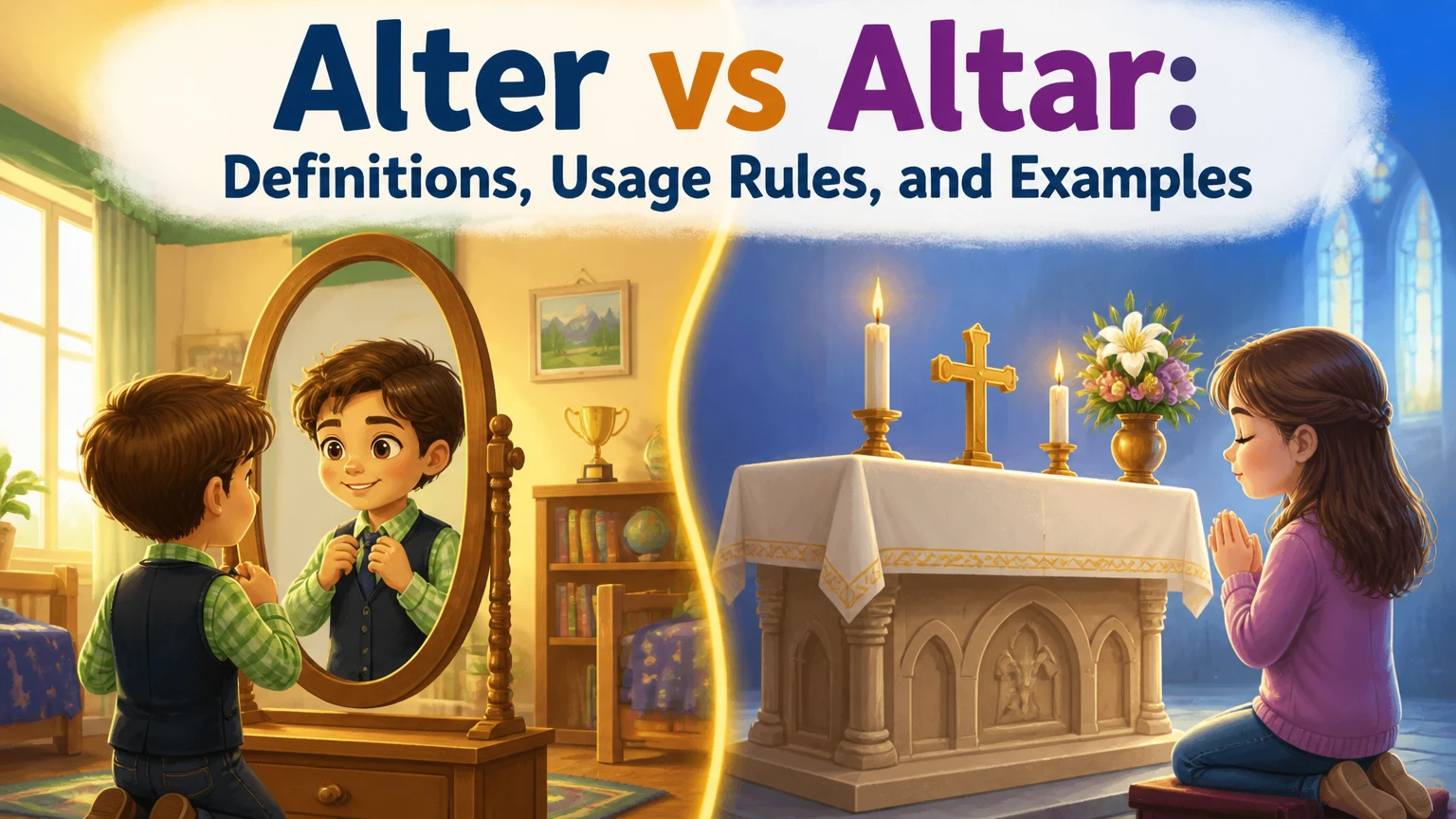
The English language is filled with homophones, which are words that sound identical but possess vastly different meanings and spellings. Understanding the distinction between “alter” and “altar” is a fundamental skill for writers, students, and professionals who wish to communicate with precision and clarity. These two terms are frequently confused because their pronunciation is nearly indistinguishable, yet they belong to entirely different parts of speech and serve unique functions in a sentence. Mastery of these words involves recognizing that one describes a physical structure while the other describes a process of change, such as when we modify, adjust, transform, vary, or fluctuate. By learning the subtle nuances of these terms, you can avoid common writing pitfalls and ensure your message is interpreted exactly as intended.
Table of Contents
- Comprehensive Definitions
- Structural Breakdown and Etymology
- Grammatical Functions and Parts of Speech
- Extensive Examples and Comparison Tables
- Usage Rules and Contextual Guidelines
- Idioms and Related Phrases
- Common Mistakes and How to Avoid Them
- Advanced Topics: Phonetics and Linguistics
- Practice Exercises and Worksheets
- Frequently Asked Questions (FAQ)
- Conclusion and Final Tips
Comprehensive Definitions
Defining “Alter”
The word alter is a verb that means to make different in some particular way, as in size, style, or course, without changing the thing into something else entirely. It implies a modification or a partial change. When you alter something, the core identity of the object usually remains, but its characteristics or qualities are adjusted.
In a professional context, “alter” is often used in tailoring to describe adjusting clothing to fit a person better. In a scientific or academic context, it refers to changing variables or conditions. It is a dynamic word that suggests action and transition.
Defining “Altar”
The word altar is a noun that refers to a raised structure or place on which sacrifices are offered or incense is burned in worship. In modern contexts, it most commonly refers to the table or platform at the front of a church where religious ceremonies, such as weddings or communions, take place.
Unlike “alter,” which is an action word, “altar” is a concrete object. It is a stationary, physical entity often associated with spirituality, reverence, and ritual. Understanding this distinction is the first step toward perfect usage.
Structural Breakdown and Etymology
The Origins of Alter
The verb “alter” finds its roots in the Middle English alteren, which was borrowed from the Old French alterer. This, in turn, stems from the Medieval Latin alterare, derived from the Latin alter, meaning “the other” or “other of two.”
The linguistic history emphasizes the concept of “otherness.” When you alter something, you are making it “other” than it was before. This helps us remember that “alter” is an action that results in a difference.
The Origins of Altar
The noun “altar” has a different lineage. It comes from the Old English altar, which was influenced by the Latin altare. The Latin root is related to altus, which means “high.”
Because the root means “high,” an altar is literally a “high place.” This etymological connection serves as a great mnemonic device: an altar (with an ‘a’) is a high place, and “high” also contains the letter ‘a’.
Grammatical Functions and Parts of Speech
Understanding the part of speech is crucial for correct placement in a sentence. Below is a table detailing the grammatical properties of both words.
| Feature | Alter | Altar |
|---|---|---|
| Part of Speech | Verb (Transitive or Intransitive) | Noun (Countable) |
| Primary Meaning | To change or modify | A ceremonial table or platform |
| Past Tense | Altered | N/A (Not a verb) |
| Present Participle | Altering | N/A (Not a verb) |
| Plural Form | Alters (Third-person singular) | Altars |
| Synonyms | Modify, adjust, change, revamp | Shrine, sanctuary, table, pedestal |
As seen in the table above, “alter” behaves like any other regular verb. It can be conjugated to fit different timeframes. “Altar,” being a noun, can only be singular or plural and cannot take on tense.
Extensive Examples and Comparison Tables
25 Examples of “Alter” in Sentences
The following table provides 25 distinct sentences using “alter” in various contexts, ranging from daily life to professional environments.
| # | Sentence Example | Context |
|---|---|---|
| 1 | The tailor needed to alter the hem of the trousers. | Fashion/Tailoring |
| 2 | We must alter our travel plans due to the storm. | Logistics |
| 3 | The new evidence did not alter the jury’s verdict. | Legal |
| 4 | You can alter the settings on your phone for better privacy. | Technology |
| 5 | Adding salt will alter the flavor of the soup. | Culinary |
| 6 | The architect decided to alter the floor plan. | Construction |
| 7 | Age can alter a person’s perspective on life. | Philosophy |
| 8 | The medication might alter your sleep patterns. | Medical |
| 9 | Please do not alter the document without permission. | Administrative |
| 10 | The company had to alter its marketing strategy. | Business |
| 11 | The climate crisis is beginning to alter local ecosystems. | Environmental |
| 12 | He tried to alter his voice to sound more authoritative. | Social |
| 13 | The software update will alter the user interface. | Software |
| 14 | She chose to alter her appearance with a new haircut. | Personal |
| 15 | The coach had to alter the lineup before the game. | Sports |
| 16 | Can we alter the meeting time to 3:00 PM? | Scheduling |
| 17 | The artist decided to alter the colors in the painting. | Art |
| 18 | Economic shifts can alter consumer behavior. | Economics |
| 19 | The witness refused to alter her testimony. | Legal |
| 20 | The teacher had to alter the lesson plan for the substitute. | Education |
| 21 | Genetic engineering can alter the traits of an organism. | Science |
| 22 | The heavy rain did not alter his determination to finish. | General |
| 23 | We need to alter the contract to include the new clause. | Legal |
| 24 | The photographer had to alter the lighting in the studio. | Photography |
| 25 | Don’t let fame alter who you are inside. | Personal |
25 Examples of “Altar” in Sentences
The following table provides 25 sentences using “altar” to demonstrate its use as a physical object in religious and symbolic contexts.
| # | Sentence Example | Context |
|---|---|---|
| 1 | The couple stood before the altar to exchange vows. | Wedding |
| 2 | The priest placed the bread and wine on the altar. | Religious Rite |
| 3 | Flowers were arranged beautifully around the altar. | Decoration |
| 4 | The ancient ruins featured a stone altar for sacrifices. | History |
| 5 | He knelt at the altar to offer a silent prayer. | Devotion |
| 6 | The altar was draped in a fine white cloth. | Ceremony |
| 7 | In many cultures, the altar is the center of the home. | Cultural |
| 8 | The candles on the altar flickered in the draft. | Atmosphere |
| 9 | The museum displayed a portable altar from the 14th century. | Exhibition |
| 10 | The bride walked down the aisle toward the altar. | Wedding |
| 11 | Incense smoke rose slowly from the golden altar. | Ritual |
| 12 | The community raised funds to restore the church altar. | Community |
| 13 | An altar boy assisted the bishop during the service. | Ecclesiastical |
| 14 | The altar was carved from a single block of marble. | Architecture |
| 15 | She placed a photograph of her grandmother on the altar. | Memorial |
| 16 | The sacred text was kept on a small altar in the corner. | Spirituality |
| 17 | The altar call invited people to come forward for prayer. | Church Service |
| 18 | During the festival, the altar was covered in fruit. | Celebration |
| 19 | The cathedral has a magnificent high altar. | Architecture |
| 20 | He felt a sense of peace standing near the altar. | Personal |
| 21 | The altar piece was a famous painting by a Renaissance master. | Art History |
| 22 | The shaman prepared the altar for the healing ceremony. | Cultural Ritual |
| 23 | The light from the stained glass hit the altar perfectly. | Visual |
| 24 | They built a temporary altar for the outdoor service. | Logistics |
| 25 | The altar is considered the most sacred part of the building. | Theology |
Usage Rules and Contextual Guidelines
To use these words correctly, you must first identify the intent of your sentence. Is there an action taking place involving change? Or are you describing a location or object? Here are the specific rules governing their use.
Rule 1: Identify the Part of Speech
If you need a verb, use alter. Verbs describe actions. You can test this by trying to change the tense. If you can say “altered” or “altering,” then “alter” is the correct choice. You cannot “altar” something because “altar” is not an action.
Rule 2: Identify the Physicality
If you are referring to a physical object, especially one used for religious or ceremonial purposes, use altar. This is a noun. You can put things on an altar, walk toward an altar, or clean an altar. You cannot “alter” an altar unless you are physically modifying the table itself.
Rule 3: Check the Ending
A helpful trick is to look at the last two letters. Alter ends in “-er,” which is common for verbs and agents of change (like “maker” or “doer”). Altar ends in “-ar,” which is less common for verbs but appears in nouns like “pillar” or “cedar,” which are also physical structures.
Rule 4: The “Change” Test
Replace the word in your sentence with the word “change.” If the sentence still makes sense, use alter. If the sentence becomes nonsensical, you likely need altar. For example: “I need to change my shirt” (Correct – use alter). “I stood at the change” (Incorrect – use altar).
Idioms and Related Phrases
While “altar” is mostly used literally, it does appear in a few common English idioms. “Alter,” being a more general word for change, appears in many technical and common expressions.
Lead someone to the altar
This phrase means to marry someone. It refers to the tradition of a groom leading a bride (or vice versa) to the front of a church to perform the marriage ceremony. Example: After five years of dating, he finally led her to the altar.
Sacrifice on the altar of…
This is a metaphorical expression meaning to give up something important for the sake of something else. It uses the imagery of an ancient sacrificial altar. Example: He sacrificed his health on the altar of career success.
Alter ego
An “alter ego” is a second self or a different version of a person. It literally translates from Latin as “other I.” Example: Peter Parker’s alter ego is Spider-Man.
Unalterable
This adjective describes something that cannot be changed. It is frequently used in legal or formal contexts. Example: The laws of physics are unalterable.
Common Mistakes and How to Avoid Them
The most common mistake is using “altar” when you mean “change.” This often happens in casual writing or when people rely too heavily on spell-checkers that don’t recognize the contextual error.
| Incorrect Sentence | Correct Sentence | Explanation |
|---|---|---|
| I need to altar my dress. | I need to alter my dress. | You are changing the dress, not putting it on a table. |
| The church has a beautiful alter. | The church has a beautiful altar. | The church has a physical structure, not a “change.” |
| Nothing can altar my mind. | Nothing can alter my mind. | “Mind” is being changed; therefore, a verb is needed. |
| The sacrifice was placed on the alter. | The sacrifice was placed on the altar. | The object is a place of sacrifice. |
To avoid these errors, always pause when you type either word. Ask yourself: “Am I talking about a table or a transformation?” This simple mental check will eliminate 99% of mistakes involving these homophones.
Advanced Topics: Phonetics and Linguistics
The Schwa Sound
The reason these words are so confusing is the presence of the “schwa” sound /ə/. In most English dialects, the unstressed final syllable in both “alter” and “altar” is pronounced with this neutral vowel sound. This makes /ˈɔːltər/ and /ˈɔːltər/ sound identical.
Homophones and Cognitive Load
Linguistically, homophones like these increase the “cognitive load” on the reader. When a reader sees the wrong spelling, their brain momentarily stalls as it tries to reconcile the meaning of “religious table” with the context of “changing a dress.” This is why correct spelling is vital for smooth communication; it prevents the reader from being distracted by errors.
Derivational Morphology
We can also look at how these words grow. “Alter” can become “alteration” (noun), “alterable” (adjective), or “unaltered” (adjective). “Altar” is much more limited; it rarely changes form except for the plural “altars.” This morphological flexibility is a hallmark of verbs in English.
Practice Exercises and Worksheets
Exercise 1: Fill in the Blanks
Choose the correct word (alter or altar) to complete each sentence.
- The priest bowed deeply before the ________.
- We had to ________ our course because of the construction.
- She decided to ________ her hairstyle for the summer.
- The ancient stone ________ was covered in mysterious carvings.
- Will this new law ________ the way we pay taxes?
- The wedding ________ was decorated with lilies and roses.
- Please don’t ________ the settings on my computer.
- He left his offering at the ________.
- The tailor can ________ that jacket to fit you perfectly.
- The passage of time did not ________ their friendship.
Exercise 2: Identify the Error
Read the following sentences. Some are correct, and some contain errors. Mark them as “Correct” or “Incorrect.”
| Sentence | Status |
|---|---|
| The architect suggested we altar the window placement. | Incorrect | Correct | Correct | Incorrect | Incorrect | Correct | Correct | Incorrect | Incorrect | Correct |
Answer Key
Exercise 1: 1. altar, 2. alter, 3. alter, 4. altar, 5. alter, 6. altar, 7. alter, 8. altar, 9. alter, 10. alter
Exercise 2: See the table above for the status. (1. Incorrect: alter; 4. Incorrect: altar; 5. Incorrect: alter; 8. Incorrect: altar; 9. Incorrect: altar)
Frequently Asked Questions (FAQ)
Is “altar” ever a verb?
No, “altar” is strictly a noun. You cannot “altar” something. If you want to describe the act of changing something, you must use “alter.” While language evolves, “altar” has remained a noun for centuries.
How do I remember the difference quickly?
Think of the letters: AltAr = A high structure. AltEr = To make diffErent. This simple mnemonic links the unique letter in each word to its meaning.
Can “alter” be a noun?
No, “alter” is a verb. However, the noun form of “alter” is “alteration.” If you are looking for a noun that means “a change,” you should use “alteration” instead of “alter.”
What does “altar-bound” mean?
This is an informal adjective used to describe someone who is likely to get married soon. It literally means “headed toward the altar.”
Are there other homophones like these?
Yes, English has many, such as “compliment” vs. “complement” or “stationary” vs. “stationery.” Like “alter/altar,” these often involve a single letter difference that changes the word from a verb to a noun or an adjective.
Is “alter” used in psychology?
Yes, in psychology, especially when discussing Dissociative Identity Disorder, an “alter” is a shorthand term for an “alternate personality.” In this specific jargon, “alter” is used as a noun, but this is a specialized technical use and not common in general English.
Can I use “alter” for small changes?
Yes, “alter” is perfect for small changes. Whether it is a tiny adjustment to a recipe or a minor change to a schedule, “alter” implies that the essence of the thing remains while a detail is updated.
Why does my spell-checker not catch this?
Because both “alter” and “altar” are correctly spelled words in the English dictionary, many basic spell-checkers cannot tell if you have used the wrong one. You need a grammar checker or a careful human eye to spot the contextual error.
Conclusion and Final Tips
Distinguishing between “alter” and “altar” is a hallmark of a careful and educated writer. While they sound identical, their roles in a sentence are worlds apart. Remember that alter is a verb used for change, such as when we modify, adjust, or transform. In contrast, altar is a noun referring to a sacred table or platform. By applying the “change test” and utilizing mnemonics like “altar is a high place,” you can ensure your writing remains professional and error-free. Consistent practice and attention to detail are the best ways to master these homophones. Keep these rules in mind, and you will never find yourself stumbling at the altar of poor grammar.