Articles are essential tools in the English language that function as determiners to specify the identity and quantity of nouns. They provide the necessary context to understand whether a speaker is referring to a general concept or a specific, unique object. In everyday communication, we use these small but powerful words such as a, an, and the to clarify our meaning and ensure our listeners understand exactly which person, place, or thing we are discussing. Understanding the nuance between saying “I saw a dog” versus “I saw the dog” is a fundamental milestone for any English learner seeking to achieve fluency and precision in their writing and speech.
Mastering these tiny words is vital for academic success, professional communication, and daily social interactions because they signal the relationship between the speaker, the listener, and the subject matter. For example, using articles correctly allows you to distinguish between general items like a book or an apple and specific entities like the sun or the president. This guide is designed for students, educators, and language enthusiasts who want to delve deep into the mechanics of English grammar. By the end of this comprehensive article, you will have a thorough understanding of definite and indefinite articles, their various rules, and the many exceptions that make English such a fascinating and complex language to learn.
Table of Contents
- Definition and Classification of Articles
- The Indefinite Articles: A and An
- The Definite Article: The
- The Zero Article: When to Use Nothing
- Structural Breakdown and Placement Rules
- The Vowel vs. Consonant Sound Rule
- Geographical Names and Articles
- Articles with Abstract and Uncountable Nouns
- Extensive Example Tables
- Comprehensive Usage Rules and Nuances
- Common Mistakes and Corrections
- Advanced Topics: Generic Reference and Categorization
- Practice Exercises and Solutions
- Frequently Asked Questions (FAQ)
- Conclusion and Final Tips
Definition and Classification of Articles
In linguistic terms, articles are a sub-category of determiners. Their primary function is to “limit” or “determine” the noun that follows them. Without articles, English sentences often feel fragmented or ambiguous. For instance, the sentence “Boy ate apple” lacks the grammatical markers needed to tell us which boy or which apple is being discussed. By adding articles—”The boy ate an apple”—the sentence becomes grammatically complete and provides specific information about the subjects involved.
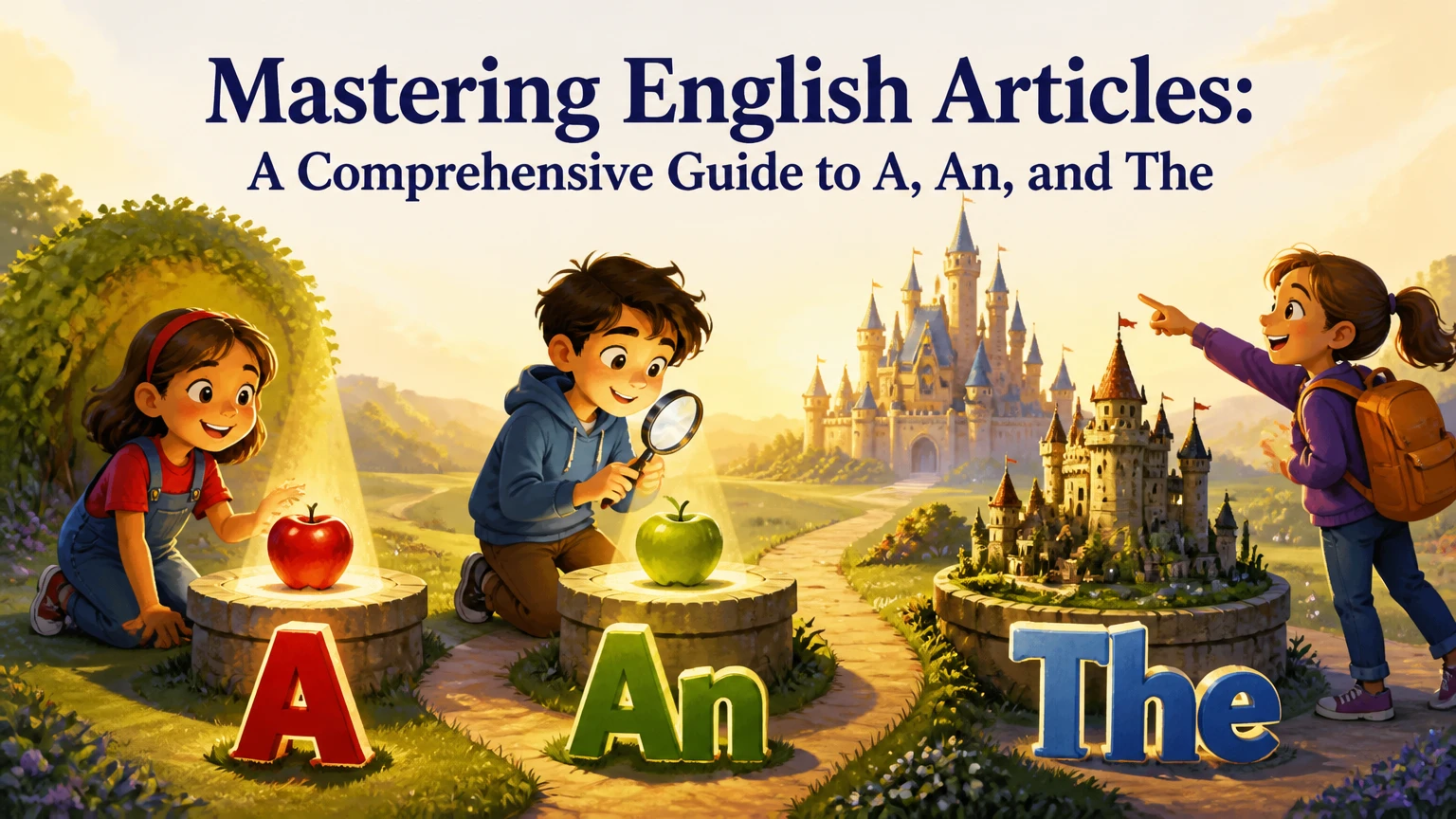
Articles are divided into two main categories: Indefinite and Definite. The indefinite articles are a and an. They are used when the noun is non-specific or when the listener does not know exactly which one you are talking about. The definite article is the. It is used when the noun is specific, unique, or has been previously mentioned in the conversation. There is also a third category often referred to by linguists as the Zero Article, which occurs when a noun requires no article at all, such as with plural indefinite nouns or most proper names.
The choice of article depends heavily on whether the noun is countable or uncountable, and whether it is singular or plural. Countable nouns refer to things that can be counted as individual units (like cat, house, or idea). Uncountable nouns refer to substances, concepts, or masses that cannot be counted as separate units (like water, happiness, or information). Understanding these distinctions is the first step toward article mastery.
The Indefinite Articles: A and An
The indefinite articles a and an are used with singular countable nouns. They originate from the Old English word for “one,” and their primary job is to introduce something new into a conversation or to refer to one member of a general group. We use a or an when we are not referring to a specific item, but rather any one of its kind.
For example, if you say, “I need a pencil,” you are communicating that any pencil will do. You are not looking for a specific pencil that you lost or a special pencil you saw earlier. If you say, “I saw an elephant at the zoo,” you are introducing the elephant for the first time; the listener does not know which specific elephant you mean, only that you saw one specimen of that animal.
The distinction between a and an is purely phonetic. It is based on the sound that begins the next word, not necessarily the letter. This is a common point of confusion for learners. We use a before words starting with a consonant sound (a car, a university) and an before words starting with a vowel sound (an apple, an hour). Notice that “university” starts with a “y” sound (consonant), while “hour” starts with an “o” sound because the “h” is silent.
The Definite Article: The
The definite article the is the most frequently used word in the English language. Unlike a and an, which are limited to singular countable nouns, the can be used with singular, plural, and uncountable nouns. Its purpose is to indicate that the noun is specific, unique, or known to both the speaker and the listener.
We use the in several distinct scenarios. First, for second mention: once you have introduced a noun with a/an, you use the for all subsequent mentions because the listener now knows which specific thing you are talking about. For example: “I bought a shirt. The shirt is blue.” Second, we use it for unique entities—things of which there is only one, such as the sun, the moon, or the internet.
Furthermore, the is used when the context makes the identity of the noun clear. If you are in a room and say, “Please close the door,” the listener knows you mean the door to that specific room. We also use the with superlatives (the best, the tallest) and with certain geographical features like mountain ranges, oceans, and rivers. This specificity is what gives the its “definite” character.
The Zero Article: When to Use Nothing
The “Zero Article” refers to the absence of an article before a noun. This is not an omission or a mistake; it is a grammatical choice that carries its own meaning. We typically use the zero article with plural countable nouns and uncountable nouns when we are speaking about them in a general or generic sense. For instance, “Dogs are loyal” (all dogs in general) or “I love music” (music as a general concept).
We also use the zero article with most proper names, including names of people (John, not the John), most countries (France, not the France), and cities (Tokyo). However, there are many exceptions to this, particularly with country names that are plural or contain words like “Republic” or “Kingdom.”
Other common uses of the zero article include academic subjects (I study biology), sports (She plays tennis), and languages (He speaks Spanish). It is also used with certain locations when we think of the purpose of the place rather than the physical building. Examples include “go to bed” (to sleep), “go to school” (to study), or “go to work” (to perform a job). If you were going to the school building just to fix a window, you might say “go to the school.”
Structural Breakdown and Placement Rules
The placement of articles in a sentence follows a very strict hierarchy within the noun phrase. Articles always come before the noun they modify. If there are adjectives modifying the noun, the article must come before the adjectives as well. The standard structure is: Article + (Adjective) + Noun.
For example, in the phrase “a large, red balloon,” the article a precedes both adjectives. If you add an adverb to the phrase, the article moves even further back: “a very large, red balloon.” The article’s choice (a vs an) is determined by the word that immediately follows it, regardless of whether that word is the noun itself or an adjective. This is why we say an apple but a red apple.
There are a few rare exceptions where the article follows a word, such as with “such,” “both,” or “all.” For example, we say “such a beautiful day” or “all the children.” Additionally, with the word “half,” the article can sometimes follow: “half an hour.” Understanding these structural patterns helps in constructing grammatically sound sentences that flow naturally.
The Vowel vs. Consonant Sound Rule
One of the most frequent errors made by English learners involves the a/an distinction. The rule is based on sound, not spelling. This is a crucial distinction because English is not a phonetic language; many words are spelled with vowels but pronounced with consonant sounds, and vice versa. This phonetic rule ensures that the language sounds fluid and avoids the awkward “glottal stop” that occurs when two vowel sounds are placed directly next to each other.
Consider words starting with the letter ‘u’. Some have a vowel sound (like umbrella, uncle, umpire), so we use an. Others have a “y” consonant sound (like university, utensil, European), so we use a. Similarly, consider the letter ‘h’. If the ‘h’ is voiced (house, horse, history), we use a. If the ‘h’ is silent (hour, honor, heir), we use an.
Acronyms and abbreviations also follow this rule. If the first letter of the acronym is pronounced with a vowel sound, use an. For example, “an MBA” (starts with the sound ’em’), “an FBI agent” (starts with ‘ef’), or “an SOS” (starts with ‘es’). Conversely, we say “a NASA scientist” because NASA is pronounced as a word starting with the consonant sound ‘n’.
Geographical Names and Articles
Geographical names are notorious for having complex article rules. While most individual countries, cities, and streets use the zero article, many other geographical features require the. This creates a mental map that learners must memorize through practice and exposure. Generally, plural names or names that describe a collection of entities require the definite article.
For example, mountain ranges (the Himalayas, the Andes) use the, but individual mountain peaks (Mount Everest, Kilimanjaro) do not. Groups of islands (the Bahamas, the Philippines) use the, but individual islands (Maui, Sicily) usually do not. Bodies of water like oceans (the Atlantic), seas (the Mediterranean), and rivers (the Nile) almost always take the, while most lakes (Lake Superior) do not.
Countries with titles like “Republic,” “Kingdom,” or “States” require the. We say the United States, the United Kingdom, the Czech Republic, and the Netherlands. However, we simply say France, Japan, or Brazil. Understanding these patterns is essential for accurate writing in geography, history, and international news.
Articles with Abstract and Uncountable Nouns
Abstract and uncountable nouns present a unique challenge. Abstract nouns refer to ideas, qualities, or conditions (love, time, beauty, fear). Uncountable nouns refer to physical masses that cannot be divided into discrete units (water, rice, sand, luggage). The general rule for these nouns is to use the zero article when speaking about them in a general sense.
For example: “Patience is a virtue” or “I need advice.” However, if you make these nouns specific by adding a modifying phrase (often starting with “of”), you must use the. Contrast “I love music” (general) with “I love the music of the 1960s” (specific). Or “Life is hard” (general) versus “The life of a coal miner is difficult” (specific).
Note that indefinite articles (a/an) are almost never used with uncountable nouns. You cannot say “a water” or “an advice.” Instead, you must use a “partitive” or “counter” to make them countable, such as “a glass of water,” “a piece of advice,” or “a bag of rice.” This distinction is vital for maintaining grammatical agreement in your sentences.
Extensive Example Tables
To help visualize these rules, the following tables provide extensive examples of article usage across different categories. These tables serve as a quick reference guide for common nouns and scenarios you will encounter in English.
The first table focuses on the Indefinite Articles (A/An). It demonstrates the phonetic rule, showing how the sound—not the spelling—determines which article to use. Pay close attention to the examples involving the letters ‘H’ and ‘U’, as these are where most mistakes occur.
| Noun/Phrase | Article | Reasoning/Sound |
|---|---|---|
| Apple | An | Vowel sound (a) |
| Banana | A | Consonant sound (b) |
| Elephant | An | Vowel sound (e) |
| University | A | Consonant sound (y-oo) |
| Umbrella | An | Vowel sound (u) |
| Hour | An | Vowel sound (silent H) |
| House | A | Consonant sound (voiced H) |
| European city | A | Consonant sound (y-oo) |
| Honest man | An | Vowel sound (silent H) |
| FBI Agent | An | Vowel sound (ef) |
| NASA Employee | A | Consonant sound (n) |
| One-way street | A | Consonant sound (w-un) |
| Orange | An | Vowel sound (o) |
| User | A | Consonant sound (y-oo) |
| X-ray | An | Vowel sound (ex) |
| Uniform | A | Consonant sound (y-oo) |
| Idea | An | Vowel sound (i) |
| Kitten | A | Consonant sound (k) |
| Ice cream cone | An | Vowel sound (i) |
| Heir | An | Vowel sound (silent H) |
| Hospital | A | Consonant sound (voiced H) |
| Unique item | A | Consonant sound (y-oo) |
| Owl | An | Vowel sound (o) |
| Year | A | Consonant sound (y) |
| Egg | An | Vowel sound (e) |
The second table illustrates the use of the Definite Article (The). This table highlights specific nouns, unique entities, and geographical features that require the definite article. It also shows the “second mention” rule in action.
| Noun/Context | Example Sentence | Rule Applied |
|---|---|---|
| Sun | The sun is shining. | Unique entity |
| Moon | Look at the moon. | Unique entity |
| Atlantic Ocean | We crossed the Atlantic. | Oceans/Seas |
| Himalayas | The Himalayas are tall. | Mountain ranges |
| United Kingdom | He lives in the UK. | Country with ‘Kingdom’ |
| Nile | The Nile flows north. | Rivers |
| Best | She is the best student. | Superlative |
| First | This is the first time. | Ordinal number |
| Internet | I found it on the internet. | Unique system |
| President | The President will speak. | Specific title |
| Same | We have the same car. | Comparison |
| Radio | I heard it on the radio. | Media/System |
| Environment | We must protect the environment. | Global concept |
| Middle | Sit in the middle. | Specific position |
| Only | You are the only one. | Specific identifier |
| Past | Think about the past. | Time period |
| Future | The future is bright. | Time period |
| Piano | She plays the piano. | Musical instruments |
| Rich (as a group) | The rich should help. | Adjective as noun |
| Police | Call the police. | Specific organization |
| Eiffel Tower | I saw the Eiffel Tower. | Unique landmark |
| Pacific | The Pacific is vast. | Oceans |
| Amazon | The Amazon is a river. | Rivers |
| Netherlands | They are from the Netherlands. | Plural country name |
| Second mention | I saw a bird. The bird was red. | Contextual reference |
The third table explores the Zero Article. It provides examples where no article is used, covering general plural nouns, uncountable substances, and specific proper names like cities and languages.
| Noun Category | Example Phrase | Correct Usage |
|---|---|---|
| General Plurals | Cats like milk. | Zero Article |
| Abstract Nouns | Love is all you need. | Zero Article |
| Languages | She speaks Japanese. | Zero Article |
| Academic Subjects | I love Mathematics. | Zero Article |
| Sports | They play soccer. | Zero Article |
| Meals | Breakfast is ready. | Zero Article |
| Cities | Paris is beautiful. | Zero Article |
| Continents | Africa is large. | Zero Article |
| Individual Mountains | Mount Fuji is iconic. | Zero Article |
| Individual Lakes | Lake Michigan is cold. | Zero Article |
| Days of the Week | See you on Monday. | Zero Article |
| Months | It rains in April. | Zero Article |
| Holidays | We celebrate Christmas. | Zero Article |
| Work (as destination) | I’m going to work. | Zero Article |
| Bed (for sleep) | Time to go to bed. | Zero Article |
| Colors | Blue is my favorite. | Zero Article |
| Substances | Water is essential. | Zero Article |
| Metals | Gold is expensive. | Zero Article |
| Illnesses (General) | Cancer is a disease. | Zero Article |
| Streets | I live on Main Street. | Zero Article |
| Airports | We landed at Heathrow. | Zero Article |
| Stations | Meet me at Victoria Station. | Zero Article |
| Companies | He works for Microsoft. | Zero Article |
| Magazines | I read Time. | Zero Article |
| Games | Do you play chess? | Zero Article |
Comprehensive Usage Rules and Nuances
Beyond the basic definitions, articles have several nuanced rules that govern their use in specific contexts. One important rule is the Generic Use of Articles. You can use all three types of articles to talk about a class of things in general, but the meaning shifts slightly. “A lion is a dangerous animal” means any individual lion representing the species. “The lion is a dangerous animal” refers to the species as a whole (more formal). “Lions are dangerous animals” is the most common way to speak generally using the plural zero article.
Another nuance involves Musical Instruments. In British English, it is standard to use the when talking about playing an instrument: “I play the guitar.” In American English, this is also common, but sometimes the article is omitted in casual speech. However, if you are talking about the instrument as a physical object, you revert to standard rules: “I bought a guitar” or “The guitar is broken.”
Articles also change based on the Quantity or Amount. We use a/an with certain expressions of quantity like “a lot of,” “a great deal of,” “a couple,” and “a dozen.” Interestingly, we use the with “the majority of” or “the number of.” Note the difference between “A number of students are…” (meaning “some students”) and “The number of students is…” (referring to the specific total count).
When it comes to Jobs and Professions, English requires an indefinite article. While some languages might say “I am teacher,” English requires “I am a teacher.” This applies to all professions: “She is an engineer,” “He is a doctor,” “They want to be an astronaut.” The only exception is if the person holds a unique, one-of-a-kind title, such as “He was elected President” (where the title acts almost like a name).
Common Mistakes and Corrections
Even advanced learners struggle with articles because many of the rules have exceptions or depend on subtle context. One of the most common mistakes is using the with plural nouns when speaking generally. For example, saying “The people like music” when you mean “People in general like music.” This error changes the meaning, as “The people” implies a specific group you have already mentioned.
Another frequent error is the misuse of a/an with uncountable nouns. Words like advice, information, luggage, furniture, and weather are uncountable in English. You should never say “an advice” or “a furniture.” Instead, use “some advice” or “a piece of furniture.” Similarly, learners often forget the article when using singular countable nouns. In English, a singular countable noun cannot stand alone; it must have a determiner (like a, the, this, or my).
| Incorrect Sentence | Correct Sentence | Explanation |
|---|---|---|
| I have a good news. | I have good news. | “News” is uncountable. |
| He is engineer. | He is an engineer. | Professions need an article. |
| I love the cats. | I love cats. | General plurals use zero article. |
| She has an unique style. | She has a unique style. | “Unique” starts with a ‘Y’ sound. |
| The sun rises in east. | The sun rises in the east. | Directions require “the”. |
| I go to the school every day. | I go to school every day. | No article for primary purpose. |
| I need a information. | I need some information. | “Information” is uncountable. |
| The Paris is beautiful. | Paris is beautiful. | Cities use zero article. |
| He is the tallest man in room. | He is the tallest man in the room. | Specific rooms need “the”. |
| I saw a movie. Movie was long. | I saw a movie. The movie was long. | Second mention requires “the”. |
Advanced Topics: Generic Reference and Categorization
For advanced learners, the concept of Generic Reference is a fascinating area of study. This occurs when we use a noun to refer to a whole class or category of things rather than a specific instance. As mentioned earlier, there are three ways to do this: the definite singular (The tiger is endangered), the indefinite singular (A tiger has stripes), and the zero plural (Tigers are predators).
The Definite Singular (The + singular noun) is often used in scientific, technical, or formal contexts. It treats the noun as a representative of the entire species or invention. For example: “The wheel changed human history” or “The heart is a vital organ.” This usage sounds more academic and abstract than the other forms.
The Indefinite Singular (A/An + singular noun) is used to define something or to state a characteristic that is true of any member of that group. “A doctor must be patient” means that if you are a doctor (any doctor), you must have this quality. It focuses on the requirements or traits of the individual member.
The Zero Plural is the most common in everyday speech. It is used to state general facts or opinions about a group. “Apples are healthy.” If you said “The apples are healthy,” you would be referring to a specific bowl of apples on the table, not all apples in existence. Mastering these subtle shifts in meaning allows a writer to control the “tone” and “scope” of their statements very precisely.
Practice Exercises and Solutions
To solidify your understanding, complete the following exercises. These questions range from basic article choice to more complex scenarios involving geographical names and uncountable nouns.
Exercise 1: Fill in the Blanks (A, An, or The)
- I saw ____ elephant at the zoo yesterday.
- ____ moon revolves around ____ earth.
- She wants to become ____ architect when she grows up.
- Could you pass me ____ salt, please?
- ____ United States is a large country.
- I have ____ hour before my next meeting.
- ____ happiness is important for a good life.
- Look at ____ beautiful birds in that tree!
- He is ____ honest person.
- We stayed at ____ hotel near ____ city center.
Exercise 2: Identifying the Zero Article
Decide whether the following sentences need an article (a, an, the) or no article (Ø). Rewrite the sentence correctly.
- I love ____ (Ø) chocolate.
- ____ (The) Nile is the longest river.
- They study ____ (Ø) French at school.
- He plays ____ (the) guitar very well.
- We are going to ____ (Ø) Japan next summer.
- ____ (The) water in this glass is cold.
- ____ (Ø) Mount Everest is very high.
- I usually have ____ (Ø) dinner at 7 PM.
- ____ (The) rich have a responsibility to help.
- She lives on ____ (Ø) Oxford Street.
Solutions to Exercise 1
| Question | Correct Answer | Reason |
|---|---|---|
| 1 | an | Starts with a vowel sound. |
| 2 | The / the | Unique entities. |
| 3 | an | Profession starting with vowel sound. |
| 4 | the | Specific item on the table. |
| 5 | The | Country name with ‘United’. |
| 6 | an | Silent ‘H’ (vowel sound). |
| 7 | Ø (No article) | General abstract noun. |
| 8 | the | Specific birds being pointed out. |
| 9 | an | Silent ‘H’ in “honest”. |
| 10 | a / the | First mention / specific location. |
Frequently Asked Questions (FAQ)
1. Why do we say “a university” but “an umbrella”?
The choice between a and an depends on the initial sound of the following word. “University” starts with a “y” consonant sound (/juː/), so we use a. “Umbrella” starts with a short “u” vowel sound (/ʌ/), so we use an. Always listen to the sound, not the spelling.
2. Do I use “the” with names of countries?
Generally, no. We say France, Germany, China, and Mexico. However, you must use the if the name is plural (the Netherlands, the Philippines) or if it contains words like “Republic,” “Kingdom,” “Union,” or “States” (the United Arab Emirates, the Dominican Republic).
3. What is the difference between “in hospital” and “in the hospital”?
This is often a difference between British and American English, but it also relates to the “purpose” rule. In British English, “in hospital” means you are a patient there for treatment. “In the hospital” means you are physically inside the building, perhaps visiting someone. In American English, “in the hospital” is used for both scenarios.
4. Can I use “a” or “an” with plural nouns?
No. A and an literally mean “one.” Therefore, they can only be used with singular countable nouns. For plural nouns, you must use the (if specific), some, or no article at all (if general).
5. Why do we say “the sun” but not “the Mars”?
We use the for unique entities that are part of our immediate environment or shared experience (the sun, the moon, the sky). However, the names of planets (Mars, Jupiter, Venus) are treated as proper names, similar to the names of people or cities, and thus take the zero article.
6. Is it “a history” or “an history”?
In modern English, it is “a history.” The ‘H’ in history is voiced (pronounced), so it follows the consonant rule. However, in some older texts or very formal British English, you might see “an historical event,” but “a historical event” is the standard and preferred form today.
7. When do I use “the” with names of people?
Usually, you don’t. But you use the when referring to a whole family by their last name in the plural: “The Smiths are coming over.” You can also use it to distinguish between people with the same name: “Are you the John Smith who wrote that book?”
8. Do I use “the” with breakfast, lunch, and dinner?
Generally, no. We say “I had breakfast” or “Let’s go to dinner.” However, if you are referring to a specific meal that was particularly memorable or previously discussed, you use the: “The dinner we had last night was delicious.”
Conclusion and Final Tips
Articles may be the smallest words in the English language, but they carry an immense amount of grammatical weight. They provide clarity, define specificity, and help organize the flow of information between a speaker and a listener. By mastering the distinction between a, an, and the, you move beyond simple word strings and begin to craft sentences with nuance and precision. Remember that the key to article mastery lies in understanding the difference between countable and uncountable nouns, as well as focusing on the sounds of words rather than their spelling. Consistency and practice are your best allies in navigating the many rules and exceptions of English articles.
To continue improving, pay close attention to articles while reading books or listening to native speakers. Ask yourself why a specific article was used in a certain context. Over time, the “feeling” for which article sounds right will become intuitive. Don’t be discouraged by mistakes; even native speakers occasionally debate the finer points of article usage. Keep practicing with exercises, use the tables in this guide as a reference, and soon you will be using a, an, and the with the confidence of a seasoned grammarian. Happy learning!