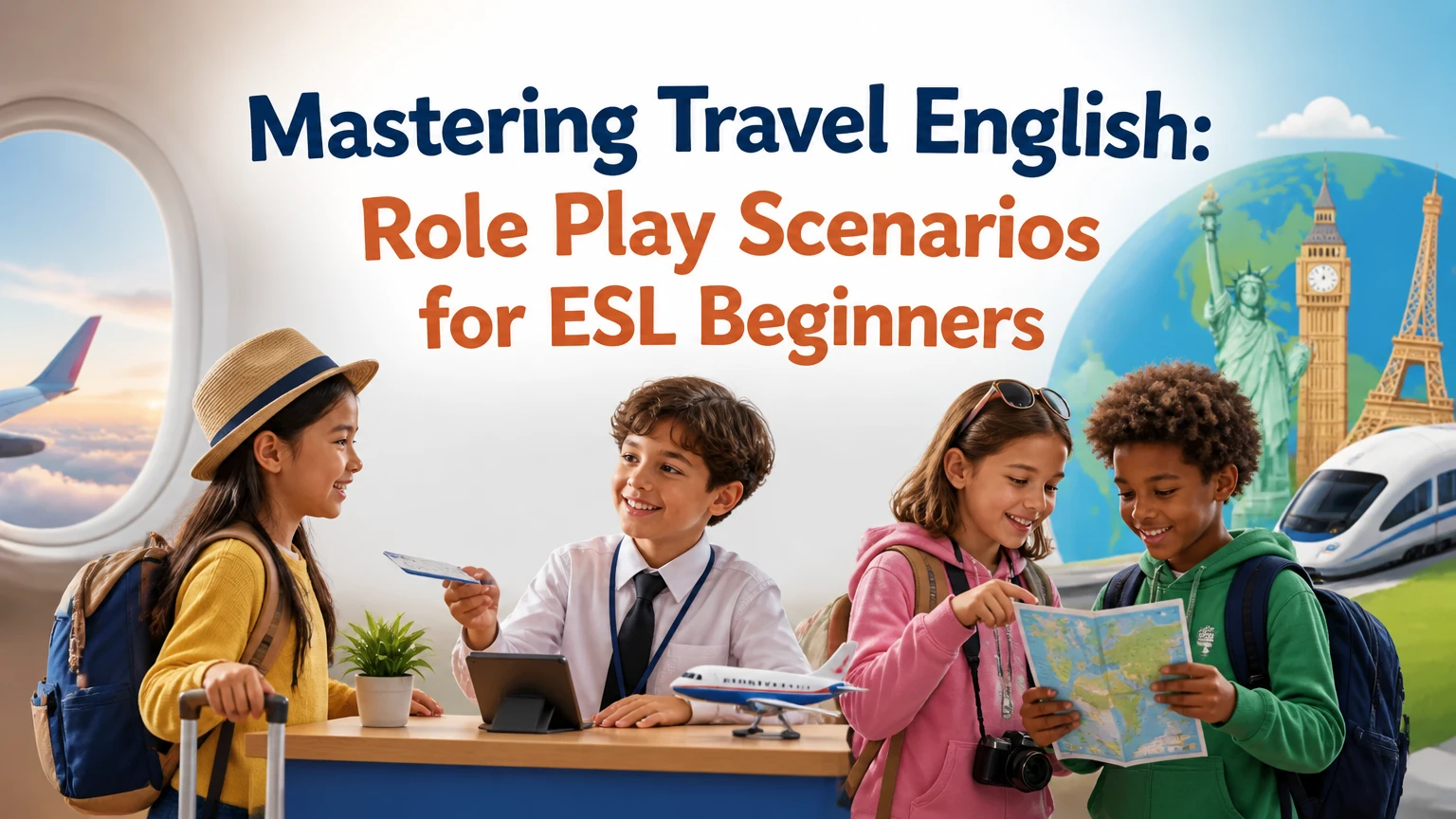
Travel role play scenarios serve as a vital bridge between theoretical grammar knowledge and real-world communication for English language learners. These simulations allow students to practice essential functional language, such as “Where is the gate?”, “I have a reservation,” “How much does this cost?”, and “Can I have a menu, please?”. By practicing these phrases in a controlled environment, beginners can build the muscle memory and confidence required to navigate airports, hotels, and restaurants in English-speaking countries. This immersive approach helps transform static vocabulary into dynamic conversational skills that are immediately applicable during international trips.
Understanding the structure of travel-related interactions is crucial for anyone planning to visit an English-speaking destination or work in the global tourism industry. These scenarios provide a safe space to make mistakes and refine pronunciation before the pressure of a real-world encounter. Whether you are a student preparing for a vacation or an educator looking for practical classroom materials, mastering these role plays ensures that basic needs are met and social interactions are smooth and professional.
Table of Contents
- Definition and Purpose of Travel Role Plays
- Structural Breakdown of a Travel Interaction
- Airport and Immigration Scenarios
- Transportation and Navigation Scenarios
- Hotel and Accommodation Scenarios
- Dining and Restaurant Scenarios
- Shopping and Sightseeing Scenarios
- Emergency and Problem-Solving Scenarios
- Grammar Rules for Travel English
- Common Mistakes and How to Avoid Them
- Practice Exercises and Worksheets
- Advanced Topics: Nuance and Politeness
- Frequently Asked Questions (FAQ)
- Conclusion and Final Learning Tips
Definition and Purpose of Travel Role Plays
A travel role play is a pedagogical technique where learners act out specific social situations encountered during a journey. In these exercises, one person typically takes the role of the “Traveler,” while another plays the “Service Provider,” such as a flight attendant, hotel clerk, or waiter. This method is highly effective because it contextualizes grammar and vocabulary, making it easier for the brain to retain information compared to rote memorization of word lists.
The primary function of these scenarios is to develop “functional fluency.” For a beginner, this doesn’t mean speaking perfectly; rather, it means being able to achieve a specific goal, like checking into a room or ordering food without confusion. These role plays focus on high-frequency phrases and predictable dialogue patterns that characterize most travel interactions. By repeating these patterns, learners reduce their “processing time”—the gap between hearing a question and formulating a response.
Furthermore, role plays help learners understand cultural norms and etiquette. For example, the way one asks for a bill in a London restaurant may differ slightly from a diner in New York. Role plays allow teachers to introduce these subtle cultural nuances, such as the use of “please” and “thank you” as linguistic cushions, which are essential for polite interaction in English-speaking cultures.
Structural Breakdown of a Travel Interaction
Most travel interactions follow a predictable five-stage structure. Understanding this flow allows ESL beginners to anticipate what comes next, even if they don’t understand every single word spoken by a native speaker. The stages typically include the Greeting, the Statement of Intent, the Clarification/Exchange, the Transaction, and the Closing.
The Greeting is the initial contact. In formal travel settings, this is often “Hello,” “Good morning,” or “How can I help you?”. The Statement of Intent follows, where the traveler explains what they need, such as “I’d like to check in” or “I need a ticket to London.” This is the most critical part for the beginner to master, as it sets the direction of the entire conversation.
The Clarification or Exchange is where details are sorted out. The service provider might ask for a passport, a credit card, or a specific preference (e.g., “Window or aisle seat?”). The Transaction is the actual fulfillment of the request, often involving payment or the handing over of a physical item like a key or a boarding pass. Finally, the Closing involves polite sign-offs like “Have a nice flight” or “Enjoy your stay.”
Airport and Immigration Scenarios
Airports are often the most stressful environments for ESL beginners because of the high stakes and the fast-paced nature of the interactions. Role plays in this category focus on check-in desks, security checkpoints, and immigration interviews. Accuracy is important here, particularly when answering questions from border officials.
In a check-in scenario, the traveler must be able to provide identification and answer questions about their luggage. Key vocabulary includes terms like “checked bag,” “carry-on,” “boarding pass,” and “identification.” Below is a table of common phrases used at the airport check-in counter.
The following table provides 25 essential phrases for airport interactions, divided between what the staff says and what the traveler should say. This helps learners recognize the “input” they will receive and the “output” they need to produce.
| Speaker | Common Phrase/Question | Context/Meaning |
|---|---|---|
| Staff | Can I see your passport and ticket, please? | Requesting identification. |
| Traveler | Here they are. | Handing over documents. |
| Staff | Are you checking any bags today? | Asking about large luggage. |
| Traveler | Yes, I have two bags to check. | Confirming luggage count. |
| Staff | Please place your bag on the scale. | Checking the weight of the bag. |
| Traveler | Is it overweight? | Asking if the bag is too heavy. |
| Staff | Do you have a preference for a window or aisle seat? | Asking about seating. |
| Traveler | I would like an aisle seat, please. | Requesting a specific seat. |
| Staff | Do you have any liquids or gels in your carry-on? | Security check question. |
| Traveler | No, I don’t. | Confirming no restricted items. |
| Staff | What is the purpose of your visit? | Immigration question. |
| Traveler | I am here for vacation/tourism. | Explaining the reason for travel. |
| Staff | How long do you plan to stay? | Asking about duration. |
| Traveler | I will be staying for ten days. | Stating the length of stay. |
| Staff | Where will you be staying? | Asking for an address. |
| Traveler | I am staying at the Hilton Hotel. | Providing accommodation details. |
| Staff | Have you visited this country before? | Asking about travel history. |
| Traveler | No, this is my first time. | Confirming first-time visit. |
| Staff | Your flight is boarding at Gate B12. | Giving boarding information. |
| Traveler | Thank you. Where is Gate B12? | Asking for directions. |
| Staff | Enjoy your flight. | Polite closing. |
| Traveler | Thank you, have a good day. | Polite response. |
| Staff | Please take everything out of your pockets. | Security instruction. |
| Staff | Do you have anything to declare? | Customs question. |
| Traveler | No, nothing to declare. | Confirming no taxable goods. |
Transportation and Navigation Scenarios
Once outside the airport, travelers must navigate local transportation systems, including taxis, buses, and trains. This requires the ability to ask for directions, understand pricing, and identify specific stops. For beginners, the use of prepositions of place (next to, across from, behind) is essential during these interactions.
When taking a taxi, the traveler must clearly state the destination. When using public transport, they need to know how to buy a ticket and which line to take. This section focuses on the vocabulary of movement and location. Role playing these scenes helps students overcome the fear of getting lost in an unfamiliar city.
The table below outlines 25 phrases specifically for transportation, including taxis, trains, and buses. It covers the basic requirements for getting from point A to point B efficiently.
| Situation | Traveler Phrase | Staff/Driver Response |
|---|---|---|
| Taxi | Could you take me to this address, please? | Sure, hop in. |
| Taxi | How much will the fare be to the city center? | It’s usually about twenty dollars. |
| Taxi | Can I have a receipt, please? | Certainly, here you go. |
| Train | I’d like a round-trip ticket to Oxford. | That will be fifteen pounds. |
| Train | Which platform does the train leave from? | It leaves from Platform 4. |
| Train | Is this the train for London? | Yes, it is. / No, this is for Brighton. |
| Bus | Does this bus go to the museum? | Yes, stay on for five stops. |
| Bus | How many stops until the Central Station? | It’s the next stop. |
| Navigation | Excuse me, where is the nearest subway station? | It’s just around the corner. |
| Navigation | Is it within walking distance? | Yes, it’s about a five-minute walk. |
| Navigation | Can you show me on the map? | Of course, we are right here. |
| Car Rental | I’d like to rent a compact car for three days. | Do you have your driver’s license? |
| Car Rental | Does the price include insurance? | Yes, full coverage is included. |
| Car Rental | Is it an automatic or manual transmission? | It’s an automatic. |
| General | Where can I buy a transit card? | At the vending machine over there. |
| General | How often do the buses run? | They come every ten minutes. |
| General | Is there a shuttle to the airport? | Yes, it leaves every hour from the lobby. |
| Navigation | I’m looking for the Tourist Information Office. | Go straight and turn left at the light. |
| Navigation | Am I heading in the right direction? | Yes, keep going for two blocks. |
| Taxi | Can you wait here for a moment? | I can wait for five minutes. |
| Train | Is there a dining car on this train? | Yes, it’s at the front of the train. |
| Bus | Do I need exact change? | No, you can tap your credit card. |
| General | Is the station open 24 hours? | No, it closes at midnight. |
| General | Where is the lost and found office? | It’s on the lower level. |
| General | Can I park my car here? | No, this is a no-parking zone. |
Hotel and Accommodation Scenarios
Hotel interactions are central to any travel experience. For ESL beginners, these role plays focus on the “Check-in” and “Check-out” processes, as well as making requests for amenities. The language used is generally formal and polite. Travelers need to be able to confirm their reservation details, ask about breakfast times, and request help with luggage.
Common issues encountered at hotels include rooms not being ready, noisy neighbors, or missing items like towels or soap. Practicing these scenarios allows students to learn how to complain politely using phrases like “Excuse me, but…” or “I’m sorry, there seems to be a problem with…”. This level of communication is vital for ensuring a comfortable stay.
This table contains 25 phrases for hotel and accommodation settings, focusing on the dialogue between a guest and a receptionist.
| Category | Guest Phrase | Receptionist Phrase |
|---|---|---|
| Check-in | I have a reservation under the name Smith. | Let me check that for you. |
| Check-in | Is breakfast included in the price? | Yes, breakfast is served from 7 to 10 AM. |
| Check-in | What time is check-out? | Check-out is at 11:00 AM. |
| Check-in | Can I have two room keys, please? | Certainly, here are your keys. |
| Amenities | What is the Wi-Fi password? | The password is ‘Guest2023’. |
| Amenities | Where is the fitness center located? | It is on the second floor. |
| Requests | Can I get some extra towels for my room? | I will send someone up right away. |
| Requests | Could you wake me up at 6:00 AM tomorrow? | Of course, I’ll set a wake-up call. |
| Problems | The air conditioning in my room isn’t working. | I’m sorry, we will send a technician. |
| Problems | My room is very noisy. Can I change rooms? | Let me see if we have another room available. |
| Billing | Can I pay by credit card? | Yes, we accept all major credit cards. |
| Billing | I think there is a mistake on my bill. | Let me review the charges for you. |
| Check-out | I’d like to check out now. | I hope you enjoyed your stay. |
| Check-out | Can you call a taxi for me? | Certainly, it will be here in five minutes. |
| Check-out | Can I leave my luggage here for a few hours? | Yes, we can store it in the luggage room. |
| Amenities | Is there a swimming pool? | Yes, it’s on the roof. |
| Requests | Is there a laundry service? | Yes, please use the bag in your closet. |
| General | What floor is my room on? | You are in room 405 on the fourth floor. |
| General | Where are the elevators? | They are just past the lobby bar. |
| General | Can I get a late check-out? | We can extend it until 1:00 PM for free. |
| General | Is there a safe in the room? | Yes, it’s inside the wardrobe. |
| General | Are pets allowed? | I’m sorry, we don’t allow pets. |
| General | Does the room have a view? | Yes, you have a view of the park. |
| General | Is there a mini-bar? | Yes, but there is an extra charge for items. |
| General | Where can I find a vending machine? | There is one near the ice machine. |
Dining and Restaurant Scenarios
Eating out is one of the most frequent activities during travel. Restaurant role plays help ESL beginners practice ordering food, asking about ingredients (crucial for those with allergies), and handling the bill. The vocabulary here includes food items, cooking methods (grilled, fried, steamed), and quantities.
In these role plays, learners practice the “Ordering Cycle”: getting a table, looking at the menu, ordering drinks, ordering the main course, and asking for the check. It is also a great place to practice the use of “I would like…” versus “I want,” the former being the polite standard in English-speaking restaurants.
The following table provides 25 essential restaurant phrases to help learners navigate a dining experience from start to finish.
| Stage | Customer Phrase | Waiter Phrase |
|---|---|---|
| Arrival | A table for two, please. | Right this way, please follow me. |
| Arrival | Do you have a reservation? | No, we don’t. Is there a long wait? |
| Ordering | Could we see the menu, please? | Here you go. I’ll be back in a moment. |
| Ordering | What do you recommend? | The grilled salmon is very popular today. |
| Ordering | I’ll have the cheeseburger, please. | How would you like that cooked? |
| Ordering | Does this dish contain nuts? | Let me check with the chef for you. |
| Ordering | Can I have the dressing on the side? | Certainly, no problem. |
| Drinks | I’d like a glass of still water, please. | Would you like ice and lemon? |
| Drinks | We’d like to order a bottle of red wine. | I’ll bring the wine list for you. |
| During Meal | Everything is delicious, thank you. | I’m glad you’re enjoying it. |
| During Meal | Could I have some more napkins? | Of course, I’ll bring them right away. |
| Problems | Excuse me, this isn’t what I ordered. | I’m so sorry, let me fix that for you. |
| Problems | My soup is a bit cold. | I apologize. I’ll heat it up for you. |
| Payment | Could we have the bill, please? | Sure, I’ll bring it right over. |
| Payment | Do you take credit cards? | Yes, we do. |
| Payment | Can we split the bill? | Yes, how would you like to divide it? |
| Payment | Keep the change. | Thank you very much. |
| Arrival | Is there a high chair for the baby? | Yes, I’ll bring one to your table. |
| Ordering | Are there any vegetarian options? | Yes, we have several salads and pasta. |
| Drinks | Can I get a refill on my soda? | Yes, refills are free. |
| During Meal | Is it possible to get more bread? | Certainly, I’ll bring a fresh basket. |
| Payment | Is service included? | Yes, a 15% tip is already added. |
| General | Where are the restrooms? | They are at the back of the restaurant. |
| General | Do you have a children’s menu? | Yes, here it is. |
| General | Can we sit by the window? | Let me see if that table is available. |
Shopping and Sightseeing Scenarios
Shopping and sightseeing involve a mix of transactional language and information-seeking questions. When shopping, beginners need to ask about prices, sizes, and colors. When sightseeing, they may need to ask for ticket prices, opening hours, or historical facts. These interactions are usually less formal than hotel or airport scenarios but still require polite structures.
Role playing a shopping trip allows students to practice numbers (for prices) and adjectives (for describing items). Sightseeing role plays help with time-telling and asking for recommendations. These scenarios are excellent for building “survival English” that allows a traveler to enjoy the local culture and bring home souvenirs.
This table offers 25 phrases for shopping and visiting tourist attractions, focusing on common questions and responses.
| Context | Traveler Question | Staff Response |
|---|---|---|
| Shopping | How much does this cost? | It’s forty-five dollars plus tax. |
| Shopping | Do you have this in a smaller size? | Let me check the stockroom for you. |
| Shopping | Can I try this on? | The fitting rooms are over there. |
| Shopping | Does this come in any other colors? | We also have it in blue and black. |
| Shopping | Is this on sale? | Yes, it’s 20% off today. |
| Shopping | What is your return policy? | You can return it within 30 days. |
| Shopping | I’m just looking, thank you. | No problem, let me know if you need help. |
| Sightseeing | How much is the entrance fee? | It’s fifteen dollars for adults. |
| Sightseeing | Are there any discounts for students? | Yes, students pay ten dollars with ID. |
| Sightseeing | What time does the museum close? | We close at 6:00 PM. |
| Sightseeing | Is photography allowed inside? | Yes, but please no flash. |
| Sightseeing | Are there guided tours in English? | Yes, they start every hour. |
| Sightseeing | Where is the gift shop? | It’s right next to the exit. |
| Sightseeing | Can I buy tickets online? | Yes, it’s cheaper to buy them online. |
| Shopping | Do you have a bag for this? | Yes, would you like a paper or plastic bag? |
| Shopping | Can I pay with my phone? | Yes, we accept Apple Pay and Google Pay. |
| Shopping | Where is the cashier? | The checkout counter is at the front. |
| Sightseeing | Is there a place to leave my coat? | Yes, we have a cloakroom downstairs. |
| Sightseeing | How long does the tour take? | It takes approximately 45 minutes. |
| Sightseeing | Is it accessible for wheelchairs? | Yes, we have ramps and elevators. |
| Shopping | Is this tax-free for tourists? | Yes, please show your passport to the clerk. |
| Shopping | Can you gift-wrap this for me? | Certainly, there is a small fee for that. |
| Sightseeing | Where is the best place to take a photo? | The balcony offers the best view. |
| General | Do you have a map of the city? | Yes, here is a free tourist map. |
| General | Is there a public restroom nearby? | Yes, there is one in the park. |
Emergency and Problem-Solving Scenarios
While no one wants to imagine things going wrong, preparing for emergencies is a critical part of travel English. These role plays cover situations like losing a passport, feeling ill, or being a victim of theft. The language here is urgent and direct. Beginners need to know how to call for help and describe their situation clearly to authorities.
Practicing these scenarios provides a “safety net” for learners. Knowing how to say “I’ve lost my wallet” or “I need a doctor” can significantly reduce panic in a real emergency. These role plays also introduce learners to the names of different emergency services and medical terms.
The table below lists 25 phrases for emergencies and problem-solving, providing the essential language needed during difficult times.
| Type | Emergency Phrase | Response/Action |
|---|---|---|
| Medical | I need a doctor, please. | I’ll call an ambulance immediately. |
| Medical | Where is the nearest pharmacy? | There is one two blocks down the street. |
| Medical | I am allergic to penicillin. | The doctor needs to know this. |
| Medical | I have a very bad headache. | I can give you some aspirin. |
| Theft | My wallet has been stolen! | We should go to the police station. |
| Loss | I’ve lost my passport. | You need to contact your embassy. |
| Loss | I left my bag on the bus. | We can call the bus company’s lost and found. |
| General | Help! | Someone will come to assist you. |
| General | Call the police! | I’m dialing 911 (or 999) now. |
| Medical | I feel dizzy and sick. | Sit down and drink some water. |
| Theft | Someone took my phone from my pocket. | Can you describe the person? |
| Loss | I can’t find my hotel. | Do you have the name or address? |
| General | Is there a hospital nearby? | Yes, follow this road for one mile. |
| Medical | I have a fever and a cough. | You might need to see a doctor. |
| Theft | My car was broken into. | Did they take anything valuable? |
| General | I’m lost. Can you help me? | Where are you trying to go? |
| Medical | I’ve been stung by a bee. | Are you allergic to bees? |
| Loss | I missed my last train home. | You might need to find a hotel. |
| General | I need a translator. | Wait here, I’ll find someone who speaks your language. |
| Medical | My child has a high temperature. | The pediatric clinic is open until 8 PM. |
| Theft | I want to report a crime. | Please fill out this police report. |
| Loss | I don’t have any money. | Can you call someone to help you? |
| General | Where is the emergency exit? | It’s the green door at the end of the hall. |
| Medical | I think I broke my arm. | Don’t move it, the paramedics are coming. |
| General | Is it safe to walk here at night? | It’s better to take a taxi after dark. |
Grammar Rules for Travel English
While travel English often relies on set phrases, a basic understanding of specific grammar rules makes communication more flexible. The three most important areas for beginners are Modal Verbs, Polite Requests, and Prepositions of Place.
Modal Verbs like can, could, and may are used to express possibility and permission. For example, “Can I sit here?” is a standard way to ask for permission. “Could you help me?” is a slightly more polite version of the same request. Beginners should focus on using “could” for requests to sound more respectful to service staff.
Polite Requests often use the structure “I would like…” rather than “I want.” While “I want a coffee” is grammatically correct, it can sound demanding. “I would like a coffee, please” is the preferred form in English-speaking cultures. Additionally, adding “please” at the end of every request is a universal rule for travel etiquette.
Prepositions of Place are essential for navigation. Words like on, in, at, next to, across from, and between allow travelers to understand and give directions. For instance, “The station is next to the bank” or “The hotel is on Main Street.” Mastering these small words prevents confusion when following a map or listening to instructions.
Common Mistakes and How to Avoid Them
ESL beginners often make mistakes that can lead to confusion or unintended rudeness. One of the most common errors is the “Direct Translation” mistake, where a student translates a phrase literally from their native language. For example, in many languages, you “have hunger,” but in English, you “are hungry.”
Another frequent mistake is the misuse of “How much” and “How many.” Remember: How much is for uncountable things like money, time, or water (“How much is this?”). How many is for countable things like bags, tickets, or people (“How many tickets do you need?”). Misusing these can make a sentence sound clunky, though the meaning is usually still clear.
The table below highlights common errors and provides the correct way to say them in a travel context.
| Incorrect Phrase | Correct Phrase | The Rule/Reason |
|---|---|---|
| I want a room. | I would like a room, please. | “I want” sounds too demanding. |
| How many does it cost? | How much does it cost? | Cost/Money is uncountable. |
| Where is station? | Where is the station? | Use “the” for specific locations. |
| I have 20 years. | I am 20 years old. | Use “to be” for age in English. |
| I lost my road. | I am lost. / I lost my way. | “Lost my road” is a literal translation error. |
| Give me the bill. | Could I have the bill, please? | Use modals for polite requests. |
| I go to London tomorrow. | I am going to London tomorrow. | Use present continuous for future plans. |
| Is there a WiFi? | Is there WiFi? / What is the WiFi password? | WiFi is usually uncountable. |
| I am agree. | I agree. | “Agree” is a verb, not an adjective. |
| He don’t have a ticket. | He doesn’t have a ticket. | Use “doesn’t” for third-person singular. |
Practice Exercises and Worksheets
To master travel English, you must practice applying these rules and phrases. Below are three exercises designed to test your knowledge of vocabulary, grammar, and situational awareness. Try to complete them without looking back at the tables first.
Exercise 1: Fill in the Blanks (Airport & Hotel)
Complete the sentences using the words: reservation, boarding, aisle, included, passport, baggage.
- Can I see your _______________ and ticket, please?
- I have a _______________ for a double room under the name ‘Miller’.
- Would you prefer a window seat or an _______________ seat?
- Where is the _______________ claim area? I need to find my suitcase.
- Is breakfast _______________ in the room rate?
- Your flight is now _______________ at Gate 15.
- I need to check two pieces of _______________.
- What time is the _______________ call for my flight?
- The hotel _______________ was confirmed via email.
- Please show your _______________ at the security gate.
Exercise 2: Match the Question to the Answer
| Question | Answer (Match them) |
|---|---|
| 1. How much is the fare? | A. It leaves from platform 9. |
| 2. Where is the elevator? | B. It’s ten dollars. |
| 3. Do you have a menu? | C. It’s across from the reception desk. |
| 4. Which platform for London? | D. Yes, here you go. |
| 5. Can I pay by card? | E. Yes, we accept Visa and Cash. |
| 6. Is the museum open today? | F. No, it’s closed on Mondays. |
| 7. What time is check-out? | G. It’s at 11:00 AM. |
| 8. Do you have a smaller size? | H. Let me check the back for you. |
| 9. Is it far to the park? | I. No, it’s just a five-minute walk. |
| 10. Can you help me? | J. Of course, what do you need? |
Exercise 3: Correct the Mistakes
Identify and fix the grammar error in each sentence.
- I would like a water, please. (Correction: I would like some water / a glass of water).
- Where I can buy a ticket?
- How many is this shirt?
- The bus go to the airport.
- I am losted.
- Can you to help me?
- I have hungry.
- The room is on second floor.
- I want check out now.
- Is there a bank near to here?
Advanced Topics: Nuance and Politeness
As beginners progress towards intermediate levels, they should start focusing on the nuance of English. This involves understanding that what you say is often as important as how you say it. In many English-speaking cultures, directness can be perceived as rudeness. Using “softeners” is a key advanced skill.
For example, instead of saying “I don’t like this food,” an advanced learner might say, “I’m sorry, but this isn’t quite what I expected.” Instead of “Where is the toilet?”, which is very direct, one might say, “Excuse me, could you tell me where the restrooms are?”. These small changes make a huge difference in how a traveler is treated by locals.
Another advanced concept is Intonation. In English, a rising intonation at the end of a sentence usually indicates a question or a polite request. A falling intonation can sound like a command. Practicing the “melody” of travel phrases helps learners sound more natural and friendly, which often leads to better service and more positive interactions.
Frequently Asked Questions (FAQ)
1. What is the most important phrase to know when traveling?
While many phrases are useful, “Excuse me, could you help me?” is arguably the most important. It is a polite way to initiate contact in almost any situation, whether you are lost, need to order food, or have a problem with your hotel room.
2. Do I need to use perfect grammar when speaking to a waiter or taxi driver?
No. In travel situations, communication is more important than perfection. Most service providers are used to speaking with non-native speakers. As long as you use keywords like “please,” “thank you,” and the name of your destination, you will be understood.
3. How can I practice role plays if I am studying alone?
You can practice by talking to yourself in a mirror or recording yourself on your phone. Imagine the other person’s responses and try to react to them. You can also use AI language tools to simulate a conversation in a specific travel setting.
4. Why do people say ‘restroom’ instead of ‘toilet’ in the US?
In the United States, “restroom” or “bathroom” is considered more polite in public settings. “Toilet” refers specifically to the plumbing fixture. In the UK, “toilet” or “loo” is more common, while “washroom” is frequently used in Canada.
5. What should I do if I don’t understand what someone said to me?
Don’t panic! Simply say, “I’m sorry, could you repeat that more slowly, please?” or “I don’t understand. Could you say that again?”. Most people are happy to help and will use simpler words if they know you are an English learner.
6. Is it okay to tip in all English-speaking countries?
Tipping customs vary. In the US, tipping 15-20% at restaurants is standard and expected. In the UK, Australia, and New Zealand, tipping is appreciated but not always required. It’s always a good idea to research the specific tipping culture of your destination before you arrive.
Conclusion and Final Learning Tips
Mastering travel English through role play scenarios is one of the most practical ways to improve your ESL skills. By focusing on high-frequency vocabulary and polite sentence structures, beginners can navigate the complexities of international travel with confidence. Remember that the goal is effective communication, not absolute perfection. Using phrases like “Could you please…” and “Thank you for your help” will go a long way in making your interactions smooth and pleasant.
To continue your progress, try to watch travel vlogs in English or listen to podcasts specifically designed for ESL learners. Consistency is key; even ten minutes of practice a day can significantly improve your fluency. Focus on the scenarios you are most likely to encounter first, and gradually expand your repertoire. With patience and practice, you will find that traveling in an English-speaking country becomes an exciting opportunity to use your new skills rather than a source of stress. Safe travels and happy learning!