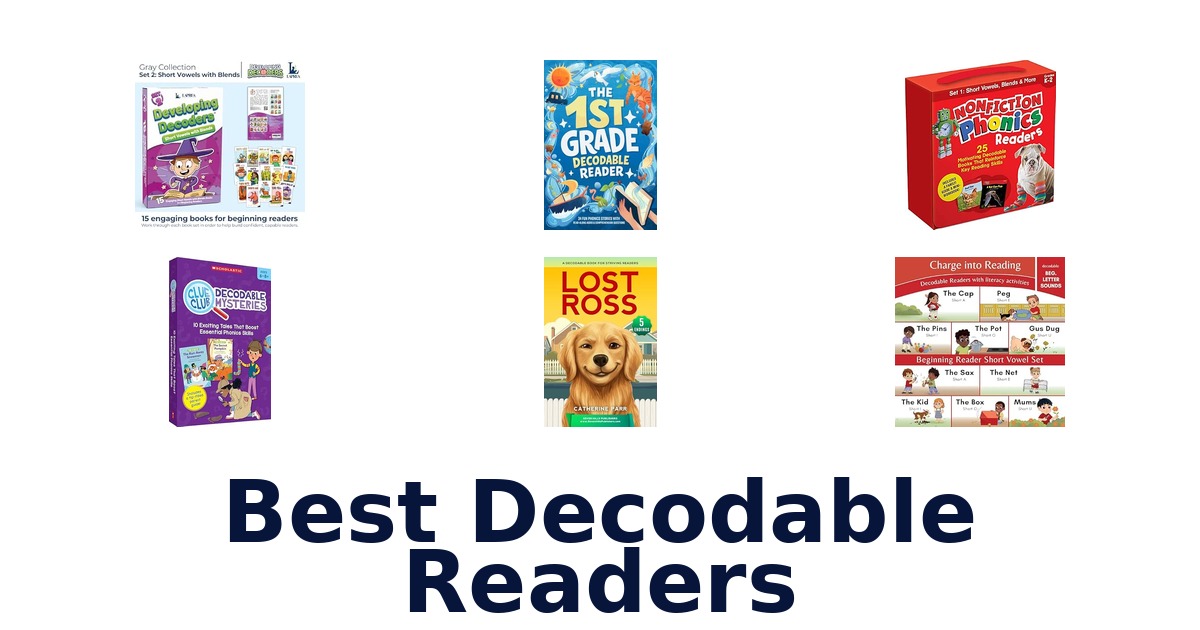
A strong decodable reader gives a beginning reader text aligned with the phonics pattern they are learning, in a format they can manage. This selection includes short-vowel books, consonant-blend practice, nonfiction, mysteries, and collections with stated book counts or difficulty levels. Charge into Reading Stage 1 is a clear starting point for kindergarten and first-grade readers who need short-vowel practice, while the Pre-1 edition is aimed at pre-K and kindergarten.
For readers ready for other patterns, Stage 2 focuses on consonant blends, and several sets offer broader or differently themed practice. The products vary in how much detail they provide about sequence and scope, so use the listed stage, phonics focus, and number of books—not the title alone—to choose a suitable next step.
Charge into Reading Stage 1 is the best overall choice for beginning readers who need short-vowel practice. It is explicitly described as five short-vowel decodable readers for kindergarten and first grade, with one short-vowel sound per book. That defined focus makes it easier to match the set to early phonics work than collections with less detail about their contents.
Choose the Pre-1 edition for a pre-K or kindergarten reader, or Stage 2 when consonant blends are the target.
Our Top Picks
 Best Overall
Its five short-vowel readers are designed for kindergarten and first grade, with one short-vowel sound per book for focused practice.
View on Amazon Most Books Stated
The set explicitly includes 15 short-vowel phonics decodable books for beginning readers ages 4–7 developing decoding skills.
View on Amazon Largest Stated Set
This bundle contains 20 decodable books and names short vowels and blends, offering a larger collection across multiple phonics patterns.
View on Amazon- Best for Blends Charge into Reading Stage 2
- Best Pre-K Start Charge into Reading Pre-1
Compare these decodable reader options
| # | Product | Buy |
|---|---|---|
| 1 | 1. Charge into Reading Stage 1Best Overall | View on Amazon |
| 2 | 2. Gray Collection Set 1Most Books Stated | View on Amazon |
| 3 | 3. First Little Readers Set 1Largest Stated Set | View on Amazon |
| 4 |  4. Charge into Reading Stage 2Best for Blends | View on Amazon |
| 5 |  5. Charge into Reading Pre-1Best Pre-K Start | View on Amazon |
| 6 |  6. First Grade Decodable ReaderReaders needing level choices | View on Amazon |
| 7 |  7. Gray Collection Set 2Set 2 short-vowel practice | View on Amazon |
| 8 |  8. Nonfiction Phonics Readers Set 1Home phonics practice | View on Amazon |
| 9 |  9. Clue Club Decodable MysteriesMystery-loving early readers | View on Amazon |
| 10 |  10. Lost RossChoice-led dyslexia story | View on Amazon |
Detailed Reviews: Best Decodable Readers
#1 · Best Overall
1. Charge into Reading Stage 1
Best for: Kindergarten vowel practice.
Why it ranks #1: Its five short-vowel readers are designed for kindergarten and first grade, with one short-vowel sound per book for focused practice.
Five short-vowel readers, each centered on one vowel sound, give kindergarten and first-grade beginners a straightforward way to focus their decoding practice. The Stage 1 paperback stories are described as a length intended to hold a new reader’s attention, making the set a compact option for early reading sessions.
Keeping one short-vowel sound as the focus of each book gives a beginner a narrower decoding task for each session. The five-reader Stage 1 collection offers repeated practice across the short-vowel set, while the stated attention-friendly story length helps avoid asking a new reader to sustain a long-book session. Its scope is specific: the title identifies short vowels, so buyers seeking a set explicitly centered on consonant blends should look at a different stage.
- Five short-vowel decodable readers
- One short-vowel sound per book
- Aimed at kindergarten and first-grade beginners
- Story length is described as attention-friendly
- Its stated teaching focus is short vowels, not consonant blends.
Skip it if you need a set explicitly focused on consonant blends; Charge into Reading Stage 2 names blend types as its target.
Consider this for a kindergarten or first-grade beginner who benefits from one short-vowel focus at a time and manageable story sessions. It is not the targeted choice when consonant-blend practice is the priority.
Listed on Amazon as: Charge into Reading Decodable Books (Stage 1): 5 Short Vowel Decodable Readers to Help Kindergarten and First Grade Beginning Readers Learn to Read (One Short Vowel Sound Per Book)
View on Amazon#2 · Most Books Stated
2. Gray Collection Set 1
Best for: Short-vowel set for ages 4–7.
Why it ranks #2: The set explicitly includes 15 short-vowel phonics decodable books for beginning readers ages 4–7 developing decoding skills.
Fifteen short-vowel phonics decodable books make the Gray Collection Set 1 a substantial starting collection for developing decoders ages 4–7. The title clearly identifies both its reader age range and its phonics focus, helping families choose a set aligned with early short-vowel practice rather than a broader, unspecified reading topic.
The 15-book count gives a developing decoder multiple short-vowel reading selections, while the stated ages 4–7 help families judge whether the intended audience aligns with the child. Because the title identifies short-vowel phonics as the focus, the collection can be considered for practice in that area. The supplied facts do not describe a particular sequence, story format, or individual vowel allocation, so buyers cannot use those details to plan a more granular progression from this listing alone.
- 15 decodable books
- Short-vowel phonics focus
- Identified for developing decoders
- Ages 4–7 specified
- The supplied details do not describe a progression through the short-vowel skills.
Skip it if you need the book count and age range together with four stated difficulty levels; The First Grade Decodable Reader lists four levels.
A fit for developing decoders ages 4–7 who need a collection focused on short-vowel phonics. Consider another listing if choosing by a stated story sequence or difficulty progression matters as much as the subject focus.
Listed on Amazon as: Decodable Readers: 15 Short Vowel Phonics Decodable Books for Beginning Readers Ages 4-7 Developing Decoders (Gray Collection: Set 1)
View on Amazon#3 · Largest Stated Set
3. First Little Readers Set 1
Best for: Twenty-book phonics bundle.
Why it ranks #3: This bundle contains 20 decodable books and names short vowels and blends, offering a larger collection across multiple phonics patterns.
Twenty decodable books put this First Little Readers bundle in a larger collection format for beginning readers. Its title names short vowels and blends among the phonics content, giving families a clear subject-area signal when they want more than a handful of books for early decoding practice.
The 20-book bundle provides multiple reading selections, while the named short-vowel and blend content signals two areas of phonics practice. That combination can suit families assembling a collection around beginning decoding rather than choosing a single reader. The listing identifies the set as a product bundle and a single-copy set, but the supplied facts do not state how the skills are sequenced across the 20 books or give a reader age range, so those factors cannot guide selection here.
- 20 decodable books
- Short vowels named in the title
- Blends named in the title
- Bundle format for beginning readers
- The supplied details do not identify a skill sequence across the 20 books.
Skip it if you need an explicit age range and short-vowel book count; Gray Collection Set 1 specifies ages 4–7 and 15 books.
A reasonable fit for beginning readers when you want 20 decodable selections covering named short-vowel and blend areas. Choose another set if you need a stated age range or a clear sequence through the skills.
Listed on Amazon as: First Little Readers: Phonics Set 1 / Short Vowels, Blends & More (Single-Copy Set): 20 Decodable Books for Beginning Readers
View on Amazon#4 · Best for Blends
4. Charge into Reading Stage 2
Best for: Early consonant-blend readers.
Why it ranks #4: Its five readers focus on consonant blends, with one blend type per book, and are aimed at kindergarten and first-grade beginners.
One blend type per book gives Stage 2 readers a focused way to practice consonant blends, rather than mixing every target into one session. Its five decodable readers are aimed at kindergarten and first-grade beginners, making the set a next-step option for learners moving beyond short-vowel-only work.
Separating blend types by book gives each reading session a defined phonics target, while five readers provide several opportunities to practice. The kindergarten and first-grade audience identifies the intended stage, and the supplied word examples include clusters such as “brisk,” “clasp,” and “stump.” Those examples make the blend focus concrete, though the listing does not specify the exact blend type assigned to each individual book, limiting precise lesson planning from the supplied details.
- Five consonant-blend decodable readers
- One blend type per book
- Aimed at kindergarten and first-grade beginners
- Word examples include consonant clusters
- The supplied details do not map each blend type to an individual book.
Skip it if you want one short-vowel sound per book rather than blends; Charge into Reading Stage 1 states that vowel-focused structure.
A fit for kindergarten and first-grade beginners ready for consonant-blend decoding in focused book-by-book sessions. It is less suitable when the learner still needs short-vowel practice or when a specific blend-to-book map is essential.
Listed on Amazon as: Charge into Reading Decodable Books (Stage 2): 5 Consonant Blends Decodable Readers to Help Kindergarten and First Grade Beginning Readers Learn to Read (One Blend Type Per Book)
View on Amazon#5 · Best Pre-K Start
5. Charge into Reading Pre-1
Best for: Pre-K short-vowel starters.
Why it ranks #5: The 10 short-vowel CVC books are aimed at pre-K and kindergarten readers, and each story is eight pages long.
One short-vowel sound per book gives Pre-K and kindergarten beginners a clear reading focus, while the 10-book Stage Pre-1 set offers a sequence of short practice sessions. Each story is eight pages long, a compact format intended to help new readers tackle a book without facing a long reading stretch.
The one-sound-per-book approach lets a beginning reader concentrate on a single short-vowel target at a time instead of juggling several targets within a story. Ten paperback books provide multiple opportunities to practice, and the eight-page stories keep each reading session brief for readers who are still building stamina. The listed word examples include blends and other challenging combinations, so this set is best suited to guided early decoding rather than assuming every word is effortless for a first-time reader.
- 10 decodable books in Stage Pre-1
- One short-vowel sound per book
- Eight-page stories support brief reading sessions
- Word examples include consonant blends and clusters
- The set focuses on short vowels rather than consonant blends as its stated teaching target.
Skip it if you want readers explicitly focused on consonant blends; Charge into Reading Stage 2 names blends as its central target.
A fit for Pre-K and kindergarten readers beginning short-vowel decoding, especially when brief sessions suit their stamina. Choose a different focus if the learner is ready to concentrate on consonant blends rather than one short-vowel sound per book.
View on Amazon#6
6. First Grade Decodable Reader
Best for: Readers needing level choices.
Why it ranks #6: It offers 34 phonics stories across four difficulty levels, giving first-grade readers a stated progression for confidence and fluency.
Four difficulty levels across 34 phonics stories give this first-grade reader a clearly tiered format for children building confidence and fluency. Instead of offering one stated difficulty, the collection identifies several levels, which can help families choose among stories as they support early independent reading.
The 34-story count supplies multiple reading selections, and the four difficulty levels provide a named way to distinguish their challenge. The title connects those stories with building confidence and reading fluency, while the first-grade focus identifies the intended school stage. Together, these details suit a reader who wants a substantial story collection with level choices. The supplied facts do not spell out the phonics sequence within each level, so the level labels do not identify particular sound patterns.
- 34 phonics stories
- Four difficulty levels
- First-grade reader focus
- Title emphasizes confidence and reading fluency
- The supplied details do not specify which phonics patterns appear at each level.
Skip it if you need an explicit one-vowel-sound-per-book structure; Charge into Reading Stage 1 states that organization in its title.
Consider it for first-grade readers who want many stories and four stated difficulty levels to choose from. If your selection depends on matching a particular phonics pattern to each level, the listing does not provide that breakdown.
Listed on Amazon as: The First Grade Decodable Reader: 34 Fun Phonics Stories for Early Readers with 4 Difficulty Levels to Build Confidence and Reading Fluency (1st Grade Reading Books for Girls & Boys)
View on Amazon#7
7. Gray Collection Set 2
Best for: Set 2 short-vowel practice.
Why it ranks #7: This collection provides 15 short-vowel phonics decodable books for beginning readers ages 4–7, though the listing gives no further scope details.
Gray Collection Set 2 supplies 15 short-vowel phonics decodable books for developing decoders ages 4–7. Its numbered set identity distinguishes it from the first Gray collection, while the title makes the intended reader group and short-vowel focus explicit for families selecting early practice materials.
The 15-book format gives a child several decodable selections to work through, and the stated ages 4–7 help identify the intended audience. Short-vowel phonics is the named focus, making the collection relevant when that is the area a family is seeking. As with the facts supplied for this listing, no particular story sequence, difficulty progression, or allocation of vowel sounds is described, so the set’s numbered designation alone does not explain how its contents progress.
- 15 decodable books
- Short-vowel phonics focus
- Identified for developing decoders
- Ages 4–7 specified
- The supplied details do not explain how Set 2 progresses through its phonics content.
Skip it if you need four explicitly stated difficulty levels; The First Grade Decodable Reader lists that structure for its 34 stories.
This suits developing decoders ages 4–7 who want another collection focused on short-vowel phonics. If you need to know how difficulty or specific vowel sounds progress from book to book, the supplied listing does not provide that map.
Listed on Amazon as: Decodable Readers: 15 Short Vowel Phonics Decodable Books for Beginning Readers Ages 4-7 Developing Decoders (Gray Collection: Set 2)
View on Amazon#8
8. Nonfiction Phonics Readers Set 1
Best for: Home phonics practice.
Why it ranks #8: The nonfiction set names short vowels and blends, and its teacher-developed home-learning resources offer a nonfiction option for phonics practice.
Short vowels, blends, and more give this nonfiction phonics reader set a broader stated scope than a collection limited to one sound pattern. Scholastic describes its home-learning resources as teacher-developed and intended to reinforce school learning, making this single-copy set a potential fit for extra practice at home.
The named coverage of short vowels and blends gives families more than one phonics area to draw on, while the nonfiction format offers a factual-reading angle alongside skill practice. Scholastic says its home-learning resources are developed by teachers to reinforce what children learn in school and should feel fun and joyful. Those facts support using the set as a home learning supplement; the supplied listing does not state a reader count or a specific sequence for the skills.
- Nonfiction phonics readers
- Title names short vowels and blends
- Teacher-developed home-learning resource
- Intended to reinforce school learning
- The supplied details do not give a specific skill sequence for the set.
Skip it if you need a stated sequence of decodable story levels; The First Grade Decodable Reader lists four difficulty levels.
A practical option for caregivers seeking nonfiction phonics practice at home across short vowels and blends. Its teacher-developed reinforcement angle is clear, but families who need a stated progression of reading levels should choose a listing that names one.
Listed on Amazon as: Nonfiction Phonics Readers SET 1: Short Vowels, Blends & More (Single-Copy Set)
View on Amazon#9
9. Clue Club Decodable Mysteries
Best for: Mystery-loving early readers.
Why it ranks #9: The hardcover set offers a mystery format for decodable reading, but the supplied details do not state its book count or phonics scope.
Decodable mysteries give this hardcover single-copy set a story-led route into early reading practice. The Clue Club title signals a mystery format, while Scholastic describes its home-learning resources as teacher-developed to reinforce school skills, a useful pairing for families wanting reading practice wrapped in a clue-solving premise.
A mystery framework can give young readers a reason to keep following a story, while the Clue Club title establishes the set’s group-centered premise. Scholastic states that its home-learning resources are developed by teachers to reinforce learning in school and that learning at home should feel playful. Together, those facts support considering the set for supplemental reading at home. The supplied details do not name a phonics target, reader count, or progression, which limits how precisely it can be matched to a decoding sequence.
- Decodable mystery format
- Clue Club premise
- Hardcover single-copy set
- Scholastic describes its home resources as teacher-developed
- The supplied details do not identify a specific phonics target.
Skip it if you need explicit short-vowel practice by book; Charge into Reading Stage 1 states one short-vowel sound per reader.
Choose this for an early reader drawn to mysteries and a Clue Club story premise, with teacher-developed home-learning context. If you are matching practice to a named phonics target, its supplied details leave that choice unclear.
Listed on Amazon as: Clue Club Decodable Mysteries (Single-Copy Set) (Our Voices)
View on Amazon#10
10. Lost Ross
Best for: Choice-led dyslexia story.
Why it ranks #10: This decodable story lets readers choose how events unfold and features a pet, heroes, and kid-crooks, but the supplied facts omit phonics scope.
Readers get to choose how the story unfolds, turning Lost Ross into a choice-led decodable story for striving readers and kids with dyslexia. The mystery begins with a mischievous family pet gone missing, then brings the young characters into a local café caper that gives the reading journey a clear narrative goal.
The choose-how-it-unfolds feature gives a striving reader an active role in the story, rather than only following a fixed sequence of events. Ross’s disappearance supplies the central question, and the café plot adds a concrete mission as the characters help save a local business from kid-crooks. That combination offers a story hook alongside decoding practice; the listing does not identify a phonics sequence or reading-level progression, so buyers needing those details should consider that boundary.
- Identified for striving readers and kids with dyslexia
- Reader chooses how the story unfolds
- A missing family pet sets up the mystery
- The plot involves saving a local café
- The supplied details do not specify a phonics sequence or level progression.
Skip it if you require a stated short-vowel sequence or explicit level progression; Charge into Reading Stage 1 specifies one vowel sound per book.
A match for a striving reader or child with dyslexia who may enjoy making choices within a pet-centered mystery. Look elsewhere if selecting books by a stated phonics sequence or reading-level progression is essential.
Listed on Amazon as: Lost Ross: Decodable Book for Striving Readers and Kids with Dyslexia
View on AmazonAvoid a phonics-pattern mismatch
The main failure mode is choosing a decodable book whose phonics patterns run ahead of what the reader has learned. The product descriptions show why the title or age range alone is not enough: Charge into Reading Stage 1 specifies one short-vowel sound per book, while Charge into Reading Stage 2 targets consonant blends. The Pre-1 volume is explicitly described as CVC beginning-reader books, and the Gray Collection sets identify short-vowel phonics.
By contrast, the supplied facts for several sets do not give a detailed sequence of patterns. Before handing over a book, check whether its target sound or blend is already familiar and whether words on the page can be sounded out using known skills.
If the reader repeatedly encounters patterns they cannot decode, treat that as a sign to step back or provide support rather than assuming more difficult text is automatically better.
A set is not always a reading sequence
A larger stated book count does not by itself show that the books form a step-by-step progression. First Little Readers Set 1 lists 20 books and names short vowels and blends, while Gray Collection Set 1 and Set 2 each list 15 short-vowel books. First Grade Decodable Reader instead states 34 stories at four difficulty levels, giving a progression detail the other listings do not provide.
Charge into Reading divides its material by stage and phonics focus, including five short-vowel readers in Stage 1 and five consonant-blend readers in Stage These descriptions serve different needs: a broad collection can supply variety, while an explicit stage or difficulty structure can help an adult choose what comes next.
Do not infer a specific order, included scope, or level of support where the supplied product facts do not say one exists.
How to Choose Decodable Readers
Match the phonics focus
Look for the sound pattern the reader is currently learning, rather than selecting by age or title alone. Charge into Reading Stage 1 offers five short-vowel books, one short-vowel sound per book; Stage 2 offers five readers focused on consonant blends, one blend type per book. The Pre-1 title specifies CVC beginning-reader books and short vowels.
Gray Collection Set 1 and Set 2 each state a short-vowel focus, while First Little Readers Set 1 names short vowels and blends. Readers who need a narrow, clearly specified target may suit a Charge into Reading stage.
Those ready for a collection spanning more than one named pattern may prefer First Little Readers.
Choose the amount of reading
Use the stated number of books and story length to estimate how much material the reader will encounter. Charge into Reading Pre-1 has 10 books, each story described as eight pages; Stage 1 and Stage 2 each have five readers. Gray Collection Set 1 and Set 2 each contain 15 books, and First Little Readers Set 1 lists 20.
First Grade Decodable Reader has 34 stories, while the nonfiction and mystery set descriptions supplied here do not specify a count. A reader with limited stamina may benefit from the explicitly short eight-page Pre-1 stories.
Families seeking a larger stated collection can look at the 15-, 20-, or 34-item options, bearing in mind that quantity alone does not establish reading order.
Consider story style and structure
Pick a format that suits the kind of reading practice the child will engage with, while checking what the listing actually confirms. The set includes nonfiction phonics readers, Clue Club decodable mysteries, and Lost Ross, whose reader can choose how the story unfolds. First Grade Decodable Reader states 34 fun phonics stories across four difficulty levels.
The Charge into Reading titles specify phonics targets and stages, and the Gray Collection books are described as short-vowel phonics decodables. Readers motivated by real-world topics may gravitate toward the nonfiction set; those drawn to mysteries or interactive choices may prefer Clue Club or Lost Ross.
If a clearly stated progression matters most, the four difficulty levels in First Grade Decodable Reader are a specific structural detail to weigh.
Which decodable readers should I choose?
For focused short-vowel practice in kindergarten or first grade, choose Charge into Reading Stage 1: it specifies five readers with one short-vowel sound per book. For a pre-K or kindergarten reader who benefits from short stories, Charge into Reading Pre-1 offers 10 CVC books with eight-page stories. If consonant blends are the next target, select Charge into Reading Stage 2.
For a larger stated collection, First Little Readers Set 1 includes 20 books and names short vowels and blends; Gray Collection Set 1 offers 15 short-vowel books. Choose First Grade Decodable Reader when four stated difficulty levels and 34 stories fit the need.
For a nonfiction, mystery, or choice-based story format, consider Nonfiction Phonics Readers Set 1, Clue Club Decodable Mysteries, or Lost Ross, noting that their supplied details give less information about sequence.
Frequently Asked Questions
How can I tell whether a decodable reader matches the phonics patterns my child has learned?
Check the book or set description for the specific patterns it names, then compare those with your child’s current lessons. A collection that identifies one short-vowel sound per book offers a defined focus; a set naming blends may suit a later target. If the sequence is unclear, ask the teacher which patterns to practice.
Should I read a decodable book with my child or let them try independently first?
Let your child attempt familiar patterns first, while staying nearby to offer calm support. If they get stuck, prompt them to sound out the word rather than supplying it immediately. You can then reread a sentence or page together.
Adjust the amount of help to your child’s confidence and the difficulty of the text.
How often should a beginning reader repeat a decodable book before moving on?
Repeat it until your child can read the words with growing accuracy and less effort, rather than following a fixed number of readings. A reread can build fluency and confidence with the same phonics pattern. Move on when the book feels manageable, and return to it later if the pattern still needs practice.
What should I consider if the book description gives little information about its sequence?
Look for a stated phonics focus, story format, or other details that fit your child’s current needs. Some options here are described as nonfiction, mysteries, or choice-based stories, but their supplied details give less information about sequence. If matching a specific lesson matters, confirm the contents before choosing.
How do the collection sizes and stated learning targets differ?
The listed sets range from five readers to 20 books, and their stated targets vary. Charge into Reading Stage 1 specifies five short-vowel readers, while First Little Readers Set 1 includes 20 books and names short vowels and blends. Choose by the phonics focus and format your child needs, not collection size alone.
Final Words
For focused short-vowel practice in kindergarten or first grade, choose Charge into Reading Stage 1: it specifies five readers with one short-vowel sound per book. For pre-K or kindergarten, consider Charge into Reading Pre-1 and its 10 CVC books; choose Stage 2 when blends are the target. Other collections offer more stated books or distinct formats, but check their described sequence against your child’s current phonics work.