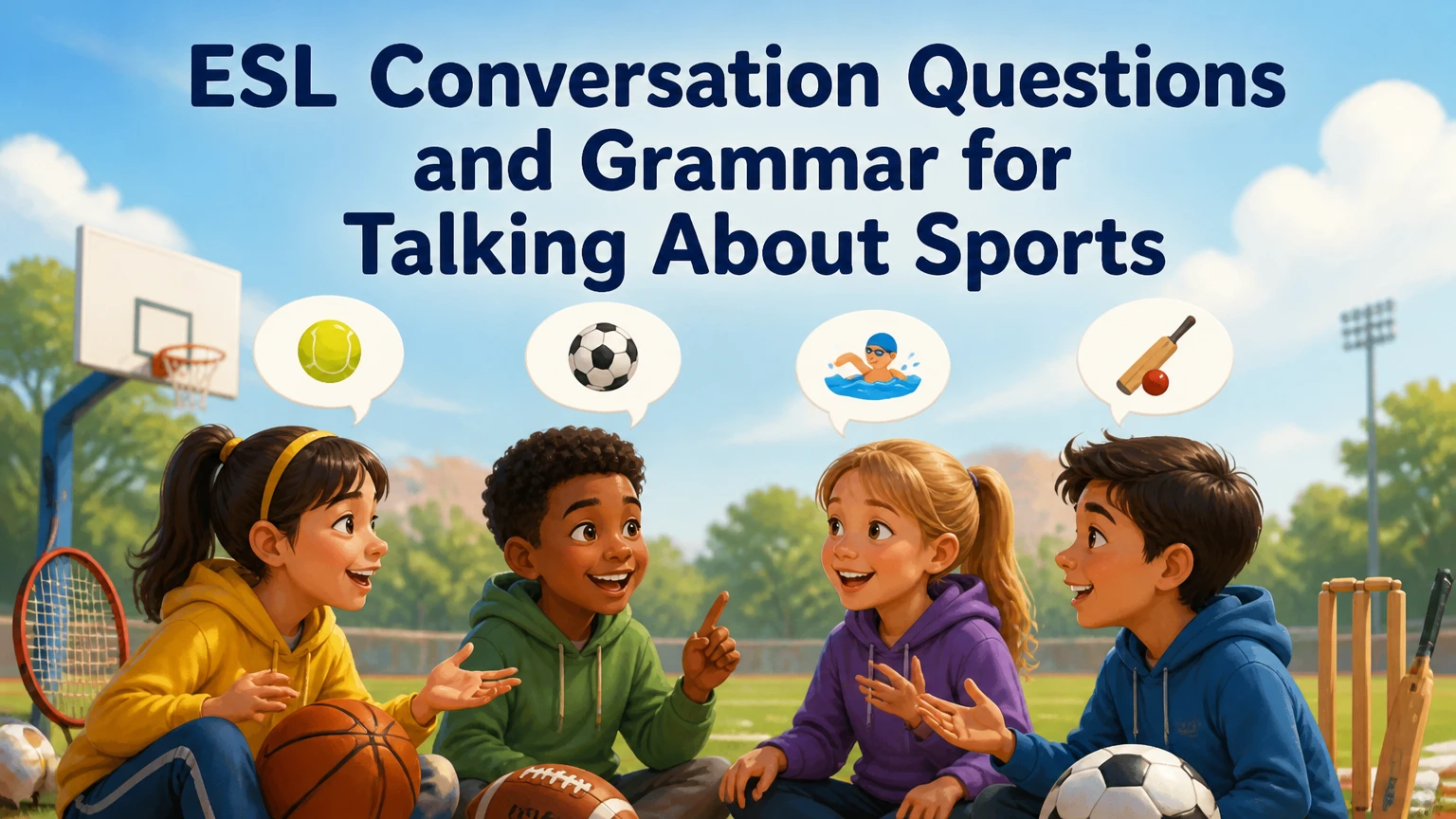
Engaging in conversations about sports is a fundamental aspect of social interaction in English-speaking cultures, requiring a specific set of vocabulary and grammatical structures. Mastering the art of discussing athletics involves using specialized terminology such as kickoff, overtime, underdog, home-field advantage, and personal best to convey enthusiasm and technical knowledge. This guide is designed for English as a Second Language (ESL) learners and educators who wish to build fluency through structured dialogue and thematic grammar. By understanding the nuances of sports-related discourse, students can participate more confidently in casual bar talk, professional networking events, or community recreational leagues where sports often serve as a social bridge.
Table of Contents
- Definition and Scope of Sports Discourse
- Structural Breakdown: The Grammar of Sports
- Categories of Sports Conversation Questions
- Extensive Example Tables for Sports Vocabulary
- Usage Rules and Collocations
- Common Mistakes and Corrections
- Practice Exercises for ESL Learners
- Advanced Topics: Idioms and Phrasal Verbs
- Frequently Asked Questions (FAQ)
- Conclusion and Learning Tips
Definition and Scope of Sports Discourse
Sports discourse refers to the specialized language, grammatical patterns, and social conventions used when discussing physical activities, competitive games, and professional athletics. In an ESL context, this encompasses everything from describing a simple morning jog to analyzing the complex strategies of a professional football match. It is not merely about knowing the names of different sports, but understanding the functional language required to express opinions, ask for clarification, and describe sequences of events.
The function of sports conversation is multifaceted. On one hand, it serves as a “social lubricant,” allowing strangers to find common ground through shared interests in a team or athlete. On the other hand, it requires precise use of tenses—such as the present perfect for career achievements or the past continuous for describing action during a game. For example, saying “He has won three championships” serves a different communicative purpose than “He was winning until the last minute.”
Furthermore, sports language is heavily influenced by regional variations. A “football” match in London refers to a different sport than a “football” game in Dallas. Understanding these contexts is crucial for ESL learners to avoid confusion. The scope of this topic also includes the “language of spectatorship,” which involves reacting to live events with specific interjections and evaluative adjectives, making the conversation dynamic and emotionally resonant.
Structural Breakdown: The Grammar of Sports
When we break down the structure of sports-related English, we primarily look at three pillars: verbs of participation, nouns of venue, and adjectives of performance. The way these elements interact determines the accuracy of the speaker’s message. For instance, the choice between the verbs do, play, and go is a classic grammatical hurdle for many students. Each verb is governed by specific rules based on the nature of the sport being discussed.
The syntactic structure of a sports conversation often follows a predictable pattern. It starts with an opening inquiry (e.g., “Do you follow any sports?”), moves to specific preferences (e.g., “I’m a big fan of tennis”), and progresses to analytical commentary (e.g., “I think their defense was too weak yesterday”). Mastering these transitions requires a solid grasp of conjunctions and transition signals like however, consequently, and on the other hand.
Another structural element is the use of comparatives and superlatives. Since sports are inherently competitive, speakers constantly compare players, teams, and eras. Phrases such as “fastest runner,” “more consistent than,” or “the most talented player I’ve ever seen” are foundational. Without these structures, a learner cannot effectively participate in the “GOAT” (Greatest of All Time) debates that are so prevalent in sports culture.
The Rule of Do, Play, and Go
The most important structural rule in sports English involves the categorization of activities. Generally, we use play for team sports or games involving a ball or competitive element (play soccer, play chess). We use go for activities ending in “-ing” that usually involve moving from one place to another (go swimming, go skiing). Finally, we use do for individual recreational activities, martial arts, or non-team exercises (do yoga, do karate).
Categories of Sports Conversation Questions
To facilitate a structured ESL lesson, conversation questions should be categorized by their intent and complexity. This helps learners move from basic identification to deep analysis. Categorization also allows teachers to target specific grammar points, such as using the conditional mood for hypothetical scenarios or the present simple for general habits.
General Interest and Habits
These questions focus on the learner’s personal relationship with sports. They often utilize the present simple and frequency adverbs. Examples include: “How often do you exercise?” or “What is your favorite sport to watch on TV?” These are excellent icebreakers that require minimal technical vocabulary but encourage the use of words like usually, occasionally, and never.
Professional Sports and Fandom
This category shifts the focus to external events and professional athletes. Questions here often involve the past simple (to discuss historical games) or the future tense (to predict upcoming matches). For instance: “Who do you think will win the World Cup?” or “Which team did you support when you were a child?” This requires knowledge of team names, positions, and tournament structures.
Health and Fitness
Sports aren’t just about professional leagues; they are also about personal well-being. Questions in this category might touch on nutrition, gym routines, and the benefits of physical activity. “Is it important for children to play sports at school?” is a common prompt that encourages the use of modal verbs like should, must, and ought to to express necessity and advice.
Extensive Example Tables for Sports Vocabulary
The following tables provide a comprehensive reference for the vocabulary and phrasing necessary for high-level sports conversations. These are organized by function to help learners find the right words for specific contexts.
Table 1 focuses on the fundamental verbs associated with different types of sports. This is the “Do, Play, Go” rule in action, providing 25 clear examples for student reference.
| Sport/Activity | Correct Verb | Example Sentence |
|---|---|---|
| Soccer | Play | I like to play soccer on weekends. |
| Swimming | Go | We should go swimming this afternoon. |
| Gymnastics | Do | She used to do gymnastics in high school. |
| Basketball | Play | They play basketball at the local park. |
| Running | Go | He goes running every morning at 6 AM. |
| Yoga | Do | Doing yoga helps me stay flexible. |
| Tennis | Play | Would you like to play tennis tomorrow? |
| Cycling | Go | We often go cycling in the mountains. |
| Karate | Do | My son wants to do karate. |
| Golf | Play | My grandfather plays golf every Tuesday. |
| Hiking | Go | Let’s go hiking in the national park. |
| Aerobics | Do | She does aerobics at the community center. |
| Cricket | Play | Cricket is played extensively in India. |
| Surfing | Go | They go surfing whenever they visit the coast. |
| Judo | Do | He has been doing judo for five years. |
| Volleyball | Play | We played volleyball at the beach party. |
| Skiing | Go | I want to go skiing in the Alps this winter. |
| Tai Chi | Do | Many elderly people do Tai Chi in the park. |
| Hockey | Play | The kids play hockey on the frozen pond. |
| Sailing | Go | They go sailing every summer. |
| Pilates | Do | I started doing pilates to improve my posture. |
| Badminton | Play | We play badminton in our backyard. |
| Jogging | Go | Go jogging if you want to lose weight. |
| Wrestling | Do | He used to do wrestling in college. |
| Baseball | Play | Americans love to play baseball in the spring. |
Table 2 explores the venues and equipment associated with various sports. Knowing where a sport is played is just as vital as knowing how to play it. This table lists 25 common pairings.
| Sport | Venue (Place) | Primary Equipment |
|---|---|---|
| Tennis | Court | Racket and Ball |
| Soccer | Pitch / Field | Ball and Cleats |
| Golf | Course | Clubs and Tee |
| Swimming | Pool | Goggles and Cap |
| Boxing | Ring | Gloves and Wraps |
| Ice Hockey | Rink | Stick and Puck |
| Baseball | Diamond / Field | Bat and Glove |
| Athletics | Track | Spikes / Running Shoes |
| Basketball | Court | Hoop and Ball |
| Skiing | Slope / Piste | Skis and Poles |
| Bowling | Alley / Lane | Heavy Ball and Pins |
| Surfing | Ocean / Beach | Surfboard and Wetsuit |
| Archery | Range | Bow and Arrows |
| Motorsport | Circuit / Track | Car and Helmet |
| Cycling | Velodrome / Road | Bicycle and Helmet |
| Gymnastics | Gym | Mat and Beam |
| Cricket | Ground / Pitch | Bat and Wicket |
| Fencing | Piste | Foil / Epee and Mask |
| American Football | Field | Helmet and Pads |
| Skateboarding | Skatepark | Board and Pads |
| Squash | Court | Racket and Small Ball |
| Billiards | Table | Cue and Balls |
| climbing | Wall / Rock Face | Harness and Rope |
| Rowing | Lake / River | Boat and Oars |
| Volleyball | Court / Beach | Net and Ball |
Table 3 provides 25 essential adjectives and descriptive phrases used to evaluate sports performances. These are crucial for expressing opinions during a conversation.
| Adjective/Phrase | Meaning | Contextual Example |
|---|---|---|
| Dominant | Completely in control | The team was dominant from start to finish. |
| Clutch | Performing well under pressure | He made a clutch shot in the final seconds. |
| Inconsistent | Not always at the same level | Their defense has been very inconsistent lately. |
| Aggressive | Playing with great force | They took an aggressive approach to the game. | Resilient | Able to recover quickly | The marathon runner was incredibly resilient. |
| Underwhelming | Less impressive than expected | The final match was quite underwhelming. |
| Explosive | Sudden, powerful energy | He has an explosive start out of the blocks. |
| Tactical | Carefully planned strategy | It was a very tactical game of chess. |
| Physical | Involving a lot of body contact | Rugby is a highly physical sport. |
| Graceful | Moving with elegance | The figure skater’s routine was graceful. |
| Determined | Showing strong will to win | She looked determined to break the record. |
| Clinical | Efficient and precise | The striker was clinical with his finishing. |
| One-sided | One team is much better | The score made it look like a one-sided affair. |
| Nerve-wracking | Causing a lot of stress | Watching the penalty shootout was nerve-wracking. |
| Legendary | Famous for many years | Pelé’s career was truly legendary. |
| Versatile | Able to do many things well | He is a versatile player who can play any position. |
| Rigorous | Extremely thorough and difficult | Training for a triathlon is a rigorous process. |
| Amateur | Not professional / for fun | He plays in an amateur league on Sundays. |
| Fierce | Very intense or violent | The rivalry between the two teams is fierce. |
| Promising | Showing signs of future success | The young quarterback is a promising talent. |
| Seasoned | Experienced over a long time | The team needs a seasoned veteran to lead them. |
| Exhilarating | Making one feel very happy/excited | Skydiving is an exhilarating experience. |
| Exhausting | Very tiring | The five-set match was exhausting for both. |
| Unpredictable | Cannot be foreseen | The weather made the race unpredictable. |
| Disciplined | Showing great self-control | The team stayed disciplined throughout the game. |
Usage Rules and Collocations
Mastering sports conversation requires more than just vocabulary; it requires an understanding of collocations—words that naturally go together. In English, we don’t “make” a goal; we score a goal. We don’t “win” an opponent; we beat an opponent. These distinctions are vital for sounding natural and professional.
One major rule involves the use of the word “sport” itself. In American English, “sport” is often used as a collective noun or an adjective (e.g., “the sport of kings”), but in British English, “sports” (plural) is more common when referring to the general concept (e.g., “I like doing sports”). Additionally, when talking about professional leagues, we use the definite article the for specific entities like the NBA, the NFL, or the Olympics, but we omit it for individual sports like tennis or basketball.
Another important area is the use of phrasal verbs. Sports English is filled with them. You warm up before a game, you work out at the gym, and a player might drop out of a tournament due to injury. Understanding how these verbs function—whether they are separable or inseparable—is a key component of intermediate and advanced grammar study.
Score vs. Win vs. Beat
This is a common area of confusion. You score points or goals (e.g., “He scored 20 points”). You win a game, a race, or a trophy (e.g., “They won the championship”). You beat an opponent or another team (e.g., “The Lakers beat the Celtics”). You can never “win a person,” unless you are talking about winning their affection!
Common Mistakes and Corrections
Learners often apply the rules of their native language to English sports terminology, leading to common errors. Identifying these early can significantly improve a student’s speaking accuracy. One frequent mistake is the misuse of “play” for individual activities. A student might say, “I play gymnastics,” which sounds incorrect to a native ear because gymnastics does not involve a ball or a team-based game structure.
Another error involves the confusion between spectators and audience. While both refer to people watching something, “spectators” is specifically for sports events, whereas “audience” is for plays, concerts, or movies. Similarly, “fans” is the most common term for people who support a specific team or player over a long period.
The following table highlights common errors and provides the grammatically correct alternative to help learners refine their speech.
| Incorrect Sentence | Correct Sentence | Grammar Rule/Explanation |
|---|---|---|
| I am going to play yoga. | I am going to do yoga. | Use ‘do’ for individual/martial arts. |
| We won the other team 2-0. | We beat the other team 2-0. | You beat an opponent; you win a game. |
| He scored a very good point. | He scored a very good goal. | Context dependent: goals for soccer/hockey. |
| I am a big fan for basketball. | I am a big fan of basketball. | ‘Fan’ takes the preposition ‘of’. |
| The match was very boring. | The match was very boring. | Correct, but ‘bored’ describes the person. |
| He is the best player of the world. | He is the best player in the world. | Superlatives often use ‘in’ for locations. |
| I go to the gym for making exercise. | I go to the gym to do exercise. | Use ‘to + infinitive’ for purpose. |
| The stadium was full of audiences. | The stadium was full of spectators. | ‘Spectators’ is for sports fans in person. |
| She is good in playing tennis. | She is good at playing tennis. | The adjective ‘good’ takes ‘at’. |
| I do running every morning. | I go running every morning. | Use ‘go’ for -ing activities. |
Practice Exercises for ESL Learners
To reinforce the concepts discussed, complete the following exercises. These are designed to test your knowledge of verbs, prepositions, and general sports vocabulary.
Exercise 1: Fill in the Blanks (Do, Play, Go)
Choose the correct verb (do, play, or go) in the correct form for each sentence.
- My sister _______ swimming every Tuesday morning.
- We used to _______ volleyball when we lived near the beach.
- It is important to _______ some form of exercise every day.
- Have you ever _______ karate?
- They _______ golf at the country club once a month.
- I want to _______ skiing in Japan next year.
- She _______ gymnastics for ten years before she retired.
- Let’s _______ bowling this Friday night!
- He _______ basketball for his school team.
- I usually _______ yoga to relax after work.
Exercise 2: Sports Idioms Matching
Match the idiom to its correct meaning. This tests your understanding of how sports language is used in everyday life.
| Idiom | Meaning |
|---|---|
| 1. The ball is in your court | A. To start something / set it in motion |
| 2. Get the ball rolling | B. It is your responsibility to make the next move |
| 3. A long shot | C. To quit or give up |
| 4. Throw in the towel | D. Something with a very low chance of success |
| 5. Blow the whistle | E. To report illegal or wrong behavior |
Answer Key
Exercise 1: 1. goes, 2. play, 3. do, 4. done, 5. play, 6. go, 7. did, 8. go, 9. plays, 10. do.
Exercise 2: 1-B, 2-A, 3-D, 4-C, 5-E.
Advanced Topics: Idioms and Phrasal Verbs
For advanced learners, the challenge lies in using sports metaphors in non-sports contexts. English is incredibly rich with sports-derived idioms that are used in business, politics, and relationships. Understanding these allows a speaker to sound more like a native and grasp the subtle nuances of professional communication.
For example, “touching base” comes from baseball and means to briefly contact someone. “Moving the goalposts” comes from soccer (and other field sports) and refers to someone changing the rules or requirements of a situation to make it harder for someone else to succeed. These phrases are ubiquitous in corporate environments.
Additionally, the passive voice is frequently used in sports journalism to focus on the event rather than the actors. Instead of saying “The referee disqualified the runner,” a journalist might say, “The runner was disqualified.” This shifts the focus to the consequence of the action, which is often more relevant in a news context. Advanced students should practice converting active sports reports into the passive voice to improve their formal writing skills.
Common Sports Phrasal Verbs
| Phrasal Verb | Definition | Example |
|---|---|---|
| Warm up | Prepare the body for activity | You must warm up for 10 minutes before the race. |
| Work out | Exercise, usually at a gym | He works out five times a week to stay fit. |
| Knock out | Eliminate from a competition | The champion was knocked out in the third round. |
| Give up | Stop trying or quit | Never give up, even if you are losing. |
| Bulk up | Gain muscle mass | The athlete needed to bulk up for the new season. |
| Pass out | Lose consciousness | It was so hot that one runner passed out. |
| Call off | Cancel an event | The game was called off due to heavy rain. |
| Take up | Start a new hobby or sport | I’m thinking of taking up tennis this summer. |
| Sit out | Not participate in a game | He had to sit out the match because of an injury. |
| Kick off | To start (usually a game) | The Super Bowl will kick off at 6:30 PM. |
Frequently Asked Questions (FAQ)
1. Is it “sport” or “sports”?
Both are correct but used differently. “Sports” is generally used as an adjective (sports car, sports center) or to refer to the general category of activities. In British English, “I like sport” is common, whereas Americans almost always say “I like sports.”
2. Why do we say “play” for some things and “do” for others?
The general rule is that “play” is for competitive games with a ball and “do” is for self-improvement or individual martial arts. If you need a partner or a team to do it, you usually “play” it. If you can do it alone in a room (like yoga or karate), you “do” it.
3. What is the difference between a “game” and a “match”?
Often they are interchangeable, but “match” is more common in British English and for sports like tennis, cricket, and soccer. “Game” is more common in American English and for sports like basketball and baseball. In tennis, a “match” consists of “sets,” which consist of “games.”
4. How do I talk about a tie score?
In American English, we say the game “ended in a tie.” In British English, they often say the game “was a draw.” If the score is 1-1, you can say “It’s one-all.” If it’s 0-0, the British often say “nil-nil,” while Americans say “zero-zero.”
5. What does “P.E.” stand for?
P.E. stands for Physical Education. This is the name of the subject in schools where students learn about health and participate in various sports and exercises.
6. What is the difference between a coach and a manager?
A coach usually focuses on the physical training and tactics of the players. A manager often has a broader role, including buying players and handling the administrative side of a team, though in some sports like baseball, the “manager” is the person in the dugout making tactical decisions.
7. What are “extreme sports”?
Extreme sports are activities perceived as having a high level of inherent danger. Examples include skydiving, rock climbing, white-water rafting, and BMX racing. They often involve speed, height, and high physical exertion.
8. Can I use sports idioms in a job interview?
Yes, but use them sparingly. Phrases like “I’m a team player” or “I’m willing to go the extra mile” are very common in interviews. However, overusing them can make you sound like you are relying on clichés rather than original thoughts.
Conclusion and Learning Tips
Mastering ESL conversation questions about sports is an excellent way to bridge the gap between textbook English and real-world communication. By focusing on the specific verbs do, play, and go, and building a vocabulary of descriptive adjectives, learners can move from simple sentences to complex analyses. Remember that sports language is not just about the rules of the game, but about the passion and community that sports create. To continue improving, try watching sports highlights in English with subtitles, or join a local recreational league where you can practice these phrases in a live setting. Consistent practice and a willingness to engage in “small talk” about the latest game will quickly elevate your fluency and confidence in any social situation.