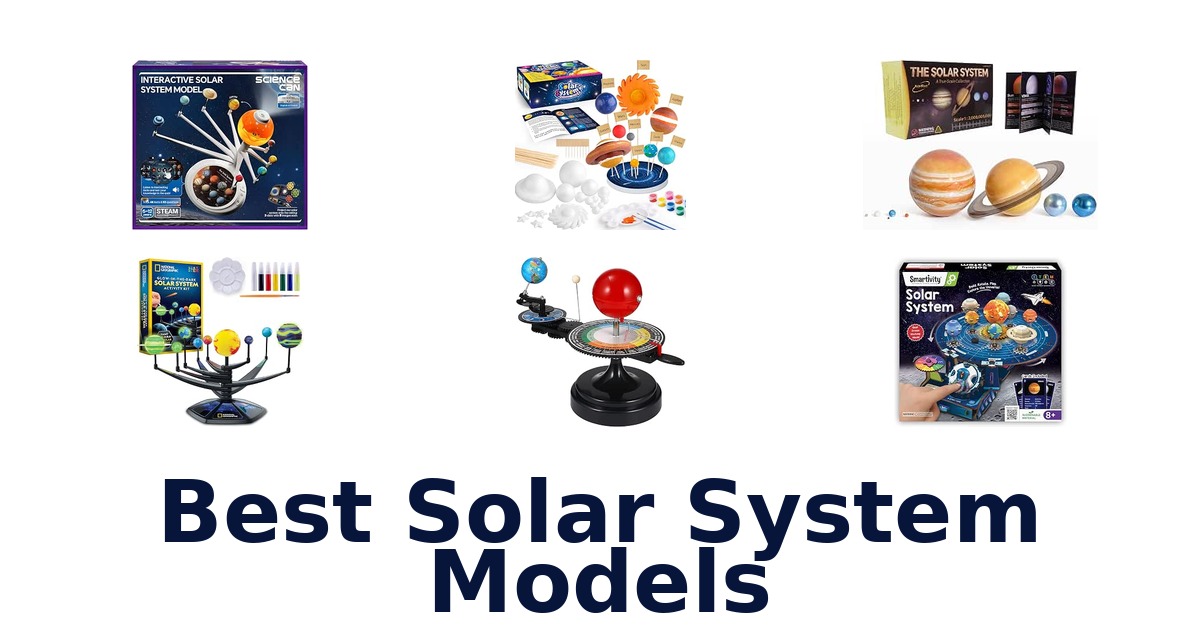
A strong solar system model should make the planets easier to see in motion or understand through hands-on building, whether it is for a classroom, a curious child, or a science-minded adult. These ten options range from EISCO’s three-dimensional display of the Sun and all eight planets to a motorized kit with 75-plus parts and a metal orrery with more than 600 pieces. Some are ready-made teaching aids; others require painting, assembly, or batteries.
The key distinction is what each model actually represents: several cover the full planetary lineup, while LEGO and HAOXIN focus on the Sun, Earth, and Moon. The comparison below weighs model coverage, movement, age guidance, materials, and included learning components to help match the format to its intended use.
EISCO Solar System Model is the best overall choice for a clear, complete planetary display: it includes the Sun and all eight planets, which can be manually moved around the Sun to demonstrate relative motion. Its sturdy base and experiment guide with three activities make it useful for teaching as well as display. Choose a motorized or build-it-yourself format instead if you want powered movement or a hands-on project; those options offer a different experience rather than a more complete planet lineup.
Our Top Picks
 Best Overall
It represents the Sun and all eight planets, lets users move planets manually, and includes a sturdy base plus a guide with three activities.
View on Amazon Best Motorized Kit
This full solar system kit has a four-speed orbit motor, more than 75 parts, and a color instruction manual for assembly.
View on Amazon Best Metal Build
More than 600 metal parts create a functional planetary model with an LED Sun; its 11-pound weight and 16-plus guidance suit older builders.
View on Amazon- Best Scale Display AstriFact True-Scale Model
- Best Glow-in-the-Dark Kit National Geographic Glow Model
Compare the solar system models by learning goal and format
| # | Product | Dimensions | Weight | Material Type | Buy |
|---|---|---|---|---|---|
| 1 | 1. EISCO Solar System ModelBest Overall | 8.5 x 18.25 x 13 in | 1.8 lb | Metal | View on Amazon |
| 2 | 2. Playz Solar System KitBest Motorized Kit | — | 1.38 kg | — | View on Amazon |
| 3 | 3. TECHING Motorized OrreryBest Metal Build | 14.37 x 14.37 x 10 in | 11 lb | Metal | View on Amazon |
| 4 |  4. AstriFact True-Scale ModelBest Scale Display 4. AstriFact True-Scale ModelBest Scale Display | 10.3 x 6.3 x 3.6 in | — | — | View on Amazon |
| 5 |  5. National Geographic Glow ModelBest Glow-in-the-Dark Kit 5. National Geographic Glow ModelBest Glow-in-the-Dark Kit | 7.09 x 2.36 x 12.01 in | 0.3 kg | Plastic | View on Amazon |
| 6 |  6. Smartivity DIY Solar SystemHands-on gear-driven learning 6. Smartivity DIY Solar SystemHands-on gear-driven learning | 12.91 x 11.61 x 1.97 in | 650 g | MDF | View on Amazon |
| 7 |  7. Science Can Talking ModelBilingual fact-and-quiz learners 7. Science Can Talking ModelBilingual fact-and-quiz learners | 12.28 x 4.37 x 9.72 in | — | Plastic | View on Amazon |
| 8 |  8. wookidel Solar System KitSchool and home craft projects 8. wookidel Solar System KitSchool and home craft projects | 10.24 x 8.66 x 3.62 in | — | Foam | View on Amazon |
| 9 |  9. LEGO Earth and Moon OrbitCrank-operated orbit demonstrations 9. LEGO Earth and Moon OrbitCrank-operated orbit demonstrations | 15.04 x 10.32 x 3.7 in | 2.2 lb | Plastic | View on Amazon |
| 10 | 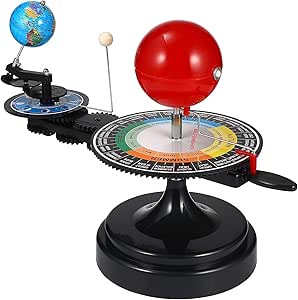 10. HAOXIN Sun Earth Moon ModelSun-Earth-Moon lesson planners 10. HAOXIN Sun Earth Moon ModelSun-Earth-Moon lesson planners | — | 0.91 kg | — | View on Amazon |
Detailed Reviews: Best Solar System Models
#1 · Best Overall
1. EISCO Solar System Model
- Dimensions: 8.5 x 18.25 x 13 in
- Weight: 1.8 lb
- Material Type: Metal
Best for: Classroom motion demonstrations.
Why it ranks #1: It represents the Sun and all eight planets, lets users move planets manually, and includes a sturdy base plus a guide with three activities.
Eight planets sit on manually movable metal rods around a 5.9-inch Sun, allowing this EISCO model to demonstrate their relative positions and motion in three dimensions. A sturdy base supports the display, while the included experiment guide supplies structured activities for science teaching.
Moving each planet’s rod around the Sun gives educators a direct way to show relative motion and position, rather than relying on a fixed diagram. The three-dimensional arrangement includes Mercury through Neptune, so the model covers the full set of eight planets. Its sturdy base supports classroom handling, and the experiment guide includes three activities, further exploration topics, a grading rubric, and a planet-location table. At 8.5 by 18.25 by 13 inches, it needs a suitable tabletop display area.
- Includes the Sun and all eight planets
- Metal rods let planets move manually around the Sun
- Sturdy base supports the three-dimensional model
- Experiment guide includes three activities and a grading rubric
- Planet motion is manual rather than motorized.
Skip it if you want powered orbit speeds; Playz’s solar-system kit has a four-speed orbit motor and a 26-by-18-inch model.
This is suited to educators and learners who need a full eight-planet model for demonstrating relative positions and motion. Its rods move by hand, so choose a motorized kit if automated orbital movement is essential.
Full product details
| Brand | EISCO |
|---|---|
| Item Dimensions | 8.5 x 18.25 x 13 inches |
| Item Weight | 1.8 pounds |
| Manufacturer | Eisco |
| Part Number | BD0074A |
| Material | Metal |
| Size | Large |
| Additional Information | Important information Directions The model includes a comprehensive experiment guide that includes three activities, various topics for further exploration, a grading rubric and a planet location table. |
Listed on Amazon as: EISCO Solar System Model, 13" – Three Dimensional – Shows Relative Position and Motion of Planets Around The Sun – Includes Experiment Guide
View on Amazon#2 · Best Motorized Kit
2. Playz Solar System Kit
- Weight: 1.38 kg
Best for: Motorized large-format projects.
Why it ranks #2: This full solar system kit has a four-speed orbit motor, more than 75 parts, and a color instruction manual for assembly.
A four-speed orbit motor gives this Playz kit adjustable planetary movement, while its large model measures 26 by 18 by 1 inches. With more than 75 parts and a color instruction manual, the project combines a sizable moving display with hands-on assembly for children aged eight and up.
The four-speed motor lets users choose among several orbit rates, making planetary movement the central feature of the finished model. More than 75 parts and a color instruction manual frame it as a substantial DIY build, with the listed educational content covering physics, astronomy, science, and engineering. Its 26-by-18-inch footprint needs a broad display or work surface, so planning space before assembly is useful. Small parts are included, and the product is not for children under three.
- Four-speed orbit motor
- Large model measures 26 by 18 by 1 inches
- More than 75 parts for hands-on assembly
- Color instructions and educational facts included
- The 26-by-18-inch model requires a broad display surface.
Skip it if you need a compact desk display; AstriFact’s true-scale miniature set measures 10.3 by 6.3 by 3.6 inches.
This fits children aged eight and up who want to assemble a large, motorized model with adjustable orbit speed. Its footprint is the main practical boundary, so reserve a broad surface for building and displaying it.
Full product details
| Brand | Playz |
|---|---|
| Item Weight | 1.38 kg |
| Manufacturer | Playz |
| Part Number | solarsystem |
| Manufacturer recommended age | 8 years and up |
| Model Number | solarsystem |
| Size | Large |
| Additional Information | Important Information Toy Safety Our recommended age: Manufacturer's minimum age: 8 years Small parts. Not for children under 3 yrs. |
Listed on Amazon as: Playz Solar System Model kit for Kids, Planetarium Projector Planet Toys
View on Amazon#3 · Best Metal Build
3. TECHING Motorized Orrery
- Dimensions: 14.37 x 14.37 x 10 in
- Weight: 11 lb
- Material Type: Metal
Best for: Mechanical model-building enthusiasts.
Why it ranks #3: More than 600 metal parts create a functional planetary model with an LED Sun; its 11-pound weight and 16-plus guidance suit older builders.
More than 600 parts turn this TECHING kit into a mechanical orrery project, with coordinated planetary movement emerging from the assembly of gears and components. Its metal construction—anodized aluminum alloy, stainless steel, and brass—gives the completed model substantial weight and refined metallic textures.
The hands-on construction connects precision metal parts with working mechanical principles, giving older builders a project that goes beyond placing planets on a stand. Coordinated planetary movement demonstrates how gears and components work together, while the LED Sun adds a lit focal point to the finished model. At 14.37 inches square and about 10 inches high, it calls for display space; its 11-pound weight also makes a stable, planned location practical. Recommended age is 16 and up.
- Assembly involves more than 600 parts
- Functional model demonstrates coordinated planetary movement
- Metal parts include aluminum alloy, stainless steel, and brass
- LED Sun and included assembly instructions
- The 11-pound metal model needs a planned display location.
Skip it if you want a straightforward child-focused rotation demonstration; LEGO Technic Planet Earth and Moon in Orbit uses a crank to show orbital movement.
This suits experienced builders aged 16 and up who enjoy mechanical assembly and want a substantial metal orrery with an LED Sun. Set aside room for its roughly 14-inch footprint and consider its 11-pound weight when choosing a display spot.
Full product details
| Brand | TECHING |
|---|---|
| Included Components | Solar System Model Kit |
| Item Dimensions | 14.37 x 14.37 x 10 inches |
| Item Weight | 11 pounds |
| Manufacturer | Guangzhou TECHING Culture Development Co., LTD |
| Part Number | DM405 |
| Manufacturer recommended age | 16 years and up |
| Material | Metal |
| Model Number | DM405 |
| Size | 14.37 × 14.37 × 9.92 inches |
| Additional Information | Important information Directions Assembly instructions included |
Listed on Amazon as: TECHING Motorized Metal Solar System Model Kit, 600+ Parts, LED Sun
View on Amazon#4 · Best Scale Display
4. AstriFact True-Scale Model
- Dimensions: 10.3 x 6.3 x 3.6 in
Best for: Scale-minded astronomy displays.
Why it ranks #4: The Sun and eight planets use a stated 1:2,000,000,000 scale, with a manual and two moons included for a compact desk display.
A stated 1:2,000,000,000 scale preserves the Sun’s and planets’ relative diameters, making this AstriFact set useful for exploring size relationships in a compact desk display. Its eight planets and Sun are rendered with colors and surface details inspired by real space photography, including Jupiter’s bands and Saturn’s rings.
The true-scale sizing gives astronomy enthusiasts a way to compare planetary diameters rather than viewing an assortment of unrelated miniatures. Real-photo-inspired surface treatments add visual cues, from Earth’s continents and oceans to Jupiter’s cloud bands and Saturn’s rings. The included solar-system manual can support reference while exploring the display, and the stated dimensions are 10.3 by 6.3 by 3.6 inches. Two moons, tweezers, and a gift card are also listed among the included components.
- 1:2,000,000,000 scale represents relative diameters
- Includes the Sun and all eight planets
- Surface details include Earth features and Saturn’s rings
- Manual, two moons, and tweezers are included
- Small parts make it unsuitable for children under three.
Skip it if you want a moving build or paint activity; Smartivity’s gear-driven MDF model lets kids assemble a rotating system.
This is a fit for astronomy enthusiasts who want a compact, true-scale static display with detailed planetary surfaces. It prioritizes relative diameters and visual reference, so choose a moving model instead if demonstrating orbital motion is central.
Full product details
| Brand | AstriFact |
|---|---|
| Included Components | Gift Card & Tweezers, Moon * 2, Planets * 8, Solar System Manual, Sun * 1 |
| Item Dimensions | 10.3 x 6.3 x 3.6 inches |
| Manufacturer | StarPremium Tech |
| Part Number | Basic |
| Manufacturer recommended age | 10 years and up |
| Size | 1:2,000,000,000 |
| Additional Information | Important information Safety Information WARNING:CHOKING HAZARD, Small parts not for children under 3 years |
Listed on Amazon as: True Scale Solar System Model, 1:2,000,000,000 Scale Sun & 8 Planet Miniature Display Model, Faithfully Recreated Planet Colors & Details, Astronomy Gift for Science Enthusiasts
View on Amazon#5 · Best Glow-in-the-Dark Kit
5. National Geographic Glow Model
- Dimensions: 7.09 x 2.36 x 12.01 in
- Weight: 0.3 kg
- Material Type: Plastic
Best for: Glow-in-the-dark craft builders.
Why it ranks #5: The kit covers all eight planets and the Sun, with paint, glow-in-the-dark accent paint, decals, and a solar system facts poster.
Glow-in-the-dark accent paint gives this National Geographic kit a display payoff after the planets are painted: kids can create a customized, glowing solar system for a space-themed room. It covers all eight planets and the Sun, making the activity a full-system craft rather than a single-planet project.
The kit pairs six vibrant paint colors with glow-in-the-dark accent paint, a brush, and palette, so children have materials for decorating the planets and Sun in one package. Fun decals add another customization option, while the included poster supplies solar-system facts to explore alongside the craft. Kid-friendly instructions support assembly, and the recommended age is eight and up. The plastic model is compact at 7.09 by 2.36 by 12.01 inches, though small-parts safety is a consideration.
- Includes all eight planets and the Sun for a complete model
- Glow-in-the-dark accent paint adds a dark-room display feature
- Six paint colors, brush, palette, and decals support customization
- Poster and kid-friendly instructions accompany the build
- Small parts carry a choking hazard warning.
Skip it if you want a pre-colored, true-scale desk display; AstriFact’s 1:2,000,000,000 model focuses on realistic planet colors instead of painting.
This suits ages eight and up who want a paint-and-build activity that becomes a glowing room display. Choose it for hands-on customization, but account for its small-parts warning and the time needed to paint the planets.
Full product details
| Brand | Blue Marble |
|---|---|
| Included Components | Everything needed to build a stunning, glow in the dark solar system model |
| Item Dimensions | 7.09 x 2.36 x 12.01 inches |
| Item Weight | 0.3 kg |
| Manufacturer | JMW Sales, Inc. |
| Part Number | NGSOLARSYS |
| Manufacturer recommended age | 8 years and up |
| Material | Plastic |
| Model Number | NGSOLARSYS |
| Size | One Size |
| Sub Brand | National Geographic |
Listed on Amazon as: National Geographic Glow in the Dark Solar System Model for Kids Ages 8-12
View on Amazon#6
6. Smartivity DIY Solar System
- Dimensions: 12.91 x 11.61 x 1.97 in
- Weight: 650 g
- Material Type: MDF
Best for: Hands-on gear-driven learning.
Why it ranks #6: Designed for ages 8 and up, this MDF kit lets children assemble a rotating model and explore planetary movement through hands-on construction.
A gear-driven rotating model lets children watch the solar system move as they assemble it, linking construction with lessons about planets and orbits. Smartivity positions the kit for ages eight to 14, with hands-on, screen-free play that also introduces concepts such as day and night.
The build-and-rotate format gives kids a physical way to connect planetary motion with the model’s gears, while the stated learning themes include orbits, day, and night. MDF construction and a package measuring 12.91 by 11.61 by 1.97 inches make the kit a project to assemble rather than a ready-made display. It is listed for ages eight and up, and the included component is specified as a box, so consult the supplied assembly instructions as part of the build.
- Gear-driven model rotates after assembly
- Connects hands-on construction with learning about orbits
- Learning themes include day and night
- Recommended for ages eight and up
- The included components listing specifies only a box.
Skip it if you want a detailed kit contents list with paints and craft supplies; wookidel lists foam pieces, colors, brushes, and sticks.
This fits curious children aged eight to 14 who learn by assembling a moving model and want screen-free activity. Its gear-driven rotation is the central appeal; buyers wanting a paint-heavy craft should consider a kit with explicitly listed art materials.
Full product details
| Brand | Smartivity |
|---|---|
| Included Components | Box |
| Item Dimensions | 12.91 x 11.61 x 1.97 inches |
| Item Weight | 650 g |
| Manufacturer | Smartivity Labs Pvt Ltd |
| Part Number | SMRT1303 |
| Manufacturer recommended age | 8 years and up |
| Material | MDF |
| Model Number | SMRT1313 |
| Additional Information | Important information Safety Information Chocking Hazard |
Listed on Amazon as: Smartivity DIY Solar System Kit – Gear-Driven Planet Model for Kids 8-14
View on Amazon#7
7. Science Can Talking Model
- Dimensions: 12.28 x 4.37 x 9.72 in
- Material Type: Plastic
Best for: Bilingual fact-and-quiz learners.
Why it ranks #7: Three knowledge cards cover 48 space facts, and the interactive model offers quiz mode plus English and French options; it needs three AA batteries.
Three knowledge cards present 48 space facts in an interactive talking solar-system model, giving children a listening-led way to explore astronomy. English and French options broaden how the information can be used, while quiz mode adds a question-and-answer activity for ages six to 12.
The talking format and three knowledge cards make the 48 facts available as an interactive learning activity rather than relying only on printed reference. English and French options support use in either language, and quiz mode adds another way for children to engage with the space content. The plastic model measures 12.28 by 4.37 by 9.72 inches. It runs on three AA batteries, which are not included, so batteries need to be available before the interactive features can be used.
- Three cards teach 48 space facts
- Offers English and French language options
- Interactive quiz mode adds a learning activity
- Compact plastic model measures 12.28 by 4.37 by 9.72 inches
- Three AA batteries are required and are not included.
Skip it if you want a gear-driven model that demonstrates orbital motion; Smartivity’s DIY kit assembles into a rotating planet model.
This is a fit for ages six to 12 who benefit from spoken facts, bilingual options, and quiz-style learning. Plan for three AA batteries, and choose a mechanical model instead if visible planetary motion matters more than interactive instruction.
Full product details
| Brand | Science Can |
|---|---|
| Included Components | Talking Astronomy Solar System Model Kit |
| Item Dimensions | 12.28 x 4.37 x 9.72 inches |
| Manufacturer | Science Can |
| Part Number | No |
| Manufacturer recommended age | 36 months – 14 years |
| Material | Plastic |
| Model Number | Science Can |
| Size | 6.5 x 9.84 x 11.42 inches |
| Additional Information | Important information Safety Information Powered by 3 AA batteries (not included). Adult supervision recommended for young children. |
Listed on Amazon as: Science Can Solar System for Kids, Interactive Talking Solar System Model
View on Amazon#8
8. wookidel Solar System Kit
- Dimensions: 10.24 x 8.66 x 3.62 in
- Material Type: Foam
Best for: School and home craft projects.
Why it ranks #8: This foam project kit includes 12 foam balls, a Sun, paint, brushes, sticks, and instructions for children to color and build a model.
A 64-piece assortment of foam shapes, sticks, paint, and tools gives children a project kit for creating a solar-system model at home or school. The included instruction sheet provides detailed steps, making this a hands-on craft option for ages six to 12 rather than a preassembled display.
The set lists a 7.87-inch foam disc, a Sun, 12 foam balls, four foam stars, and 15 bamboo sticks, supplying varied pieces for constructing a model. Fifteen toothpick flags and an instruction sheet support labeling and step-by-step assembly. Twelve colors, two brushes, and a palette let children paint their creation as part of the project. The contents fit into a package measuring 10.24 by 8.66 by 3.62 inches, convenient for keeping the craft materials together between sessions.
- Includes foam disc, Sun, 12 foam balls, and four stars
- Fifteen bamboo sticks and 15 toothpick flags support construction and labeling
- Twelve colors, two brushes, and palette included
- Instruction sheet provides detailed project steps
- The foam craft requires children to assemble and paint the model.
Skip it if you want a finished, detailed planet display without a craft session; AstriFact supplies colored miniatures at a stated true scale.
This suits ages six to 12 completing a school assignment or home craft who want the materials and instructions in one kit. It requires hands-on construction and painting, so it is less suitable when a ready-to-display model is the priority.
Full product details
| Brand | wookidel |
|---|---|
| Included Components | Solar System Model Kit |
| Item Dimensions | 10.24 x 8.66 x 3.62 inches |
| Manufacturer | wookidel |
| Part Number | WK0017 |
| Manufacturer recommended age | 6 – 12 years |
| Material | Foam |
| Model Number | WK0017 |
| Size | 8.66 x 10.24 x 3.62 inches |
| Additional Information | Important information Directions Included instruction provides detailed steps on how to create the solar system model. |
Listed on Amazon as: wookidel 64 PCS Solar System Project Kit, Solar System for Kids
View on Amazon#9
9. LEGO Earth and Moon Orbit
- Dimensions: 15.04 x 10.32 x 3.7 in
- Weight: 2.2 lb
- Material Type: Plastic
Best for: Crank-operated orbit demonstrations.
Why it ranks #9: The gear-driven build demonstrates Earth and Moon orbits around the Sun, with printed months and moon phases, but it is not a model of all eight planets.
Turning the crank moves the Earth and Moon through their orbits around the Sun, making this LEGO Technic set a hands-on way to explore celestial motion. Printed months and moon phases connect that movement to seasonal changes, with the building toy recommended for ages 10 and up.
Gear elements create the orbital movement, so the crank gives children a direct way to see the Moon orbit Earth while Earth orbits the Sun. Printed month and moon-phase details provide reference points as the model turns, helping connect motion with seasons. LEGO building elements make construction part of the activity, and the set measures 15.04 by 10.32 by 3.7 inches. This focuses on Earth, Moon, and Sun relationships rather than presenting all eight planets in a single display.
- Crank operates the Earth and Moon orbital movements
- Shows the Moon orbiting Earth as Earth orbits the Sun
- Printed months and moon phases support seasonal learning
- LEGO Technic building set for ages 10 and up
- It models Earth, Moon, and Sun rather than all eight planets.
Skip it if you need all eight planets represented in a display; EISCO’s three-dimensional model includes the Sun and eight planets on movable rods.
This suits builders aged 10 and up who want to assemble and operate a model of Earth-Moon-Sun motion. Its crank and printed calendar details support demonstrations, but it is not a complete eight-planet display.
Full product details
| Brand | LEGO |
|---|---|
| Color | Multicolor |
| Included Components | LEGO Building Elements |
| Item Dimensions | 15.04 x 10.32 x 3.7 inches |
| Item Weight | 2.2 pounds |
| Manufacturer | LEGO |
| Part Number | 6470661 |
| Manufacturer recommended age | 10 years and up |
| Material | Plastic |
| Model | tbd Technic 42179 42179 |
| Model Number | 6470661 |
| Model Year | 2024 |
| Sub Brand | Space |
| Additional Information | Important information Safety Information No |
Listed on Amazon as: LEGO Technic Planet Earth and Moon in Orbit 42179
View on Amazon#10
10. HAOXIN Sun Earth Moon Model
- Weight: 0.91 kg
Best for: Sun-Earth-Moon lesson planners.
Why it ranks #10: Its gear-driven Sun-Earth-Moon setup covers daylight, seasons, eclipses, and moon phases, but it does not model the full lineup of eight planets.
Multiple moving axes let this gear-driven model demonstrate relationships among the Sun, Earth, and Moon, including daylight, seasons, eclipses, and moon phases. Its seasonal plate adds names, order, and dates for four seasons and 24 solar terms in the traditional Chinese calendar.
The model’s rotating gears provide a physical aid for teaching how Sun, Earth, and Moon movements relate to observable events such as day and night, eclipses, and lunar phases. The included seasonal plate extends the lesson beyond orbital movement with season names, order, dates, and traditional Chinese solar terms. It is positioned for school projects and earth-science teaching, and the listed dimensions are 6.93 by 7.87 by 11.02 inches. Assembly requires attention to free gear movement; the directions caution against tightening too much.
- Multiple moving axes demonstrate Sun-Earth-Moon relationships
- Covers daylight, seasons, eclipses, and moon phases
- Seasonal plate includes four seasons and 24 solar terms
- Suitable for school projects and earth-science teaching
- Gears must rotate freely, so assembly requires careful adjustment.
Skip it if you want a full eight-planet system with a crank; LEGO Technic Planet Earth and Moon in Orbit shows Earth and Moon orbits around the Sun.
This fits teachers and families teaching Sun-Earth-Moon motion, especially when seasons and traditional Chinese solar terms are relevant. Its focus is the three-body relationship rather than displaying all eight planets, and gears need free movement during assembly.
Full product details
| Brand | HAOXIN |
|---|---|
| Item Weight | 0.91 kg |
| Manufacturer | Haoxin |
| Part Number | Solarball |
| Model Number | Solarball |
| Size | 6.93 x 7.87 x 11.02 inches |
Listed on Amazon as: English Solar System Sun Earth Moon Orbital Model, Educational Planetarium Project Kit for Science Astronomy Teaching, Earth Moon Sun Rotation Model for Kids
View on AmazonFull solar system or Sun-Earth-Moon model?
Check whether the model includes all eight planets before treating it as a full solar system display. EISCO, Playz, TECHING, AstriFact, and National Geographic explicitly cover the Sun and eight planets; the National Geographic kit says children can customize all eight planets and the Sun. LEGO and HAOXIN instead demonstrate relationships among the Earth, Moon, and Sun.
Those focused models can be useful for orbit, phases, seasons, or eclipses, but they cannot stand in for a display of the complete planetary lineup. This distinction matters for school assignments and demonstrations: a model that explains lunar phases may still omit the planets a project requires.
Read the model’s stated contents and learning focus, not just its solar-system wording, and choose according to the concept the learner needs to see.
Movement does not mean a scale-accurate orbit
A moving model can explain motion without reproducing the solar system’s actual distances or orbital times. EISCO says its planets can be moved manually to show relative motion, while Playz specifies a four-speed orbit motor and Smartivity describes a rotating, gear-driven model. LEGO uses a crank to show Earth and Moon orbital movement, with printed months and moon phases.
These are different teaching mechanisms, not evidence that each model uses a true spatial scale. AstriFact is the only listing here that states a scale, 1:2,000,000,000, and says it preserves the Sun’s and planets’ relative diameters.
Even that statement concerns size representation; the listing does not establish that its display reproduces relative orbital distances. Choose motion for demonstration or stated scale for a size comparison, and avoid assuming one provides both.
How to Choose a Solar System Model
Planet coverage and teaching focus
Start by checking whether you need all eight planets or a model focused on the Earth, Moon, and Sun. EISCO, Playz, TECHING, AstriFact, and National Geographic list the Sun and all eight planets; LEGO and HAOXIN concentrate on the Earth-Moon-Sun relationship. The distinction changes what the model can illustrate: EISCO supports demonstrations of planetary movement, while LEGO includes printed months and moon phases.
For a broad classroom display or an assignment requiring the full planetary lineup, favor a full-system option. For a lesson about eclipses, seasons, daylight, or lunar phases, a focused orbital model may be a better match even though it leaves out other planets.
Movement and assembly
Choose the kind of interaction that suits the user: manual movement, powered motion, or a build-it-yourself project. EISCO’s planets sit on metal rods and can be moved manually; Playz lists a four-speed orbit motor, and TECHING describes a functional model assembled from more than 600 parts. Smartivity offers a gear-driven build, while the National Geographic and wookidel kits involve painting or assembling components.
These formats place different demands on time and attention. A ready-to-demonstrate manual display suits straightforward classroom explanation; a motorized model suits buyers who want powered movement; and a construction kit suits children or adults who want the assembly process to be part of the activity.
Age guidance, materials, and included learning aids
Match the stated age guidance and materials to the intended builder, then check which learning components are included. The listed ages range from 8-plus for National Geographic and Smartivity to 16-plus for TECHING; AstriFact lists 10-plus, and Playz lists 8-plus. Materials also vary: the kits include plastic, foam, MDF, and metal models, while TECHING specifies anodized aluminum alloy, stainless steel, and brass.
EISCO includes an experiment guide with three activities, and National Geographic supplies a facts poster. Science Can adds three knowledge cards covering 48 facts but requires three AA batteries, which are not included.
Younger project builders may prefer supplied craft materials; older enthusiasts may want the mechanical metal assembly.
Which solar system model should you choose?
For a complete, easy-to-demonstrate display, choose EISCO Solar System Model: it includes the Sun and eight planets, movable planet rods, and a three-activity experiment guide. If you want powered planetary movement and a substantial child-focused project, Playz Solar System Kit has a four-speed motor and more than 75 parts. For a precision-oriented adult build, TECHING Motorized Orrery uses more than 600 metal parts and lists a recommended age of 16 years and up.
Choose National Geographic Glow Model for a painting activity and glow-in-the-dark display, or Science Can Talking Model for fact cards and quiz mode. If the learning goal is specifically Earth-Moon motion, seasons, or phases rather than all eight planets, consider LEGO Earth and Moon Orbit or HAOXIN Sun Earth Moon Model.
Frequently Asked Questions
Which solar system models show all eight planets moving around the Sun?
For a clear demonstration of all eight planets moving around the Sun, the EISCO Solar System Model includes the Sun and eight planets on movable rods. The TECHING and Playz options offer motorized movement, according to the article. Check each product’s listed contents and movement style to match your preferred demonstration.
Should I choose a motorized model or one that children assemble themselves?
Choose a motorized model if powered planetary movement is your priority; the TECHING and Playz options are described as motorized. Choose a build-it-yourself format for a hands-on project, such as the Smartivity gear-driven kit. These formats provide different experiences, so consider whether demonstration or assembly better suits the learner.
What should I check before using a solar system model for a school project?
First, match the model to the assignment: an all-eight-planets display, a motion demonstration, or a focused Earth-Moon topic may require different formats. Check which celestial bodies are included and how they move. Also review any learning materials; the EISCO model includes an experiment guide with three activities.
Which models focus on Earth-Moon motion instead of the full planetary lineup?
For a project about Earth-Moon motion, seasons, or phases rather than all eight planets, consider the LEGO Earth and Moon Orbit or HAOXIN Sun Earth Moon Model. These are focused alternatives to a full planetary display. Check the product details to confirm that the model’s subject matches the specific lesson.
Which options add a painting activity or interactive learning features?
The National Geographic Glow Model is the choice for a painting activity and a glow-in-the-dark display. The Science Can Talking Model offers fact cards and quiz mode. Choose between them based on whether the learner would benefit more from a creative finishing activity or spoken facts and quiz-style interaction.
Final Words
For a complete display that is easy to demonstrate, choose the EISCO model: it includes the Sun, all eight planets, movable rods, and a three-activity guide. If powered movement or a substantial child-focused build is the priority, consider Playz; for a precision-oriented adult build, consider TECHING. For Earth-Moon lessons, choose a focused orbit model instead.
Match the format and included learning features to the project before deciding.