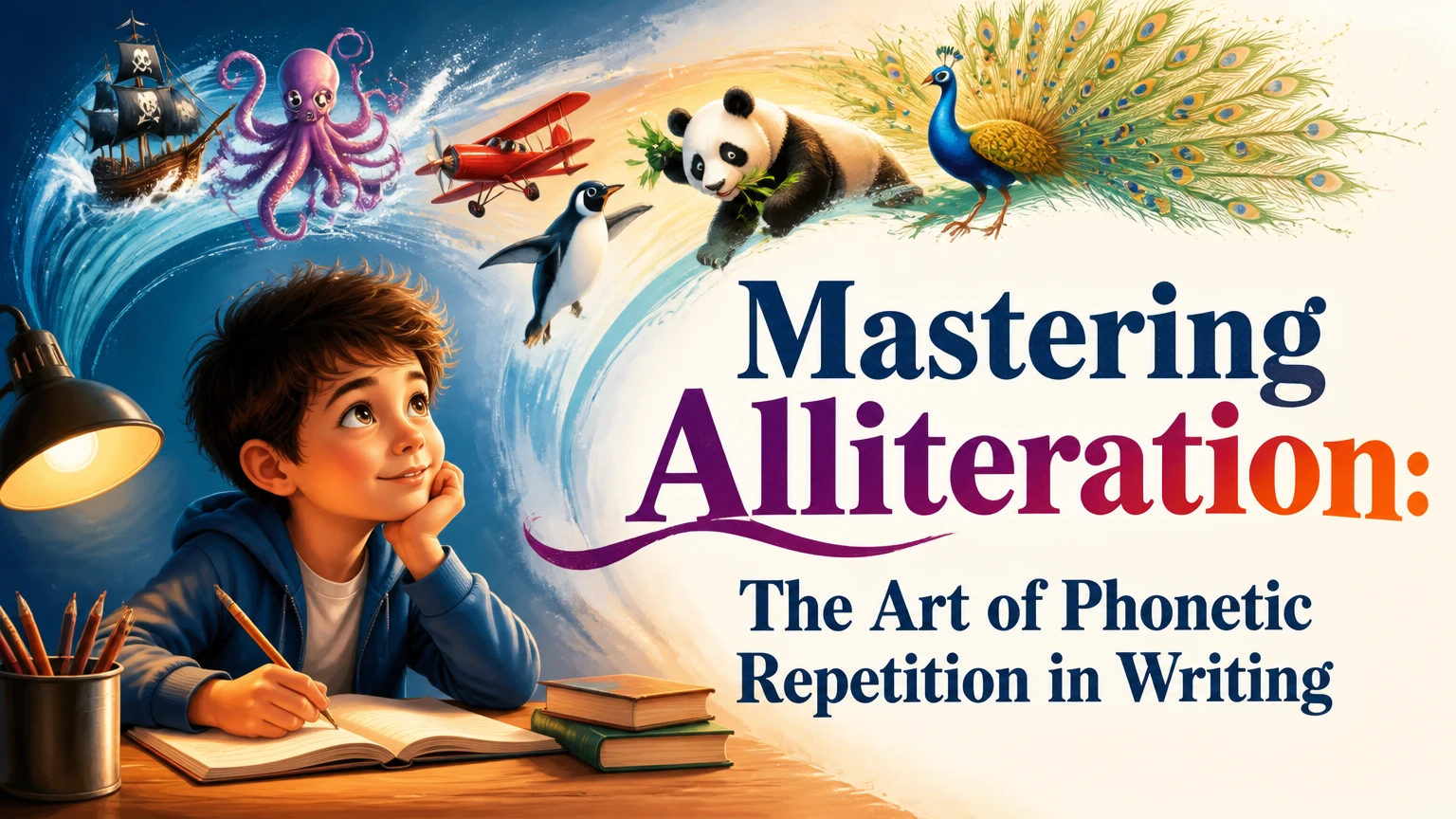
Alliteration is a powerful stylistic device used by writers and speakers to create rhythm, mood, and memorable phrasing through the repetition of initial consonant sounds. This literary technique appears in various forms of communication, such as Peter Piper picked, sweet smelling sessions, mighty mountains, and bed bath and beyond. By strategically placing words with similar beginning sounds in close proximity, a writer can guide the reader’s pace and emphasize specific themes or emotions within a text. Understanding how to harness the musicality of language through these repetitive sounds is essential for anyone looking to enhance their creative writing, marketing copy, or public speaking skills.
The practice of alliteration extends far beyond simple tongue twisters or children’s nursery rhymes, serving as a foundational element in classical poetry and modern branding alike. It functions as a mnemonic device that helps audiences retain information while simultaneously providing an aesthetic quality to the prose. Whether you are crafting a persuasive speech or a lyrical poem, the intentional use of consonant clusters can transform a mundane sentence into a vibrant, resonant piece of art. This comprehensive guide will explore the mechanics, types, and applications of alliteration to help you master this timeless linguistic tool.
Table of Contents
- Defining Alliteration: More Than Just First Letters
- The Structural Breakdown of Alliterative Patterns
- Types and Categories of Alliteration
- Extensive Examples: Literature and Poetry
- Extensive Examples: Pop Culture and Branding
- Rules of Engagement: How to Use Alliteration Effectively
- Common Mistakes and Pitfalls to Avoid
- Practice Exercises for Mastery
- Advanced Topics: Consonance, Assonance, and Sibilance
- Frequently Asked Questions (FAQ)
- Conclusion: Polishing Your Prose
Defining Alliteration: More Than Just First Letters
At its core, alliteration is the repetition of the same letter or sound at the beginning of adjacent or closely connected words. While many people believe it only applies to the literal first letter of a word, linguists clarify that it is specifically the phonetic sound that matters most. For example, “kool kids” is alliterative because of the “k” sound, even if the spelling differs slightly in a creative context, whereas “city cats” is not alliterative because “city” starts with an “s” sound and “cats” starts with a “k” sound.
The primary function of this device is to create a “musical” effect in the text. This auditory quality can evoke specific feelings; soft sounds like “s” or “l” might create a soothing atmosphere, while harsh sounds like “b” or “g” can create a sense of tension or impact. In the history of English literature, particularly in Old English poetry like Beowulf, alliteration served as the primary structural unit of a verse, taking the place of the rhyme schemes we are more familiar with today.
In modern contexts, alliteration is used to make phrases “sticky.” This is why it is so prevalent in advertising and journalism. A headline that uses alliteration is more likely to be remembered by a reader than one that does not. It acts as a cognitive shortcut, allowing the brain to group related concepts together through the harmony of sound. When used correctly, it provides a sense of balance and intentionality to a writer’s work.
The Structural Breakdown of Alliterative Patterns
To understand how alliteration works, we must look at the relationship between stressed syllables and word placement. Alliteration typically occurs on the stressed syllables of words. This is why “around the rock” might not feel as alliterative as “rocky road,” even though both contain “r” sounds; the emphasis in the former is split, while the latter hits the sound consistently at the start of the primary beats.
There are three main components to a successful alliterative phrase: the sound source, the proximity, and the rhythm. The sound source is the specific consonant being repeated. Proximity refers to how close the words are to one another; they do not have to be immediately adjacent, but they must be close enough that the ear perceives the connection. Finally, the rhythm dictates how the sounds interact with the overall meter of the sentence.
Writers often use a “rule of three” when applying alliteration. Three consecutive alliterative words, such as “dark, deep, and dangerous,” create a satisfying cadence that feels complete to the human ear. Using only two words can feel like a coincidence, while using four or more can sometimes become overwhelming or distracting unless the writer is intentionally trying to create a chaotic or overwhelming effect.
Types and Categories of Alliteration
General Alliteration
This is the most common form where the first letter of each word is the same. It is the easiest to spot and the most frequently used in everyday speech. Examples include “big bad bear” or “green garden.” It is straightforward and effective for creating immediate emphasis.
Symmetry Alliteration
This occurs when the alliteration follows a specific pattern within a sentence, often mirroring the structure of the clause. For example, “The fearful foe fled the field.” Here, the repetition is consistent across the entire action, creating a sense of rapid movement or finality.
Consonance-Based Alliteration
While consonance generally refers to the repetition of consonant sounds anywhere in a word, it becomes alliterative when those sounds are at the start. However, some definitions include the repetition of sounds in the middle of words if they are the primary stressed syllable. For instance, “The pitter-patter of paws.”
Hidden Alliteration
Hidden alliteration occurs when the letters are different but the sounds are identical. A classic example is “The phone fell.” Even though one word starts with “p” and the other with “f,” the “f” sound is what the listener hears. This is often more subtle and sophisticated than literal alliteration.
Extensive Examples: Literature and Poetry
The following table provides a comprehensive list of alliterative phrases found in classical literature, poetry, and famous speeches. These examples demonstrate how masters of the English language have used sound to elevate their writing. Note how the repetition often mimics the subject matter being described.
| Author/Source | Alliterative Phrase | Sound Emphasis | Effect/Mood |
|---|---|---|---|
| William Shakespeare | From forth the fatal loins of these two foes | F | Aggressive, tragic |
| Samuel Taylor Coleridge | The fair breeze blew, the white foam flew | F / B | Light, airy, nautical |
| Edgar Allan Poe | Deep into that darkness peering, long I stood there wondering, fearing | D | Ominous, heavy |
| Robert Frost | Saying snow so soft | S | Quiet, gentle |
| John Milton | Behemoth, biggest born | B | Grand, massive |
| Maya Angelou | The caged bird sings with a fearful trill | B / S | Melodic, anxious |
| T.S. Eliot | The yellow fog that rubs its back upon the window-panes | W | Soft, lingering |
| James Joyce | Hearken to the humming of the honey-bees | H | Drowsy, natural |
| Seamus Heaney | The cold smell of potato mould | C / M | Earthly, damp |
| F. Scott Fitzgerald | So we beat on, boats against the current | B | Rhythmic, persistent |
| Walt Whitman | O Captain! my Captain! our fearful trip is done | C | Staccato, urgent |
| William Blake | Tyger, Tyger, burning bright | B | Intense, fiery |
| Alfred Tennyson | The moan of doves in immemorial elms | M | Mournful, slow |
| Dylan Thomas | Do not go gentle into that good night | G | Strong, resistant |
| Sylvia Plath | The blood jet is poetry | P / B | Sharp, visceral |
| Emily Dickinson | The Soul selects her own Society | S | Soft, exclusive |
| W.B. Yeats | The lake isle of Innisfree | I / L | Liquid, serene |
| Lewis Carroll | The vorpal blade went snicker-snack | S | Sharp, cutting |
| John Keats | A thing of beauty is a joy for ever | B / J | Harmonious |
| Oscar Wilde | The Picture of Dorian Gray | D / G | Formal, structured |
| Gerard Manley Hopkins | Fresh-firecoal chestnut-falls | F | Crackling, energetic |
| Thomas Hardy | The world was wan with wildness | W | Desolate, vast |
| Christina Rossetti | My heart is like a singing bird | B / S | Cheerful, light |
| Lord Byron | She walks in beauty, like the night | B / L | Elegant, flowing |
| Robert Browning | The wild white horses of the sea | W | Powerful, repetitive |
Extensive Examples: Pop Culture and Branding
Alliteration is perhaps most visible today in the world of business and entertainment. Companies spend millions of dollars to find the perfect name that rolls off the tongue. The “musicality” of alliteration ensures that a brand name stays in the consumer’s mind longer than a non-alliterative one. Below is a list of famous brands and characters that utilize this technique.
| Category | Example Name | Repeated Sound | Field |
|---|---|---|---|
| Brand | Best Buy | B | Retail |
| Brand | Coca-Cola | C (K sound) | Beverage |
| Brand | Dunkin’ Donuts | D | Food |
| Brand | Lululemon | L | Apparel |
| Brand | PayPal | P | Finance |
| Brand | Krispy Kreme | K | Food |
| Brand | Bed Bath & Beyond | B | Retail |
| Brand | American Airlines | A | Travel |
| Brand | Weight Watchers | W | Health |
| Brand | Gold’s Gym | G | Fitness |
| Character | Mickey Mouse | M | Animation |
| Character | Donald Duck | D | Animation |
| Character | Peter Parker | P | Comics |
| Character | Lois Lane | L | Comics |
| Character | Bugs Bunny | B | Animation |
| Character | Bilbo Baggins | B | Literature |
| Character | Severus Snape | S | Literature |
| Character | Willy Wonka | W | Literature |
| Character | Stephen Strange | S | Comics |
| Character | Wonder Woman | W | Comics |
| Character | Bruce Banner | B | Comics |
| Character | Clark Kent | K sound | Comics |
| Character | Peppa Pig | P | Animation |
| Character | SpongeBob SquarePants | S | Animation |
| Character | Pink Panther | P | Animation |
Rules of Engagement: How to Use Alliteration Effectively
To use alliteration properly, you must first identify the purpose of your writing. If you are writing a technical manual, excessive alliteration might come across as unprofessional or distracting. However, in creative writing, it can be used to slow down a reader’s pace. For instance, long vowel sounds and soft consonants like “l” or “s” can make a sentence feel elongated and leisurely. Conversely, hard consonants like “t,” “k,” and “p” create a staccato effect, speeding up the perceived tempo of the text.
Another rule is to ensure that the alliterative words are meaningfully connected. Randomly using words that start with the same letter just for the sake of it is known as “forced alliteration,” and it usually results in awkward phrasing. The words should naturally belong together in the context of the sentence. If you have to reach for an obscure synonym just to get a matching letter, you are likely sacrificing clarity for style, which is a common mistake for beginning writers.
Furthermore, consider the distance between the sounds. Alliteration does not require the words to be back-to-back. You can have “filler” words like “the,” “of,” or “and” in between. As long as the stressed syllables carry the same sound, the effect will be preserved. For example, “The mountains moved with majesty” is a perfectly valid alliterative sentence despite the small words separating the key terms. The key is to maintain a consistent auditory thread throughout the phrase.
| Adjective | Noun | Context |
|---|---|---|
| Bitter | Battle | Conflict |
| Cold | Comfort | Irony/Sadness |
| Deep | Despair | Emotion |
| Fast | Friends | Relationship |
| Green | Grass | Nature |
| Heavy | Heart | Emotion |
| Jumping | Jacks | Exercise |
| Kind | Knight | Character |
| Last | Laugh | Idiom |
| Mighty | Mouse | Contrast |
| Noisy | Neighbor | Description |
| Proud | Peacock | Metaphor |
| Quick | Question | Interaction |
| Rough | Road | Travel |
| Sweet | Smell | Sensory |
| Tiny | Toys | Description |
| Urban | Utopia | Concept |
| Vicious | Vulture | Nature |
| Wild | West | History |
| Young | Yogi | Character |
Common Mistakes and Pitfalls to Avoid
One of the most frequent errors is confusing visual alliteration with phonetic alliteration. Because English is a language with many irregular spellings, two words starting with the same letter may not sound the same. For example, “The gentle giant gave a gift” is not fully alliterative because “gentle” starts with a “j” sound while “giant” also starts with “j,” but “gave” and “gift” start with a hard “g.” To a listener, the chain of sound is broken.
Overuse is another major pitfall. Alliteration is like a spice; a small amount enhances the flavor of the writing, but too much makes it unpalatable. If every sentence in a paragraph uses alliteration, the reader will become more focused on the “cleverness” of the writing than the actual content. This is particularly dangerous in academic or professional writing, where it can make the author seem less serious or overly whimsical.
Finally, avoid “tongue twisters” unless you are writing for children or specifically creating a linguistic challenge. Phrases like “The sixth sick sheik’s sixth sheep’s sick” are impressive feats of alliteration, but they are physically difficult to read and even harder to say aloud. In most writing contexts, your goal should be fluency and flow, not making the reader trip over their own tongue.
| Attempted Sound | Incorrect (Visual Only) | Correct (Phonetic) |
|---|---|---|
| S Sound | Sugar sounds sweet | Seven silver spoons |
| K Sound | Knights keep keys | Cool cats climb |
| N Sound | New names now | Nifty noble knights |
| H Sound | Honest humans help | Happy horses hop |
| P Sound | Psychology plays parts | Proud people pray |
| J Sound | Just giants jump | Gentle giants join |
| F Sound | Five phones fell | Fancy flowers flourish |
| W Sound | Who writes well | Wild wolves wander |
Practice Exercises for Mastery
To truly master alliteration, you must practice identifying it in others’ work and creating your own. The following exercises are designed to test your understanding of phonetic sounds and rhythmic placement. Remember to focus on the sound of the words rather than just the spelling.
Exercise 1: Identification
Identify the alliterative sound in each of the following sentences. If the sentence is NOT alliterative, explain why.
- The shimmering sun sank slowly behind the sea.
- Knights know how to kneel before kings.
- Cats and dogs can be quite chaotic.
- Philosophers find fame following funerals.
- A big blue bird bit the berry.
- The city center is certainly crowded.
- Glistening glaciers glow in the gloom.
- Heavy hammers hit the hard wood.
- Waves washed over the weathered wharf.
- Quiet queens question the quality of quilts.
Exercise 2: Creative Construction
Complete the following phrases by adding an alliterative word that fits the context. Try to avoid using the same word twice.
| Initial Phrase | Your Alliterative Addition | Target Sound |
|---|---|---|
| The brave ______ | (e.g., baker) | B |
| Silly ______ | __________ | S | __________ | M |
| Dark ______ | __________ | D |
| Fancy ______ | __________ | F |
| Golden ______ | __________ | G |
| Purple ______ | __________ | P |
| Tiny ______ | __________ | T |
| Lucky ______ | __________ | L |
| Wandering ______ | __________ | W |
Exercise 3: Answer Key
| Question # | Answer | Explanation |
|---|---|---|
| 1 | S Sound | “Shimmering, sun, sank, slowly, sea” all start with “S” or “Sh”. |
| 2 | N Sound | “Knights, know, kneel” all start with the “N” sound. |
| 3 | None | “Cats” (K), “Dogs” (D), “Chaotic” (K). Mixed sounds. |
| 4 | F Sound | “Philosophers, find, fame, following, funerals” all start with “F”. |
| 5 | B Sound | “Big, blue, bird, bit, berry” all start with “B”. |
| 6 | S Sound | “City, center, certainly” all start with “S” sound. |
| 7 | G Sound | “Glistening, glaciers, glow, gloom” all start with “G”. |
| 8 | H Sound | “Heavy, hammers, hit, hard” all start with “H”. |
| 9 | W Sound | “Waves, washed, weathered, wharf” all start with “W”. |
| 10 | K Sound | “Quiet, queens, question, quality, quilts” all start with “Kw” sound. |
Advanced Topics: Consonance, Assonance, and Sibilance
For the advanced student of English, alliteration is just one part of a broader family of phonetic devices known as schemes of sound. To truly elevate your writing, you should understand how alliteration interacts with its cousins: consonance and assonance. While alliteration focuses on the start of words, consonance refers to the repetition of consonant sounds anywhere in the words (e.g., “the lumpy, bumpy road”). Assonance, on the other hand, is the repetition of vowel sounds (e.g., “the rain in Spain stays mainly in the plain”).
Another specialized form of alliteration is sibilance. This is the repetition of “hissing” sounds, primarily “s,” “sh,” and “z.” Sibilance is often used to create a sense of stealth, danger, or softness. In poetry, it can mimic the sound of wind or water. However, writers must be careful with sibilance in scripts meant for recording, as “s” sounds can cause “clipping” or “popping” in microphones, a technical issue known as sibilance in the audio engineering world as well.
Finally, there is the concept of internal alliteration. This occurs when the alliterative sound appears on the stressed syllable inside a word rather than at the very beginning. For example, “The unread letter was returned.” Even though the “r” sound isn’t the first letter of every word, it is the dominant sound that creates the rhythmic link. Mastering these nuances allows a writer to create complex “soundscapes” that influence a reader’s subconscious without being overtly obvious.
| Device | Focus | Example |
|---|---|---|
| Alliteration | Initial Consonants | Peter Piper picked… |
| Assonance | Internal Vowels | The light of the fire… |
| Consonance | Any Consonants | Sent and went… |
| Sibilance | Hissing Sounds | Seven snakes slithered… |
| Onomatopoeia | Sound Mimicry | The bee buzzed… |
Frequently Asked Questions (FAQ)
Q: Does alliteration have to be the exact same letter?
A: No. Alliteration is about the sound, not the letter. “C” and “K” can alliterate (e.g., “cool cats”), and “Ph” and “F” can alliterate (e.g., “phone fun”). Conversely, “Know” and “Keep” do not alliterate because the “K” in “know” is silent.
Q: How many words do I need for it to count as alliteration?
A: Technically, just two words are enough to form an alliterative pair. However, in literary analysis, three or more words in a single phrase or sentence are typically required to establish a clear intentional pattern.
Q: Is alliteration okay to use in business emails?
A: Use it sparingly. It can be great for a subject line to grab attention (e.g., “Project Proposal Progress”), but using it too much in the body of a professional email can make you sound less serious or overly poetic.
Q: What is the difference between alliteration and rhyme?
A: Alliteration happens at the beginning of words (head rhyme), while traditional rhyme happens at the end of words (end rhyme). Alliteration is often called “initial rhyme.”
Q: Can alliteration use vowel sounds?
A: While some older definitions included vowels, modern grammar usually classifies the repetition of initial vowel sounds as alliterative assonance. Most contemporary critics reserve “alliteration” specifically for consonant sounds.
Q: Why do authors use alliteration?
A: Authors use it to create mood, enhance rhythm, emphasize specific points, and make their writing more memorable. It is a tool for “painting” with sound.
Q: Is there such a thing as “bad” alliteration?
A: Yes. Alliteration is considered “bad” or “forced” when it compromises the meaning of the sentence, makes the text hard to read, or feels out of place with the tone of the piece.
Conclusion: Polishing Your Prose
Alliteration is a timeless and versatile tool that bridges the gap between language and music. By understanding the phonetic nature of this device, you can move beyond simple “letter matching” and begin to craft sentences that resonate with a deep, rhythmic beauty. Whether you are naming a new brand, writing a heartfelt poem, or simply looking to make your prose more engaging, the strategic use of repetitive sounds like bold brave beginnings and crisp clear communication will serve you well. Remember to prioritize clarity and context over cleverness, and always read your work aloud to ensure the sounds are working in harmony with your message. With practice, alliteration will become a natural and powerful part of your writing repertoire.