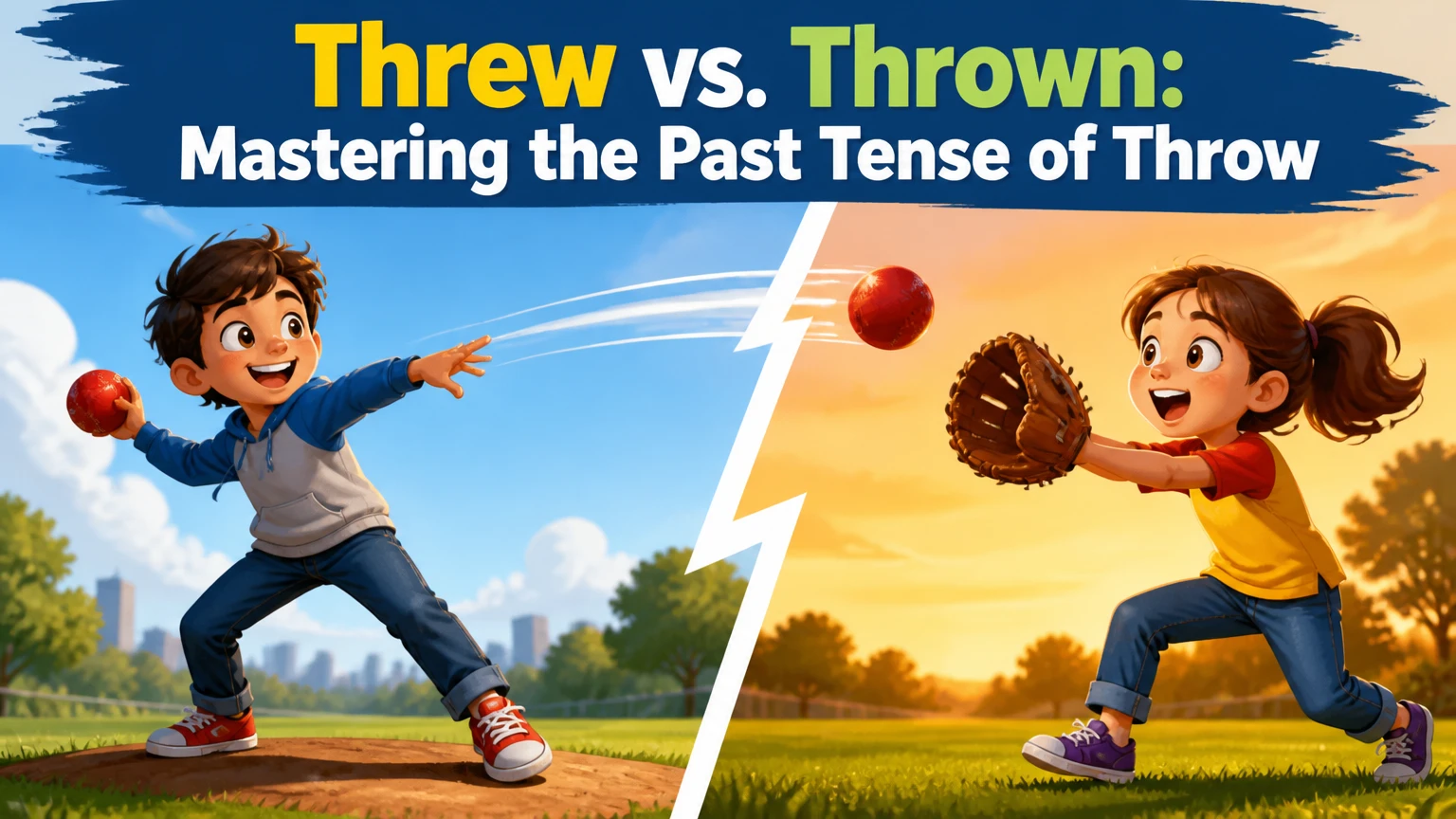
Understanding the distinction between various verb forms is a cornerstone of English mastery, particularly when dealing with irregular verbs like throw. The verb throw follows a specific pattern of conjugation that often confuses learners because it does not follow the standard “-ed” ending rule found in regular verbs. When we discuss the past actions of launching an object through the air, we must choose between specific forms such as threw, thrown, throws, and throwing. For example, a professional athlete might say they threw the ball with precision, or a coach might remark that the record has been thrown away by a careless mistake. Mastering these distinctions is essential for academic writing, professional communication, and daily conversation alike.
Properly utilizing these forms ensures that your narrative remains chronologically accurate and grammatically sound for your audience. Whether you are writing a sports report, a creative short story, or a formal email, the ability to distinguish between the simple past and the past participle is a vital skill. This guide will provide a deep dive into the mechanics of the verb throw, exploring its history, its various tenses, and the common pitfalls that even native speakers encounter. By the end of this comprehensive exploration, you will have the confidence to use threw and thrown correctly in every possible linguistic context.
Table of Contents
- Definition and Linguistic Classification
- Structural Breakdown of the Verb Throw
- The Primary Difference: Threw vs. Thrown
- Conjugation Patterns and Tense Overviews
- Comprehensive Usage Rules and Syntax
- Common Mistakes and Misconceptions
- Phrasal Verbs and Idiomatic Expressions
- Extensive Example Tables (100+ Examples)
- Advanced Topics: Passive Voice and Participle Phrases
- Practice Exercises and Assessment
- Frequently Asked Questions (FAQ)
- Conclusion and Final Summary
Definition and Linguistic Classification
The word throw functions primarily as a verb, though it can also serve as a noun in specific contexts. As a verb, it is defined as the act of propelling something with force through the air by a movement of the arm and hand. In a broader sense, it can mean to move or put something into a particular place or condition rapidly or roughly.
In terms of linguistic classification, throw is an irregular verb. Most English verbs are regular, meaning they form their past tense and past participle by adding “-ed” to the base form (e.g., walk becomes walked). However, throw belongs to a specific group of irregular verbs that undergo a vowel change in the past tense and add an “-n” or “-en” in the past participle. This pattern is similar to verbs like grow/grew/grown and know/knew/known.
The etymology of the word traces back to the Old English thrawan, which originally meant to twist or turn. Over centuries, the meaning shifted from the physical act of twisting to the act of hurling or casting. This historical “twisting” origin is still subtly visible in certain mechanical uses of the word, such as “throwing a switch” or “throwing a pot” on a potter’s wheel.
Structural Breakdown of the Verb Throw
To understand how to use this verb, we must look at its four primary forms. Each form serves a specific grammatical function within a sentence’s structure. Understanding these building blocks is the first step toward grammatical accuracy.
The Base Form (Infinitive) is “throw.” This is used for the present tense (except for third-person singular) and after modal verbs like can, should, and will. For example: “I will throw the trash away.”
The Simple Past is “threw.” This form is used exclusively for actions that were completed at a specific time in the past. It does not require an auxiliary (helping) verb. For example: “He threw the keys to me yesterday.”
The Past Participle is “thrown.” This form is never used alone as the main verb of a sentence. It must be paired with an auxiliary verb like have, has, had, is, was, or been. For example: “I have thrown the ball many times.”
The Present Participle is “throwing.” This form is used for continuous or progressive tenses and indicates an ongoing action. For example: “She is throwing a party tonight.”
The Primary Difference: Threw vs. Thrown
The most frequent point of confusion for English learners is deciding between threw and thrown. The rule is actually quite simple once you understand the concept of “helping verbs.”
Threw is a “lone wolf.” It stands by itself to indicate the past tense. You should never say “I have threw” or “He was threw.” If there is no helping verb (has, have, was, etc.), and you are talking about the past, threw is almost certainly the correct choice.
Thrown is a “team player.” It requires a partner (an auxiliary verb) to function correctly. You should never say “I thrown the ball.” Instead, you must say “I have thrown” or “The ball was thrown.” This form is used in perfect tenses and the passive voice.
Think of it this way: Threw is the action itself in the past. Thrown is the state of the object after the action has been completed or when the action is being described from the perspective of the object receiving the action.
Conjugation Patterns and Tense Overviews
To master this verb, one must see how it behaves across all twelve English tenses. While some tenses are more common than others, knowing the full spectrum allows for precise expression of time and duration.
In the Present Simple, we use throw or throws. In the Past Simple, we use threw. In the Future Simple, we use will throw. These are the most basic building blocks of English communication.
The Perfect Tenses are where “thrown” comes into play. The Present Perfect (have thrown) connects the past to the present. The Past Perfect (had thrown) describes an action completed before another past action. The Future Perfect (will have thrown) describes an action that will be completed by a certain point in the future.
The Progressive Tenses utilize “throwing.” The Present Progressive (is throwing) describes what is happening right now. The Past Progressive (was throwing) describes an ongoing action in the past. The Future Progressive (will be throwing) describes an ongoing action in the future.
Comprehensive Usage Rules and Syntax
Using threw and thrown correctly involves more than just picking the right word; it involves understanding the syntax of the sentence. The verb throw is transitive, which means it usually requires a direct object—the thing being thrown.
Rule 1: Simple Past (Threw). Use threw when the subject of the sentence performed the action at a definite time in the past. Example: “The pitcher threw a fast-ball.” Here, the pitcher is the subject, and the ball is the object.
Rule 2: Present Perfect (Have/Has Thrown). Use thrown with have or has to describe an action that happened at an unspecified time or an action that has relevance to the present. Example: “She has thrown many successful events.”
Rule 3: Past Perfect (Had Thrown). Use thrown with had to indicate an action that was finished before another past event. Example: “By the time I arrived, he had already thrown the letter away.”
Rule 4: Passive Voice (Was/Is Thrown). Use thrown when the object of the action becomes the subject of the sentence. Example: “The stone was thrown by a stranger.” In this case, the focus is on the stone, not the person who threw it.
Common Mistakes and Misconceptions
One of the most common errors is the use of “throwed.” Because many English verbs are regular, children and non-native speakers often attempt to apply the “-ed” rule to throw. However, “throwed” is not a recognized word in standard English and should be avoided in all formal and informal writing.
Another frequent mistake is the “Helping Verb Omission.” This occurs when a speaker says something like, “I thrown the paper in the bin.” This is incorrect because thrown cannot stand alone as a past tense verb. The correct version would be “I threw the paper” or “I have thrown the paper.”
Confusing threw with the preposition through is a homophone error. While they sound identical, they have completely different meanings. Threw is a verb (action), while through indicates movement from one side to the other or the completion of a process. Example: “He threw the ball through the window.”
Phrasal Verbs and Idiomatic Expressions
The verb throw is incredibly versatile and appears in numerous phrasal verbs and idioms. In these cases, the rules for threw and thrown remain the same, but the meaning of the verb changes based on the preposition that follows it.
Throw away: To discard something. “I threw away the old newspapers.” / “The trash has been thrown away.”
Throw up: To vomit or to raise something quickly. “He threw up his hands in frustration.” / “The child has thrown up twice today.”
Throw out: To expel someone or discard something. “The umpire threw him out of the game.” / “He was thrown out for arguing.”
Throw a party: To organize and host a social gathering. “We threw a surprise party for her.” / “Many parties have been thrown in this hall.”
Throw under the bus: To betray someone for personal gain. “He threw his colleague under the bus to get the promotion.” / “She felt she had been thrown under the bus.”
Extensive Example Tables
The following tables provide a comprehensive look at how to use these verbs in various contexts. Study these examples to internalize the patterns of usage for both threw and thrown.
Table 1: 30 Examples of “Threw” (Simple Past)
This table demonstrates the use of the simple past tense in various contexts. Note that none of these examples use a helping verb.
| Subject | Verb (Simple Past) | Object/Complement | Context |
|---|---|---|---|
| The quarterback | threw | a long pass. | Sports |
| I | threw | the keys on the table. | Daily Life |
| She | threw | her head back and laughed. | Expression |
| The toddler | threw | a massive tantrum. | Behavior |
| We | threw | a coin into the fountain. | Tradition |
| He | threw | the heavy box into the truck. | Physical Action |
| The chef | threw | some salt into the pot. | Cooking |
| They | threw | the old documents away. | Cleaning |
| The protestor | threw | a flyer into the crowd. | Social Action |
| My brother | threw | me a surprise party. | Social Event |
| The horse | threw | its rider. | Accident |
| The volcano | threw | ash into the sky. | Nature |
| I | threw | the ball to the dog. | Play |
| The wrestler | threw | his opponent down. | Sports |
| She | threw | a glance in my direction. | Idiom |
| The storm | threw | the boat against the rocks. | Nature |
| He | threw | his clothes into the suitcase. | Travel |
| We | threw | caution to the wind. | Idiom |
| The judge | threw | the case out of court. | Law |
| The teacher | threw | a difficult question at us. | Education |
| I | threw | my support behind the candidate. | Politics |
| The machine | threw | a spark. | Technical |
| She | threw | the frisbee perfectly. | Recreation |
| They | threw | confetti at the wedding. | Celebration |
| The pitcher | threw | a curveball. | Sports |
| He | threw | a blanket over the sleeping child. | Care |
| The company | threw | money at the problem. | Business |
| I | threw | the fishing line into the water. | Hobby |
| The light | threw | long shadows on the wall. | Visual |
| She | threw | the letter into the fire. | Dramatic Action |
Table 2: 30 Examples of “Thrown” (Past Participle)
This table illustrates the use of the past participle. Notice that every instance is accompanied by a helping verb (has, have, had, was, been, etc.).
| Subject/Object | Helping Verb + Thrown | Context/Details | |
|---|---|---|---|
| The dice | have been thrown. | Gambling/Decision | |
| He | has thrown | the ball further than anyone. | Achievement |
| The garbage | was thrown | away this morning. | Passive Voice |
| We | had thrown | the party before they arrived. | Past Perfect |
| She | has thrown | her back out again. | Injury |
| The suspect | was thrown | into jail. | Legal |
| I | have thrown | too many things away. | Regret |
| The towel | was thrown | in by the boxer. | Idiom (giving up) |
| They | had thrown | the anchor before the storm. | Maritime |
| The switch | has been thrown. | Mechanical | |
| A wrench | was thrown | into our plans. | Idiom |
| The pottery | is thrown | on a wheel. | Art |
| He | was thrown | off by the loud noise. | Confusion |
| The ball | will be thrown | by the guest of honor. | Future Passive |
| She | has thrown | herself into her work. | Dedication |
| The documents | were thrown | out by mistake. | Error |
| The curveball | was thrown | with precision. | Sports |
| I | have thrown | darts since I was ten. | Experience |
| The rider | was thrown | from the horse. | Accident |
| The challenge | has been thrown | down. | Metaphor |
| The party | is being thrown | at a hotel. | Ongoing Passive |
| He | had thrown | the evidence in the river. | Crime |
| Many stones | were thrown | at the windows. | Vandalism |
| She | might have thrown | the invitation away. | Possibility |
| The blanket | was thrown | over the couch. | Description |
| I | should have thrown | that old milk out. | Modal Perfect |
| The game | was thrown | by the corrupt players. | Slang (fixed) |
| A lifeline | was thrown | to the drowning man. | Rescue |
| He | has thrown | away a great opportunity. | Life Decision |
| The shadow | was thrown | across the floor. | Atmosphere |
Table 3: Comparison of Threw vs. Thrown
This table provides a direct comparison of how the same sentence changes when moving from simple past to present perfect or passive voice.
| Simple Past (Threw) | Past Participle (Thrown) | Grammatical Change |
|---|---|---|
| I threw the ball. | I have thrown the ball. | Added “have” (Perfect) |
| He threw the trash. | The trash was thrown. | Passive Voice |
| She threw a fit. | She has thrown a fit. | Repeated Action |
| We threw the dice. | The dice were thrown. | Subject-Object swap |
| The horse threw him. | He was thrown by the horse. | Focus on the victim |
| They threw the bricks. | The bricks had been thrown. | Past Perfect Passive |
| I threw the keys. | The keys are thrown. | Present Passive |
| He threw a party. | A party was thrown. | Event focus |
| She threw a glance. | A glance was thrown. | Metaphorical passive |
| We threw the net. | The net has been thrown. | Action completion |
Advanced Topics: Passive Voice and Participle Phrases
For advanced learners, the distinction between threw and thrown becomes even more critical when constructing complex sentences. One such area is the use of participle phrases. A participle phrase uses the past participle (thrown) to act as an adjective modifying a noun. For example: “The ball thrown by the pitcher reached 100 miles per hour.” In this sentence, “thrown by the pitcher” describes the ball. You could not use “threw” here because “threw” is a verb, not an adjective.
Another advanced concept is the Passive Infinitive. This occurs after certain verbs or as a subject. Example: “He didn’t want to be thrown into the deep end.” Here, the infinitive “to be” is paired with the past participle “thrown” to create a passive meaning. This is common in formal writing and literature.
Finally, consider the Perfect Participle, which uses “having” + “thrown.” This is used to indicate that one action was completed before another began. Example: “Having thrown the final pitch, the player walked off the mound.” This structure allows for more sophisticated narrative pacing and shows a high level of English proficiency.
Practice Exercises and Assessment
Test your knowledge with the following exercises. These range from basic identification to complex sentence completion.
Exercise 1: Fill in the Blanks
Complete the sentences by choosing either threw or thrown.
| Number | Sentence | Answer |
|---|---|---|
| 1 | He _____ the ball as hard as he could. | threw |
| 2 | The old clothes have been _____ away. | thrown |
| 3 | I _____ my back out lifting that box. | threw |
| 4 | She had _____ the letter before I could read it. | thrown |
| 5 | Who _____ that rock through the window? | threw |
| 6 | The rider was _____ from the horse. | thrown |
| 7 | We _____ a surprise party for our parents. | threw |
| 8 | Has the trash been _____ out yet? | thrown |
| 9 | The wrestler _____ his opponent to the mat. | threw |
| 10 | They have _____ caution to the wind. | thrown |
Exercise 2: Identify the Error
In the following sentences, identify if the use of the verb is correct or incorrect. If incorrect, provide the correction.
- The pitcher has threw three strikes in a row. (Incorrect: has thrown)
- I thrown the paper in the recycling bin yesterday. (Incorrect: threw)
- She threw her arms around her mother. (Correct)
- The dice was thrown by the dealer. (Correct)
- He throwed the frisbee to the dog. (Incorrect: threw)
- By noon, the anchor had been thrown. (Correct)
- I threw away my chance at the scholarship. (Correct)
- Have you threw the ball yet? (Incorrect: thrown)
- The coach threw the towel in. (Correct)
- The party was threw by the office staff. (Incorrect: thrown)
Frequently Asked Questions (FAQ)
Is “throwed” ever correct?
No, “throwed” is not a standard English word. While you may hear it in certain regional dialects or used by young children who are still learning irregular verb patterns, it is considered grammatically incorrect in all formal contexts. Always use “threw” for the simple past.
What is the difference between “threw” and “through”?
These are homophones, meaning they sound the same but have different meanings and spellings. “Threw” is the past tense of the verb throw (e.g., “He threw the ball”). “Through” is a preposition or adverb indicating movement from one side to another (e.g., “He walked through the door”).
Can “thrown” be used without a helping verb?
Generally, no. In standard English, “thrown” is a past participle and requires an auxiliary verb like has, have, was, or been to function as a verb. The only exception is when it is used as a participle phrase acting as an adjective (e.g., “The ball thrown by the boy…”).
How do I know when to use “threw” vs “thrown”?
Look for a helping verb. If you see words like has, have, had, is, was, were, be, or been right before the verb, use “thrown.” If there is no helping verb and the action happened in the past, use “threw.”
Is “thrown” used for future tense?
Yes, but only in the Future Perfect tense or Future Passive. For example: “By tomorrow, the old couch will have been thrown away” (Future Perfect Passive) or “The first pitch will be thrown at 7 PM” (Future Passive).
Can “throw” be used as a noun?
Yes, “throw” can be a noun referring to the act of throwing (e.g., “That was a great throw”) or a light blanket (e.g., “Put a throw on the sofa”). However, this does not change the past tense rules for the verb form.
Is “threw” used in the passive voice?
No, the passive voice always requires the past participle form. Therefore, you must use “thrown” in passive constructions (e.g., “The ball was thrown,” NOT “The ball was threw”).
What are some common idioms using “thrown”?
Common idioms include “thrown under the bus” (betrayed), “thrown a curveball” (given a surprise or challenge), and “thrown for a loop” (completely surprised or confused).
Conclusion and Final Summary
Mastering the distinction between threw and thrown is an essential step in achieving English fluency. Remember that threw is the simple past tense, used for completed actions without any auxiliary verbs, such as “I threw the ball.” In contrast, thrown is the past participle, which always requires a helping verb like have, has, or was, as in “I have thrown the ball.” Avoiding the non-standard “throwed” and being mindful of the homophone “through” will significantly improve the clarity and professionalism of your writing. To maintain your skills, practice identifying these forms in your daily reading and try to incorporate them into your own sentences. With consistent application of these rules, the correct use of throw will become second nature, allowing you to focus on the content of your message rather than the mechanics of your grammar.