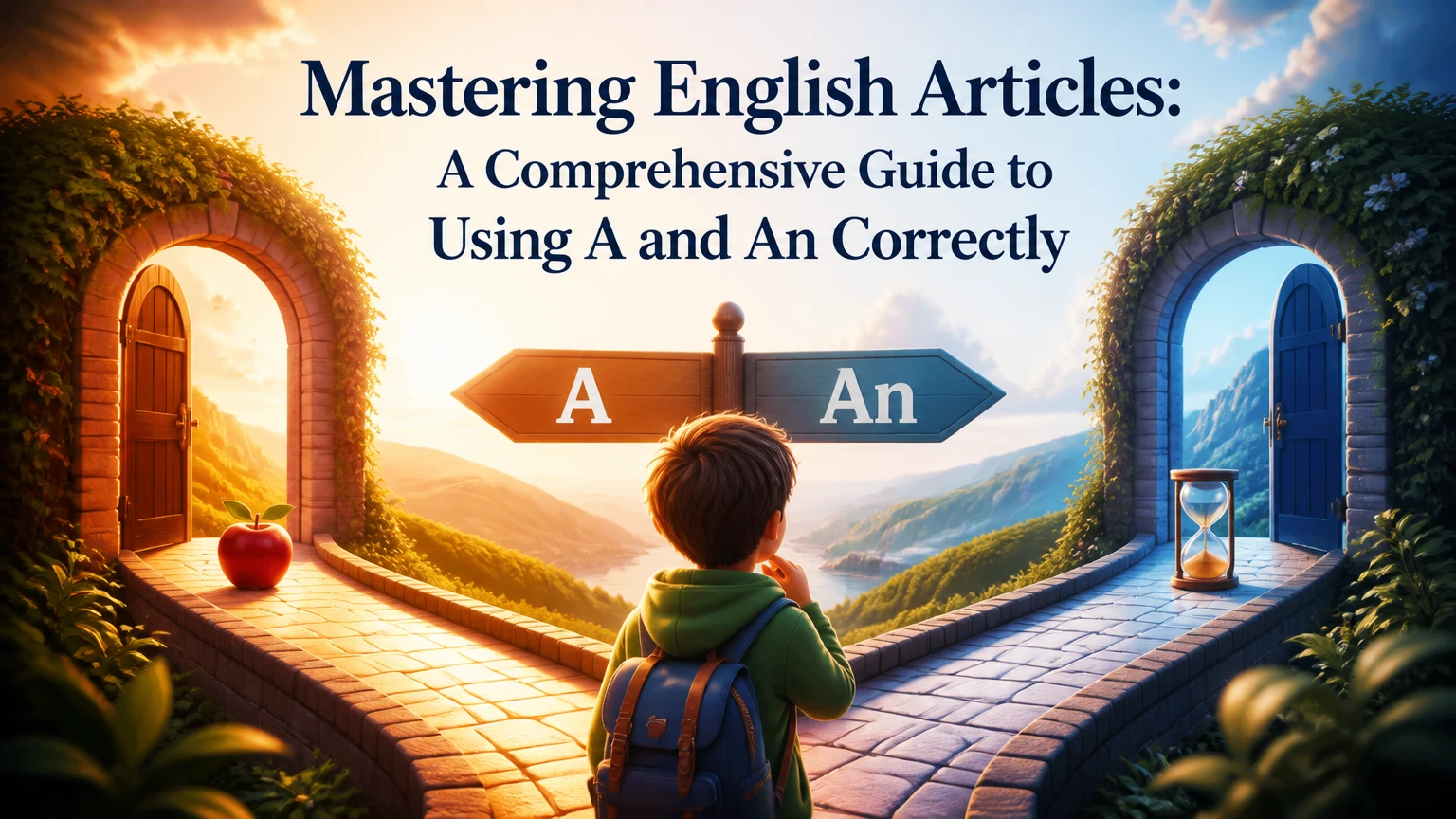
Articles are essential building blocks of the English language that function as adjectives to modify nouns and provide necessary context regarding specificity. In everyday communication, we use articles such as a book, an apple, the car, an hour, and a university to signal to the listener whether we are referring to something general or something specific. Understanding the subtle distinctions between these small words is crucial for achieving fluency and precision in both spoken and written English. This guide is designed to help learners of all levels navigate the phonetic rules and grammatical nuances that dictate article usage, ensuring that your sentences sound natural and professional in any setting.
Table of Contents
- What is an Article? Definition and Function
- Indefinite vs. Definite Articles
- The Core Rule: Sounds vs. Letters
- Using ‘An’ with Vowel Sounds
- Using ‘A’ with Consonant Sounds
- The Curious Case of the Letter ‘H’
- The Mystery of ‘U’ and ‘Eu’
- Articles with Acronyms and Abbreviations
- Articles Before Adjectives
- Countable vs. Uncountable Nouns
- Geographical and Proper Noun Exceptions
- Extensive Example Tables
- Common Mistakes and How to Avoid Them
- Advanced Topics: Stylistic Omission and Nuance
- Practice Exercises and Solutions
- Frequently Asked Questions (FAQ)
- Conclusion and Final Tips
What is an Article? Definition and Function
In the realm of English grammar, an article is a word used to modify a noun, which is a person, place, object, or idea. Technically, articles are categorized as determiners, a class of words that clarify what a noun refers to. They function similarly to adjectives because they provide more information about the noun they precede, specifically regarding its definiteness or indefiniteness.
The primary function of an article is to indicate whether a noun is being used in a general sense or a specific sense. When you use an article, you are telling your reader or listener whether you are talking about “any” member of a group or “one specific” member that has already been identified. Without articles, English sentences would feel disjointed and lack the necessary signals for shared understanding between the speaker and the audience.
Articles are small, but they carry significant weight in sentence structure. For example, saying “I saw dog” is grammatically incomplete; you must say “I saw a dog” (any dog) or “I saw the dog” (a specific dog we both know). This distinction is the foundation of English noun phrases and is one of the first hurdles for many language learners.
Indefinite vs. Definite Articles
English articles are divided into two main categories: indefinite and definite. Understanding the difference between these two categories is the first step toward mastering their usage. The choice depends entirely on the context of the conversation and the level of familiarity the listener has with the subject being discussed.
The indefinite articles are a and an. They are used when referring to a non-specific item or a member of a general group. If you ask someone for “a pen,” you are signaling that any pen will do; you do not have a specific one in mind. Indefinite articles are also used when introducing a new topic into a conversation for the first time.
The definite article is the. This word is used when the noun is specific, unique, or has been previously mentioned. If you ask for “the pen,” you are referring to a specific pen that both you and the listener are aware of, perhaps the one sitting on the desk or the one you lent them earlier. While this article does not change based on sounds, it is important to distinguish it from a and an.
The Core Rule: Sounds vs. Letters
The most important rule to remember when choosing between a and an is that the choice is determined by the sound of the following word, not the letter it starts with. This is a common point of confusion for students who were taught that “an” goes before vowels (a, e, i, o, u) and “a” goes before consonants.
While that simplified rule works about 90% of the time, the English language is full of phonetic exceptions. We use an before a vowel sound and a before a consonant sound. This rule exists for the sake of euphony—the quality of being pleasing to the ear. It is physically easier and sounds more fluid to transition from the “n” in an to a vowel sound than it is to stop the breath between two vowel sounds.
For instance, try saying “a apple.” You have to pause slightly between the two “a” sounds. Now try “an apple.” The “n” acts as a bridge, allowing the words to flow together seamlessly. This phonetic bridge is the entire reason the distinction exists, and keeping this in mind will help you navigate tricky words that start with silent letters or unusual pronunciations.
Using ‘An’ with Vowel Sounds
We use the indefinite article an when the word immediately following it begins with a vowel sound. Vowel sounds in English include the sounds produced by the letters A, E, I, O, and U when they are pronounced as vowels. However, as we will see later, it also includes words that start with a silent consonant but lead with a vowel sound.
Standard examples include words like an egg, an orange, and an island. In these cases, the first letter and the first sound match. The “e” in egg is a vowel sound, so we use an. The “o” in orange is a vowel sound, so we use an. This is the most straightforward application of the rule.
It is important to note that the word following the article isn’t always the noun itself. It could be an adjective modifying the noun. In the phrase “an exciting day,” the article an is chosen because “exciting” starts with a vowel sound, even though “day” starts with a consonant. Always look at the word that comes immediately after the article.
Using ‘A’ with Consonant Sounds
The indefinite article a is used when the following word begins with a consonant sound. This includes most words starting with B, C, D, F, G, J, K, L, M, N, P, Q, R, S, T, V, W, X, Y, and Z. Because these sounds involve some level of constriction in the mouth or throat, the single vowel sound of a transitions naturally into them.
Common examples include a cat, a house, a tree, and a yellow balloon. In “a yellow balloon,” the word “yellow” starts with the “y” sound, which is considered a consonant sound in this context, even though “y” can sometimes act as a vowel. The phonetic transition from a to y is smooth and requires no bridge.
Just like with an, the rule for a applies to whatever word follows it directly. If you are describing a “big umbrella,” you would say “a big umbrella” because “big” starts with a consonant sound. If you were just talking about the “umbrella,” you would say “an umbrella.” The article must always harmonize with its immediate neighbor.
The Curious Case of the Letter ‘H’
The letter ‘H’ is one of the most frequent sources of error regarding a vs. an. In English, the letter ‘H’ can be either “voiced” (pronounced with a breathy sound) or “silent.” The article you choose depends entirely on whether you hear the ‘H’ or not.
When the ‘H’ is voiced, it acts as a consonant. Words like horse, habit, history, and home all require the article a. You say “a horse” because you are pronouncing the ‘H’ sound at the start of the word. It is a physical sound that breaks the airflow, making a the appropriate choice.
However, when the ‘H’ is silent, the word begins with a vowel sound. Common examples include hour, honor, and heir. Since we don’t pronounce the ‘H’ in these words (we say “our,” “onor,” and “air”), we must use an. Therefore, we say “an hour,” “an honor,” and “an heir.” This is a strict rule in modern English, though you may occasionally see older texts use “an” before voiced ‘H’ words like “an historic event,” but this is now considered archaic or overly formal.
The Mystery of ‘U’ and ‘Eu’
Another major exception involves words starting with the letter ‘U’ or the vowel combination ‘Eu.’ While ‘U’ is a vowel letter, it can represent two different sounds: a short vowel sound (like in “umbrella”) or a long “yu” sound (like in “university”).
When ‘U’ makes a long “yu” sound, it is phonetically starting with a “Y” consonant sound. Because of this, we use the article a. Examples include a university, a utopia, a unit, and a European city. Even though these words start with vowel letters, the sound produced is a consonant sound, so a is the correct choice.
Conversely, when ‘U’ makes a short vowel sound, we use an. Examples include an umbrella, an uncle, an ugly sweater, and an understanding. In these cases, the letter and the sound are both vowels, following the standard pattern. Always say the word out loud to yourself; if it starts with a “yu” sound, use a. If it starts with an “uh” or “oo” sound, use an.
Articles with Acronyms and Abbreviations
Acronyms and abbreviations follow the same phonetic rules as standard words. You must determine how the first letter of the acronym is pronounced when read aloud. If the name of the letter starts with a vowel sound, use an. If it starts with a consonant sound, use a.
Consider the letter ‘M.’ When we say the letter ‘M,’ we pronounce it as “em.” Since “em” starts with a vowel sound (short ‘e’), we use an before acronyms starting with ‘M.’ For example, we say “an MBA student” or “an MRI scan.” Similarly, the letter ‘S’ is pronounced “ess,” so we say “an SOS signal.”
On the other hand, the letter ‘B’ is pronounced “bee,” which starts with a consonant sound. Therefore, we say “a BBC reporter.” The letter ‘F’ is pronounced “ef,” so we say “an FBI agent.” This can be confusing because the letter itself is a consonant, but its name begins with a vowel sound. The table below will provide more clarity on this specific category.
Articles Before Adjectives
In many sentences, a noun is preceded by one or more adjectives. When this happens, the article a or an must agree with the sound of the adjective that immediately follows it, not the noun that the article is technically modifying. This is a rule that often trips up learners who focus too much on the noun.
For example, the noun “apple” usually takes an. However, if we add the adjective “delicious,” we must say “a delicious apple” because “delicious” starts with a consonant sound. Conversely, the noun “car” usually takes a. But if we describe it as “expensive,” we must say “an expensive car” because “expensive” starts with a vowel sound.
This rule applies regardless of how many adjectives are in the string. You only ever care about the sound of the word directly to the right of the article. This ensures the phonetic flow remains smooth as the speaker moves from the determiner into the descriptive part of the noun phrase.
Countable vs. Uncountable Nouns
An essential grammatical constraint on the use of a and an is that they can only be used with singular, countable nouns. Countable nouns are things that can be counted as individual units, such as “a chair,” “a bottle,” or “an idea.” Because a/an literally means “one,” it cannot be used with plural nouns or uncountable (mass) nouns.
You cannot say “a chairs” or “an apples” because these are plural. Instead, you would use “some chairs” or just “apples.” Similarly, you cannot use a/an with uncountable nouns like water, air, advice, or information. You would not say “a water” or “an advice.” Instead, you say “some water” or “a piece of advice.”
Understanding the distinction between countable and uncountable nouns is vital because using a/an with an uncountable noun is a very common error for non-native speakers. Always ask yourself: “Can I put a number in front of this noun?” If you can say “one book, two books,” then it is countable, and you can use a book. If you cannot say “one information, two informations,” then it is uncountable, and a/an is incorrect.
Extensive Example Tables
The following tables provide a wealth of examples to help you internalize these rules. The first table focuses on the standard usage of a and an based on the initial letter and sound of the word.
| Word | Correct Article | Reasoning |
|---|---|---|
| Apple | An apple | Starts with a vowel sound |
| Banana | A banana | Starts with a consonant sound |
| Cat | A cat | Starts with a consonant sound |
| Elephant | An elephant | Starts with a vowel sound |
| Frog | A frog | Starts with a consonant sound |
| Guitar | A guitar | Starts with a consonant sound |
| Ice cream | An ice cream | Starts with a vowel sound |
| Jacket | A jacket | Starts with a consonant sound |
| Kangaroo | A kangaroo | Starts with a consonant sound |
| Lemon | A lemon | Starts with a consonant sound |
| Mountain | A mountain | Starts with a consonant sound |
| Notebook | A notebook | Starts with a consonant sound |
| Ocean | An ocean | Starts with a vowel sound |
| Piano | A piano | Starts with a consonant sound |
| Queen | A queen | Starts with a consonant sound |
| Rabbit | A rabbit | Starts with a consonant sound |
| Snake | A snake | Starts with a consonant sound |
| Train | A train | Starts with a consonant sound |
| Umbrella | An umbrella | Starts with a vowel sound |
| Violin | A violin | Starts with a consonant sound |
| Window | A window | Starts with a consonant sound |
| Xylophone | A xylophone | Starts with a consonant sound (Z-sound) |
| Yacht | A yacht | Starts with a consonant sound |
| Zebra | A zebra | Starts with a consonant sound |
| Actor | An actor | Starts with a vowel sound |
| Office | An office | Starts with a vowel sound |
| Idea | An idea | Starts with a vowel sound |
| Error | An error | Starts with a vowel sound |
| Answer | An answer | Starts with a vowel sound |
| Underpass | An underpass | Starts with a vowel sound |
The second table highlights the tricky cases involving the letter ‘H’ and the letter ‘U,’ which are the most common sources of confusion.
| Word | Correct Article | Sound Type |
|---|---|---|
| Hour | An hour | Silent H (Vowel sound) |
| History | A history | Voiced H (Consonant sound) |
| Honest man | An honest man | Silent H (Vowel sound) |
| Hotel | A hotel | Voiced H (Consonant sound) |
| Honor | An honor | Silent H (Vowel sound) |
| Heir | An heir | Silent H (Vowel sound) |
| Hospital | A hospital | Voiced H (Consonant sound) |
| Hammer | A hammer | Voiced H (Consonant sound) |
| University | A university | Long U (Consonant “Y” sound) |
| Ugly duckling | An ugly duckling | Short U (Vowel sound) |
| Uniform | A uniform | Long U (Consonant “Y” sound) |
| Unicorn | A unicorn | Long U (Consonant “Y” sound) |
| Unusual day | An unusual day | Short U (Vowel sound) |
| Unit | A unit | Long U (Consonant “Y” sound) |
| Usage | A usage | Long U (Consonant “Y” sound) |
| User | A user | Long U (Consonant “Y” sound) |
| Uncle | An uncle | Short U (Vowel sound) |
| Upset stomach | An upset stomach | Short U (Vowel sound) |
| European | A European | Long U sound (Consonant “Y”) |
| Euphemism | A euphemism | Long U sound (Consonant “Y”) |
| Herb (US) | An herb | Silent H (US Pronunciation) |
| Herb (UK) | A herb | Voiced H (UK Pronunciation) |
| Humorous story | A humorous story | Voiced H (Consonant sound) |
| Humble pie | A humble pie | Voiced H (Consonant sound) |
| Unidentified object | An unidentified object | Short U (Vowel sound) |
The third table explores how articles function when paired with adjectives and acronyms, demonstrating the importance of the immediate following sound.
| Phrase/Acronym | Correct Article | Explanation |
|---|---|---|
| Old man | An old man | “Old” starts with a vowel sound |
| Big apple | A big apple | “Big” starts with a consonant sound |
| Excellent choice | An excellent choice | “Excellent” starts with a vowel sound |
| Unique gift | A unique gift | “Unique” starts with a “Y” sound |
| MBA | An MBA | M is pronounced “em” (vowel) |
| FBI agent | An FBI agent | F is pronounced “ef” (vowel) |
| NASA scientist | A NASA scientist | NASA is pronounced “nassa” (consonant) |
| UFO | A UFO | U is pronounced “yu” (consonant) |
| SOS | An SOS | S is pronounced “ess” (vowel) |
| PhD | A PhD | P is pronounced “pee” (consonant) |
| RSPCA officer | An RSPCA officer | R is pronounced “ar” (vowel) |
| LCD screen | An LCD screen | L is pronounced “el” (vowel) |
| HTML document | An HTML document | H is pronounced “aitch” (vowel) |
| X-ray | An X-ray | X is pronounced “ex” (vowel) |
| One-way street | A one-way street | “One” starts with a “W” sound |
| Orange shirt | An orange shirt | “Orange” starts with a vowel sound |
| Hard lesson | A hard lesson | “Hard” starts with a consonant sound |
| Expensive watch | An expensive watch | “Expensive” starts with a vowel sound |
| Small insect | A small insect | “Small” starts with a consonant sound |
| Interesting book | An interesting book | “Interesting” starts with a vowel sound |
Comprehensive Coverage of Rules
To master a and an, you must look beyond the simple vowel/consonant distinction and understand the broader rules of English determiners. These rules ensure that your usage is not only phonetically correct but also grammatically sound within the context of the sentence.
Rule 1: The Principle of First Mention. We use a or an when we introduce a person or thing for the first time in a conversation. Once the listener knows which specific thing we are talking about, we switch to the. Example: “I saw a cat in the garden. The cat was black.”
Rule 2: Defining Professions. In English, we always use indefinite articles when stating someone’s job or profession. While some languages omit the article here, English requires it. Example: “She is an architect” or “He is a teacher.”
Rule 3: Singular Countable Nouns Only. As mentioned previously, a/an cannot be used with plural nouns. You cannot say “a dogs.” Similarly, they cannot be used with uncountable nouns like “happiness,” “luggage,” or “water” unless you use a counter like “a bottle of water.”
Rule 4: Numerical Meaning. Sometimes a/an is used to mean “one” or “per.” For example, “I’ll be there in a minute” (one minute) or “This costs five dollars a pound” (per pound). This is a common idiomatic use of the indefinite article.
Rule 5: Descriptions and Categorizations. We use indefinite articles to describe what kind of thing something is. Example: “That is a beautiful painting” or “Cairo is a large city.” Here, the article helps categorize the subject into a broader group of similar things.
Common Mistakes and How to Avoid Them
Even advanced learners make mistakes with articles because they are often absent or used differently in other languages. Recognizing these common pitfalls is the best way to avoid them in your own writing and speech.
| Incorrect Sentence | Correct Sentence | Explanation |
|---|---|---|
| I need an advice. | I need some advice. | Advice is uncountable. |
| He is a honest man. | He is an honest man. | Honest starts with a vowel sound. |
| She goes to an university. | She goes to a university. | University starts with a “Y” sound. |
| I saw a elephants. | I saw an elephant. | “A” cannot be used with plural nouns. |
| It was a unusual event. | It was an unusual event. | Unusual starts with a vowel sound. |
| He is engineer. | He is an engineer. | Professions require an article. |
| I have a information for you. | I have some information. | Information is uncountable. |
| It’s an one-time offer. | It’s a one-time offer. | “One” starts with a “W” sound. |
| I waited for a hour. | I waited for an hour. | Hour has a silent H. |
| She is a MP. | She is an MP. | M is pronounced “em” (vowel). |
One of the most frequent errors is the “visual trap.” This happens when a writer sees a vowel letter and automatically puts an, or sees a consonant and puts a. To avoid this, always “hear” the word in your head. If you are writing “a/an user,” say the word “user.” Since it starts with the “Y” sound, you will naturally feel that “a user” sounds better than “an user.”
Another mistake is using a/an with uncountable nouns. Words like money, furniture, luggage, weather, and work are uncountable in English. You should never use a or an with these words. Instead of “a weather,” say “the weather” or “some weather.” Instead of “a furniture,” say “a piece of furniture.”
Advanced Topics: Stylistic Omission and Nuance
As you become more proficient in English, you will notice that articles are sometimes omitted for stylistic or specific grammatical reasons. This is known as the Zero Article. Understanding when not to use a or an is just as important as knowing when to use them.
Generalizations: When talking about things in general using plural nouns, we omit the article. “Dogs are loyal animals” (all dogs in general) vs. “A dog is a loyal animal” (a single representative of the species). Both are correct, but the plural version is more common for broad generalizations.
Abstract Concepts: We generally do not use a or an with abstract nouns like love, hate, peace, or justice. You would say “Love is all you need,” not “A love is all you need,” unless you are referring to a specific instance of love (e.g., “A love like ours”).
Institutions: In British English, articles are often omitted when referring to the primary purpose of an institution. For example, “He is in hospital” (as a patient) vs. “He is in a hospital” (referring to the building). Similarly, we say “go to school,” “go to church,” or “go to bed” without articles when referring to the activity associated with those places.
The “Herb” Debate: Pronunciation can vary by dialect, which changes the article. In American English, the ‘H’ in herb is silent, so they say “an herb.” In British English, the ‘H’ is pronounced, so they say “a herb.” Neither is “wrong,” but you should be consistent based on the dialect you are using.
Practice Exercises and Solutions
Testing your knowledge is the best way to ensure you’ve grasped the concepts. Below are two sets of exercises ranging from basic to intermediate difficulty. Try to complete them before checking the answers in the tables provided.
Exercise 1: Fill in the Blanks (A or An)
- ___ open door
- ___ used car
- ___ historical novel
- ___ umbrella
- ___ yellow bird
- ___ FBI investigation
- ___ unique opportunity
- ___ honorable mention
- ___ one-hour flight
- ___ egg sandwich
| Question | Correct Answer | Reason |
|---|---|---|
| 1 | An open door | Vowel sound |
| 2 | A used car | “Y” sound at start of “used” |
| 3 | A historical novel | Voiced H sound |
| 4 | An umbrella | Vowel sound |
| 5 | A yellow bird | Consonant sound |
| 6 | An FBI investigation | “Ef” sound for F |
| 7 | A unique opportunity | “Y” sound at start of “unique” |
| 8 | An honorable mention | Silent H sound |
| 9 | A one-hour flight | “W” sound at start of “one” |
| 10 | An egg sandwich | Vowel sound |
Exercise 2: Sentence Correction
Each of the following sentences contains an article error. Identify the error and correct it.
- She is a honest person who never tells lies.
- I bought an new laptop yesterday at the mall.
- It was a honor to meet the president.
- He wants to be an pilot when he grows up.
- We waited for a hour but the bus never came.
- That is an very interesting story you told.
- I need a information about the flight schedule.
- She has a uncle who lives in New York.
- It was an one-time mistake.
- He is an university professor.
| Question | Correction | Reason |
|---|---|---|
| 1 | an honest person | Silent H |
| 2 | a new laptop | “New” starts with consonant |
| 3 | an honor | Silent H |
| 4 | a pilot | “Pilot” starts with consonant |
| 5 | an hour | Silent H |
| 6 | a very interesting | “Very” starts with consonant |
| 7 | some information | Information is uncountable |
| 8 | an uncle | Vowel sound |
| 9 | a one-time | “W” sound |
| 10 | a university | “Y” sound |
Frequently Asked Questions (FAQ)
Q: Why do we say “a university” but “an umbrella”?
A: This is because the letter ‘U’ in “university” is pronounced with a “Y” sound (yoo-ni-ver-si-ty), which is a consonant sound. In “umbrella,” the ‘U’ is pronounced as a short vowel (uhm-brel-la). The article always follows the sound, not the letter.
Q: Is it “a historic” or “an historic”?
A: In modern English, “a historic” is the standard and most correct form because the ‘H’ is voiced. Some people use “an historic” in very formal or older contexts, but “a historic” is preferred in both American and British English today.
Q: Can I use “a” or “an” with plural words?
A: No. The articles a and an are derived from the Old English word for “one.” Therefore, they can only be used with singular nouns. For plural nouns, you use “the,” “some,” or no article at all.
Q: What article should I use with the word “X-ray”?
A: You should use “an.” When you pronounce the letter ‘X,’ you say “ex,” which starts with a vowel sound. Therefore, “an X-ray” is the correct usage.
Q: Do I use “a” or “an” before the word “one”?
A: You use “a.” Although “one” starts with the vowel letter ‘O,’ it is pronounced with a “W” sound (won). Since “W” is a consonant sound, we say “a one-way street” or “a one-man show.”
Q: Why do Americans say “an herb” while the British say “a herb”?
A: This is a dialect difference. In American English, the ‘H’ in “herb” is silent, so it starts with a vowel sound. In British English, the ‘H’ is pronounced. Both are correct within their respective regions.
Q: Can I use “a” with uncountable nouns like “water”?
A: Generally, no. You cannot say “a water” unless you are using it as shorthand for “a bottle of water” or “a glass of water” in a restaurant setting. In formal grammar, uncountable nouns do not take a or an.
Q: How do I know whether to use “a” or “the”?
A: Use “a” or “an” when you are talking about something for the first time or something non-specific. Use “the” when the listener already knows which specific thing you are referring to.
Conclusion and Final Tips
Mastering the use of a and an is a significant milestone in your journey toward English fluency. While the basic rules are simple, the phonetic exceptions—such as a unit, an hour, and a European—require careful attention to the actual sounds produced by the words. Remember that the primary goal of these articles is to facilitate smooth speech and clear communication. To improve, try reading aloud frequently to get a feel for the natural rhythm of the language. When in doubt, let your ears be your guide; if a word starts with a vowel sound, use an, and if it starts with a consonant sound, use a. With consistent practice and attention to detail, using articles correctly will eventually become second nature, enhancing the clarity and professionalism of your English.