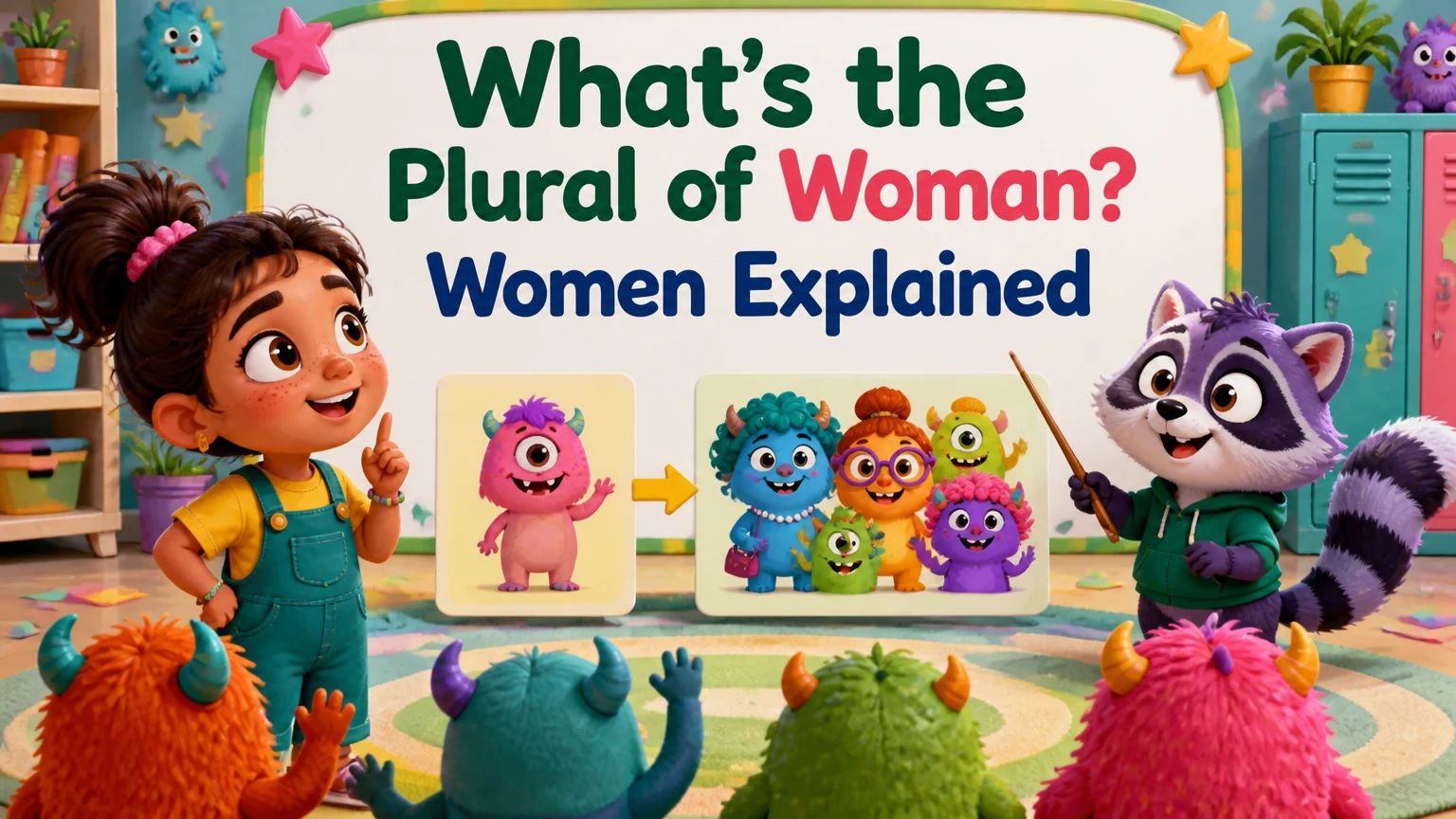
The plural of woman is women. Woman means one adult female human, while women means two or more adult female humans; the spelling changes from woman to women, and the first vowel also changes in pronunciation from /ʊ/ to /ɪ/.
Key Facts at a Glance
The correct plural spelling is women, not womans.
Woman is usually pronounced /ˈwʊmən/, similar to “wu-mən.”
Women is usually pronounced /ˈwɪmɪn/, similar to “wim-in.”
The plural possessive form is women’s, as in women’s health.
The plural of businesswoman is businesswomen.
English inherited the vowel change from the older plural pattern seen in man/men.
What Is the Plural of Woman?
The plural of woman is women, with no added s. Use woman for one person and women for more than one person: “One woman arrived” and “Four women arrived.” The form womans is not standard English.
| Meaning | Correct form | Example |
|---|---|---|
| One adult female human | woman | “That woman is a doctor.” |
| More than one adult female human | women | “Those women are doctors.” |
| One person’s possession | woman’s | “The woman’s bag is blue.” |
| Several women’s possession | women’s | “The women’s bags are blue.” |
The spelling is irregular because English does not form this plural with the ordinary -s ending. The change belongs to an older Germanic plural pattern in which a vowel changed inside the word.
Woman and Women in Complete Sentences
Woman takes singular grammar, while women takes plural grammar. That difference affects demonstratives, verbs, pronouns, and nouns that describe the people involved.
- This woman is an engineer.
- These women are engineers.
- The woman has finished the report.
- The women have finished the report.
- Each woman received a certificate.
- Several women received certificates.
The words this, is, has, and each commonly signal a singular noun. The words these, are, have, and several commonly accompany a plural noun.
How Do You Pronounce Woman and Women?
Woman is commonly pronounced /ˈwʊmən/, while women is commonly pronounced /ˈwɪmɪn/. In approximate learner spelling, woman sounds like “wu-mən,” and women sounds like “wim-in,” although English accents vary.
| Word | IPA | Approximate guide | Syllables |
|---|---|---|---|
| woman | /ˈwʊmən/ | “wu-mən” | 2 |
| women | /ˈwɪmɪn/ | “wim-in” | 2 |
| man | /mæn/ | “man” | 1 |
| men | /men/ | “men” | 1 |
The most important pronunciation difference occurs in the first syllable. The o in woman has the vowel found in book or good in many accents. The o in women has the short vowel found in sit or swim.
Spelling creates the trap. A reader who sees wo-men may try to pronounce the first syllable like “woo.” Standard pronunciation does not use that sound. A useful memory aid is woman = wuh-man and women = wih-min, but learners should treat those spellings as pronunciation reminders rather than formal written English.
Do All English Speakers Pronounce Women the Same Way?
No. The phonetic symbols /ˈwʊmən/ and /ˈwɪmɪn/ describe common pronunciations, not an accent requirement. Some speakers reduce the unstressed second vowel toward a schwa, and connected speech can make the ending sound closer to “min” or “mən.”
The spelling remains women across standard English varieties. Regional pronunciation differences do not create alternative standard plural spellings.
Why Does Woman Become Women?
Woman becomes women because English preserved an inherited vowel-change pattern rather than replacing it with a regular -s plural. The historical relationship resembles man/men, where the vowel changes inside the word instead of receiving a suffix.
Old English used wīfman, a compound meaning approximately “female person” or “female human.” The first element was related to wīf, meaning woman or wife, and the second element was man, meaning person or human being in older usage.
The plural of man developed as men through a Germanic process called i-mutation, also known as umlaut. A vowel in one syllable was influenced by a high front vowel in a following syllable. Over time, the conditioning vowel disappeared or changed, but the earlier vowel effect remained.
The older compound therefore developed a plural related to wīfmen. Later sound changes and spelling changes produced the modern forms woman and women.
The common explanation that the f simply “dropped out” is too compressed. The modern word developed through several historical changes, including the loss or alteration of the first element’s pronunciation and the reshaping of the compound. The reliable practical point is that women preserves the old plural behavior of man.
Is Women an Umlaut Plural?
Women is historically connected to an umlaut or i-mutation plural, although modern speakers do not actively apply that process when forming the word. The term describes a historical sound change, not a pronunciation rule that English speakers can use productively today.
Other English examples preserve related vowel alternations:
- man → men
- foot → feet
- goose → geese
- tooth → teeth
- mouse → mice
These forms are irregular in modern English because their historical formation is no longer transparent. Speakers learn them as individual word pairs.
What Is the Difference Between Woman and Women?
Woman is singular, and women is plural. The distinction affects both meaning and grammar, so the choice depends on whether the sentence refers to one person or multiple people.
| Sentence purpose | Singular example | Plural example |
|---|---|---|
| Identify a person | “A woman called.” | “Women called.” |
| Describe a profession | “The woman is a pilot.” | “The women are pilots.” |
| Use a demonstrative | “This woman is ready.” | “These women are ready.” |
| Use a possessive | “The woman’s coat.” | “The women’s coats.” |
| Use a quantifier | “One woman spoke.” | “Five women spoke.” |
A frequent editing error is changing the noun but not the verb. “The women is waiting” is incorrect because women requires the plural verb are. The correct sentence is “The women are waiting.”
Another error reverses the forms: “One women” and “two woman.” Number words provide a strong check. One, a, and each normally require woman; two, many, several, and both require women.
How Do You Form the Possessive of Woman?
Use woman’s for possession by one woman and women’s for possession by more than one woman. The apostrophe comes before s in woman’s and after the existing n in women’s.
| Meaning | Correct form | Example |
|---|---|---|
| Belonging to one woman | woman’s | “The woman’s passport expired.” |
| Belonging to several women | women’s | “The women’s passports expired.” |
| One woman owns several items | woman’s | “The woman’s shoes are outside.” |
| Several women own one group item | women’s | “The women’s team won.” |
The spelling womens’ is not the standard possessive of women. The plural noun does not end in s, so standard English adds apostrophe plus s: women’s.
The phrase women’s rights means rights associated with or belonging to women as a group. The phrase woman’s rights refers to one woman’s rights, although context may make that singular phrasing unusual.
Women’s or Womens?
Women’s is correct in ordinary English, while womens and womens’ are incorrect for the plural possessive. The same pattern applies to other irregular plurals that do not end in s, such as children’s, men’s, and people’s.
- Women’s clothing is correct.
- Women’s football is correct.
- The women’s committee is correct.
- Womens clothing is incorrect in edited English.
- Womens’ clothing is also incorrect.
Apostrophes mark possession or contraction. The apostrophe in women’s does not create the plural; women is already plural.
What Is the Plural of Businesswoman?
The plural of businesswoman is businesswomen. In a closed compound, the final element changes from woman to women, just as businessman becomes businessmen.
| Singular compound | Plural compound | Example |
|---|---|---|
| businesswoman | businesswomen | “The businesswomen opened firms.” |
| policewoman | policewomen | “Two policewomen testified.” |
| chairwoman | chairwomen | “The chairwomen signed the document.” |
| saleswoman | saleswomen | “The saleswomen attended training.” |
| craftswoman | craftswomen | “The craftswomen displayed furniture.” |
| Congresswoman | Congresswomen | “Several Congresswomen introduced bills.” |
The same change applies when woman appears as the final part of a hyphenated or open expression, but style guides can differ about whether a compound is closed, hyphenated, or written as separate words.
Should You Write Woman Doctor or Women Doctors?
Use woman doctor for one doctor who is a woman and women doctors for multiple doctors who are women. In the plural phrase, both woman and doctor normally become plural because both refer to multiple people.
| Number | Recommended phrase | Meaning |
|---|---|---|
| One person | a woman doctor | One doctor who is a woman |
| Several people | women doctors | Multiple doctors who are women |
| One person, alternative | a female doctor | One doctor, with a gender descriptor |
| Several people, alternative | female doctors | Multiple doctors, with a gender descriptor |
However, woman doctor and women doctors may sound less natural than a profession-first construction in some contexts. If gender matters, a woman who is a doctor or women physicians may provide greater clarity. If gender does not matter, simply write doctor or doctors.
A counterintuitive grammar point matters here: woman is not always an adjective merely because it appears before another noun. In woman doctor, the first noun still identifies the people being counted, so plural usage commonly becomes women doctors.
Is Womans a Correct Plural?
Womans is not the standard plural of woman. The correct form is women, even when the writer is applying the common English rule of adding s to a noun.
| Incorrect form | Correct form | Reason |
|---|---|---|
| womans | women | Irregular historical plural |
| womens | women | Missing possessive context |
| womens’ | women’s | Incorrect plural possessive |
| woman’s for several owners | women’s | Singular possessive used for a plural group |
| two woman | two women | Plural noun required after two |
The form womans may appear in learner writing, search queries, unedited transcripts, or software output. Standard dictionaries and edited publications do not treat it as the normal plural.
The memory rule “woman contains man, so woman becomes women” is useful but incomplete. English words do not always preserve the behavior of visible word parts, and some compounds have specialized histories. Use the rule as a prompt, then verify the complete form: woman, women.
How Can You Remember the Spelling and Pronunciation?
Memorize woman/women as a pair and practice the sound contrast separately from the spelling. The most dependable learner technique is to place each form in a short sentence, say both sentences aloud, and connect singular grammar with the first form.
- Say: “One woman is here.”
- Say: “Two women are here.”
- Contrast the first vowel: /wʊ/ versus /wɪ/.
- Write woman five times, then write women five times.
- Check the verb: woman is, women are.
- Add the possessives: woman’s, women’s.
Children learning English often acquire frequent irregular plurals through repeated exposure rather than by studying historical linguistics. The exact age varies by child, dialect, vocabulary, and testing method, so a fixed claim that every child masters women between ages three and five is too precise without a specified study.
English learners should avoid the pronunciation “woo-men.” The first syllable of standard women normally uses the vowel in win, not the vowel in moon. Listening to a dictionary recording from a trusted source such as Cambridge Dictionary, Oxford Learner’s Dictionaries, or Merriam-Webster can help establish a regional model.
How Do Dictionaries and Software Treat Women?
Dictionaries list women as the irregular plural of woman, while language-processing systems usually store an explicit relationship between the two forms. A reliable lemmatizer maps women to the lemma woman rather than attempting to remove a suffix.
| Task | Input | Expected result |
|---|---|---|
| Lemmatization | women | woman |
| Part-of-speech tagging | women | Plural noun |
| Number detection | women are | Plural |
| Possessive detection | women’s | Plural possessive |
| Regular suffix stripping | woman | No plural suffix to remove |
| Spell checking | womans | Flag as nonstandard plural |
A simple suffix rule that changes every final s or es will fail in several ways. It may leave women untouched instead of identifying its lemma, or it may incorrectly process women’s as if the apostrophe were part of the noun.
Software developers should place woman → women in an irregular morphology table. A practical test suite should include woman, women, woman’s, women’s, businesswoman, and businesswomen, plus sentences that test singular and plural agreement.
The cost claim in some automated summaries needs qualification. Adding an irregular mapping is usually inexpensive in a modern NLP pipeline, but the total development cost depends on the system, programming language, tokenizer, annotation scheme, test coverage, and maintenance requirements.
Which Related Woman Words Have Irregular Plurals?
Many compounds ending in woman change to women, but related words such as womanhood and womanly do not use the same plural pattern. The final element determines whether the word is a count noun, a compound noun, or an abstract derivative.
| Word type | Singular or base form | Plural or related form | Usage |
|---|---|---|---|
| Person compound | businesswoman | businesswomen | Multiple businesswomen |
| Person compound | sportswoman | sportswomen | Multiple sportswomen |
| Person compound | spokeswoman | spokeswomen | Multiple spokeswomen |
| Abstract noun | womanhood | Usually uncountable | “Womanhood has many meanings.” |
| Adjective | womanly | No plural form | “Womanly grace” |
| Collective noun | womenkind | Usually collective | Rare, formal, or literary usage |
Modern professional writing often prefers a neutral job title when gender is irrelevant. Chair, spokesperson, and sales representative can be clearer alternatives to chairwoman, spokeswoman, and saleswoman. The choice depends on the person’s title, the organization’s terminology, and whether gender is relevant to the sentence.
What Are the Most Common Usage Mistakes?
The most common errors involve number, pronunciation, apostrophe placement, and compound agreement. Correcting the exact grammatical feature is more effective than memorizing a single isolated spelling.
| Problem | Incorrect example | Correct example | Fix |
|---|---|---|---|
| Regular pluralization | “Three womans arrived.” | “Three women arrived.” | Memorize the irregular plural |
| Wrong vowel | “Woo-men” | “Wim-in,” approximately | Practice /wɪ/ in the first syllable |
| Singular agreement | “The women is ready.” | “The women are ready.” | Match plural noun and verb |
| Singular possessive | “The womens’ room” | “The women’s room” | Add apostrophe plus s |
| Wrong number | “One women spoke.” | “One woman spoke.” | Match the noun to the quantity |
| Compound plural | “Two businesswomans” | “Two businesswomen” | Change the final element |
One expert editing rule is especially useful: locate the quantity word before choosing the noun. A, one, and each point toward woman; two, many, and several point toward women.
A second rule concerns apostrophes. Ask whether the noun is already plural and whether the plural ends in s. Women is plural but does not end in s, so its possessive is women’s, not womens’.
A third rule concerns context. Gender may be central in a sentence about women’s health or women’s history, but it may be unnecessary in “The doctor called.” Good usage includes grammatical accuracy and appropriate description.
Frequently Asked Questions
What Is the Plural of a Woman?
The plural of a woman is women. The article changes from a to a plural determiner or disappears: “a woman,” “two women,” “many women,” or simply “women.” The verb must also change when required, as in “A woman is speaking” and “Women are speaking.”
Is Women’s the Plural of Woman?
No. Women is the plural noun, while women’s is the plural possessive form. Use women when naming several people: “Women attended.” Use women’s when showing that something belongs to or concerns women: “Women’s education expanded.”
Is the Plural of Woman Women or Womyn?
The standard English plural is women. Womyn is a historical alternative spelling used in some feminist contexts, but it is not the ordinary plural form in contemporary standard English. Writers should follow the spelling preferred by the person, group, publication, or community they are describing.
Can Woman Be Used as a Modifier?
Yes, woman can modify another noun in phrases such as woman doctor, woman artist, or woman entrepreneur. When the phrase refers to multiple people, standard usage commonly pluralizes both nouns, producing women doctors, women artists, and women entrepreneurs.
What Is the Plural of Wonder Woman?
The plural of Wonder Woman depends on meaning. When referring to multiple characters or people described by that name, write Wonder Women in a generic descriptive use, but retain the official singular character name when discussing the DC Comics character. Proper-name capitalization and franchise style can determine the final form.
What Is the Difference Between Women and Females?
Women is a noun referring to adult human females, while female can function as an adjective or noun and can describe humans or other animals. In ordinary reference to adult people, women is often more natural as a noun. Context, precision, and the preferences of the people described should guide the choice.
The Bottom Line
The answer to what’s the plural of woman is women. Use woman for one person, women for two or more, woman’s for one woman’s possession, and women’s for possession or association involving several women. Remember the pronunciation pair /ˈwʊmən/ and /ˈwɪmɪn/, and use businesswomen, women doctors, and women’s rights when the context requires those forms.