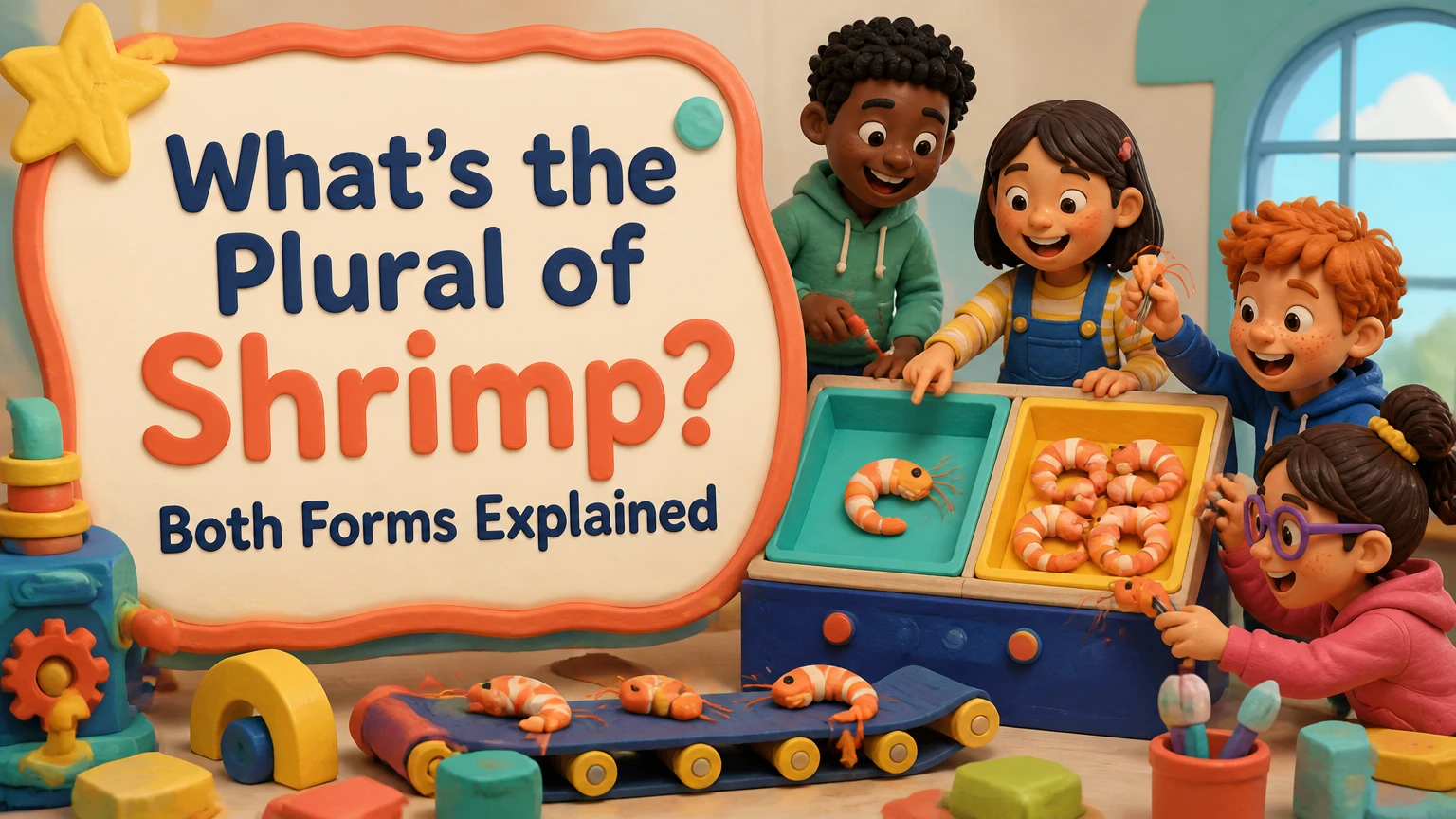
The plural of shrimp is shrimp or shrimps. Shrimp is the standard and far more common form for food, ordinary conversation, and counted animals, while shrimps is grammatical when writers emphasize separate specimens, different kinds, or multiple species.
Key Facts
Shrimp is the usual plural in modern everyday English.
Shrimps is also a valid plural, especially in biological or variety-focused writing.
“I saw five shrimp” is natural standard English.
“The aquarium contains several shrimps” can emphasize individual animals or kinds.
“Two pounds of shrimp” uses shrimp as a food or mass noun.
No dependable universal statistic proves that exactly 85%-90% of writers choose shrimp; percentages vary by corpus, region, and subject.
Which Plural of Shrimp Is Correct?
Both shrimp and shrimps are correct plurals, but shrimp is the unmarked default. Use shrimp when referring to multiple animals generally, seafood as food, or a quantity that does not focus on separate biological categories. Use shrimps when the sentence draws attention to individual creatures or distinct types.
| Sentence | Form | Meaning | Naturalness |
|---|---|---|---|
| We caught six shrimp. | shrimp | Six animals counted together | Standard |
| She ordered grilled shrimp. | shrimp | Seafood as food | Standard |
| The pond contains several shrimps. | shrimps | Separate aquarium animals | Acceptable |
| Researchers compared three shrimps. | shrimps | Three individual specimens | Formal or specialized |
| The Pacific contains many shrimp species. | shrimp | Species in a general category | Most precise |
The practical rule is simple: choose shrimp unless your sentence needs to stress separation, variety, or taxonomy. In many scientific sentences, however, shrimp species or individual shrimp communicates the meaning more precisely than shrimps.
Is Shrimp Singular or Plural?
Shrimp can be singular or plural. The singular meaning comes from a determiner or a singular verb, while the plural meaning comes from a number, plural determiner, or context.
| Number | Example | Grammatical signal |
|---|---|---|
| Singular | One shrimp is under the rock. | One plus singular verb |
| Singular | A shrimp crossed the sand. | A plus singular verb |
| Plural | Five shrimp are under the rock. | Five plus plural verb |
| Plural | Many shrimp crossed the sand. | Many plus plural verb |
| Unspecified | Shrimp is sold frozen. | Food or mass noun |
The noun’s spelling does not reveal its number by itself. The surrounding words do. This pattern is called a zero plural, an unchanged noun form whose singular and plural spellings are identical.
Why Does Shrimp Stay Unchanged?
Shrimp stays unchanged because English allows certain animal nouns to form plurals without adding a suffix. Linguists call this an invariant form or zero plural. The same pattern appears in “one fish, two fish,” “one sheep, two sheep,” and “one deer, two deer,” although each noun has its own usage history.
The two forms developed through different pressures in English. Animal names often retain an unchanged plural when speakers commonly discuss groups, catches, herds, or food. English also permits regular -s plurals when speakers want to mark separate items or categories.
The unchanged form does not mean that shrimps is an error. Dictionaries including Merriam-Webster and the Oxford English Dictionary record plural shrimps, while major learner and general dictionaries also list shrimp as the ordinary plural. Dictionary entries establish possibility, not equal frequency in every context.
Is Shrimp a Collective Noun?
Shrimp is not only a collective noun; it can be a count noun, a mass noun, or an invariant plural. The grammatical role depends on the sentence.
- Count noun: “I bought twelve shrimp.”
- Mass noun: “We served shrimp with rice.”
- General plural: “Shrimp live in coastal waters.”
- Collective reference: “The net was full of shrimp.”
A collective noun normally names a group as one unit, as in team or flock. Shrimp does not behave exactly like those nouns. In “ten shrimp,” the speaker counts individual animals, even though the noun remains unchanged.
When Should You Use Shrimp?
Use shrimp for ordinary counting, food, menus, recipes, shopping, journalism, and general descriptions of the animal group. The form sounds natural because it is the default choice in most conversational and commercial contexts.
| Context | Preferred wording | Why |
|---|---|---|
| Grocery list | Buy two pounds of shrimp. | Seafood is treated as food |
| Restaurant menu | Garlic shrimp, $18 | Established culinary usage |
| Recipe | Add 500 grams of peeled shrimp. | Quantity of ingredients |
| Fishing report | The boat landed 240 shrimp. | Ordinary counted catch |
| General biology | Shrimp live in oceans and rivers. | Broad animal category |
| News report | Officials found dead shrimp in the lagoon. | General plural reference |
Food writing almost always prefers shrimp. A menu that says “fried shrimps” may be understandable, but many readers will perceive it as nonstandard or translated English, particularly in North American commercial writing.
The same preference applies when a number identifies the animals: “three shrimp,” “twenty shrimp,” and “a dozen shrimp” are all standard. The number already carries the plural meaning, so adding -s is unnecessary.
How Do Quantity Phrases Work With Shrimp?
Quantity phrases determine whether shrimp refers to individual animals or an amount of food. Use a number directly before shrimp for animals, and use a measurement phrase when the ingredient or biomass matters more than the individual count.
| Quantity expression | Example | Interpretation |
|---|---|---|
| Exact number | 14 shrimp | Fourteen individual animals |
| Weight | 1.5 pounds of shrimp | Food quantity by mass |
| Container | A bowl of shrimp | An unspecified amount |
| Group word | A school of shrimp | A group, not an exact count |
| Approximation | Several shrimp | More than two, exact number unknown |
| Scientific sample | 20 individual shrimp | Explicit specimen count |
The word shrimp can therefore be countable and uncountable in different sentences. “I counted ten shrimp” is countable. “Shrimp contains protein” uses a food substance interpretation, although a more natural nutritional sentence may say “Shrimp is a source of protein.”
When Is Shrimps Appropriate?
Use shrimps when the writer wants to distinguish separate individuals, varieties, or species and that distinction matters to the sentence. The form is less common than shrimp, but it is documented and grammatical rather than universally wrong.
| Intended emphasis | Example with shrimps | More precise alternative |
|---|---|---|
| Individual animals | The tank held six shrimps. | Six individual shrimp |
| Variety | The exhibit displayed colorful shrimps. | Several shrimp varieties |
| Species | The region contains rare shrimps. | Rare shrimp species |
| Comparative biology | The study examined two shrimps. | Two individual shrimp |
| Literary description | Tiny shrimps moved through the water. | Tiny shrimp moved through the water |
Scientific writers should not use shrimps automatically. Taxonomic precision often improves when the sentence names the unit directly: species, specimens, populations, or individual shrimp. “The researchers identified four shrimp species” is clearer than “The researchers identified four shrimps,” because the first sentence explicitly states what was counted.
Is Shrimps More Scientific?
Shrimps is not inherently more scientific, and scientific style does not require it. Academic writers use both forms, with the choice depending on whether they mean a general group, individual specimens, or different kinds.
Compare these sentences:
- “Shrimp were collected from three estuaries.”
- “Each shrimp was measured before preservation.”
- “The researchers compared three shrimp species.”
- “The collection included shrimps with different feeding behaviors.”
The first sentence describes a general sample. The second identifies animals individually. The third counts species, not shrimp. The fourth uses shrimps to foreground distinct animals or forms, but it could be revised for greater precision.
A useful editorial rule is to name the biological unit rather than rely on the plural ending. Use individual shrimp for specimens and shrimp species for taxa. Reserve shrimps for prose where its contrastive or stylistic effect is genuinely useful.
What Is the Difference Between Shrimp and Shrimps?
The difference is mainly usage and emphasis, not basic grammatical validity. Shrimp is the default plural and works across nearly every context; shrimps is a marked regular plural that can signal separate animals or varieties.
| Criterion | Shrimp | Shrimps |
|---|---|---|
| Standard everyday plural | Yes | Less common |
| Food and recipes | Preferred | Usually awkward |
| Exact animal counts | Preferred | Acceptable |
| Multiple species | Often followed by species | Possible, but less precise |
| Academic specimen reference | Common | Also documented |
| Dictionary status | Valid plural | Valid plural |
| Risk of sounding unnatural | Low | Moderate outside specialist contexts |
No reliable global market-share figure can be assigned to the two forms without specifying a corpus. A search database, marine biology journal collection, restaurant menu archive, and British newspaper corpus would produce different results. Claims such as “shrimp accounts for exactly 85%-90% of usage” should therefore be treated as rough, unsourced estimates rather than established linguistic data.
Which Form Should Editors Choose?
Editors should choose shrimp as the house default and permit shrimps when the surrounding context clearly benefits from the regular plural. This approach preserves natural English without falsely labeling a recorded form as incorrect.
A style sheet can use the following rule:
Use shrimp for food, general plural reference, and ordinary counts. Use shrimps only when the prose deliberately distinguishes individual animals or kinds, and consider replacing it with individual shrimp or shrimp species when precision is available.
The rule works for most publishing environments. A marine biology journal may have its own terminology, while a restaurant, cookbook, school worksheet, or newspaper will normally prefer shrimp.
Are Shrimp and Prawns Interchangeable?
Shrimp and prawn are not exact synonyms worldwide, although everyday seafood usage often overlaps. North American English commonly uses shrimp for many edible decapod crustaceans, whereas British, Australian, and some other varieties of English more often distinguish or prefer prawn for larger species.
The biological boundary is not perfectly consistent in common language. “Shrimp” and “prawn” can refer to different taxonomic groups, but commercial names do not always match scientific classification. A product labeled king prawn in the United Kingdom may be marketed as jumbo shrimp in the United States.
| Situation | Common US wording | Common UK or Commonwealth wording |
|---|---|---|
| Restaurant dish | Shrimp cocktail | Prawn cocktail |
| Large seafood | Jumbo shrimp | King prawns |
| Small freshwater aquarium animal | Cherry shrimp | Cherry shrimp |
| General ingredient | Shrimp | Prawns or prawns |
| Scientific identification | Named species | Named species |
Use the term required by the audience, product label, regional style guide, or biological source. The plural question remains separate: shrimp can be plural in American English, while prawns is the regular plural of prawn.
What Mistakes Should Writers Avoid?
The most common mistakes involve confusing a valid but less common form with the default form, or using a plural ending where a more specific biological noun would be clearer.
- Writing “shrimps” on an ordinary menu
Replace “fried shrimps” with “fried shrimp” unless a regional house style intentionally uses the former. - Assuming “shrimps” is always wrong
Dictionaries record the form, and specialist prose can use it. Judge the sentence by meaning and audience. - Using “shrimps” to count species
Write “five shrimp species,” not “five shrimps,” when five biological species are meant. - Using a singular verb after a plural number
Write “Ten shrimp are in the net,” not “Ten shrimp is in the net.” - Treating shrimp as permanently singular
“A shrimp is small” is singular, but “Shrimp are crustaceans” is plural in a general biological statement. - Adding a plural ending to a mass phrase
Write “two pounds of shrimp,” not “two pounds of shrimps,” when referring to seafood as an ingredient.
The fastest editing test is to ask what the sentence counts. If it counts food, a general group, or ordinary animals, choose shrimp. If it counts separate kinds, use shrimp species. If it truly foregrounds individual animals, shrimps remains available.
How Does Verb Agreement Work?
Verb agreement follows the meaning supplied by the determiner and context, not the visible ending of shrimp. Singular phrases take singular verbs, and plural phrases take plural verbs.
- “One shrimp is missing.”
- “Several shrimp are missing.”
- “Shrimp are common in the estuary.”
- “Shrimp is on the menu.”
- “The shrimp was overcooked,” when the noun means one portion or dish.
- “The shrimp were released,” when the noun means several animals.
Food language creates occasional ambiguity. “The shrimp were served” normally refers to multiple animals or pieces. “The shrimp was served” can refer to one dish or portion. The verb helps the reader identify the intended sense.
Does the Plural Change for Baby Shrimp or Aquarium Shrimp?
Baby shrimp and aquarium shrimp normally keep the word shrimp unchanged in the plural. Write “ten baby shrimp,” “a colony of aquarium shrimp,” or “several freshwater shrimp,” unless the context intentionally emphasizes separate individuals.
| Phrase | Preferred form | Explanation |
|---|---|---|
| One baby shrimp | Singular | One animal |
| Ten baby shrimp | Plural | Unchanged plural |
| Several cherry shrimp | Plural | Aquarium variety |
| Two colonies of shrimp | Plural | Group category |
| Different shrimp species | Plural modifier | Species is the counted noun |
| Several shrimps in the display | Valid marked form | Individual emphasis |
In aquarium commerce, shrimp is overwhelmingly the normal plural in product descriptions and hobby discussion. Species names such as cherry shrimp, amanо shrimp, and ghost shrimp usually retain the unchanged form after a number or quantifier.
Can You Say Shrimpies?
Shrimpies is an informal nickname, not the standard plural of shrimp. Speakers may use it affectionately for small shrimp, aquarium animals, children’s characters, or online communities, but formal writing should use shrimp or shrimps according to context.
The suffix -ies does not follow the normal spelling pattern for this noun. English speakers sometimes create playful forms such as “doggies,” “birdies,” or “sweeties,” and shrimpies belongs to that informal word-formation pattern. It does not replace the established plural forms in scientific, culinary, educational, or professional prose.
What Does a Dictionary Say About Shrimp?
Major English dictionaries recognize shrimp as both a singular noun and an unchanged plural, while also recording shrimps as a plural form. Merriam-Webster defines a shrimp as a small, edible or commercially valuable decapod crustacean and lists the plural forms shrimp and shrimps.
Dictionary evidence answers the validity question, but corpus and context answer the style question. A form can be grammatically possible yet uncommon in a particular setting. For example, shrimps may appear in biological descriptions, while shrimp dominates restaurant menus and everyday speech.
The Associated Press Stylebook and many general editorial practices favor ordinary contemporary usage rather than forcing a suffix onto nouns that commonly use a zero plural. Specialized publications may make different choices, so the publication’s existing terminology should control when consistency matters.
FAQ
What Is the Plural of Shrimp in American English?
The usual American English plural is shrimp. Write “We caught three shrimp,” “The market sells fresh shrimp,” and “Several shrimp live in the tank.” Shrimps is also grammatically possible, but it is less common and normally requires a context involving individual animals, varieties, or species.
Is “Five Shrimps” Grammatically Wrong?
No. “Five shrimps” is grammatically acceptable, although “five shrimp” is more idiomatic for most speakers. Use five shrimp for an ordinary count. Use five shrimps only when the sentence deliberately emphasizes five separate animals or follows a specialized usage convention.
Should a Restaurant Menu Say Shrimp or Shrimps?
A restaurant menu should normally say shrimp. Standard examples include “shrimp scampi,” “fried shrimp,” “shrimp tacos,” and “grilled shrimp.” The unchanged plural matches established culinary English. A regional restaurant may use shrimps, but that choice can sound unusual to many North American readers.
What Is the Plural of a Shrimp Species?
The clearest wording is shrimp species, as in “The river contains four shrimp species.” If referring to animals belonging to several species, write “individual shrimp from four species.” Shrimps can convey the same idea in some scientific prose, but it is less precise than naming the counted unit.
Does Shrimp Have a Different Plural in British English?
British English also uses shrimp, but prawn is more common for many edible crustaceans, especially in commercial and culinary contexts. The choice depends on regional terminology and the animal being described. British usage does not make shrimps the required plural of shrimp.
Is “Shrimp” a Countable or Uncountable Noun?
Shrimp is both countable and uncountable. It is countable in “six shrimp” and uncountable when referring to food or material in “some shrimp.” The noun’s interpretation comes from words such as one, six, some, a pound of, and from whether the sentence discusses animals or an ingredient.
The Bottom Line
The plural of shrimp is shrimp or shrimps, but shrimp is the correct default for nearly all everyday uses. Choose shrimp for food, menus, recipes, general groups, and ordinary counts; choose shrimps only when separate individuals or varieties are the intended focus. When scientific precision matters, individual shrimp and shrimp species are usually clearer than either plural ending.