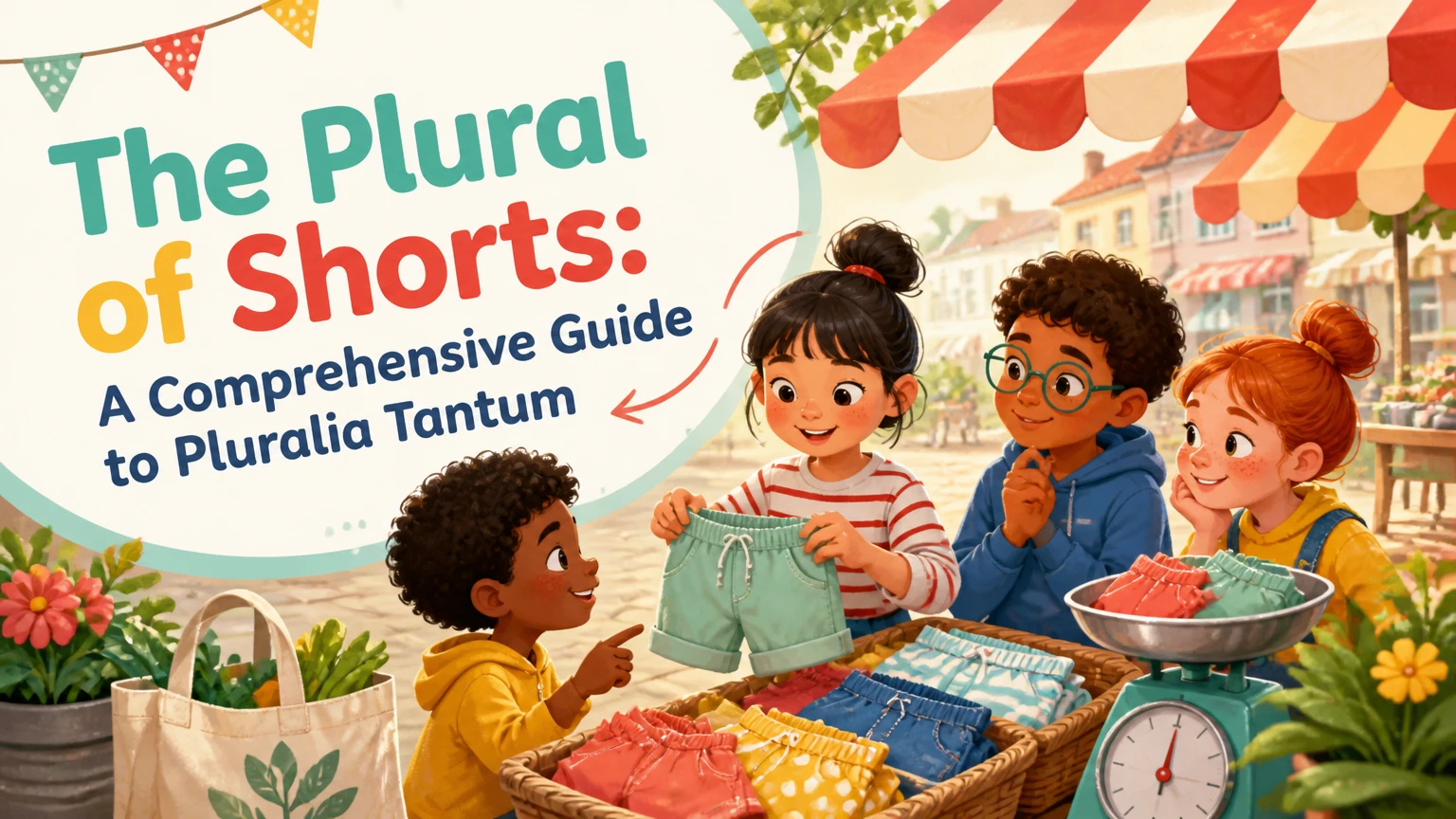
The English language frequently presents learners and native speakers alike with fascinating morphological puzzles, particularly when it comes to nouns that describe items of clothing worn on the lower half of the body. Understanding the plural of “shorts” requires an exploration of a specific linguistic category known as pluralia tantum, which refers to words that exist only in the plural form and lack a singular counterpart. This category includes common household and wearable items such as shorts, trousers, scissors, goggles, and binoculars. Because these words do not follow the standard singular-to-plural transformation, they require special attention regarding subject-verb agreement and numerical quantification. Mastering these nuances is essential for anyone looking to achieve high-level English proficiency, as it ensures grammatical accuracy in both casual conversation and formal writing contexts.
Table of Contents
- Definition and Linguistic Classification
- Structural Breakdown of Pluralia Tantum
- The Morphology of “Shorts”
- Categories of Similar Nouns
- Extensive Examples and Reference Tables
- Comprehensive Usage Rules
- Common Mistakes and Corrections
- Practice Exercises and Assessment
- Advanced Topics: Historical Context and Dialects
- Frequently Asked Questions (FAQ)
- Conclusion and Key Takeaways
Definition and Linguistic Classification
To answer the question “What is the plural of shorts?”, one must first understand that shorts is already a plural noun. In linguistic terms, it is classified as a plurale tantum (Latin for “plural only”). Unlike a regular noun like “cat,” which has a distinct singular form (“cat”) and a plural form (“cats”), “shorts” functions as a collective plural that refers to a single garment.
This classification occurs because the item is perceived as consisting of two identical parts—the two legs—joined together. Even though you are wearing one single piece of clothing, the English language treats it as a plural entity. Therefore, you would never say “a short” to refer to the garment, nor would you use a singular verb like “is” when the word “shorts” is the subject.
The function of these nouns is to describe objects that are intrinsically bipartite. This means their very structure is defined by a pair of elements. In the case of shorts, the two leg openings necessitate a plural construction. This logic extends to many other items in the English lexicon, particularly in the realms of tools and apparel.
Structural Breakdown of Pluralia Tantum
The structure of the word “shorts” is comprised of the root adjective “short” and the plural suffix “-s.” Historically, this term evolved from the phrase “short trousers.” Over time, the noun “trousers” was dropped, and the adjective “short” was nominalized (turned into a noun) while retaining the plural marker of the original head noun.
When analyzing the syntax of sentences containing “shorts,” the word always triggers plural concord. This means that any verbs, pronouns, or demonstratives associated with the word must also be in their plural forms. For instance, we use “these” instead of “this,” and “they” instead of “it.”
To quantify these nouns, English employs a “measure word” or “classifier.” Since we cannot say “one shorts” or “two shortses,” we use the phrase “a pair of.” This allows us to count the items while maintaining the grammatical plurality of the noun itself. “A pair of shorts” is the standard way to refer to one single unit of the garment.
The Morphology of “Shorts”
Morphology is the study of word formation, and “shorts” provides a perfect case study. The base morpheme is “short,” which denotes length. The addition of the “-s” inflectional morpheme transforms it from an adjective describing a quality into a noun describing an object. Unlike “apples,” where the “-s” signifies more than one apple, the “-s” in “shorts” signifies the bipartite nature of the object.
Interestingly, if we remove the “-s,” the word reverts to an adjective. “That is a short story” uses the singular adjective. “Those are short shorts” uses the adjective to describe the noun. This distinction is vital for learners to grasp: the “-s” is not optional; it is a permanent feature of the noun’s identity.
Categories of Similar Nouns
Understanding “shorts” becomes easier when you see it as part of a larger family of words. These can be grouped into several logical categories based on their physical characteristics or usage. Most of these items are tools or clothing that consist of two linked parts.
Clothing and Apparel
This is the most common category for pluralia tantum nouns. Almost every garment that covers the legs individually is plural. This includes items like jeans, leggings, pajamas, and trunks. Even though you put them on as one unit, the language recognizes the two-legged structure.
Tools and Instruments
Many mechanical tools that operate with a pivot or two blades are always plural. Examples include pliers, tweezers, shears, and tongs. You would never ask for a “tweezer” unless you were using the word as an adjective (e.g., “a tweezer grip”).
Optical and Sensory Devices
Items designed for the eyes often come in pairs because we have two eyes. Words like spectacles, goggles, shades, and bifocals follow this rule. Even modern technology like VR goggles maintains this plural structure.
Extensive Examples and Reference Tables
To solidify your understanding of how “shorts” and similar words function, it is helpful to look at them in various contexts. The following tables provide a comprehensive list of words that follow the same rules as “shorts,” along with their proper quantification and usage patterns.
The table below lists common clothing items that are always plural. Note how the “Pair of” construction is used to make them singular in count but plural in grammar.
| Noun (Plurale Tantum) | Singular Reference | Plural Reference | Example Sentence |
|---|---|---|---|
| Shorts | A pair of shorts | Three pairs of shorts | These shorts are too tight. |
| Jeans | A pair of jeans | Many pairs of jeans | My blue jeans are in the wash. |
| Trousers | A pair of trousers | Several pairs of trousers | His trousers were tailored perfectly. |
| Pajamas | A pair of pajamas | Two pairs of pajamas | Those pajamas look very comfortable. |
| Leggings | A pair of leggings | New pairs of leggings | The leggings are made of spandex. |
| Briefs | A pair of briefs | Clean pairs of briefs | Where are my clean briefs? |
| Knickers | A pair of knickers | Old pairs of knickers | She bought some silk knickers. |
| Overalls | A pair of overalls | Sturdy pairs of overalls | His overalls are covered in paint. |
| Panties | A pair of panties | Cotton pairs of panties | These panties are on sale. |
| Slacks | A pair of slacks | Formal pairs of slacks | The slacks need to be ironed. |
| Tights | A pair of tights | Black pairs of tights | Her tights have a ladder in them. |
| Trunks | A pair of trunks | Swimming trunks | His swimming trunks are drying outside. |
| Culottes | A pair of culottes | Fashionable culottes | These culottes look like a skirt. |
| Jodhpurs | A pair of jodhpurs | Riding jodhpurs | The jodhpurs are essential for riding. |
| Chaps | A pair of chaps | Leather chaps | The cowboy wore leather chaps. |
| Boxers | A pair of boxers | Silk boxers | He prefers boxers to briefs. |
| Denims | A pair of denims | Distressed denims | Her denims are very trendy. |
| Corduroys | A pair of corduroys | Brown corduroys | These corduroys make a swishing sound. |
| Sweatpants | A pair of sweatpants | Baggy sweatpants | I love wearing sweatpants at home. |
| Bloomers | A pair of bloomers | Vintage bloomers | The bloomers were worn in the 19th century. |
The following table focuses on tools and household items that share the same grammatical properties as “shorts.” These items are almost always used with plural verbs.
| Tool/Item | Quantification | Verb Agreement | Example Sentence |
|---|---|---|---|
| Scissors | A pair of scissors | Are | The scissors are on the table. |
| Pliers | A pair of pliers | Were | These pliers were in the toolbox. |
| Tweezers | A pair of tweezers | Do | Where do the tweezers go? |
| Tongs | A pair of tongs | Have | The tongs have a rubber grip. |
| Shears | A pair of shears | Need | The garden shears need sharpening. |
| Forceps | A pair of forceps | Are | The forceps are sterilized. |
| Bellows | A pair of bellows | Work | The bellows work well to start the fire. |
| Clippers | A pair of clippers | Are | The nail clippers are missing. |
| Goggles | A pair of goggles | Protect | Safety goggles protect your eyes. |
| Binoculars | A pair of binoculars | Help | These binoculars help me see birds. |
| Spectacles | A pair of spectacles | Sit | His spectacles sit on his nose. |
| Sunglasses | A pair of sunglasses | Are | My sunglasses are polarized. |
| Scales | A pair of scales | Show | The kitchen scales show grams. |
| Compasses | A pair of compasses | Draw | These compasses draw perfect circles. |
| Nippers | A pair of nippers | Cut | Wire nippers cut through copper. |
| Dividers | A pair of dividers | Measure | The dividers measure the distance. |
| Nutcrackers | A pair of nutcrackers | Crack | The nutcrackers crack the shells. |
| Snips | A pair of snips | Are | Tin snips are very sharp. |
| Handcuffs | A pair of handcuffs | Lock | The handcuffs lock securely. |
| Shackles | A pair of shackles | Hold | The shackles hold the heavy gate. |
In addition to clothing and tools, there are abstract or collective nouns that function as pluralia tantum. These do not usually use “a pair of” but still require plural verbs.
| Noun | Category | Verb Context | Example Sentence |
|---|---|---|---|
| Riches | Abstract/Wealth | Riches are… | Riches are often fleeting. |
| Earnings | Finance | Earnings have… | His earnings have increased this year. |
| Belongings | Possessions | Belongings were… | Their belongings were packed in boxes. |
| Surroundings | Environment | Surroundings are… | The surroundings are beautiful here. |
| Annals | History | Annals show… | The annals of history show many wars. |
| Credentials | Identity | Credentials are… | Your credentials are impressive. |
| Remains | Physical State | Remains were… | The remains were found in the cave. |
| Proceeds | Finance | Proceeds go… | The proceeds go to charity. |
| Goods | Commerce | Goods are… | The goods are shipped daily. |
| Dregs | Physical State | Dregs stay… | The dregs stay at the bottom. |
| Outskirts | Geography | Outskirts are… | The outskirts are less crowded. |
| Odds | Probability | Odds favor… | The odds favor the home team. |
| Pains | Effort | Pains were… | Great pains were taken to ensure safety. |
| Thanks | Social | Thanks go… | Our thanks go to the volunteers. |
| Vitals | Medical | Vitals are… | The patient’s vitals are stable. |
| Winnings | Finance | Winnings were… | The winnings were split equally. |
| Shivers | Physical State | Shivers run… | The shivers run down my spine. |
| Alms | Social | Alms were… | Alms were given to the poor. |
| Customs | Government | Customs check… | Customs check all international mail. |
| Troops | Military | Troops move… | The troops move at dawn. |
Comprehensive Usage Rules
Using “shorts” and its linguistic cousins correctly involves more than just knowing they end in “-s.” There are specific rules regarding agreement, quantification, and pronoun usage that must be followed to maintain grammatical integrity.
1. Subject-Verb Agreement
The most important rule is that “shorts” always takes a plural verb. This remains true even if you are only talking about one physical item. For example, “The shorts are blue” is correct, while “The shorts is blue” is incorrect. This can be counter-intuitive for learners whose native languages treat these items as singular.
2. The “Pair of” Exception
When you use the phrase “a pair of shorts,” the grammatical subject changes from “shorts” (plural) to “pair” (singular). Consequently, the verb must agree with “pair.” For example: “A pair of shorts is lying on the floor.” However, if you say “Two pairs of shorts are lying on the floor,” the verb becomes plural again because “pairs” is plural.
3. Demonstrative Adjectives
Because “shorts” is plural, you must use plural demonstrative adjectives. You should say “these shorts” or “those shorts.” Using “this” or “that” with “shorts” is a common grammatical error. Even if you are holding one pair in your hand, you must refer to them as “these.”
4. Pronoun Replacement
When replacing “shorts” with a pronoun, always use “they,” “them,” or “their.” For example: “I like those shorts. I think I will buy them.” Using “it” to refer to shorts is incorrect. If you want to use “it,” you must refer to the pair: “I like that pair of shorts. I think I will buy it.”
Common Mistakes and Corrections
Even advanced learners occasionally stumble over pluralia tantum. The most frequent errors involve treating the word as a standard singular noun or forgetting the plural verb agreement. Below is a table highlighting common mistakes and how to fix them.
| Incorrect Sentence | Correct Sentence | Explanation |
|---|---|---|
| Where is my shorts? | Where are my shorts? | “Shorts” requires a plural verb. |
| I bought a new short yesterday. | I bought a new pair of shorts yesterday. | “Short” is an adjective; use “pair of” for the noun. |
| This shorts is too big. | These shorts are too big. | Use plural demonstratives and verbs. |
| I washed it (the shorts). | I washed them. | Use plural pronouns for pluralia tantum. |
| How much is that shorts? | How much are those shorts? | Price inquiries must use plural forms. |
| Give me a scissors. | Give me a pair of scissors. | “Scissors” cannot be preceded by “a” alone. |
| My trouser is torn. | My trousers are torn. | “Trouser” is only used as an adjective. |
| He has one shorts. | He has one pair of shorts. | Use “pair” to specify a single unit. |
Practice Exercises and Assessment
To master the usage of “shorts” and other pluralia tantum nouns, try the following exercises. These are designed to test your understanding of verb agreement, demonstratives, and quantification.
Exercise 1: Fill in the Blanks (Verb Agreement)
Choose the correct verb form (is/are, was/were, has/have) for each sentence.
- These cargo shorts ________ (be) perfect for hiking.
- A pair of shorts ________ (be) all I need for the beach.
- Where ________ (be) the scissors I left on the counter?
- My pajamas ________ (have) been in the dryer for an hour.
- The binoculars ________ (be) helpful during the safari.
- That pair of jeans ________ (look) great on you.
- These tweezers ________ (be) not sharp enough.
- The tongs ________ (be) used for the barbecue.
- Her leggings ________ (be) made of recycled plastic.
- The surroundings ________ (be) very peaceful.
Exercise 2: Sentence Correction
Each of the following sentences contains one error. Identify and correct it.
- I need to buy a new trouser for the interview.
- That shorts is very colorful.
- He lost his sunglass at the park.
- These pair of pliers are broken.
- Where is the shears for the garden?
- I found it (the pajamas) under the bed.
- The teacher asked for a scissors.
- Those jeans belongs to my brother.
- I have three shortses in my suitcase.
- The police is looking for his belongings.
Answer Key
| Exercise 1 Answers | Exercise 2 Corrections |
|---|---|
| 1. are | 1. a new pair of trousers |
| 2. is | 2. Those shorts are |
| 3. are | 3. sunglasses |
| 4. have | 4. This pair of pliers is |
| 5. were | 5. Where are the shears |
| 6. looks | 6. I found them |
| 7. are | 7. a pair of scissors |
| 8. were | 8. Those jeans belong |
| 9. are | 9. three pairs of shorts |
| 10. are | 10. belongings are |
Advanced Topics: Historical Context and Dialects
The way we use the word “shorts” today is the result of centuries of linguistic evolution. In Old English, many items of clothing were described by their components. The transition from “short trousers” to “shorts” is a process called elliptical shortening. This happens when a modifier (short) becomes so closely associated with a noun (trousers) that the noun is eventually dropped, and the modifier takes on the noun’s grammatical properties.
Regional Variations
While “shorts” is universally understood, other pluralia tantum words vary by dialect. In British English, “trousers” is the standard, whereas American English prefers “pants.” Interestingly, in some parts of the UK, “pants” refers to underwear (another plural noun!). In Australian English, you might hear “boardies” (board shorts) or “stubbies” (a specific brand of short shorts), both of which retain the plural form.
The “Trouser” Exception in Fashion
In the fashion industry and tailoring, you might occasionally hear the singular form “trouser” used as an attributive noun. For example, a designer might talk about a “trouser leg” or a “trouser suit.” In these cases, the word is acting as an adjective to describe another noun. However, as soon as the word stands alone to describe the garment, it must return to its plural state: “The trousers are finished.”
Collective Plurals vs. Pluralia Tantum
It is important to distinguish pluralia tantum from collective nouns like “team” or “family.” A collective noun is singular in form but can take a plural verb (especially in British English). Pluralia tantum words like “shorts” are the opposite: they are plural in form and virtually always plural in function, regardless of whether they represent one or many objects.
Frequently Asked Questions (FAQ)
Q: Can I ever say “one short”?
A: Only if you are using “short” as an adjective or a different type of noun. For example, “I am one short of a full set” (meaning you are missing an item) or “That was a short movie.” You cannot use “one short” to refer to a single pair of shorts.
Q: Why do we say “a pair of shorts” when it’s only one item?
A: This is a historical carryover from when garments were often made of two separate pieces (one for each leg) that were tied together at the waist. Although modern shorts are one piece of fabric, the linguistic structure reflecting the two legs remains.
Q: Is “shortses” a word?
A: No, “shortses” is not a standard English word. To refer to multiple items, you should say “shorts” (e.g., “I have many shorts”) or “pairs of shorts.”
Q: What about “glasses”? Is that the same?
A: Yes, “glasses” (eyewear) is a plurale tantum. However, “glass” (the material) or “a glass” (the container) are different words with different rules. If you mean the thing you wear to see better, it is always plural.
Q: Can I say “My shorts is dirty”?
A: In casual, non-standard speech, people sometimes do this, but it is grammatically incorrect. In any formal or educational setting, you must say “My shorts are dirty.”
Q: How do I make “shorts” possessive?
A: Since “shorts” ends in “s,” you add an apostrophe after the “s.” For example: “The shorts’ pockets are very deep.”
Q: Are “leggings” and “tights” the same as “shorts”?
A: Grammatically, yes. They are all pluralia tantum clothing items that require plural verbs and can be quantified with “a pair of.”
Q: Why is “shirt” singular but “shorts” is plural?
A: A shirt is perceived as a single trunk covering with attached sleeves, whereas leg-wear is historically perceived as two separate “hose” or “legs” joined together. This is a quirk of how the English-speaking mind categorized these items centuries ago.
Conclusion and Key Takeaways
Mastering the plural of “shorts” is a significant milestone in understanding English noun morphology. The key takeaway is that “shorts” is a plurale tantum noun, meaning it is inherently plural and has no singular form. Whether you are talking about one pair or twenty, the word remains “shorts” and generally requires plural verbs, plural pronouns (them/they), and plural demonstratives (these/those). To refer to a single unit, always use the classifier “a pair of.” By keeping these rules in mind—especially the shift to a singular verb when using “a pair of”—you will avoid the most common pitfalls associated with these bipartite nouns. Continue practicing with similar words like scissors, jeans, and binoculars to build your grammatical intuition and ensure your English remains both natural and accurate.