
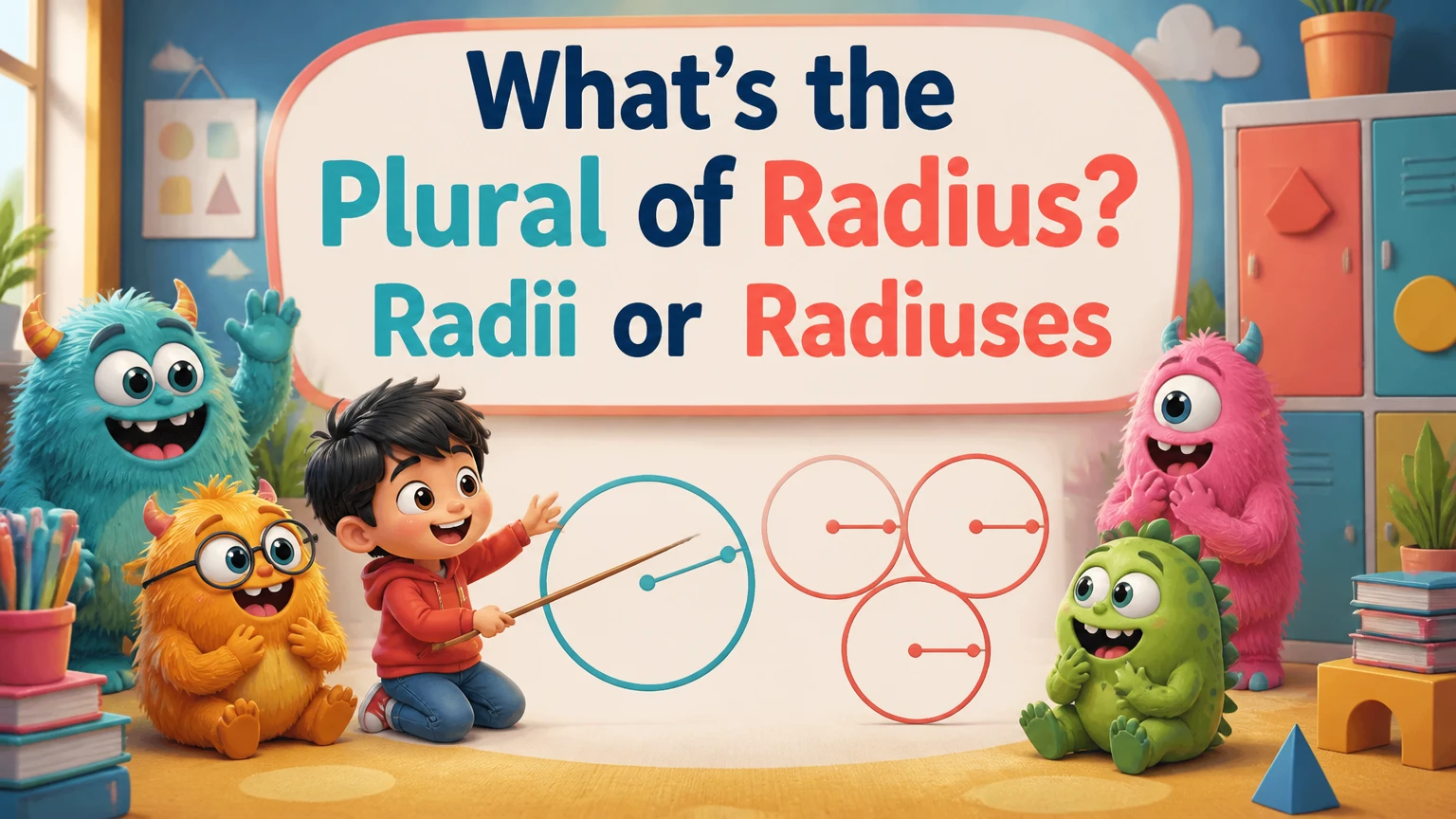
The plural of radius is radii or radiuses. Radii is the traditional Latin plural and the preferred form in mathematics, science, engineering, and anatomy, while radiuses is an accepted English plural that fits general, conversational, and public-facing writing.
Key Facts at a Glance
- Radius is singular; radii and radiuses are plural.
- Radii is pronounced most commonly as RAY-dee-eye.
- Radiuses is pronounced RAY-dee-us-iz.
- Mathematics and anatomy generally prefer radii.
- General English can use radiuses, especially when clarity and natural speech matter more than classical form.
- Radius’s is a singular possessive, not a plural.
What Is the Correct Plural of Radius?
The correct plural of radius is radii in formal and technical contexts, although radiuses is also grammatically acceptable in modern English. Writers describing circles, spheres, physical measurements, or the forearm bone will usually choose radii, because that form is established in mathematical, scientific, and medical terminology.
Examples include:
- “The two circles have different radii.”
- “The radiologist compared the radii of the vessels.”
- “The map displays several search radiuses.”
- “The application supports custom border radii.”
The choice is therefore grammatical and stylistic, not a simple right-versus-wrong test. The American Heritage Dictionary, Merriam-Webster, and the Oxford English Dictionary record the historical plural radii; major English dictionaries also recognize radiuses as an English plural.
A useful editing rule is simple: use radii when the subject is specialized, measured, or academic, and use radiuses when the sentence is aimed at a broad audience and the Anglicized form sounds more natural.
Why Is the Plural of Radius R a d i i?
The plural radii comes from Latin, where radius belongs to a noun pattern that changes the ending -us to -i in the plural. English borrowed the classical plural along with the Latin-derived noun, so radii remains common in technical vocabulary.
The spelling contains two consecutive i letters:
- Singular: rad-i-us
- Plural: rad-i-i
- Written plural: radii
The double i is not a typing mistake. The first i belongs to the stem radi-, and the second i represents the Latin plural ending. The same historical pattern appears in words such as fungus, which may take fungi, and stimulus, which may take stimuli, although English does not apply the pattern consistently to every word ending in -us.
English also creates regular plurals by adding -es. That productive English pattern gives radiuses, which avoids requiring readers to know or recognize a Latin inflection. Both forms can therefore exist at the same time.
Do All Words Ending in -Us Form Plurals in -I?
No. English words ending in -us have different plural patterns, and etymology alone cannot predict the preferred modern form. For example, bus usually becomes buses, while cactus can be cacti, cactuses, or, in some style contexts, either depending on meaning and audience.
| Singular noun | Traditional or borrowed plural | Regular English plural | Common modern preference |
|---|---|---|---|
| radius | radii | radiuses | radii in technical writing |
| cactus | cacti | cactuses | both forms |
| fungus | fungi | funguses | fungi in biology |
| stimulus | stimuli | stimuluses | stimuli in academic writing |
| bus | uncommon: bi | buses | buses |
| octopus | uncommon: octopodes | octopuses | octopuses |
The practical rule is to verify the individual noun rather than memorize a universal -us to -i formula. Radii is conventional because mathematics and science preserved the Latin form, not because every English noun with the same ending must behave identically.
How Do You Pronounce Radii?
Radii is most commonly pronounced RAY-dee-eye, with three syllables. The final sound resembles the word eye, not the ending of radius.
| Written form | Common pronunciation | Syllables | Example |
|---|---|---|---|
| radius | RAY-dee-us | 3 | “The radius is 4 cm.” |
| radii | RAY-dee-eye | 3 | “The radii are 4 cm and 7 cm.” |
| radiuses | RAY-dee-us-iz | 4 | “The service covers several radiuses.” |
| radius’s | RAY-dee-us-iz | 4 | “The radius’s endpoint is marked.” |
Some speakers pronounce radii more like RAY-dee-ee, particularly when reading the spelling aloud. In mathematics classrooms and technical presentations, RAY-dee-eye is the clearest widely recognized pronunciation.
Do not pronounce radii as RAY-dee-us. That pronunciation is the singular form, so it can create confusion when a sentence requires a plural verb or plural measurement.
What Does Radius Mean in Mathematics?
In mathematics, a radius is a line segment or distance from the center of a circle or sphere to its boundary. More than one such measurement gives radii, as in “the circles have equal radii.”
For a circle, the radius is half the diameter:
[ r = \frac{d}{2} ]
The radius also appears in these standard formulas:
| Geometric quantity | Formula using radius (r) | Example when (r = 5) cm |
|---|---|---|
| Diameter | (d = 2r) | 10 cm |
| Circumference | (C = 2\pi r) | approximately 31.42 cm |
| Circle area | (A = \pi r^2) | approximately 78.54 cm² |
| Sphere surface area | (A = 4\pi r^2) | approximately 314.16 cm² |
| Sphere volume | (V = \frac{4}{3}\pi r^3) | approximately 523.60 cm³ |
A circle with one center has infinitely many radii in geometry, because every segment from the center to the circumference has the same length in an exact circle. In practical measurement, radii usually refers to multiple circles, multiple measured values, or multiple line segments shown in a diagram.
Radius, Diameter, and Circumference
Radius, diameter, and circumference describe different properties of a circle. The radius runs from the center to the edge, the diameter crosses the entire circle through the center, and the circumference is the distance around the edge.
| Term | Meaning | Relationship when (r = 8) cm | Correct plural |
|---|---|---|---|
| radius | Center to circumference | 8 cm | radii or radiuses |
| diameter | Edge to edge through center | 16 cm | diameters |
| circumference | Distance around circle | approximately 50.27 cm | circumferences |
| chord | Segment joining two boundary points | Varies by position | chords |
A frequent mistake is to write “the circle has two radiuses” when the intended meaning is “the circle has a diameter.” A circle can have many radii, but a specified diameter is twice the radius and passes through the center.
When Should You Use Radii Instead of Radiuses?
Use radii for mathematics, physics, engineering, anatomy, academic papers, laboratory records, and technical documentation. Use radiuses when writing general-audience copy, informal explanations, dialogue, or interface text where the regular English plural is easier to read.
| Context | Recommended form | Example sentence | Reason |
|---|---|---|---|
| Geometry textbook | radii | “The triangle has circumcircles with equal radii.” | Established mathematical usage |
| Physics report | radii | “The particles followed paths with different radii.” | Technical convention |
| Medical record | radii | “Fractures affected both radii.” | Anatomical terminology |
| Engineering drawing | radii | “Apply 2 mm radii to the four corners.” | Dimensioning convention |
| Delivery website | radiuses | “Compare delivery radiuses in your area.” | Natural public-facing English |
| Casual conversation | radiuses | “The search tool uses three radiuses.” | Conversational accessibility |
| Source code | radii or project-specific identifier | borderRadii = [4, 8, 12] |
Naming depends on API and team style |
| Legal or policy document | radii | “The restricted zones have defined radii.” | Formal precision |
The distinction is a register choice. Radiuses is not automatically an error, and radii is not automatically better. A sentence for professional mathematicians should follow their established terminology; a sentence for customers should prioritize immediate comprehension.
Is Radiuses Grammatically Wrong?
Radiuses is not grammatically wrong in modern English. Some traditional editors prefer radii because it preserves the Latin plural, but dictionaries and actual English usage support radiuses as a regular plural, particularly outside specialist fields.
The form can sound awkward in a mathematical paper because readers expect radii there. That reaction reflects disciplinary convention rather than a universal grammatical prohibition. In a sentence such as “The app offers five search radiuses,” the regular plural may be entirely appropriate because users are choosing geographic coverage areas rather than studying geometry.
A practitioner rule helps: do not replace radiuses with radii merely to appear formal. Replace it when the publication’s style guide, technical audience, or field convention specifically calls for the classical form.
Is Radii Singular or Plural?
Radii is plural. The singular form is radius, so the verb and demonstrative must agree with the number of objects or measurements described.
Correct examples:
- “The radius is 12 millimeters.”
- “The radii are 12 and 18 millimeters.”
- “This circle has a radius of 6 centimeters.”
- “These circles have radii of 6 and 9 centimeters.”
| Incorrect sentence | Correct sentence | Reason |
|---|---|---|
| “The radii is equal.” | “The radii are equal.” | Plural subject takes are |
| “The radius are 5 and 9 cm.” | “The radii are 5 and 9 cm.” | Multiple values require plural |
| “Each radii measures 5 cm.” | “Each radius measures 5 cm.” | Each takes a singular noun |
| “The two radius are different.” | “The two radii are different.” | Two measurements require plural |
The word radii can refer to several line segments, several circles’ measurements, or both forearm bones. Context determines the precise meaning, but grammatical number does not change.
What Is the Plural of Radius in Anatomy?
In anatomy, the plural of the radius, the forearm bone, is usually radii. The radius is the shorter, broader bone on the thumb side of the forearm when the palm faces forward; the other forearm bone is the ulna.
Medical examples include:
- “The patient sustained fractures of both radii.”
- “The left radius is shorter than the right.”
- “Radiographs showed healing in the distal radii.”
- “The surgeon examined the radial head of each radius.”
Medical writing strongly favors radii because anatomical terminology traditionally retains many Latin plurals. A general-audience health article may explain the term as “the radius bones” for clarity, but radiuses is less conventional in clinical prose.
The anatomical meaning should not be confused with the geometric meaning. Both senses share the same historical noun because the Latin word referred to a rod, spoke, or ray-like structure. The forearm bone received the name because of its elongated form.
How Do You Form the Possessive of Radius?
The singular possessive is radius’s, while the plural possessive can be radii’s or radiuses’, depending on which plural form is being used. The apostrophe indicates possession or association; it does not create an ordinary plural.
| Meaning | Correct form | Example |
|---|---|---|
| One radius owns or has something | radius’s | “The radius’s length is 7 cm.” |
| Several radii own or have something | radii’s | “The radii’s average length is 9 cm.” |
| Several radiuses own or have something | radiuses’ | “The radiuses’ values appear in the report.” |
| More than one radius | radii or radiuses | “The circles have equal radii.” |
Many style guides permit radius’ instead of radius’s, especially in formal publishing, but radius’s is the clearest general form because it reflects the usual pronunciation and the standard possessive rule for singular nouns.
Never write radiis as the plural. Never write radius’s when you simply mean more than one radius.
How Do Technical Writers Handle Radii?
Technical writers usually use radii for the geometric or engineering concept and reserve radiuses for explanatory copy aimed at non-specialists. The strongest choice depends on whether the reader is interpreting a measurement or selecting an option.
For software documentation, terminology may split across layers:
- API reference:
cornerRadii,radii, or the exact identifier defined by the library. - Design specification: “Use 8 px corner radii.”
- Consumer interface: “Choose a search radius.”
- Marketing copy: “Expand your search to larger radiuses.”
- Developer comment: “The renderer accepts four corner radii.”
CSS provides a useful example. The property border-radius is singular as a property name, even when it assigns multiple corner values. Writers should not alter official syntax to match ordinary English grammar. A developer might write “CSS supports different border radii,” while the code remains border-radius: 8px.
The same principle applies to geographic applications. A technical GIS manual may say “buffer radii,” whereas a map interface may say “search areas” instead of either plural. Replacing a potentially unfamiliar word with a precise plain-English alternative can improve usability.
What Are the Most Common Radius Plural Errors?
The most common errors are radiis, singular-plural agreement mistakes, incorrect apostrophes, and confusion between radius and diameter. Each error has a specific correction rather than a general rule about Latin words.
- Radiis
Incorrect: “The radiis are measured.”
Correct: “The radii are measured.”
The plural ends in one i after the stem’s existing i, producing radii, not radiis. - Radius’s as a plural
Incorrect: “The shape has three radius’s.”
Correct: “The shape has three radii.”
The apostrophe belongs to a possessive construction. - Radius with a plural verb
Incorrect: “The radius are unequal.”
Correct: “The radii are unequal.”
The noun must match the number of measurements. - Radii with a singular determiner
Incorrect: “This radii measures 4 cm.”
Correct: “This radius measures 4 cm.”
“This,” “each,” and “one” require the singular form. - Two radii mistaken for a diameter
Incorrect: “The diameter is one radius from edge to edge.”
Correct: “The diameter is twice the radius.”
Two collinear radii can form a diameter, but one radius cannot. - Assuming radiuses is never valid
Incorrect advice: “Radiuses is always wrong.”
Better advice: “Use radii in technical contexts and radiuses when general English or house style favors it.”
Which Form Should You Choose?
Choose radii when the sentence belongs to mathematics, physics, engineering, medicine, academia, or a technical standard. Choose radiuses when the sentence belongs to ordinary conversation, consumer content, informal explanation, or user-facing language and no field convention requires radii.
| Writer or reader | Best default | Example | Editing priority |
|---|---|---|---|
| High-school mathematics student | radii | “Find the radii of the two circles.” | Match textbook convention |
| University physics researcher | radii | “Particle orbits have varying radii.” | Preserve disciplinary terminology |
| Physician or anatomist | radii | “Both radii show normal alignment.” | Follow clinical usage |
| UX copywriter | radiuses or search areas | “Set delivery radiuses.” | Optimize immediate comprehension |
| Novelist writing dialogue | radiuses | “The patrol checks three radiuses.” | Match natural character speech |
| General business writer | radiuses or service areas | “We operate within two service areas.” | Prefer clarity over Latin form |
The safest academic choice is radii. The safest broad-audience choice is often radiuses or a plain-English substitute such as service areas, coverage distances, or search zones.
FAQ
Is “radii” the only correct plural of radius?
No. Radii is the traditional and preferred plural in technical English, but radiuses is also accepted in modern general English. A geometry textbook, medical report, or engineering specification should normally use radii. A consumer-facing sentence can use radiuses without being grammatically defective.
What is the plural of radius in a geometry problem?
The plural is usually radii. For example, “The two circles have radii of 4 cm and 9 cm.” Geometry instruction, mathematical notation, and academic solutions use the classical form because it is the established term in the discipline.
Can I use “radiuses” in formal writing?
You can, but the audience and field determine whether it is a wise choice. General formal writing may accept radiuses, while formal mathematics, physics, engineering, and anatomy generally expect radii. Follow the publication’s style guide when one exists.
Is the pronunciation “ray-dee-eye” or “ray-dee-ee”?
RAY-dee-eye is the most widely recognized pronunciation of radii. Some speakers use a final sound closer to -ee, especially when reading Latin-derived words aloud, but the three-syllable pronunciation ending like “eye” is clear in technical speech.
What is the plural of the forearm bone called the radius?
The anatomical plural is radii. A medical sentence might say, “The patient fractured both radii.” In plain-language health communication, “radius bones” may be clearer for readers who do not know anatomical Latin plurals.
Is “radius’s” a plural form?
No. Radius’s is normally the singular possessive, as in “the radius’s length.” The ordinary plural is radii or radiuses. For a plural possessive, use radii’s or radiuses’, although rewriting the sentence can often make the meaning easier to read.
The Bottom Line
The plural of radius is radii or radiuses. Use radii for mathematics, science, engineering, anatomy, and other technical subjects; use radiuses for general English when the regular plural sounds more accessible. Remember that radii is pronounced RAY-dee-eye, and radius’s is a possessive, not a plural.


