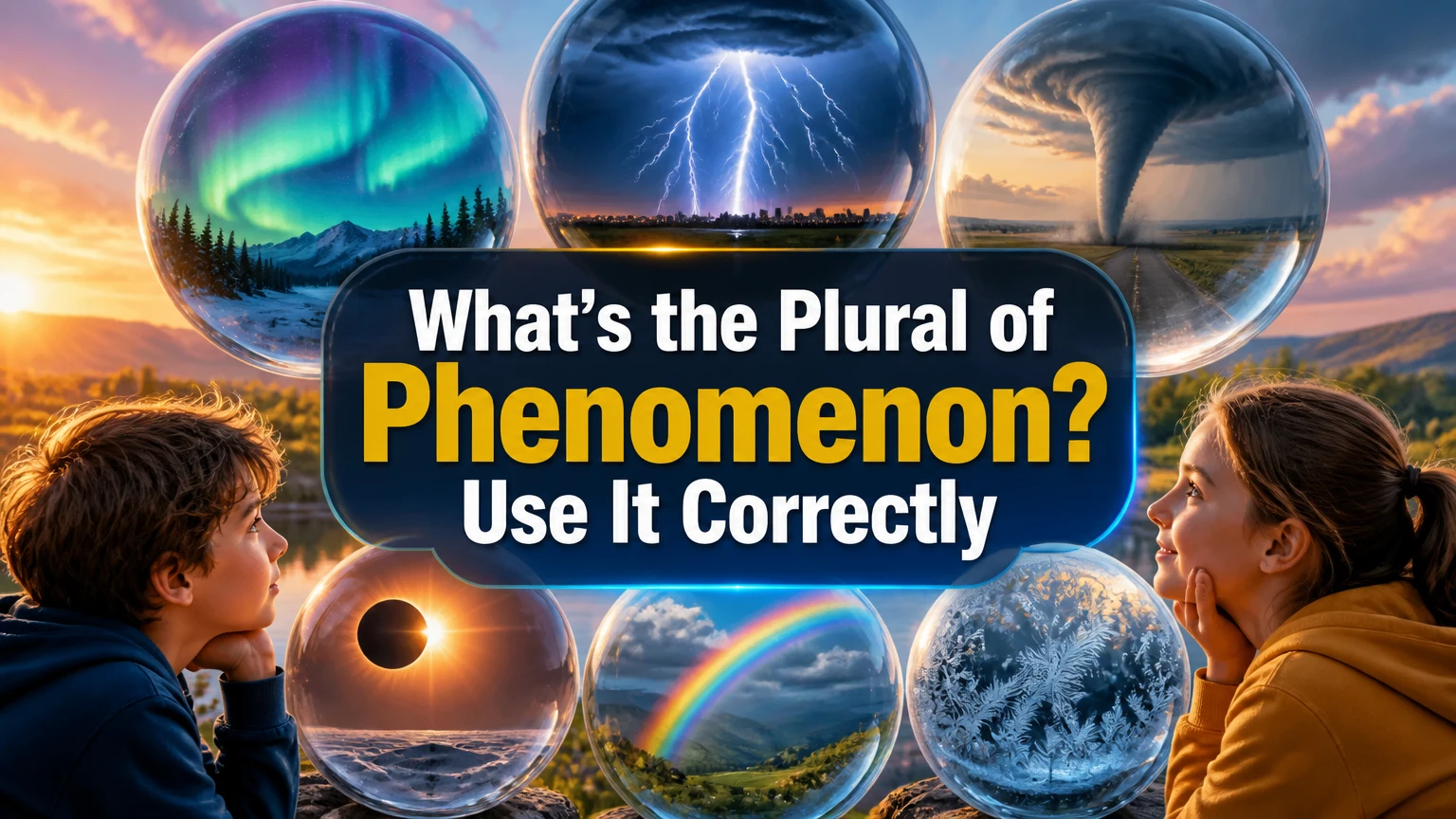
The plural of phenomenon is phenomena. Use phenomenon for one observable event, fact, or exceptional person, and use phenomena for two or more. The plural noun normally takes a plural verb, as in “These phenomena are difficult to explain.” Phenomenons is also recorded, but it is uncommon and usually less suitable for formal writing.
Key Facts at a Glance
- Phenomenon is singular: “A rare phenomenon occurred.”
- Phenomena is the standard plural: “Several phenomena occurred.”
- Phenomena takes plural verbs such as are, were, and have.
- Phenomenons is an established but uncommon anglicized plural, not automatically a grammatical error.
- The word comes from Ancient Greek phainomenon, meaning “that which appears.”
- The safest choice in academic, scientific, and professional writing is phenomenon for one and phenomena for more than one.
What Is the Plural of Phenomenon?
The correct standard plural of phenomenon is phenomena. The form changes the Greek ending -on to -a, following the historical plural pattern of certain Greek neuter nouns borrowed into English.
Examples include:
- “A solar eclipse is a natural phenomenon.”
- “Solar eclipses are natural phenomena.”
- “The researchers recorded three unusual phenomena.”
- “Social media has created a new cultural phenomenon.”
- “Several cultural phenomena emerged during the decade.”
The answer applies whether phenomenon means a physical occurrence, an observable fact, a social trend, or an unusually talented person. Number determines the form: one is a phenomenon; more than one are phenomena.
The plural phenomena remains common because English has preserved several classical plurals in academic and technical vocabulary. Comparable pairs include criterion/criteria, datum/data, and bacterium/bacteria, although each pair has developed its own modern usage patterns.
Is Phenomena Singular or Plural?
Phenomena is grammatically plural in its standard use. A singular subject requires phenomenon, while a plural subject requires phenomena: “The phenomenon is unexplained” versus “The phenomena are unexplained.”
| Meaning | Correct noun | Correct verb | Example |
|---|---|---|---|
| One observable event | phenomenon | is | “The phenomenon is rare.” |
| Several observable events | phenomena | are | “The phenomena are rare.” |
| One past occurrence | phenomenon | was | “The phenomenon was documented.” |
| Several past occurrences | phenomena | were | “The phenomena were documented.” |
| Several occurrences with present relevance | phenomena | have | “The phenomena have been studied.” |
The most common agreement error is writing “the phenomena is.” That construction treats the plural ending as if it were singular. Replace phenomena with phenomenon, or change the verb to a plural form.
Correct:
“The phenomenon is difficult to reproduce.”
“The phenomena are difficult to reproduce.”
Incorrect:
“The phenomena is difficult to reproduce.”
A second mistake occurs when writers use phenomena after the indefinite article a. The article a marks a singular count noun, so “a phenomena” cannot be standard English. Write “a phenomenon” instead.
Why Does Phenomenon Become Phenomena?
Phenomena comes from the Ancient Greek plural of phainomenon, a neuter noun meaning “that which appears.” English borrowed the singular through Latin and Greek scholarly vocabulary, retaining the classical plural ending rather than forming the plural with -s.
The underlying Greek pattern changes a neuter noun ending in -on to -a in the plural. English contains several words shaped by related classical patterns:
| Singular | Plural | Typical field | Example |
|---|---|---|---|
| phenomenon | phenomena | science and general writing | “Weather phenomena vary.” |
| criterion | criteria | research and evaluation | “The criteria are strict.” |
| bacterium | bacteria | biology and medicine | “Bacteria are widespread.” |
| medium | media | communication and art | “Digital media have changed.” |
| curriculum | curricula | education | “The curricula differ.” |
The historical explanation describes the word’s origin, not an unbreakable rule for every English loanword. English speakers regularly adopt classical nouns and later give them ordinary -s plurals. That process explains why phenomenons appears in modern dictionaries and published writing, even though phenomena remains the established default.
What Does Phenomenon Mean?
A phenomenon is an observable event, condition, fact, or entity that can be perceived, described, or studied. The word does not necessarily mean something supernatural, rare, or extraordinary.
The meaning depends on context:
| Context | Meaning | Singular example | Plural example |
|---|---|---|---|
| Physics | Observable physical event | “Refraction is a phenomenon.” | “Optical phenomena include refraction.” |
| Weather | Atmospheric occurrence | “A tornado is a dangerous phenomenon.” | “Storm phenomena are monitored.” |
| Society | Social pattern or trend | “Viral fame is a modern phenomenon.” | “Migration phenomena cross borders.” |
| Psychology | Mental or behavioral occurrence | “Memory loss is a complex phenomenon.” | “Cognitive phenomena vary.” |
| Everyday life | Noticeable fact or event | “The delay was an unexpected phenomenon.” | “Similar phenomena occurred.” |
| Popular culture | Exceptional person or success | “The young athlete is a phenomenon.” | “The athletes are phenomena.” |
In science, phenomenon usually refers to something that observation or measurement can identify. A scientific phenomenon may be common, such as evaporation, or rare, such as a total solar eclipse. Rarity is not part of the word’s basic definition.
The word can also describe a person whose ability or success attracts unusual attention. Sports journalism often calls a player “a phenomenon,” while music journalism may describe a group of performers as “phenomena.”
Is Phenomenons a Correct Plural?
Phenomenons is a recognized but uncommon plural. It is an anglicized form that follows the ordinary English pattern of adding -s, and it can appear when writers treat phenomenon as a regular English noun.
Many editors still prefer phenomena, especially in academic, scientific, and formal prose. The choice is therefore mainly a matter of standard usage and register, not a simple division between “correct” and “incorrect.”
| Form | Grammatical status | Common setting | Recommended use |
|---|---|---|---|
| phenomena | Standard classical plural | Science, academia, journalism | Default choice |
| phenomenons | Uncommon anglicized plural | Informal commentary, popular culture | Use only when the register supports it |
| phenomenas | Nonstandard double plural | Casual mistakes | Avoid |
| phenomenon | Singular form | Every context | Use for one |
The claim that phenomenons is used only for extraordinary people is too restrictive. The form is most noticeable in informal descriptions of talented people, performers, or athletes, but actual usage can extend to events and trends. A writer might say “the two rookies are phenomenons,” yet a scientific paper would almost certainly say “the two observations are phenomena.”
Use phenomena when the subject is a natural process, measured event, academic object, or group of occurrences. Consider phenomenons only when deliberately using an informal voice and when the regular English plural improves the intended tone.
When Should You Use Phenomena?
Use phenomena in formal writing, technical writing, examination answers, and any sentence about multiple observable events. The classical plural is widely understood and rarely attracts editorial criticism.
Preferred examples:
- “The study examines optical phenomena.”
- “Economic phenomena cannot always be predicted.”
- “These phenomena were observed under controlled conditions.”
- “The researchers compared three related phenomena.”
- “Unusual linguistic phenomena occur in bilingual communities.”
The form is especially appropriate when a noun is modified by a technical adjective, such as quantum phenomena, atmospheric phenomena, biological phenomena, or cultural phenomena. Those combinations are conventional in published English.
When Could You Use Phenomenons?
Use phenomenons only when an informal, conversational, or deliberately anglicized style is appropriate. The form may sound natural in sports, entertainment, and promotional commentary, although phenomena remains fully grammatical in those contexts.
Examples:
- “The two teenage chess players are phenomenons.”
- “Those siblings became internet phenomenons.”
- “The performers were local phenomenons before signing nationally.”
The word can sound marked or unusual because many readers expect the classical plural. In a university essay, scientific report, legal document, or language examination, phenomena is the safer choice.
How Do You Pronounce Phenomena?
In standard English, phenomena is commonly pronounced approximately fi-NOM-uh-nuh. The first syllable is usually unstressed, the primary stress falls on nom, and the final two syllables are weak.
Pronunciation varies by dialect. The Cambridge Dictionary gives UK and US pronunciations with the main stress on the second syllable, while the exact vowel in the first syllable differs between varieties of English.
| Form | Approximate pronunciation | Stress pattern | Syllables |
|---|---|---|---|
| phenomenon | fuh-NOM-uh-non | second syllable | 4 |
| phenomena | fi-NOM-uh-nuh | second syllable | 4 |
| phenomenons | fi-NOM-uh-nuhnz | second syllable | 4 |
| phenomenon’s | fuh-NOM-uh-nonz | second syllable | 4 |
The final sound of phenomena is not normally pronounced like the final syllable of phenomenon. The plural ends with an unstressed vowel sound, often represented in dictionaries by an IPA transcription similar to /fəˈnɒmɪnə/ in British English and /fəˈnɑːmənə/ in American English.
Pronunciation guides are approximations for learners. Listening to a current dictionary recording is more reliable than spelling the word phonetically from its letters.
What Verb Follows Phenomena?
The plural noun phenomena takes a plural verb in ordinary subject-verb agreement. Use are, were, have, and do when phenomena is the grammatical subject.
Examples:
- “The phenomena are difficult to classify.”
- “Several phenomena were recorded.”
- “The phenomena have similar causes.”
- “These phenomena do not occur every year.”
- “The phenomena remain poorly understood.”
| Incorrect sentence | Correct sentence | Reason |
|---|---|---|
| “The phenomena is unusual.” | “The phenomena are unusual.” | Phenomena is plural |
| “These phenomena was recorded.” | “These phenomena were recorded.” | Past plural agreement |
| “The phenomena has changed.” | “The phenomena have changed.” | Present perfect plural |
| “A phenomena occurred.” | “A phenomenon occurred.” | A requires singular |
| “Several phenomenas occurred.” | “Several phenomena occurred.” | Do not add -s |
One subtle issue is attributive use. A noun can modify another noun without functioning as the sentence subject, as in “phenomena research” or “phenomena analysis.” The main noun controls the verb: “Phenomena analysis is difficult” because analysis is singular. In ordinary prose, however, “analysis of phenomena” is often clearer.
How Do You Form Possessives?
The singular possessive is phenomenon’s, and the plural possessive is phenomena’s when the plural noun does not end in -s. The plural possessive may look unfamiliar, but it follows the same rule as children’s.
| Meaning | Possessive form | Example |
|---|---|---|
| Belonging to one phenomenon | phenomenon’s | “The phenomenon’s cause is unknown.” |
| Belonging to several phenomena | phenomena’s | “The phenomena’s effects were measured.” |
| Belonging to one researcher | researcher’s | “The researcher’s theory changed.” |
| Belonging to several researchers | researchers’ | “The researchers’ results differed.” |
Writers can often avoid the unusual-looking plural possessive by using an of phrase:
- “The effects of the phenomena were measured.”
- “The causes of several phenomena remain uncertain.”
Do not write phenomenas’ when you mean the plural possessive of phenomenon. Phenomenas is already an incorrect double plural in standard usage.
How Does Usage Differ by Context?
The best plural depends on the audience and subject, but phenomena is the broadly suitable default. Formal disciplines use the classical form because it is established terminology and because precision matters more than conversational regularity.
| Audience or field | Preferred form | Example | Reason |
|---|---|---|---|
| University essay | phenomena | “The phenomena are historically significant.” | Formal standard |
| Scientific paper | phenomena | “The phenomena were measured.” | Technical convention |
| News report | phenomena | “Weather phenomena disrupted travel.” | Broad readership |
| Business presentation | phenomena | “Market phenomena affect demand.” | Professional register |
| Sports commentary | phenomena or phenomenons | “The rookies are phenomena.” | Both possible, tone decides |
| Fictional dialogue | Either | “They’re absolute phenomenons.” | Character voice permits informality |
| English examination | phenomena | “The phenomena were observed.” | Safest accepted answer |
A useful practitioner rule is to preserve the classical plural when the noun refers to things being classified, measured, or compared. Choose the anglicized plural only when the speaker’s voice is intentionally informal and the unusual form contributes meaning.
What Are Common Mistakes With Phenomena?
Most errors involve number, agreement, or adding an unnecessary English plural ending. Editors can usually fix the sentence by identifying whether the writer means one occurrence or several.
Mistake 1: Using Phenomena for One Event
Incorrect: “A strange phenomena occurred last night.”
Correct: “A strange phenomenon occurred last night.”
The article a identifies one countable event. Replace phenomena with the singular phenomenon.
Mistake 2: Using a Singular Verb
Incorrect: “The phenomena is fascinating.”
Correct: “The phenomena are fascinating.”
The plural subject requires a plural verb. Check the verb even when other words intervene, as in “The phenomena observed during the trial were unexpected.”
Mistake 3: Writing Phenomenas
Incorrect: “These phenomenas are difficult to explain.”
Correct: “These phenomena are difficult to explain.”
The ending -a already marks the traditional plural. Adding -s creates a nonstandard double plural.
Mistake 4: Treating Phenomenon as a Synonym for Disaster
Incorrect assumption: “A phenomenon must be dangerous or supernatural.”
Correction: “Rainfall is a natural phenomenon.”
The noun means an observable occurrence. The adjective or surrounding context supplies the evaluation.
Mistake 5: Confusing Phenomenon With Phenomenal
Phenomenon is a noun. Phenomenal is an adjective meaning remarkable, extraordinary, or impressive.
- “The eclipse was a rare phenomenon.”
- “The athlete gave a phenomenal performance.”
Mistake 6: Using Phenomenon’s for a Simple Plural
Incorrect: “Several phenomenon’s were reported.”
Correct: “Several phenomena were reported.”
An apostrophe does not form an ordinary plural. Use an apostrophe only for possession or contraction.
How Can You Choose the Right Form Quickly?
Choose the noun by counting the referents, then check the verb and determiner. The process takes only a few seconds during proofreading.
- Count the subject. Use phenomenon for one and phenomena for more than one.
- Check the determiner. Use a phenomenon, one phenomenon, or each phenomenon for singular meaning.
- Check the verb. Pair phenomenon with is/was/has and phenomena with are/were/have.
- Remove double plurals. Delete the final -s from phenomenas.
- Match the register. Prefer phenomena in formal and technical writing.
- Check the intended meaning. Confirm whether the noun describes an event, trend, fact, or exceptional person.
A sentence-editing example makes the method clear:
Draft: “The three new phenomena is an interesting phenomenas in online culture.”
Edited: “The three new phenomena are interesting developments in online culture.”
The correction changes is to are, removes the double plural, and replaces the awkward noun phrase with a more precise expression.
What Are Better Alternatives in Some Sentences?
Writers do not always need either plural form. A more specific noun can improve clarity when readers may not know what the phenomena are.
| General wording | More precise alternative | When the alternative helps |
|---|---|---|
| “Several phenomena occurred.” | “Several atmospheric events occurred.” | Weather reporting |
| “The phenomena were studied.” | “The measurable effects were studied.” | Scientific precision |
| “These social phenomena spread.” | “These social trends spread.” | Public-facing explanation |
| “The phenomena are linked.” | “The observed patterns are linked.” | Research summary |
| “The musicians are phenomena.” | “The musicians are prodigies.” | Talent is the intended meaning |
“Phenomena” is accurate when the reader already understands the category. A specific noun is better when the article must explain whether the subject involves events, patterns, effects, behaviors, or people.
An honest limitation matters here: phenomena can sound overly abstract. In consumer instructions or elementary explanations, “events,” “patterns,” or “effects” may communicate more efficiently. Formal correctness does not guarantee maximum clarity.
What Is the Difference Between Phenomenon and Phenomena?
Phenomenon identifies one observable occurrence, while phenomena identifies multiple occurrences. The difference is grammatical number, not a difference in scientific importance, rarity, or seriousness.
| Feature | Phenomenon | Phenomena |
|---|---|---|
| Number | Singular | Plural |
| Determiner | a, one, each | these, several, many |
| Verb | is, was, has | are, were, have |
| Example | “One phenomenon was recorded.” | “Several phenomena were recorded.” |
| Possessive | phenomenon’s | phenomena’s |
| Formality | Standard | Standard and preferred plural |
The two forms can describe the same type of thing at different quantities. “A volcanic eruption is a geological phenomenon” and “Volcanic eruptions are geological phenomena” differ only in number.
The plural does not mean that every example has been fully explained. A phenomenon can be observed without its cause being known, and phenomena can be grouped before researchers understand their relationship.
FAQ
Is Phenomena Always the Plural of Phenomenon?
In standard English, phenomena is the traditional and most widely accepted plural of phenomenon. The uncommon form phenomenons also appears in modern usage, particularly in informal descriptions of exceptional people. Formal writers should normally choose phenomena.
Can Phenomena Describe People?
Yes. English can call an unusually talented or successful person “a phenomenon,” and multiple people “phenomena.” For example, “The two young musicians are phenomena.” In informal writing, “phenomenons” may also appear, but phenomena remains the safer plural for edited prose.
Is the Plural of Phenomenon Phenomenons or Phenomena?
The standard plural is phenomena. Phenomenons is an anglicized plural found in dictionaries and published usage, but it is much less common. Use phenomena for academic, scientific, professional, and examination writing.
What Is the Singular of Phenomena?
The singular of phenomena is phenomenon. Write “one phenomenon,” “a phenomenon,” or “the phenomenon” when referring to one event, fact, occurrence, trend, or exceptional person.
Can You Say Phenomenas?
No. Phenomenas is a nonstandard double plural in ordinary English. The traditional plural ending is already present in phenomena, so the correct sentence is “Several phenomena were observed,” not “Several phenomenas were observed.”
Should Phenomena Be Capitalized?
No, phenomena is normally lowercase because it is a common noun. Capitalize it only when it begins a sentence or appears in a title using title-case conventions. Scientific fields do not require capitalization of the word itself.
The Bottom Line
The answer to whats the plural of phenomenon is phenomena. Use phenomenon for one observable event or exceptional person and phenomena for two or more, then pair the plural with are, were, or have. Phenomenons exists as an uncommon anglicized plural, but phenomena is the dependable choice for formal and technical writing.