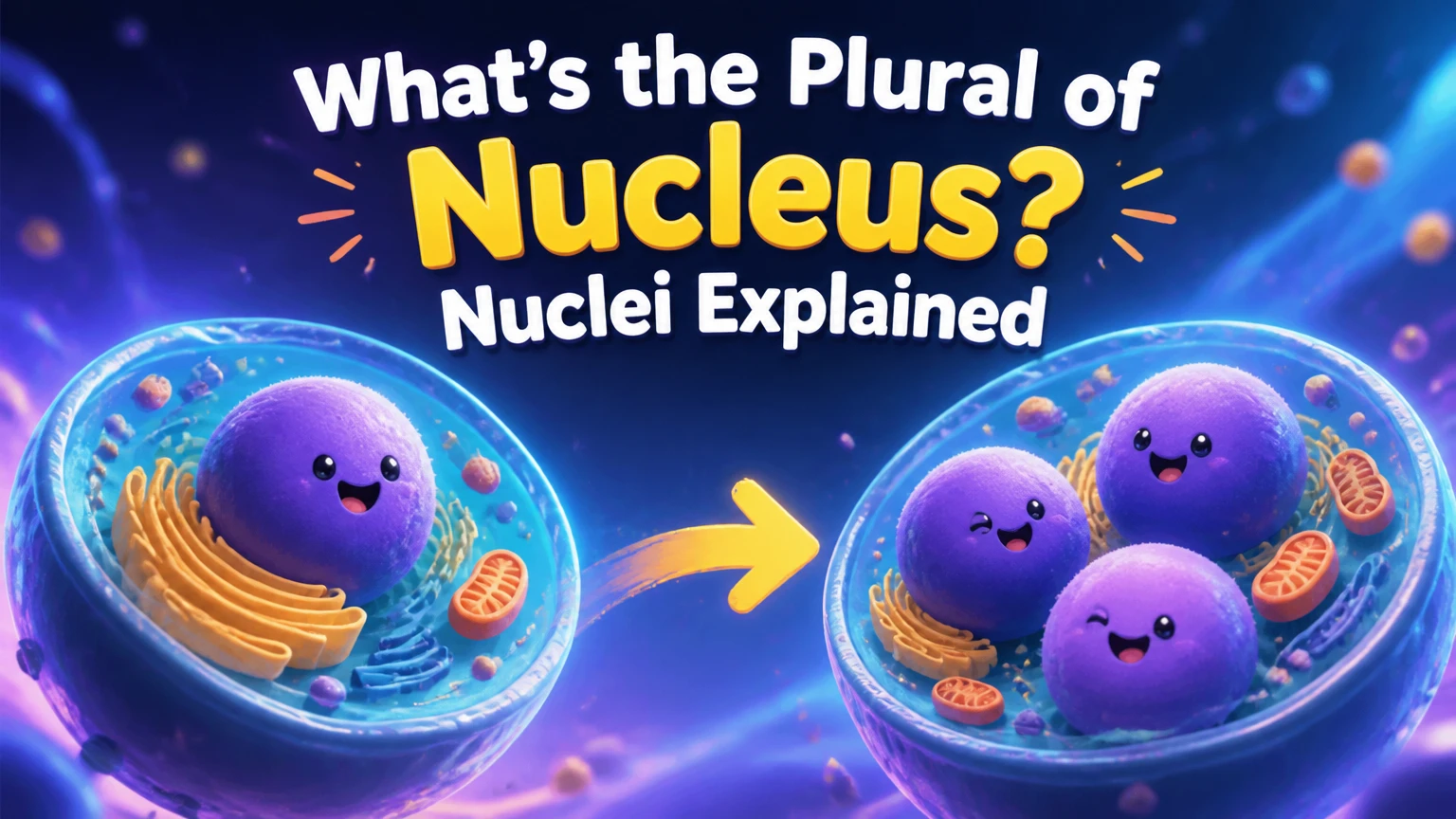
The plural of nucleus is nuclei, pronounced NEW-clee-eye. The alternative plural nucleuses appears in some general dictionaries, but nuclei is the standard and strongly preferred form in scientific, medical, academic, and most formal writing.
Key Facts at a Glance
- Nuclei is the conventional plural of nucleus.
- Nuclei is pronounced NEW-clee-eye, with three syllables.
- Nucleuses is an accepted regularized plural in some dictionaries, but it is less common.
- A biological nucleus contains most of a eukaryotic cell’s DNA and regulates gene expression.
- An atomic nucleus contains protons and neutrons, except that ordinary hydrogen-1 has one proton and no neutron.
- In neuroanatomy, a nucleus is a group of neuron cell bodies located within the central nervous system.
What Is the Plural of Nucleus?
The correct plural of nucleus is nuclei. The word follows a Latin-derived plural pattern in which the singular ending -us changes to -i, similar to stimulus and stimuli or fungus and fungi, although English usage varies for some words borrowed from Latin.
Use nuclei when writing about cells, atoms, brain structures, or abstract central groups. For example, “The cells contain several nuclei,” “Atomic nuclei can undergo fusion,” and “The thalamic nuclei relay sensory information” are all standard constructions.
The plural is not spelled nucleii. That form incorrectly adds an extra i. The singular remains nucleus, while the plural removes the final -s and changes the ending to -i.
What Does Nuclei Mean?
Nuclei means two or more central structures called nucleus. The meaning depends on the field. In cell biology, nuclei are membrane-bound compartments containing genetic material. In physics, nuclei are the dense central parts of atoms. In neuroscience, nuclei are organized clusters of neurons.
The same plural therefore connects several technical meanings without changing spelling. Context determines whether a reader should picture cell organelles, atomic cores, or brain structures.
How Do You Pronounce Nuclei?
Nuclei is usually pronounced NEW-clee-eye, represented approximately as /ˈnuː.kli.aɪ/ in English pronunciation systems. The singular nucleus is commonly pronounced NEW-clee-us, with three syllables.
| Word | Pronunciation | Syllables | Example |
|---|---|---|---|
| nucleus | NEW-clee-us | 3 | one nucleus |
| nuclei | NEW-clee-eye | 3 | several nuclei |
| nucleuses | NEW-clee-us-iz | 4 | several nucleuses |
| nucleolus | new-KLEE-uh-lus | 4 | one nucleolus |
A common mistake is pronouncing nuclei as NEW-klee, dropping the final syllable. Another is treating the ending like cacti and saying NEW-klee-eye correctly in spelling but stressing the wrong syllable. Standard English places the main stress on the first syllable.
Why Does the Spelling Change From Nucleus to Nuclei?
The spelling changes because nucleus entered English from Latin, where nucleus belongs to a noun pattern whose classical plural is nuclei. English retained that form in technical vocabulary, especially after biology, medicine, and physics adopted the word.
English does not apply Latin plurals consistently. Some borrowed words preserve their original forms, while others take the regular English -s ending. That is why both nuclei and nucleuses can appear in dictionaries, even though they do not have equal status in professional usage.
Is Nuclei an Irregular Plural?
Nuclei is an irregular English plural but a regular classical Latin plural. English speakers generally learn the form as a vocabulary item rather than generate it from a fully productive rule.
Other examples include:
| Singular | Traditional plural | Regularized plural or alternative |
|---|---|---|
| nucleus | nuclei | nucleuses |
| stimulus | stimuli | stimuluses |
| alumnus | alumni | alumnuses |
| syllabus | syllabi | syllabuses |
| cactus | cacti | cactuses |
The comparison does not mean every Latin plural is interchangeable with its English alternative. In scientific writing, the established technical form usually carries more authority than the regularized form.
Is Nucleuses Correct?
Nucleuses is grammatically possible and is listed as an alternative plural by some English dictionaries. However, nuclei is the safer choice for formal writing because scientists, physicians, researchers, and educators overwhelmingly use it for technical meanings.
The regular plural nucleuses can be useful when discussing several central points in a broad, nontechnical context, particularly when a writer wants to avoid a foreign-looking plural. Even there, readers may regard nuclei as more natural because the word is strongly associated with scientific terminology.
| Context | Preferred form | Reason |
|---|---|---|
| Cell biology | nuclei | Standard terminology in textbooks and research |
| Nuclear physics | nuclei | Conventional form for atomic cores |
| Neuroanatomy | nuclei | Established anatomical usage |
| General metaphor | nuclei | Clear and widely recognized |
| Informal general English | nuclei or nucleuses | Register determines the choice |
| Academic assignment | nuclei | Lowest risk of correction |
A useful editorial rule is simple: choose nuclei unless a house style, dictionary exercise, or deliberate plain-English policy specifically calls for nucleuses.
What Does Nuclei Mean in Biology?
In biology, nuclei are membrane-bound organelles that contain chromosomes and coordinate gene activity in eukaryotic cells. A nucleus typically contains DNA, chromatin, nucleoplasm, a nuclear envelope, nuclear pores, and one or more nucleoli.
The nucleus does not literally control every cellular action, but it stores genetic instructions and regulates which genes are transcribed. During gene expression, RNA polymerase transcribes DNA into precursor messenger RNA inside the nucleus; processing removes introns, modifies the transcript, and prepares mature messenger RNA for export through nuclear pores.
The sequence then continues outside the nucleus. Ribosomes in the cytoplasm translate messenger RNA into protein, while the endoplasmic reticulum and Golgi apparatus process many proteins destined for membranes or secretion.
What Are the Main Parts of Cell Nuclei?
Cell nuclei contain several specialized structures with distinct roles.
| Structure | Typical feature | Primary role | Example |
|---|---|---|---|
| Nuclear envelope | Double membrane | Separates nucleoplasm from cytoplasm | Eukaryotic cells |
| Nuclear pore complex | Protein-lined channel | Controls molecular transport | mRNA export |
| Chromatin | DNA plus histone proteins | Packages genetic material | Euchromatin |
| Nucleolus | Dense nuclear region | Produces ribosomal subunits | Ribosomal RNA synthesis |
| Nucleoplasm | Internal fluid matrix | Supports nuclear reactions | DNA replication |
A human cell nucleus is often about 5-10 micrometres across, although size varies by cell type and physiological state. Human DNA would extend roughly 1.8 metres if fully uncoiled from one diploid cell, so histones and higher-order chromatin organization are necessary for compact packaging.
How Is Nucleus Used in Physics?
In physics, an atomic nucleus is the compact central region of an atom containing positively charged protons and, in most isotopes, electrically neutral neutrons. Nearly all of an atom’s mass is concentrated in its nucleus, but the often-repeated figure of 99.9% is an approximation rather than a universal exact value.
A more precise statement is that an atomic nucleus contains more than 99.9% of an atom’s mass for ordinary atoms because electrons contribute a very small fraction. For hydrogen-1, the electron-to-atom mass ratio is approximately 1 part in 1,836, so the nuclear share is about 99.95%.
The strong nuclear interaction binds protons and neutrons at distances of roughly 1 femtometre, while electromagnetic repulsion pushes positively charged protons apart. Nuclear stability depends on the balance among proton number, neutron number, quantum effects, and binding energy.
How Do Fission and Fusion Involve Nuclei?
Fission splits a heavy nucleus into smaller nuclei, while fusion combines light nuclei into a heavier nucleus. Both processes can release energy when the products have greater binding energy per nucleon than the original nuclei.
In uranium-235 fission, neutron absorption can produce an unstable uranium-236 nucleus that divides into lighter fragments, additional neutrons, and energy. In stellar fusion, hydrogen isotopes ultimately combine through nuclear reactions that produce helium, as occurs in the Sun.
The reaction energy comes from a small mass difference described by Einstein’s equation E = mc². Nuclear energy is not chemical combustion, and changing electron bonds cannot produce the same scale of energy per particle.
What Does Nucleus Mean in Neuroanatomy?
In neuroanatomy, a nucleus is a defined group of neuron cell bodies within the central nervous system, and nuclei is its standard plural. A brain nucleus may receive, process, or transmit signals as part of a specific neural circuit.
Examples include the suprachiasmatic nucleus, which helps coordinate circadian rhythms; the subthalamic nucleus, involved in motor control; and the geniculate nuclei, which participate in visual and auditory pathways. The term differs from a peripheral ganglion, which usually describes a cluster of neuron cell bodies outside the brain and spinal cord.
Neuroanatomical nuclei can be small and difficult to distinguish on routine imaging. A 3-tesla MRI may provide useful structural detail, but imaging resolution depends on sequence design, scan duration, field strength, anatomy, and the clinical question.
How Do Biological, Atomic, and Neural Nuclei Differ?
The three meanings share the idea of a central or organizing unit, but their material, size, and function differ substantially.
| Type of nucleus | Main components | Typical scale | Main function | Example |
|---|---|---|---|---|
| Cell nucleus | DNA, chromatin, nuclear envelope | 5-10 µm | Gene storage and regulation | Nucleus of a liver cell |
| Atomic nucleus | Protons and neutrons | 1-10 fm radius | Atomic mass and identity | Carbon-12 nucleus |
| Neural nucleus | Neuron cell bodies and connections | Millimetres to centimetres | Signal processing | Caudate nucleus |
| Nucleolus | Ribosomal RNA and proteins | 1-5 µm | Ribosome assembly | Nucleolus in an oocyte |
The shared word is conceptual, not evidence that the structures work the same way. A cell nucleus is an organelle, an atomic nucleus is a quantum-mechanical particle system, and a neural nucleus is an anatomical population of cells.
Which Cells Lack a Nucleus?
Bacteria and archaea lack a membrane-bound nucleus, while eukaryotic cells generally possess one or more nuclei. Mature mammalian red blood cells are a major human exception because they expel their nuclei during development, creating more internal space for haemoglobin.
Other anucleate or specialized cells include mammalian platelets, which are cell fragments rather than complete cells, and mature lens fibre cells, which lose their nuclei as they differentiate. Some eukaryotic organisms contain multinucleate cells, such as skeletal muscle fibres and certain fungal hyphae.
| Cell or organism | Nucleus status | Biological consequence |
|---|---|---|
| Human skin cell | One nucleus | Maintains DNA and gene regulation |
| Human skeletal muscle fibre | Many nuclei | Supports a large elongated cell |
| Mature human red blood cell | No nucleus | Maximizes haemoglobin capacity |
| Bacterium | No membrane-bound nucleus | DNA occupies a nucleoid region |
| Plant cell | Usually one nucleus | Coordinates cellular metabolism |
| Oocyte | One large nucleus before maturation changes | Stores genetic material |
Calling a bacterial DNA region a nucleus is inaccurate in standard biology. The correct term is nucleoid.
How Large Are Different Nuclei?
Cell nuclei commonly measure several micrometres, atomic nuclei measure a few femtometres, and neuroanatomical nuclei range from tiny microscopic groups to structures visible on millimetre-scale brain images. These scales differ by factors of millions or more.
| Nucleus type | Typical measurement | Unit conversion | Measurement qualification |
|---|---|---|---|
| Human cell nucleus | 5-10 | µm | Varies by cell type |
| Atomic nucleus | 1-10 | fm radius | Depends on proton number |
| Human DNA length per diploid cell | About 1.8 | m uncoiled | Approximate total length |
| Neural nucleus | 1-20 | mm or larger | Boundary depends on anatomy |
| Nuclear pore complex | About 100 | nm across | Molecular structure |
The atomic scale requires care. A femtometre equals 10⁻¹⁵ metres, while a micrometre equals 10⁻⁶ metres. A micrometre is therefore one billion times larger than a femtometre.
How Do You Use Nuclei in Sentences?
Use nuclei when the noun refers to more than one nucleus. The word can function as a subject, object, or complement, and its grammatical role does not change the spelling.
- “The researcher stained the cell nuclei with DAPI.”
- “Several atomic nuclei emitted particles.”
- “The basal ganglia contain interconnected nuclei.”
- “The nuclei were visible under fluorescence microscopy.”
- “These nuclei regulate hormone release.”
What Is the Possessive Plural of Nuclei?
The possessive plural of nuclei is nuclei’s when the sentence refers to something belonging to multiple nuclei. For example, “The nuclei’s membranes became permeable” uses an apostrophe before s because nuclei already ends in i, not s.
| Meaning | Correct form | Example |
|---|---|---|
| One nucleus possesses something | nucleus’s | The nucleus’s membrane is intact |
| Several nuclei possess something | nuclei’s | The nuclei’s membranes are intact |
| More than one nucleus, no possession | nuclei | The nuclei divide |
| Alternative plural possession | nucleuses’ | The nucleuses’ locations were recorded |
In most technical writing, rewriting the sentence can improve clarity: “The membranes of the nuclei became permeable.”
What Words Are Commonly Confused With Nucleus?
Nucleus, nucleolus, nucleon, nucleoid, and nuclear are related terms but do not mean the same thing. Confusing them can produce a scientifically incorrect sentence even when the plural spelling is right.
| Term | Meaning | Correct plural | Example |
|---|---|---|---|
| nucleus | Central structure | nuclei | Cell nuclei contain chromosomes |
| nucleolus | Region inside a cell nucleus | nucleoli | Nucleoli assemble ribosomes |
| nucleon | Proton or neutron | nucleons | A carbon-12 atom has 12 nucleons |
| nucleoid | DNA-containing region in prokaryotes | nucleoids | Bacteria have nucleoids |
| nuclear | Adjective meaning related to a nucleus | No noun plural | Nuclear membrane |
The distinction between nuclei and nucleoli matters especially in microscopy. A nucleolus is inside a cell nucleus, so a cell can contain one nucleus and several nucleoli.
What Are the Main Grammar Mistakes With Nucleus?
The most common mistakes involve adding the wrong ending, confusing singular and plural agreement, or using a related term in the wrong scientific context.
- Writing nucleii. The correct spelling is nuclei, with one final i.
- Using nucleus after a plural number. Write “two nuclei,” not “two nucleus.”
- Using nuclei for one structure. Write “the nucleus is,” not “the nuclei is.”
- Treating nuclei as a singular noun. Write “the nuclei are visible.”
- Calling a bacterial nucleoid a nucleus. Prokaryotic cells do not have a membrane-bound nucleus.
- Using nucleolus for the whole organelle. The nucleolus is only one region within a eukaryotic nucleus.
A practical editing test is to replace the noun with “one central structure” or “several central structures.” If the sentence means several, nuclei is usually the appropriate form.
How Much Do Nuclear Studies Cost?
Nuclear research and imaging costs vary too widely for a universal price, but typical laboratory figures illustrate the difference between learning the term and studying the structures themselves. A DAPI stain may cost about $50-$150 per vial, while fluorescent microscopy access may cost roughly $50-$150 per hour, depending on the facility.
| Activity | Typical cost | Typical duration | Main variable |
|---|---|---|---|
| DAPI stain vial | $50-$150 | 10-30 minutes for staining | Supplier and concentration |
| Fluorescence microscopy | $50-$150 per hour | 1-2 hours of imaging | Facility and instrument |
| 3T brain MRI | $500-$3,500 | 30-45 minutes scanning | Insurance and location |
| NMR spectroscopy system | $200,000-$2,000,000+ | Facility-scale operation | Field strength and configuration |
These figures are practical ranges, not universal prices. They do not determine the plural form, and they should not be presented as intrinsic costs of “nuclei.” A grammar question usually requires no laboratory equipment.
What Is the Best Way to Study Cell Nuclei?
For basic cell-nucleus observation, a prepared slide and light microscope are sufficient; fluorescent staining and microscopy are better suited to research questions involving nuclear DNA, morphology, or protein localization.
DAPI binds strongly to DNA and can reveal nuclei under ultraviolet or violet excitation, but prolonged illumination causes photobleaching. Researchers commonly use anti-fade mounting media and minimize exposure time. A stain identifies DNA-rich structures; it does not, by itself, prove that every visible structure is a complete, healthy nucleus.
Which Form Should You Choose?
Choose nuclei for scientific reports, medical documents, university assignments, textbooks, and nearly all references to biological, physical, or neurological structures. Choose nucleuses only when a specific editorial guide accepts it, a general-language audience benefits from a regular plural, or the writer is deliberately discussing the word as a broad metaphor.
The choice is therefore based on register rather than grammatical possibility. Nuclei has the widest acceptance and the strongest connection to established terminology, while nucleuses may sound more transparently English to some readers but can appear nontechnical.
Expert Editing Rules
- Use nuclei in captions, figure labels, laboratory notes, and exam answers.
- Preserve nuclei when quoting a scientific source unless the quotation requires exact modernization.
- Do not change nucleuses automatically if it appears in a general dictionary definition.
- Check whether nucleus means a cell organelle, atomic core, brain cluster, or metaphor before selecting related terminology.
- Prefer “the membranes of the nuclei” over an ambiguous possessive such as “the nuclei’s membranes” in dense technical prose.
FAQ
Is nuclei singular or plural?
Nuclei is plural. The singular form is nucleus. Write “one nucleus contains DNA” and “several nuclei contain DNA.” The verb must agree with the number: “the nucleus is” is singular, while “the nuclei are” is plural.
Is nucleuses more correct than nuclei in modern English?
No. Nucleuses is an accepted alternative in some dictionaries, but nuclei is more established in modern scientific and academic English. Writers who want the form least likely to be marked wrong should use nuclei, especially for biology, physics, medicine, and neuroscience.
What is the plural of cell nucleus?
The plural of cell nucleus is cell nuclei or nuclei of cells. The compound noun keeps cell unchanged and pluralizes nucleus as nuclei: “The cell nuclei were stained with DAPI.”
What is the plural of nucleus in physics?
The plural of nucleus in physics is nuclei. Physicists write about atomic nuclei, nuclear nuclei only rarely and redundantly, isotope nuclei, and unstable nuclei. The term refers to the central proton-neutron system of an atom.
Is nuclei pronounced like nuclear?
No. Nuclei is pronounced NEW-clee-eye, while nuclear is commonly pronounced NEW-clee-er or NEW-kyuh-ler, depending on the speaker and dialect. The spelling relationship does not make their pronunciations identical.
What is the difference between nuclei and nucleoli?
Nuclei are entire cell nuclei, while nucleoli are dense structures inside nuclei that produce ribosomal subunits. A single nucleus can contain multiple nucleoli, so the terms describe different levels of cellular organization.
The Bottom Line
The answer to whats the plural of nucleus is nuclei, pronounced NEW-clee-eye. Although nucleuses is sometimes accepted, nuclei is the preferred form for formal English and for every major technical meaning, including cell biology, atomic physics, and neuroanatomy.