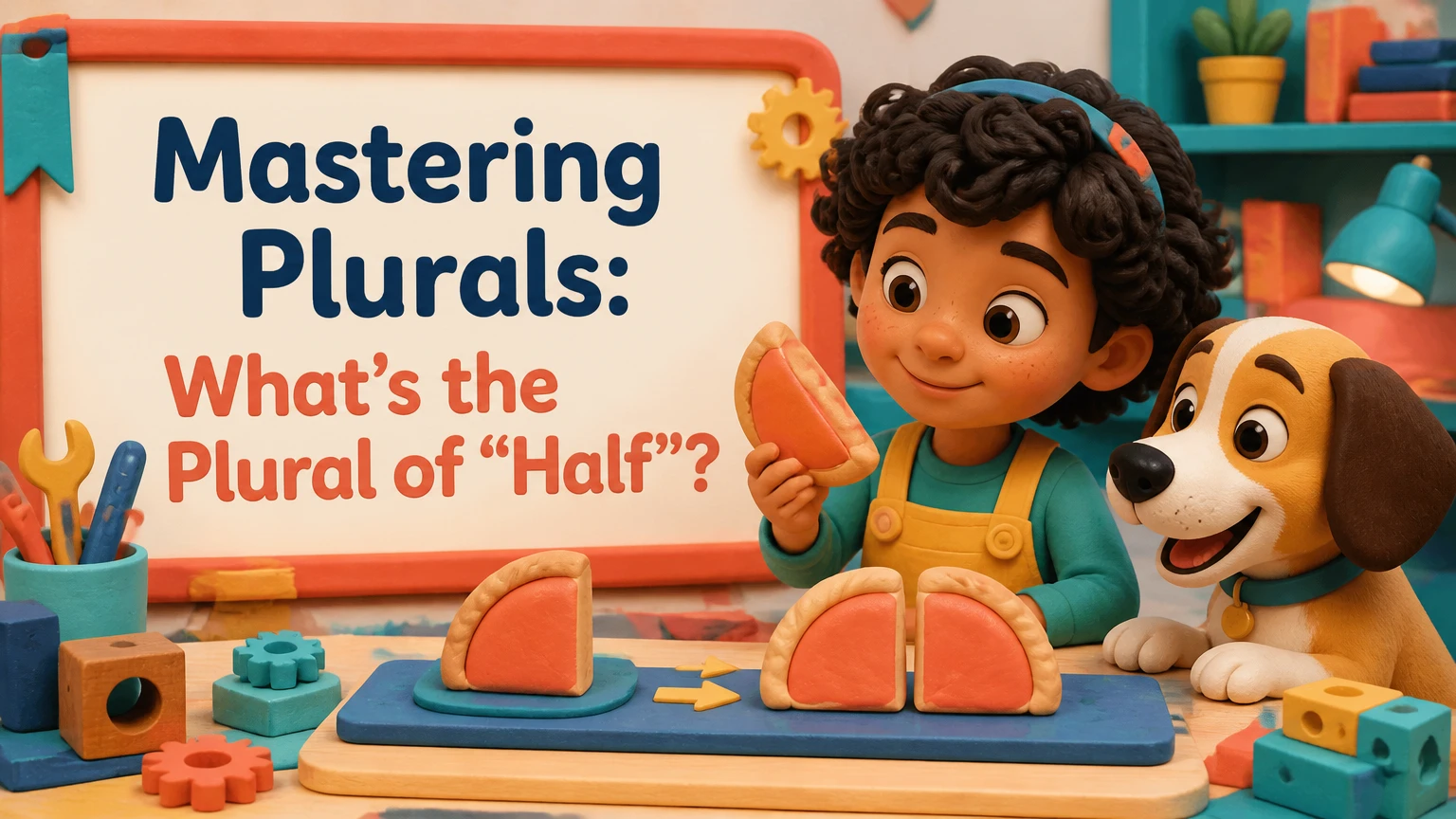
Understanding how to form plurals correctly is a fundamental aspect of English grammar. While most nouns simply add an “s” to become plural, some words, including “half,” require special attention. The plural of “half” is “halves,” reflecting a change in the word’s ending, much like other words such as knife-knives, leaf-leaves, wife-wives. Knowing when and how to use “halves” is crucial for clear and accurate communication, especially in contexts involving fractions, measurements, or divided portions. Correct usage ensures clarity in both written and spoken language, benefiting students, professionals, and anyone aiming to improve their command of English.
Table of Contents
- Definition of “Half” and “Halves”
- Structural Breakdown
- Examples of “Half” and “Halves” in Sentences
- Usage Rules for “Half” and “Halves”
- Common Mistakes
- Practice Exercises
- Advanced Topics
- Frequently Asked Questions
- Conclusion
Definition of “Half” and “Halves”
The word “half” refers to one of two equal parts into which something is or can be divided. It can function as a noun, an adjective, or an adverb, depending on the context. As a noun, it represents a single portion that is equivalent to 50% of the whole. For example, “I ate half of the pizza.” As an adjective, it describes something that is a half portion, such as “a half hour.” As an adverb, it can modify verbs, indicating something is done to a partial extent. The plural form, “halves,” denotes more than one of these equal parts. Understanding the different roles “half” and “halves” play in a sentence is crucial for accurate grammar.
Structural Breakdown
The transformation of “half” to “halves” follows a specific pattern in English grammar. Many nouns that end in “-f” or “-fe” change the “f” to a “v” and add “-es” to form their plural. This pattern is observed in words like “leaf” (leaves), “knife” (knives), “wife” (wives), and “life” (lives). The singular noun “half” ends with “-f,” so it adheres to this rule, becoming “halves” in its plural form. This change is phonetic as well as orthographic, affecting both the spelling and pronunciation of the word.
The structure of phrases involving “half” and “halves” often includes prepositions like “of” or quantifiers such as “two,” “three,” or “several.” For example, “half of the cake” refers to a single portion, while “three halves of the cake” refers to more than one. The use of “of” is essential when specifying what the half or halves belong to. Without “of,” the sentence might lack clarity or be grammatically incorrect. The number preceding “halves” indicates how many portions are being discussed, influencing the overall meaning of the sentence. Consider these examples: “Half the battle is won” vs. “Two halves make a whole.”
Examples of “Half” and “Halves” in Sentences
Understanding the correct usage of “half” and “halves” requires examining them in various sentence structures. The following tables provide examples of how these words function as nouns, adjectives, and within different contexts.
“Half” as a Noun
When “half” is used as a noun, it represents one of two equal parts. The following table illustrates its usage in various sentences.
| Sentence | Explanation |
|---|---|
| I ate half of the apple. | “Half” refers to one portion of the apple. |
| He spent half his life traveling. | “Half” represents 50% of his life. |
| Half of the students passed the exam. | “Half” indicates 50% of the students. |
| She donated half of her salary to charity. | “Half” refers to one portion of her salary. |
| The glass is half full. | “Half” indicates the water level relative to the glass’s capacity. |
| He only did half the work. | “Half” denotes a portion of the total work. |
| I’ll meet you halfway. | “Halfway” refers to a point equidistant between two locations. |
| Half an hour is enough time. | “Half” describes a portion of an hour. |
| He gave it half a thought. | “Half” suggests incomplete consideration. |
| It’s half past three. | “Half” indicates 30 minutes past the hour. |
| Half the fun is getting there. | “Half” represents a portion of the total enjoyment. |
| She kept half for herself. | “Half” indicates a portion retained by her. |
| Half measures are not enough. | “Half” suggests incomplete actions. |
| He’s only half joking. | “Half” indicates a partial degree of seriousness. |
| The project is half finished. | “Half” represents the completion status. |
| Half the price is acceptable. | “Half” indicates a portion of the original cost. |
| I’ll take half of that. | “Half” denotes a portion being accepted. |
| Half the story is missing. | “Half” represents a portion of the narrative. |
| He’s half my age. | “Half” indicates a portion of someone’s age. |
| Half the battle is showing up. | “Half” represents a significant portion of success. |
| She’s only half listening. | “Half” indicates a partial degree of attention. |
| Half the world knows. | “Half” represents a significant portion of the population. |
| He’s half right. | “Half” indicates a partial degree of correctness. |
| Half the challenge is understanding it. | “Half” represents a significant portion of the challenge. |
| She’s half asleep. | “Half” indicates a partial state of consciousness. |
| Half the truth is a lie. | “Half” represents a portion of the truth. |
| He’s half hearted. | “Half” indicates a lack of complete enthusiasm. |
| Half the problem is solved. | “Half” represents a portion of the total problem. |
“Halves” as a Noun
When “halves” is used as a noun, it refers to more than one portion that results from dividing something into two equal parts. The following table provides examples of its usage.
| Sentence | Explanation |
|---|---|
| The orange was cut into halves. | “Halves” indicates two equal portions. |
| He collected the two halves of the broken vase. | “Halves” refers to the two pieces of the vase. |
| The teacher divided the class into two halves. | “Halves” represents two equal groups. |
| The recipe calls for the juice of two lemon halves. | “Halves” indicates portions of two lemons. |
| He glued the halves together to repair the toy. | “Halves” refers to the two separated pieces. |
| The two halves of the brain communicate with each other. | “Halves” represents the two hemispheres of the brain. |
| The two halves of the apple pie were gone in minutes. | “Halves” indicates portions of the apple pie. |
| The team was split into halves for the practice drill. | “Halves” represents two equal groups for practice. |
| Several orange halves were left on the table. | “Halves” suggests multiple portions of oranges. |
| The walnuts were separated into their halves. | “Halves” indicates the two parts of each walnut. |
| He picked up the two halves of the document. | “Halves” refers to the two fragments of the document. |
| She aligned the two halves perfectly. | “Halves” indicates the two aligned portions. |
| The halves of the puzzle fit together seamlessly. | “Halves” represents the puzzle pieces. |
| He joined the halves of the broken heart pendant. | “Halves” refers to the two parts of the pendant. |
| The two halves of the story finally came together. | “Halves” represents the two parts of the narrative. |
| The halves of the equation must balance each other. | “Halves” indicates the two sides of the equation. |
| I collected the halves of the shattered mirror. | “Halves” denotes the fragments of the mirror. |
| The halves of the debate presented opposing viewpoints. | “Halves” represents the two sides of the debate. |
| He sorted the halves of the seashells. | “Halves” indicates the portions of the seashells. |
| The halves of the sandwich disappeared quickly. | “Halves” represents the portions of the sandwich. |
| The two halves of the project were due separately. | “Halves” indicates the two parts of the project. |
| She displayed the halves of the geode. | “Halves” represents the two parts of the geode. |
| The halves of the team celebrated together. | “Halves” indicates the two groups of the team. |
| He examined the halves of the ancient tablet. | “Halves” represents the two fragments of the tablet. |
| The halves of the apple were shared among the children. | “Halves” indicates the portions of the apple. |
| The two halves of the experiment yielded different results. | “Halves” represents the two parts of the experiment. |
| She compared the halves of the graph. | “Halves” indicates the two sections of the graph. |
| The halves of the puzzle were challenging to connect. | “Halves” represents the puzzle pieces. |
“Half” as an Adjective
When “half” is used as an adjective, it modifies a noun, indicating that the noun is a portion of the whole. The following table provides examples of its usage.
| Sentence | Explanation |
|---|---|
| I ran a half marathon. | “Half” modifies “marathon,” indicating it’s a portion of a full marathon. |
| She ordered a half portion of fries. | “Half” modifies “portion,” indicating a smaller serving. |
| He took a half day off work. | “Half” modifies “day,” indicating a partial day. |
| They lived in a half house. | “Half” modifies “house,” suggesting a smaller dwelling. |
| She bought a half size dress. | “Half” modifies “size,” indicating a smaller dimension. |
| He made a half hearted attempt. | “Half” modifies “attempt,” indicating a lack of full commitment. |
| The store offered a half price sale. | “Half” modifies “price,” indicating a reduced cost. |
| She baked a half batch of cookies. | “Half” modifies “batch,” indicating a smaller quantity. |
| He completed a half circle. | “Half” modifies “circle,” indicating a portion of a full circle. |
| She wrote a half page essay. | “Half” modifies “page,” indicating a shorter length. |
| He drank a half cup of coffee. | “Half” modifies “cup,” indicating a smaller amount. |
| She took a half step forward. | “Half” modifies “step,” indicating a smaller movement. |
| He gave a half smile. | “Half” modifies “smile,” indicating a subtle expression. |
| She sang a half song. | “Half” modifies “song,” indicating an incomplete performance. |
| He painted a half wall. | “Half” modifies “wall,” indicating a partial area. |
| She built a half bridge. | “Half” modifies “bridge,” indicating an incomplete structure. |
| He drew a half moon. | “Half” modifies “moon,” indicating a lunar phase. |
| She cooked a half chicken. | “Half” modifies “chicken,” indicating a portion of the whole bird. |
| He read a half chapter. | “Half” modifies “chapter,” indicating a portion of the book. |
| She planted a half garden. | “Half” modifies “garden,” indicating a partial area. |
| He watched a half movie. | “Half” modifies “movie,” indicating an incomplete viewing. |
| She played a half game. | “Half” modifies “game,” indicating a partial play. |
| He wrote a half letter. | “Half” modifies “letter,” indicating an incomplete message. |
| She climbed a half mountain. | “Half” modifies “mountain,” indicating a partial ascent. |
| He built a half house. | “Half” modifies “house,” indicating an incomplete construction. |
| She ate a half sandwich. | “Half” modifies “sandwich,” indicating a portion of the whole. |
| He ran a half mile. | “Half” modifies “mile,” indicating a shorter distance. |
| She baked a half cake. | “Half” modifies “cake,” indicating a smaller dessert. |
Usage Rules for “Half” and “Halves”
The correct usage of “half” and “halves” depends on whether you are referring to one portion or multiple portions. Here are some key rules to remember:
- Use “half” when referring to a single portion: For example, “I ate half of the pizza.”
- Use “halves” when referring to more than one portion: For example, “The orange was cut into halves.”
- When using “half” as an adjective, it typically precedes the noun: For example, “a half hour.”
- The preposition “of” is often used after “half” to specify what is being divided: For example, “half of the cake.”
Exceptions: There are few exceptions to these rules, but understanding the context is crucial. For instance, in mathematical contexts, “one half” is often used instead of just “half,” especially in formal writing. Also, idiomatic expressions may have specific usages that deviate slightly, such as “meeting someone halfway.”
Common Mistakes
One common mistake is using “half” when “halves” is required, and vice versa. For example, saying “The orange was cut into half” is incorrect; the correct sentence is “The orange was cut into halves.” Another common error is omitting the preposition “of” after “half,” leading to unclear or grammatically incorrect sentences. For instance, saying “I ate half the pizza” is acceptable, but saying “I ate half pizza” is incorrect. Here’s a table illustrating common mistakes and their corrections:
| Incorrect | Correct | Explanation |
|---|---|---|
| The orange was cut into half. | The orange was cut into halves. | “Halves” is needed because the orange is divided into two portions. |
| I ate half pizza. | I ate half of the pizza. | The preposition “of” is necessary to specify what is being divided. |
| He collected the two half of the broken vase. | He collected the two halves of the broken vase. | “Halves” is the plural form. |
| She divided the class into two half. | She divided the class into two halves. | “Halves” is needed to indicate multiple portions. |
| The recipe calls for the juice of two lemon half. | The recipe calls for the juice of two lemon halves. | “Halves” is required for plural lemons. |
| He glued the half together. | He glued the halves together. | “Halves” is used because there are two pieces. |
| The two half of the brain. | The two halves of the brain. | “Halves” refers to the two hemispheres. |
| Several orange half were left. | Several orange halves were left. | “Halves” denotes multiple portions. |
| The walnuts were separated into half. | The walnuts were separated into halves. | “Halves” indicates two parts. |
| He picked up the two half of the document. | He picked up the two halves of the document. | “Halves” refers to the fragments. |
Practice Exercises
Test your understanding of “half” and “halves” with these practice exercises. Fill in the blanks with the correct form of the word.
| Question | Answer |
|---|---|
| 1. I only ate ______ of the sandwich. | half |
| 2. The apple was cut into two equal ______. | halves |
| 3. He spent ______ an hour waiting for the bus. | half |
| 4. She collected the two ______ of the broken plate. | halves |
| 5. ______ of the students passed the test. | Half |
| 6. The recipe requires two lemon ______. | halves |
| 7. He only completed ______ the assignment. | half |
| 8. The orange was divided into ______. | halves |
| 9. I’ll meet you ______ way. | half |
| 10. She paid ______ price for the item. | half |
Advanced Practice: Rewrite the following sentences to use “half” or “halves” correctly.
| Question | Answer |
|---|---|
| 1. The pizza was divided into two equal parts. | The pizza was divided into halves. |
| 2. He only ate a portion of the cake. | He only ate half of the cake. |
| 3. The class was split into two groups. | The class was split into halves. |
| 4. She spent a portion of her day off. | She spent half of her day off. |
| 5. The apple was cut into two pieces. | The apple was cut into halves. |
| 6. A portion of the students passed. | Half of the students passed. |
| 7. The lemon was cut into two segments. | The lemon was cut into halves. |
| 8. He only finished a portion of the job. | He only finished half the job. |
| 9. The orange was divided into segments. | The orange was divided into halves. |
| 10. I’ll meet you at the midway point. | I’ll meet you halfway. |
Advanced Topics
For advanced learners, exploring the nuances of “half” and “halves” can involve examining idiomatic expressions and their historical origins. For example, the phrase “not half bad” is an idiomatic expression meaning “quite good.” Understanding the subtle connotations and contexts in which these expressions are used can enhance fluency and comprehension. Additionally, exploring the mathematical and scientific applications of “half” and “halves” can provide a deeper understanding of their significance across various disciplines. For instance, understanding the concept of “half-life” in nuclear physics requires a precise grasp of what “half” represents in a scientific context.
Furthermore, the use of “half” in compound adjectives, such as “half-baked” or “half-hearted,” can be analyzed for their figurative meanings. “Half-baked” suggests something is incomplete or poorly thought out, while “half-hearted” indicates a lack of enthusiasm or commitment. Analyzing these expressions can improve vocabulary and comprehension of nuanced meanings.
Frequently Asked Questions
Here are some frequently asked questions about the plural of “half”:
- Question: Why does “half” become “halves” in the plural?
Answer: The change from “f” to “v” and the addition of “-es” is a common pattern in English for nouns ending in “-f” or “-fe.” This is due to historical phonetic shifts in the English language. - Question: Is it ever correct to say “halfs”?
Answer: No, “halfs” is not a correct plural form of “half.” The correct plural is always “halves.” - Question: When should I use “half of” versus just “half”?
Answer: You can use “half of” when you want to specify what is being divided. For example, “half of the cake.” Using “half” alone is often acceptable when the context is clear, such as “I ate half.” - Question: Can “half” be used as a verb?
Answer: No, “half” is not typically used as a verb. The verb form would be “to halve,” meaning to divide into two equal parts. - Question: What is the difference between “half” and “a half”?
Answer: “Half” is generally used when referring to a portion of something specific, while “a half” can be used more generally. For example, “I ate half of the pizza” versus “I need a half hour to finish.” - Question: How do I use “halves” in a sentence with a number?
Answer: When using “halves” with a number, ensure the number indicates more than one. For example, “two halves,” “three halves,” etc. The number specifies how many portions you are referring to. - Question: Are there any idiomatic expressions that use “half” or “halves” in unusual ways?
Answer: Yes, there are several idiomatic expressions, such as “not half bad,” which means “quite good,” and “go halves,” which means to share the cost of something equally. - Question: Can “half” be used with uncountable nouns?
Answer: Yes, “half” can be used with uncountable nouns. For example, “half of the water,” “half of the time,” “half of the effort.”
Conclusion
Mastering the use of “half” and “halves” is essential for accurate and effective communication in English. Remembering that “half” refers to a single portion while “halves” indicates multiple portions is the key to avoiding common errors. Paying attention to the context and practicing with various examples will solidify your understanding. By following the rules and guidelines outlined in this article, you can confidently use these words in your writing and speaking, ensuring clarity and precision. Remember, like many grammar rules, consistent practice and awareness are the best tools for mastering the nuances of the English language, leading to improved overall communication skills.