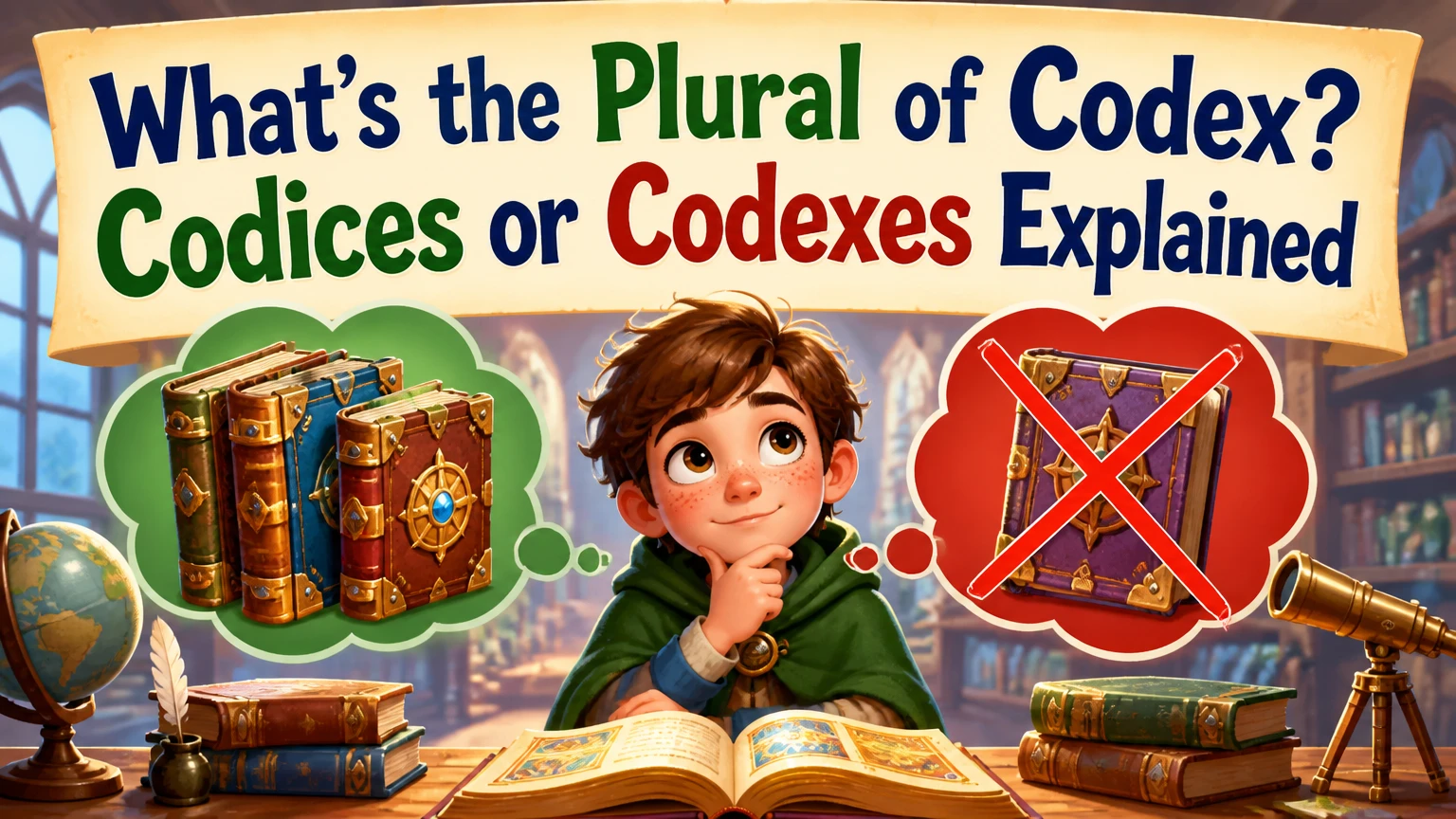
The plural of codex is codices, pronounced KOH-dih-seez. Codexes is also an accepted English plural, especially for modern, nonhistorical, or fictional contexts. Use codices in formal historical and academic writing when referring to multiple ancient manuscripts, and use codexes when treating codex as an ordinary modern English noun.
Key Facts at a Glance
- Codices is the traditional plural of the Latin-derived noun codex.
- Codexes is a valid modern English plural, not a spelling error.
- Codices is pronounced KOH-dih-seez, with the final sound matching sees.
- A codex is a bound manuscript or book with separate leaves, unlike a scroll.
- Historical codices could contain parchment, papyrus, bark paper, or other writing materials.
- A codex can describe a historical manuscript, a legal compilation, a fictional rulebook, or a modern data collection.
What Is the Plural of Codex?
Codices is the standard traditional plural of codex, while codexes is the regular English plural. The choice depends on register and meaning: historians commonly write about illuminated codices, whereas authors may describe fictional spellbooks or digital collections as codexes.
The two forms are grammatically understandable, but they create different stylistic signals. Codices preserves the word’s Latin history and fits museum catalogues, palaeography, art history, classical studies, and manuscript scholarship. Codexes applies the normal English plural ending and often feels more natural when the word means a modern system, database, reference book, or fictional document.
Examples:
- “The library holds several medieval codices.”
- “Researchers compared four Mesoamerican codices.”
- “The game contains six enemy codexes.”
- “The software stores regional law in separate codexes.”
Codices or Codexes: Which Form Should You Use?
| Context | Preferred plural | Example | Reason |
|---|---|---|---|
| Medieval manuscript studies | Codices | “The codices contain marginal notes.” | Traditional scholarly register |
| Biblical manuscript catalogue | Codices | “Early biblical codices survive.” | Historical terminology |
| Mesoamerican history | Codices | “The surviving codices use pictographs.” | Established disciplinary usage |
| Science fiction | Codexes or codices | “The fleet carried encrypted codexes.” | Authorial style determines tone |
| Video game reference entries | Codexes | “Read the codexes to unlock lore.” | Regular modern English plural |
| Digital legal collections | Codexes | “The platform organizes compliance codexes.” | Modern extended meaning |
For a formal essay about real historical manuscripts, codices is the safest choice. For a contemporary product name or fictional archive, codexes may communicate the intended meaning more clearly.
How Do You Pronounce Codices?
Codices is pronounced KOH-dih-seez, commonly represented in the International Phonetic Alphabet as approximately /ˈkɒdɪsiːz/ in British English and /ˈkoʊdɪsiːz/ in American English. The final syllable sounds like sees, not sex or deeks.
The singular codex is usually pronounced KOH-deks, with the final consonant cluster sounding like deks. English changes the ending when forming the traditional plural, so the plural does not sound like “codex” plus an ordinary -s.
| Form | Approximate pronunciation | Final sound |
|---|---|---|
| Codex | KOH-deks | “eks” |
| Codices | KOH-dih-seez | “seez” |
| Codexes | KOH-dek-siz | “eks-iz” |
| Index | IN-deks | “eks” |
| Indices | IN-dih-seez | “seez” |
A common mistake is pronouncing codices as “co-deeks.” That pronunciation incorrectly treats the spelling as though the letters -ices represent a long e sound.
What Does Codex Mean?
A codex is a book-shaped document made from separate leaves joined along one edge. In historical usage, the leaves could be parchment, vellum, papyrus, or paper, and the pages were gathered into sections and attached through sewing or another binding method.
The word does not automatically mean “ancient book.” A codex may be ancient, medieval, early modern, or fictional. The defining structural contrast is with a scroll or roll: a codex presents discrete leaves that a reader can turn and revisit individually.
The Latin noun codex originally referred to a tree trunk, block of wood, or wooden tablet. Latin caudex, associated with wood, developed into codex and later acquired the meaning of a collection of written pages. The semantic connection reflects early writing surfaces made from wooden tablets coated with wax.
Is a Codex the Same as a Manuscript?
A codex is one type of manuscript, but the terms are not synonyms. Manuscript refers broadly to a handwritten document, while codex identifies a physical book structure.
A handwritten letter, a rolled papyrus document, and a bound parchment Gospel can all be manuscripts. Only the bound, leaf-based example is a codex. A printed book can also have a codex structure, although scholars usually reserve the term for historical, specialized, or deliberately book-like objects.
| Term | Physical structure | Typical example | Relationship to codex |
|---|---|---|---|
| Manuscript | Any handwritten document | Medieval letter | Broad category |
| Codex | Separate leaves bound at one edge | Codex Sinaiticus | A manuscript format |
| Scroll | Continuous sheet rolled around an axis | Torah scroll | Different format |
| Tablet | Flat rigid surface | Wax writing tablet | Earlier writing object |
| Volume | One book within a set | Volume 2 of a history | Bibliographic unit |
The distinction matters in cataloguing. Calling every manuscript a codex can erase information about whether the original document was rolled, folded, loose, or bound.
How Is a Codex Organized?
A historical codex is organized from individual leaves into folded sheets, gatherings, and a bound body. The basic unit is a bifolium, a single sheet folded once to produce two leaves and four writing surfaces, although actual page counting depends on how the leaves are numbered.
Several bifolia are nested to form a quire, also called a gathering. Scribes or binders then arranged the quires in sequence and connected them along the spine. Parchment pages could be ruled with prick marks, lead points, dry styluses, or ink lines before text was copied.
| Component | Meaning | Typical physical value | Function |
|---|---|---|---|
| Leaf | One physical page sheet | 2 sides | Basic writing surface |
| Bifolium | One sheet folded in half | 2 leaves, 4 sides | Starting folded unit |
| Folio | A leaf, or a leaf reference | Folio 12r and 12v | Cataloguing and citation |
| Quire | Nested folded sheets | 4-12 bifolia commonly | Structural gathering |
| Spine | Bound edge | 1 long edge | Holds gatherings together |
| Board | Rigid cover support | Wood or pasteboard | Protects the text block |
The terms folio and page are not interchangeable in specialist description. A folio identifies a leaf, usually with recto and verso sides, while a page commonly identifies one numbered side. “Folio 20r” means the front side of leaf 20, and “folio 20v” means its back.
How Were Historical Codices Made?
Historical codices were produced through a sequence of material preparation, page planning, writing, decoration, collation, sewing, and covering. A large illuminated manuscript could require months or years because parchment preparation, text copying, correction, painting, and binding involved different skilled workers.
The exact process varied by period and region. A late antique papyrus codex did not use the same materials or binding techniques as a fifteenth-century European vellum Gospel, and Mesoamerican books often used screen-fold formats that differ from European gatherings.
- Prepare the writing material. Parchment makers cleaned, limed, stretched, and scraped animal skins; papyrus makers layered plant strips, while Mesoamerican scribes used bark paper or animal hide.
- Cut and fold the sheets. Sheets were trimmed into book-shaped units and folded into bifolia or another regional format.
- Plan the page. Scribes marked margins, ruling lines, columns, and writing areas with pricking, lead, ink, or a blunt stylus.
- Copy the text. Scribes used reed pens or quills with inks such as carbon ink or iron-gall ink, depending on place and period.
- Add decoration. Rubricators supplied headings, while illuminators applied pigments, painted initials, and sometimes gold leaf.
- Arrange the gatherings. The binder checked sequence, corrected misplaced leaves, and used quire signatures or catchwords to maintain order.
- Sew the text block. Cords, thongs, or sewing supports joined the gatherings along the spine.
- Attach the covers. Wooden boards, leather, parchment, metal fittings, or fabric protected the finished book.
A practical correction is necessary here: codices were not always produced by monks. Monastic scriptoria created many European religious books, but professional workshops, court ateliers, scribes, and Indigenous Mesoamerican specialists also made codex-format works.
What Are the Main Types of Codices?
The main types of codices include late antique biblical books, medieval European illuminated manuscripts, Mesoamerican books, and modern or fictional reference systems. Classification can follow material, region, subject, date, script, binding, or cultural tradition, so one codex may belong to several categories at once.
| Type | Material or format | Period or region | Named example |
|---|---|---|---|
| Biblical codex | Papyrus or parchment | 4th-5th century Mediterranean | Codex Sinaiticus |
| Illuminated manuscript | Vellum or parchment | 6th-15th century Europe | Book of Kells |
| Mesoamerican codex | Amatl bark paper or hide | Pre-Columbian and colonial Americas | Dresden Codex |
| Legal codex | Papyrus, parchment, or paper | Roman and medieval traditions | Theodosian Code manuscripts |
| Modern fictional codex | Paper or digital interface | Contemporary fiction and games | In-universe lore codex |
Famous Codices and Their Uses
Codex Sinaiticus is a fourth-century Greek biblical manuscript written on parchment. It is significant for textual and religious history, but it is not a complete modern Bible in the sense of one standardized canonical edition.
Codex Amiatinus is an early eighth-century Latin Bible associated with the Wearmouth-Jarrow tradition and now preserved at the Biblioteca Medicea Laurenziana in Florence. Its scale required substantial animal-skin resources, although exact estimates vary with assumptions about skin size, usable area, losses, and page layout.
The Book of Kells is an illuminated Gospel manuscript associated with Insular culture. Its elaborate initials and decoration make it an artistic landmark, but its pages also contain textual corrections, omissions, and unfinished decoration.
The Dresden Codex is one of the most important surviving Maya manuscripts. It uses a screen-fold format rather than functioning exactly like a bound European volume, which is why “codex” should be understood as a broad book-form term rather than a single universal binding design.
Codex Versus Scroll: What Is the Difference?
A codex has separate leaves bound along an edge, while a scroll uses a continuous sheet wound around one or two rods. The codex permits direct access to different sections, supports writing on both sides more conveniently, and can be indexed through page or folio references.
The change was gradual rather than instantaneous. Scrolls remained important for legal, religious, literary, and ceremonial purposes long after codices became common, and the preferred format depended on local practice, material supply, text length, and social setting.
| Feature | Codex | Scroll | Practical consequence |
|---|---|---|---|
| Reading surface | Separate leaves | Continuous roll | Codex supports rapid page turning |
| Writing sides | Often recto and verso | Usually one primary side | Codex can use material efficiently |
| Random access | High | Lower for distant passages | Codex suits reference reading |
| Storage | Stacks on shelves | Cylinders or rolled storage | Codex fits book shelving |
| Citation | Folio or page numbers | Column or section location | Codex supports stable references |
| Cover protection | Boards or wrappers | Roll ends and outer layer | Protection methods differ |
The codex was not automatically superior in every situation. A scroll can display a long continuous text, image sequence, genealogy, or ritual composition without interruptions caused by page turns.
How Much Did Codices Cost to Produce?
Historical production costs cannot be reduced to one reliable price because surviving records rarely provide a complete accounting. A large parchment codex could consume hundreds of prepared animal skins and require months or years of skilled labor, while a small papyrus book required fewer materials and less binding work.
A frequently cited estimate for the Codex Amiatinus is more than 500 calfskins, but the exact figure depends on page dimensions, skin quality, cutting losses, ruling margins, and whether damaged pieces were discarded. The estimate describes resource consumption, not a documented invoice.
| Object or production type | Typical material scale | Typical time scale | Modern price relevance |
|---|---|---|---|
| Small papyrus codex | 10-40 sheets | Weeks to months | Rare originals vary widely |
| Medium parchment manuscript | 100-250 skins | 6-24 months | Museum or institutional value |
| Large illuminated Bible | 400-600-plus skins | 1-3 years | Usually not openly market-priced |
| Modern hand-bound facsimile | Printed paper, leather, boards | 3-18 months | About $2,000-$15,000 typically |
| Decorative reproduction | Machine-printed paper | Days to weeks | About $50-$500 typically |
The $2,000-$15,000 range applies to high-quality hand-bound facsimiles and is a typical modern retail range, not a universal appraisal. Authentic ancient codices are generally held by libraries, museums, churches, universities, or governments, and their cultural value cannot be inferred from a facsimile price.
What Should You Check When Buying a Codex Facsimile?
A credible facsimile should identify the original institution, edition specifications, paper or parchment substitute, dimensions, binding method, and production limits. A glued perfect-bound reproduction may reproduce the images accurately while failing to reproduce the original structure.
Check these details before purchasing:
- Original manuscript and holding institution.
- Full-page, foldout, or partial reproduction scope.
- Leaf size, binding dimensions, and number of volumes.
- Sewn signatures versus glued binding.
- Pigment, foil, or printed imitation of illumination.
- Publisher, edition size, publication date, and condition.
- Provenance for any claimed historical original.
When Should You Use Codices Instead of Codexes?
Use codices for multiple historical manuscripts, especially in academic writing, museum descriptions, and discussions of Latin or Greek textual traditions. Use codexes when the plural refers to modern systems, fictional documents, software entries, or newly created books whose writers treat codex as a regular English noun.
Neither plural is inherently ungrammatical. Style consistency matters more than claiming that only one form is correct.
| Sentence | Assessment | Preferred revision |
|---|---|---|
| “Several ancient codexes survive.” | Acceptable, less formal | “Several ancient codices survive.” |
| “The game contains three codices.” | Correct, elevated tone | Keep if intentional |
| “The database stores legal codices.” | Understandable, formal | “The database stores legal codexes.” |
| “The curator catalogued two codexes.” | Acceptable modern English | “The curator catalogued two codices.” |
| “The Maya codexes reveal calendar signs.” | Acceptable but less conventional | “The Maya codices reveal calendar signs.” |
For an essay, match the terminology used by the relevant field or institution. A paper about the Dresden Codex should normally use codices because that is the established scholarly plural, while a game manual can use codexes without error.
Common Mistakes With Codex Plurals
The most common mistakes are treating codices as the only possible English form, pronouncing it as “co-deeks,” and using codex as a synonym for every manuscript. Accurate usage requires attention to grammar, pronunciation, structure, and historical context.
- Calling codexes wrong. English dictionaries recognize regular plurals for many Latin-derived nouns, and codexes is accepted in modern usage.
- Using codices for one object. The singular is codex: “The Codex Sinaiticus is a manuscript.”
- Pronouncing codices like codex. The traditional ending sounds like “seez.”
- Calling a scroll a codex. A scroll is rolled; a codex is leaf-based.
- Assuming every codex is handwritten. Codex describes format, although historical examples are often manuscripts.
- Treating all codices as European. Mesoamerican codices follow distinct material, pictorial, and folding traditions.
- Assuming a codex must be complete. Surviving works may have missing leaves, damaged gatherings, or unfinished decoration.
An expert rule of thumb is to prioritize codices when the object belongs to a named historical tradition and codexes when the writer has created a new category. That choice communicates subject knowledge without pretending English has only one valid plural.
How Is Codex Used in Modern Contexts?
Modern writers use codex for a reference collection, rulebook, archive, or fictional knowledge system. Video games often present a “codex” as an in-game encyclopedia, while science fiction uses the term for a legal, religious, military, or technical data repository.
Modern usage expands the meaning without erasing the historical one. A digital codex does not need parchment, quires, or sewing; it borrows the codex’s organizing idea, namely a structured body of information that users can consult in discrete entries.
| Modern context | Singular meaning | Natural plural | Example |
|---|---|---|---|
| Video game | Lore or encyclopedia menu | Codexes | “Read the codexes for faction histories.” |
| Science fiction | In-universe book or archive | Codexes | “The imperial codexes define citizenship.” |
| Legal publishing | Organized body of rules | Codices or codexes | “The legal codices were revised.” |
| Software documentation | Searchable information set | Codexes | “Separate codexes document each API.” |
| Literary criticism | Book-form compilation | Codices | “The novel imitates ancient codices.” |
The historical noun remains useful because format-based metaphors carry expectations. A “codex” suggests organized, authoritative, consultable knowledge, whereas “scroll” suggests linear reading, continuity, or an unfolding record.
What Is the Best Plural for an Academic Essay?
Codices is the best default for an academic essay about ancient or medieval manuscripts. Academic writers should retain codices when discussing biblical, classical, Byzantine, European, or Mesoamerican examples unless a style guide, quoted source, or specific institution uses codexes.
Define the term on first use if the audience may not know it: “The codices, or bound manuscript books, contain related liturgical texts.” After that definition, use one plural consistently. Switching between forms without a change in meaning can look like an editing error even though both forms are acceptable.
A formal sentence might read: “The surviving Maya codices preserve calendrical, astronomical, and ritual information.” A modern sentence might read: “The software’s codexes organize technical entries by module.” Both are grammatical because the register and referent differ.
FAQ
Is Codices the Only Correct Plural of Codex?
No. Codices is the traditional plural and the preferred form for historical or academic contexts, but codexes is also accepted in modern English. Writers should choose the form that matches the noun’s context, then use that form consistently throughout the document.
Is Codexes Grammatically Wrong?
No. Codexes follows the regular English plural pattern and appears in modern technical, fictional, and general contexts. Some readers prefer codices because of the word’s Latin origin, but that preference does not make codexes ungrammatical.
What Is the Singular of Codices?
The singular of codices is codex. For example, “The Codex Sinaiticus is held by the British Library,” while “Several codices preserve related biblical texts” refers to multiple manuscripts.
Does Codex Mean Book?
A codex is a book-shaped document made from separate leaves joined along one edge. The word often refers to historical manuscripts, but modern writers also use it for fictional rulebooks, digital encyclopedias, legal collections, and searchable databases.
Are Codices and Manuscripts the Same?
No. Manuscript means a handwritten document of any physical format, while codex identifies a leaf-based book structure. A scroll can be a manuscript, but it is not a codex; a codex can be handwritten, printed, historical, or fictional.
What Is the Difference Between Codices and Codexes?
Codices is the traditional Latin-derived plural, pronounced “KOH-dih-seez.” Codexes is the regular modern English plural, pronounced approximately “KOH-dek-siz.” Historical scholarship generally favors codices, while contemporary fiction and digital products often use codexes.
The Bottom Line
The answer to whats the plural of codex is codices, with codexes accepted as a modern English alternative. Choose codices for historical manuscripts, formal scholarship, and museum writing; choose codexes for contemporary databases, games, fictional documents, or other modern categories. Both forms are correct when the register and meaning support them.