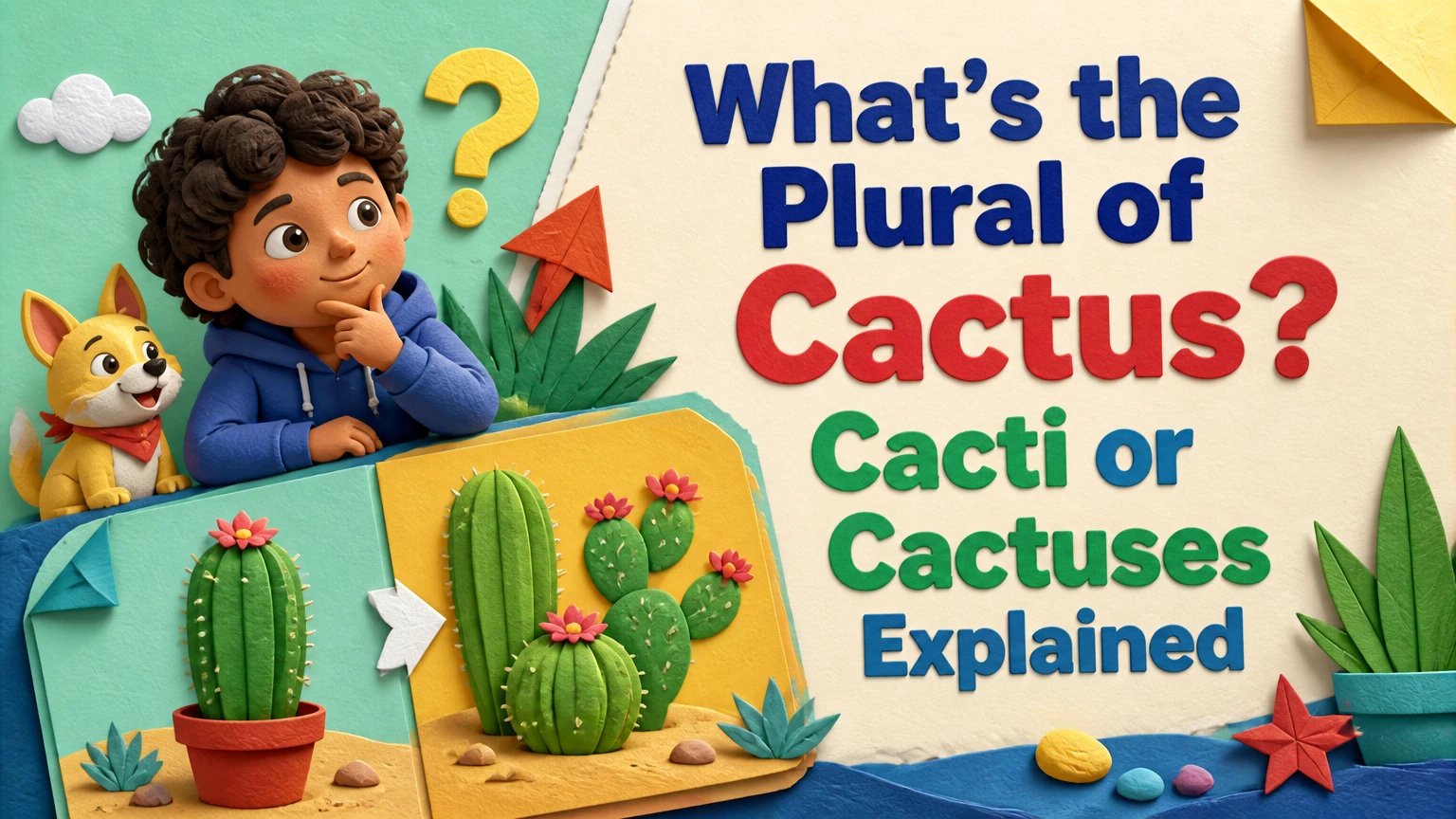
The plural of cactus can be either cacti or cactuses. Cacti is the traditional plural inherited from Latin, while cactuses is the regular English plural formed with -es. Both forms are standard and correct; choose according to audience, register, regional preference, and the convention of your publication or institution.
Key Facts at a Glance
Cacti and cactuses are both accepted English plurals of cactus.
Cacti follows the Latin plural pattern for many masculine nouns ending in -us.
Cactuses applies ordinary English pluralization and is especially natural in general conversation.
Cacti often appears in botanical, horticultural, academic, and formal contexts.
Cactuses is not a grammatical error, even though some traditionalists prefer cacti.
The correct singular is one cactus; the correct plural is several cacti or several cactuses.
What’s the Plural of Cactus?
The plural of cactus is cacti or cactuses, with neither form being categorically more correct. Cacti sounds traditional and technical, whereas cactuses sounds fully natural in ordinary English. A sentence such as “The desert contains many cacti” and a sentence such as “The shop sells several small cactuses” are both grammatically correct.
The choice is mainly stylistic. A botany textbook, botanical garden label, or scientific paper may favor cacti, particularly when the surrounding vocabulary is technical. A children’s book, newspaper, product description, or conversation may use cactuses because the regular English ending is immediately familiar.
Neither plural changes the plant’s meaning. Both forms refer to multiple members of the cactus family in ordinary English.
Is Cacti the Correct Plural?
Cacti is a correct plural of cactus and is the traditional Latin-based form. Latin nouns ending in -us do not all take -i, but cactus belongs to the Latin pattern that produces cacti. English retained that form after borrowing the word.
The ending is pronounced in two common ways. English speakers often say cacti as “KAK-tie,” while some use “KAK-tee,” especially in technical or regionally influenced speech. Both pronunciations occur in established English usage, although “KAK-tie” is widely recognized in American English.
The word cacti frequently appears in formal contexts:
- A greenhouse contains more than 200 cacti.
- The researcher measured water loss in five cacti.
- The botanical garden’s desert house displays Mexican cacti.
- Several cacti survived the unusually cold winter.
A frequent spelling error is cactis. The correct form is cacti, spelled with a final i.
Is Cactuses a Correct Plural?
Cactuses is a correct English plural of cactus. English speakers form it by adding -es, just as they do with many borrowed nouns that have become ordinary English vocabulary. The form usually receives three syllables, pronounced approximately “KAK-tuh-siz.”
Regularization is a normal feature of language change. Borrowed words often preserve an older plural for a time, then develop an English plural, or retain both forms with different stylistic associations. Cactuses follows the same broad pattern found in pairs such as indexes and indices, or formulas and formulae, although the preferred options differ by word and field.
Examples of natural usage include:
- The apartment has three potted cactuses.
- The children painted colorful cactuses at art class.
- The store replaced its damaged cactuses.
- Several tall cactuses grew beside the trail.
Calling cactuses wrong confuses tradition with grammar. Major English dictionaries list the form as standard.
Why Does Cactus Have Two Plurals?
Cactus has two plurals because English retained a Latin form while also creating a regular English form. The Latin-derived cacti entered English through learned and scientific usage, while cactuses developed through ordinary English pluralization. Both forms survived because speakers use them in overlapping contexts.
The noun ultimately traces back to Ancient Greek kaktos, a word associated with a spiny plant. Latin adopted the word as cactus, and English borrowed it in the early modern period. The historical path explains why cacti has a Latin appearance, but origin alone does not determine modern English correctness.
Borrowing is not a one-time event. After a word enters English, speakers adapt its spelling, pronunciation, and inflection to English patterns. The coexistence of cacti and cactuses records two stages of that process:
- A learned plural preserves the source language’s morphology.
- A regular plural fits productive English grammar.
- Different communities assign different levels of formality to each form.
English does not require every borrowed noun to keep its original plural.
How Do You Choose Between Cacti and Cactuses?
Choose cacti for a technical, botanical, or formal register, and choose cactuses when a plain, conversational English tone matters more. If a house style, instructor, journal, or employer specifies one form, follow that instruction consistently.
| Situation | Recommended form | Example sentence | Reason |
|---|---|---|---|
| Botanical research | cacti | The study examined 18 cacti | Technical convention |
| Botanical garden label | cacti | Cacti of the Sonoran Desert | Concise formal register |
| General conversation | cactuses | We bought two cactuses | Natural regular plural |
| Children’s writing | cactuses | The cactuses need sunlight | Familiar pronunciation |
| Academic essay | cacti | Several cacti tolerate drought | Formal vocabulary |
| Newspaper feature | Either | Both forms are acceptable | Match publication style |
| Creative dialogue | Either | Character voice determines choice | Register and personality |
| Product listing | cactuses | Six small cactuses in ceramic pots | Consumer-friendly wording |
A writer should not alternate randomly within one short passage. Repeated switching can look like an editing oversight, especially when the text discusses the same plants in the same register.
Consistency matters more than claiming that one form is universally superior.
Is Cacti More Formal Than Cactuses?
Cacti is generally more formal or technical than cactuses, but the difference is one of register rather than grammatical correctness. Scientific writers, horticulturists, and institutions often prefer cacti because the form connects with botanical tradition. General readers may find cactuses more conversational.
The distinction is not absolute. A casual speaker may say cacti, and a botanist may write cactuses when addressing children or a broad public audience. Audience determines the most effective choice.
| Register | More likely choice | Typical audience | Example |
|---|---|---|---|
| Scientific | cacti | Researchers and students | Cacti regulate gas exchange at night |
| Horticultural | cacti | Gardeners and growers | Fertilize cacti during active growth |
| Institutional | cacti | Museums and gardens | Native cacti occupy this habitat |
| General journalism | Either | Newspaper readers | The storm damaged desert plants |
| Retail | cactuses | Home gardeners | Indoor cactuses need bright light |
| Informal speech | cactuses | Friends and family | Those cactuses are growing fast |
The practical rule is simple: use cacti when technical convention helps the text, and use cactuses when ordinary English improves accessibility.
Do Botanists Prefer Cacti?
Many botanists and horticultural institutions prefer cacti, but cactuses remains grammatically acceptable in botanical communication. Professional preference often reflects tradition, terminology, and the expected audience rather than a rule that invalidates the regular English plural.
Scientific taxonomy introduces an important distinction. Cactus can refer to the common plant group, but a scientific name follows formal nomenclatural conventions. Scientific names are italicized, capitalized according to rank, and governed by international codes. The plural of a genus name is often avoided in formal taxonomic writing; authors may write “species of Cactus” instead of treating the genus name as an ordinary plural noun.
That convention does not make cacti the only valid plural in general English. A museum label might say “native cacti,” while a public-facing gardening guide might say “easy-care cactuses.” Both can communicate accurately.
What Is the Plural in Botanical Writing?
In ordinary botanical prose, cacti is the safest traditional choice when the text addresses professionals or uses specialized terminology. The word fits naturally beside terms such as succulent, areole, xerophyte, photosynthesis, and drought tolerance.
A formal sentence might read:
The collection includes 42 cacti from the Chihuahuan Desert.
A public interpretation panel might instead read:
These cactuses store water in thick stems.
The second sentence is not scientifically defective because it uses cactuses. It simply uses a more regular English form for a broad audience.
Is Cacti Singular or Plural?
Cacti is plural, not singular. The singular noun is cactus, so the correct pair is “one cactus” and “two cacti.” The plural noun takes plural determiners and plural verbs.
| Number | Correct noun phrase | Correct verb phrase | Incorrect example |
|---|---|---|---|
| One | one cactus | The cactus is flowering | one cacti |
| Two | two cacti | The cacti are flowering | two cactus |
| Several | several cactuses | The cactuses are indoors | several cactus |
| No specified number | many cacti | Many cacti need sunlight | many cactus |
| Scientific reference | species of Cactus | The species occurs in Mexico | cacti species, in formal taxonomy |
Correct agreement includes:
- This cactus is flowering.
- These cacti are flowering.
- That group of cactuses is in the greenhouse.
- Several cacti have developed new growth.
The phrase a cactus is singular. The phrase a group of cacti is grammatically singular because the head noun is group, not cacti.
How Are Cacti and Cactuses Pronounced?
Cacti is commonly pronounced “KAK-tie” or “KAK-tee,” while cactuses is usually pronounced “KAK-tuh-siz.” Pronunciation can vary by region, profession, and speaker, but the spelling cactuses does not use the sound found in the ending of “houses.”
| Form | Common pronunciation | Syllables | Practical note |
|---|---|---|---|
| cactus | KAK-tus | 2 | Singular form |
| cacti | KAK-tie | 2 | Common American pronunciation |
| cacti | KAK-tee | 2 | Also established in English |
| cactuses | KAK-tuh-siz | 3 | Regular English plural |
| cactus plants | KAK-tus plants | 3 | Useful plain-English alternative |
Writers sometimes avoid a perceived pronunciation problem by using cactus plants. That phrase is understandable, but it is not always an improvement. In a sentence that already establishes the plant category, either plural noun is shorter and more precise.
Is Cacti More Common Than Cactuses?
Cacti often appears more frequently in formal and published writing, but no single percentage describes all English usage. Relative frequency changes according to country, publication type, date, subject area, and whether the source contains scientific or conversational language.
Claims such as “cacti is used 70% of the time” should not be treated as a universal language statistic unless they identify a corpus, search period, sampling method, and genre. Google Books Ngram Viewer, newspaper databases, web corpora, and spoken-language corpora measure different populations. A result from one database cannot establish a fixed rule for all English.
The frequency difference makes practical sense. Cacti is favored by botanical institutions and formal publications, while cactuses is more likely in conversation, retail copy, children’s material, and accessible journalism. A technical corpus can therefore produce a much larger proportion of cacti than a corpus of everyday speech.
Frequency is evidence of preference, not a test of grammatical validity.
Do American and British English Use Different Forms?
American and British English both accept cacti and cactuses, although local editorial traditions can influence preference. American speakers commonly recognize both forms, while British writers may also use cacti in formal or horticultural contexts and cactuses in ordinary English.
Regional preference is weaker here than with some vocabulary differences. The same speaker may choose cacti in a gardening article and cactuses in a conversation without considering the forms contradictory.
| English variety or context | Likely tendency | Status of the other form |
|---|---|---|
| American academic prose | cacti | cactuses remains correct |
| American conversation | cactuses or cacti | Both understood |
| British horticultural prose | cacti | cactuses remains correct |
| British general prose | Either | Neither is disallowed |
| International science writing | cacti | Follow journal house style |
| English as an additional language | cacti often taught first | cactuses is standard too |
A regional audience may influence tone, but it should not be presented as a strict American-versus-British grammar rule.
Should Students Write Cacti or Cactuses?
Students should follow the teacher’s rubric, course style guide, or required dictionary; when no instruction exists, cacti is a conservative choice for formal academic prose. A student will not normally lose correctness for writing cactuses, but a consistent register can make the work appear more controlled.
For a biology report, cacti fits the subject’s formal vocabulary:
The cacti were placed under controlled light conditions.
For a personal narrative, cactuses may sound more natural:
My grandmother kept three cactuses on the kitchen windowsill.
Students should avoid claiming that cactuses is wrong. If an instructor prefers cacti, describe that preference as a class or style requirement rather than a universal grammar law.
Can You Use Cacti and Cactuses in the Same Document?
You can use both forms in one document, but consistent usage is usually clearer when the noun has the same meaning and register throughout. Switching forms may be justified when the audience or voice changes, such as in a quoted conversation inside a scientific article.
A document can legitimately contain both forms in separate contexts:
The laboratory examined desert cacti. In the children’s exhibit, visitors could touch several harmless cactuses.
The first form fits research language, and the second suits a public exhibit. However, this sentence is needlessly inconsistent:
The greenhouse contains cacti and several cactuses of the same species.
A cleaner version is:
The greenhouse contains several cacti of the same species.
An editor’s rule of thumb is to select one form for the dominant register, then change it only when a deliberate shift in audience, quotation, or voice requires the alternative.
What Are Common Cactus Plural Mistakes?
The most common mistakes are treating cactuses as incorrect, spelling cacti as cactis, using singular agreement with cacti, and confusing a genus name with an ordinary common noun. Each error has a straightforward correction.
- Wrong: The cactuses are incorrect grammar.
Correct: Cactuses is a standard plural. - Wrong: The cactis need water.
Correct: The cacti need water. - Wrong: These cacti is flowering.
Correct: These cacti are flowering. - Wrong: One cacti grew beside the path.
Correct: One cactus grew beside the path. - Potentially imprecise: Three Cactus were identified.
Better formal wording: Three species of Cactus were identified.
The last example concerns scientific naming, not ordinary plural grammar. Writers should preserve italics and nomenclatural conventions when referring to a formal genus.
What Alternative Can You Use Instead of Cacti or Cactuses?
Cactus plants is the clearest alternative when a writer wants to avoid choosing between the two accepted plurals. The phrase is slightly longer and can sound repetitive if the context already makes the plant category obvious.
| Alternative phrase | Best context | Example | Limitation |
|---|---|---|---|
| cactus plants | General audience | Cactus plants need bright light | Slightly repetitive |
| desert plants | Broad ecological discussion | Desert plants conserve water | Includes non-cacti |
| succulent plants | Horticultural comparison | Succulent plants vary widely | Includes many other families |
| members of the cactus family | Formal explanation | Members of the cactus family flower at night | Longer phrasing |
| species of Cactaceae | Taxonomic context | Species of Cactaceae occur worldwide | More technical |
Do not use succulents as a perfect synonym. Every cactus is a succulent, but many succulents are not cacti. The broader term changes the biological scope.
Which Form Should You Choose?
Use cacti in scientific papers, botanical labels, formal academic work, and technical horticultural writing unless the relevant style guide says otherwise. Use cactuses in casual speech, children’s writing, retail copy, and general-audience prose when a regular English plural sounds more direct.
The following decision guide handles most real editing situations:
- Writing for botanists: choose cacti.
- Writing a biology assignment: choose cacti, unless the instructor specifies another form.
- Writing dialogue: choose the form that matches the speaker.
- Writing for children: choose cactuses when pronunciation and familiarity matter.
- Writing product descriptions: choose cactuses for a conversational retail tone.
- Writing a formal garden label: choose cacti.
- Editing an existing manuscript: preserve the author’s consistent choice unless house style requires a change.
- Writing for an international audience: either form works; define the plant category if technical precision matters.
The central editorial rule is consistency with audience and register.
FAQ
Is “cactuses” considered bad grammar?
No. Cactuses is a standard English plural listed by major dictionaries, including Merriam-Webster, Oxford English Dictionary resources, and Cambridge Dictionary resources. Traditionalists may prefer cacti because it follows Latin morphology, but preference does not turn the regular English plural into an error.
What is the plural of cactus in a sentence?
Both examples are correct: “The desert contains many cacti” and “The nursery sells several cactuses.” Use a plural verb with either form, as in “The cacti are flowering” or “The cactuses are flowering.”
Is “cactuses” or “cacti” better for a resume?
Cacti is usually the safer choice for a formal resume, especially when describing botanical, horticultural, ecological, or research experience. The wording should still match the employer’s style and the surrounding vocabulary. For a general audience, cactus plants may be clearer than either specialized plural.
Can cactus be used as a collective or mass noun?
Yes, but the meaning changes. In “The greenhouse grows cactus,” cactus functions as a broad material or category term, similar to “cactus as a plant type.” When counting individual plants, use cacti or cactuses, as in “The greenhouse grows 80 cacti.”
Is the plural of cactus “cactopodes”?
No. Cactopodes is not the ordinary English plural of cactus. The standard choices are cacti and cactuses. Invented alternatives may appear as jokes or wordplay, but they are not appropriate in formal writing.
Do all words ending in “-us” take “-i” in the plural?
No. English nouns ending in -us use several plural patterns. Examples include bus/buses, virus/viruses, campus/campuses, octopus/octopuses, and alumnus/alumni. The ending alone does not determine the plural, so each borrowed noun must be checked individually.
The Bottom Line
The answer to what’s the plural of cactus is cacti or cactuses. Choose cacti for traditional, botanical, scientific, and formal contexts; choose cactuses for regular, conversational, and general-audience English. Both forms are correct, and the best choice depends on register, audience, regional preference, and house style.