
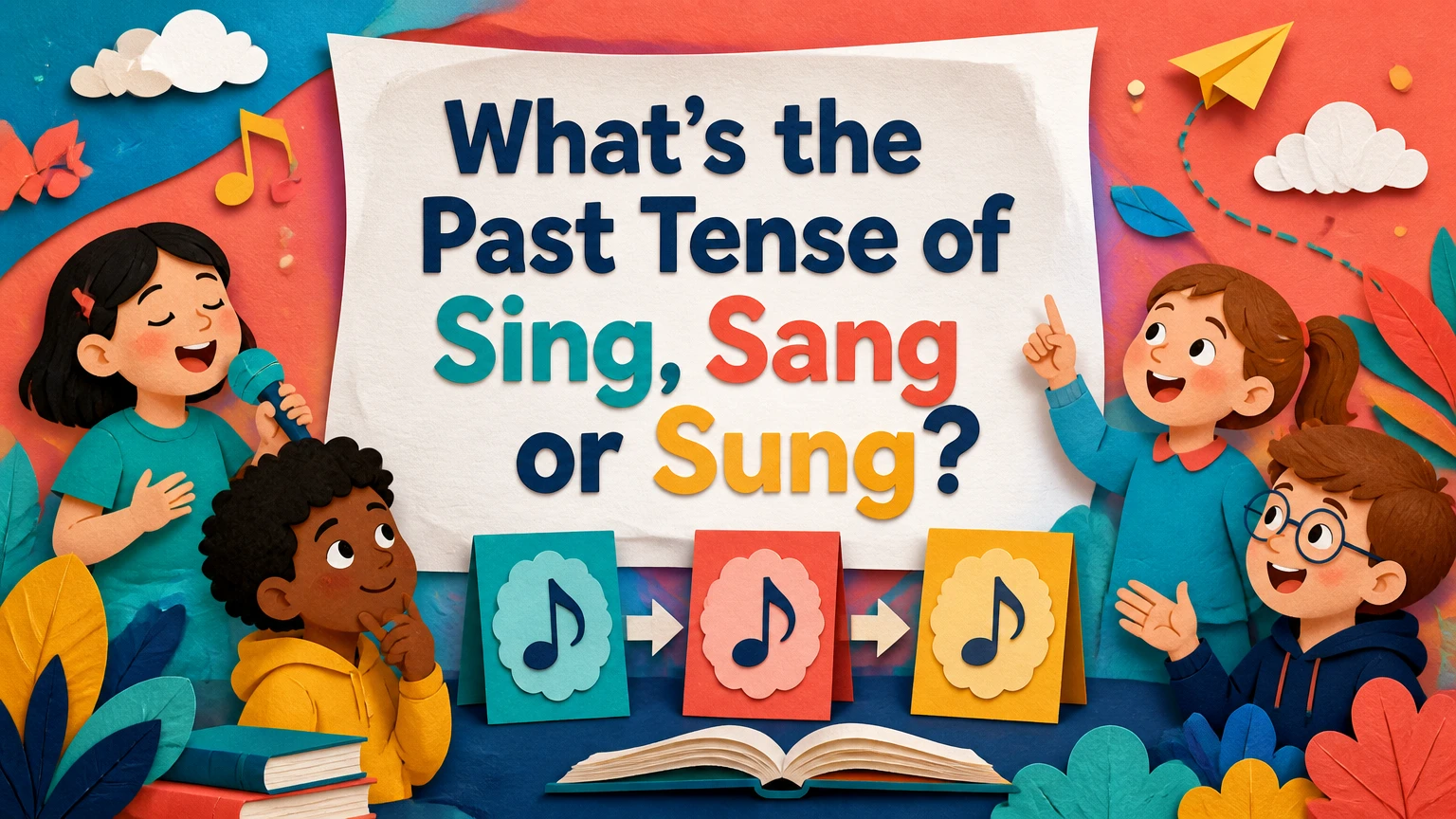
The past tense of sing is sang: “She sang at the concert yesterday.” Sung is the past participle, used with a helping verb such as has, have, or had, as in “She has sung at many concerts.” The complete principal-part sequence is sing, sang, sung.
Key Facts at a Glance
- Sing is the present or base form: “I sing in the choir.”
- Sang is the simple past form: “I sang last night.”
- Sung is the past participle: “I have sung that song before.”
- Singing is the present participle and gerund: “They are singing.”
- Sings is the third-person singular present form: “He sings professionally.”
- Singed is usually the past tense of singe, meaning to burn superficially, not a form of sing.
What Is the Past Tense of Sing?
The simple past tense of sing is sang. Use sang for an action that happened and finished in the past, whether the sentence names a specific time or describes a completed event in a story.
Examples include:
- “Maya sang the national anthem.”
- “The children sang before lunch.”
- “I sang that song when I was younger.”
- “We sang for two hours at the festival.”
The sentence does not need have, has, or had before sang. In standard English, “She sang yesterday” is correct, while “She sung yesterday” is generally incorrect in edited writing.
English calls sing an irregular verb because its past form does not add the regular -ed ending. The vowel changes instead. The pattern is traditionally written i-a-u, although the broader history of English contains several related vowel patterns and sound changes.
Is Sung a Past Tense or Past Participle?
Sung is the past participle of sing, not the ordinary simple past form. The past participle normally combines with an auxiliary verb to create a perfect tense or passive construction.
Compare these sentences:
- Simple past: “The choir sang beautifully.”
- Present perfect: “The choir has sung beautifully.”
- Past perfect: “The choir had sung before the guests arrived.”
- Passive voice: “The anthem was sung by the choir.”
A useful editing rule is simple: if the sentence describes a completed past action with no helping verb, choose sang. If the sentence contains has, have, had, is, are, was, or were in a construction that requires a participle, sung may be correct.
Complete Forms of Sing
| Form | Grammatical name | Example | Typical function |
|---|---|---|---|
| sing | Base or present form | “I sing daily.” | Present actions, infinitives, commands |
| sings | Third-person singular present | “Lena sings daily.” | Present with he, she, or it |
| sang | Simple past | “Lena sang yesterday.” | Completed past action |
| sung | Past participle | “Lena has sung.” | Perfect tenses and passive voice |
| singing | Present participle or gerund | “Lena is singing.” | Progressive tenses and noun-like use |
When Should You Use Sang?
Use sang when the verb itself carries the past-time meaning without requiring a perfect or passive construction. A finished performance, a remembered event, or a past habit can all use sang.
The simple past is especially common with time expressions such as yesterday, last week, in 2022, when I was young, and earlier this morning. The exact time can remain unstated if the surrounding story establishes that the action happened in the past.
Examples:
- “The soloist sang the final verse.”
- “Our class sang in the assembly.”
- “He sang every evening during the summer.”
- “Who sang that opening line?”
- “The audience sang along.”
Sang in Questions and Negatives
Questions and negatives use the base form sing after the auxiliary did. English does not normally use sang after did, because did already marks the past tense.
| Sentence type | Correct example | Incorrect example |
|---|---|---|
| Statement | “She sang at noon.” | “She sung at noon.” |
| Question | “Did she sing at noon?” | “Did she sang at noon?” |
| Negative | “She did not sing at noon.” | “She did not sang at noon.” |
| Emphatic statement | “She did sing at noon.” | “She did sang at noon.” |
The grammatical principle extends beyond sing. After did, use the plain base form: did go, did write, did swim, and did sing.
When Should You Use Sung?
Use sung after an auxiliary verb in perfect tenses or passive voice. The most common perfect constructions are has sung, have sung, and had sung, while passive constructions include was sung, were sung, and is sung.
Examples of perfect tenses:
- “She has sung in three productions.”
- “They have sung this hymn before.”
- “He had sung before the microphone failed.”
- “By 8 p.m., the band had sung six songs.”
Examples of passive voice:
- “The song was sung in Spanish.”
- “Three verses were sung by the audience.”
- “The lullaby is sung at the end of the ceremony.”
Sung does not always appear beside an auxiliary in every shortened or descriptive construction. For example, “the song sung by the finalist” is a reduced relative clause equivalent to “the song that was sung by the finalist.” In ordinary learner writing, however, treating sung as auxiliary-dependent prevents most errors.
Sang Versus Sung: What Is the Difference?
Sang is the simple past form, while sung is the past participle. The choice depends on the grammatical structure, not on how recent, impressive, or repeated the performance was.
| Feature | Sang | Sung |
|---|---|---|
| Verb form | Simple past | Past participle |
| Auxiliary required in ordinary use | No | Usually yes |
| Example with yesterday | “She sang yesterday.” | Not standard: “She sung yesterday.” |
| Present perfect | Not used | “She has sung.” |
| Past perfect | Not used | “She had sung.” |
| Passive voice | Not used for the passive verb | “The song was sung.” |
| Question with did | “Did she sing?” | Not applicable |
The common error “He has sang” combines the wrong form with a perfect auxiliary. The correction is “He has sung.” Conversely, “He sung yesterday” should normally become “He sang yesterday.”
A Fast Sang-or-Sung Decision Test
Ask two questions:
- Does did appear before the verb? Use sing: “Did they sing?”
- Does has, have, had, is, are, was, or were create a perfect, progressive, or passive construction? Check whether the grammar requires sung: “They have sung” or “The song was sung.”
If neither condition applies and the sentence describes a completed past action, sang is usually the correct choice.
How Do Perfect Tenses Use Sung?
Perfect tenses use a form of have plus the past participle sung. Present perfect uses has sung or have sung, and past perfect uses had sung; the auxiliary expresses the timeline while sung identifies the completed singing event.
| Tense | Auxiliary pattern | Example | Meaning |
|---|---|---|---|
| Present perfect | has/have + sung | “She has sung here before.” | Past event connected to now |
| Past perfect | had + sung | “She had sung before dinner.” | Earlier than another past event |
| Future perfect | will have + sung | “She will have sung by eight.” | Completed before a future point |
| Modal perfect | should/could/might have + sung | “They might have sung already.” | Possibility or judgment about a past event |
The auxiliary must agree with the subject and tense. “They have sung” is correct, while “They has sung” is not. In a sentence with a modal, the sequence is might have sung, not might has sung.
How Does the Passive Voice Use Sung?
The passive voice uses sung when the song, anthem, hymn, or melody is more important than the performer. The standard pattern is a form of be plus sung, optionally followed by by and the performer.
Active and passive sentences express related information:
- Active: “The choir sang the anthem.”
- Passive: “The anthem was sung by the choir.”
- Active: “The audience sang three verses.”
- Passive: “Three verses were sung by the audience.”
The passive form changes the subject and uses a form of be. The tense appears partly in was, were, or is, while sung remains the participle.
| Active sentence | Passive sentence | Tense |
|---|---|---|
| “The choir sang the hymn.” | “The hymn was sung by the choir.” | Simple past |
| “The choir has sung the hymn.” | “The hymn has been sung by the choir.” | Present perfect |
| “The choir will sing the hymn.” | “The hymn will be sung by the choir.” | Future |
| “The choir is singing the hymn.” | “The hymn is being sung by the choir.” | Present progressive |
Passive voice is useful when the performer is unknown or less relevant. It is less direct when the writer wants to emphasize who performed the action.
Why Is Singed Usually Wrong?
Singed is usually the past tense or past participle of singe, a different verb meaning “to burn lightly.” The correct past form of sing, meaning to produce musical notes with the voice, is sang.
Compare:
- “The soprano sang an aria.”
- “The flame singed the paper.”
- “The smoke singed his eyebrows.”
- “The paper was singed at the edge.”
“Singed” therefore belongs in a sentence about heat, burning, or scorching. A sentence such as “She singed at the concert” changes the meaning and is not a standard substitute for “She sang.”
Which Verbs Resemble Sing?
Several irregular verbs use related vowel changes, but learners should memorize each verb’s forms rather than assume that every English verb follows a perfect i-a-u sequence.
| Base form | Simple past | Past participle | Example |
|---|---|---|---|
| sing | sang | sung | “They sang and have sung.” |
| ring | rang | rung | “The bell rang and has rung.” |
| swim | swam | swum | “He swam and has swum.” |
| drink | drank | drunk | “She drank and has drunk.” |
| begin | began | begun | “The show began and has begun.” |
The vowel pattern is a memory aid, not a complete grammatical law. Pronunciation also changes across forms: sing commonly has /ɪ/, sang has /æ/, and sung commonly has /ʌ/ in many varieties of English. Regional accents can alter the exact vowel sound without changing the spelling rule.
Can You Say “I Sung It”?
In standard edited English, use “I sang it” for a completed past action and “I have sung it” when the present perfect is intended. “I sung it” occurs in some dialects and informal speech, but it is not the safest choice for schoolwork, professional writing, exams, or formal editing.
| Intended meaning | Standard sentence | Why |
|---|---|---|
| Completed event | “I sang it yesterday.” | Simple past requires sang |
| Experience up to now | “I have sung it before.” | Perfect tense requires sung |
| Earlier past event | “I had sung it already.” | Past perfect requires sung |
| Passive event | “It was sung by me.” | Passive voice requires sung |
| Question about a past event | “Did you sing it?” | Did takes the base form |
Dialect variation is real, but audience expectations matter. A novelist writing dialogue may preserve a character’s regional grammar; an academic essay should use the standard distinction.
Is “He Has Sang” Correct?
“He has sang” is not standard English because has requires the past participle, sung. The corrected sentence is “He has sung.”
The same rule applies to every perfect auxiliary:
- “She has sung the solo.”
- “They have sung together for years.”
- “He had sung before the guests arrived.”
- “We could have sung another verse.”
The form sang can follow a subject directly in a simple past statement, but it cannot normally follow has, have, or had. Remember the contrast as two fixed frames:
- Subject + sang: “The child sang.”
- Subject + has/have/had + sung: “The child has sung.”
How Can You Remember Sing, Sang, Sung?
Memorize sing, sang, sung as one three-part sequence, then attach a sentence frame to each form. A practical five-minute drill can establish the distinction more reliably than repeating the isolated words.
Use these frames:
- Sing: “I sing every day.”
- Sang: “I sang yesterday.”
- Sung: “I have sung before.”
- Singing: “I am singing now.”
- Singed: “The heat singed the cloth.”
Say each sentence aloud, write each sentence once, and then create a new example involving a real event. A useful practitioner rule is to memorize the auxiliary with the participle: think have sung, not merely sung.
For additional practice, substitute ring/rang/rung, swim/swam/swum, and begin/began/begun. The comparison helps learners notice the grammatical role of the form, although the vocabulary must still be learned individually.
Common Mistakes and Fast Corrections
| Mistake | Correction | Rule |
|---|---|---|
| “She sung yesterday.” | “She sang yesterday.” | Simple past uses sang |
| “He has sang twice.” | “He has sung twice.” | Perfect tense uses sung |
| “Did they sang?” | “Did they sing?” | Did takes the base form |
| “The song was sang.” | “The song was sung.” | Passive voice uses sung |
| “The fire sung the paper.” | “The fire singed the paper.” | Singed comes from singe |
| “They are sang now.” | “They are singing now.” | Progressive tense uses singing |
One counterintuitive point matters: sung does not mean “more strongly past” than sang. The difference is grammatical structure. A short action yesterday uses sang, while a lifetime of performances can use has sung because the perfect construction links the past event to another time.
Another useful editing rule concerns did. Writers sometimes add two past markers, producing “did sang.” English normally permits one past-tense marker in that clause, so did sing is the standard form.
Are There Regional Variations?
Regional and social dialects may use sung where standard edited English uses sang, especially in informal speech or dialogue. The variation does not change the formal rule expected in international English instruction, examinations, business writing, and most edited publications.
Some speakers also use nonstandard forms such as “I seen” or “he done,” but their presence in speech does not make them appropriate in every register. Editors should distinguish a deliberate dialect portrayal from an accidental grammar error.
Pronunciation varies as well. The spelling remains sing, sang, sung, while vowel quality can differ among American, British, Australian, and other English varieties. Pronunciation dictionaries such as the Cambridge English Dictionary and Oxford Learner’s Dictionaries provide audio models, but the grammatical roles remain the same.
What Is the Simplest Rule for Sing, Sang, and Sung?
Use sing for the present or after did, sang for a completed simple past action, and sung after a perfect or passive auxiliary. The compact rule is:
Sing now, sang yesterday, have sung before.
Examples make the rule concrete:
- Now: “I sing in a band.”
- Past: “I sang in a band last year.”
- Perfect: “I have sung in a band for ten years.”
- Progressive: “I am singing in a band tonight.”
- Passive: “The song was sung by the band.”
The rule is highly reliable for standard English, but sung can appear without an immediately visible auxiliary in a reduced clause such as “the hymn sung at the service.” That construction abbreviates “the hymn that was sung at the service,” so it does not undermine the ordinary learner rule.
Frequently Asked Questions
What Is the Past Participle of Sing?
The past participle of sing is sung. Use sung with has, have, or had in perfect tenses, as in “She has sung,” and with a form of be in passive voice, as in “The anthem was sung.”
Is “I Have Sang” Ever Correct?
In standard edited English, “I have sang” is incorrect. The correct sentence is “I have sung,” because have requires the past participle. Some dialects may use have sang in informal speech, but formal writing should use have sung.
Is “Sang” a Past Participle?
No. Sang is the simple past form, while sung is the past participle. “The singer sang yesterday” uses simple past; “the singer has sung before” uses the past participle in the present perfect.
What Is the Past Tense of “Sing” in a Question?
After did, use the base form sing: “Did she sing?” Do not write “Did she sang?” because did already marks the past tense. Without did, use sang in a past-tense question such as “Who sang the solo?”
What Is the Difference Between “Singing” and “Sung”?
Singing is the present participle and appears in progressive constructions such as “They are singing.” Sung is the past participle and appears in perfect or passive constructions such as “They have sung” and “The song was sung.”
Can “Sung” Appear Without “Have” or “Be”?
Yes, but the construction is usually reduced or descriptive: “the song sung by the finalist.” The full form is “the song that was sung by the finalist.” In a normal standalone past-tense statement, use sang, as in “The finalist sang the song.”
The Bottom Line
The answer to whats the past tense of sing sang or sung is sang. Use sang for the simple past, sung as the past participle after an appropriate auxiliary, and singing for progressive actions. The complete sequence is sing, sang, sung: “I sing today, I sang yesterday, and I have sung before.”


