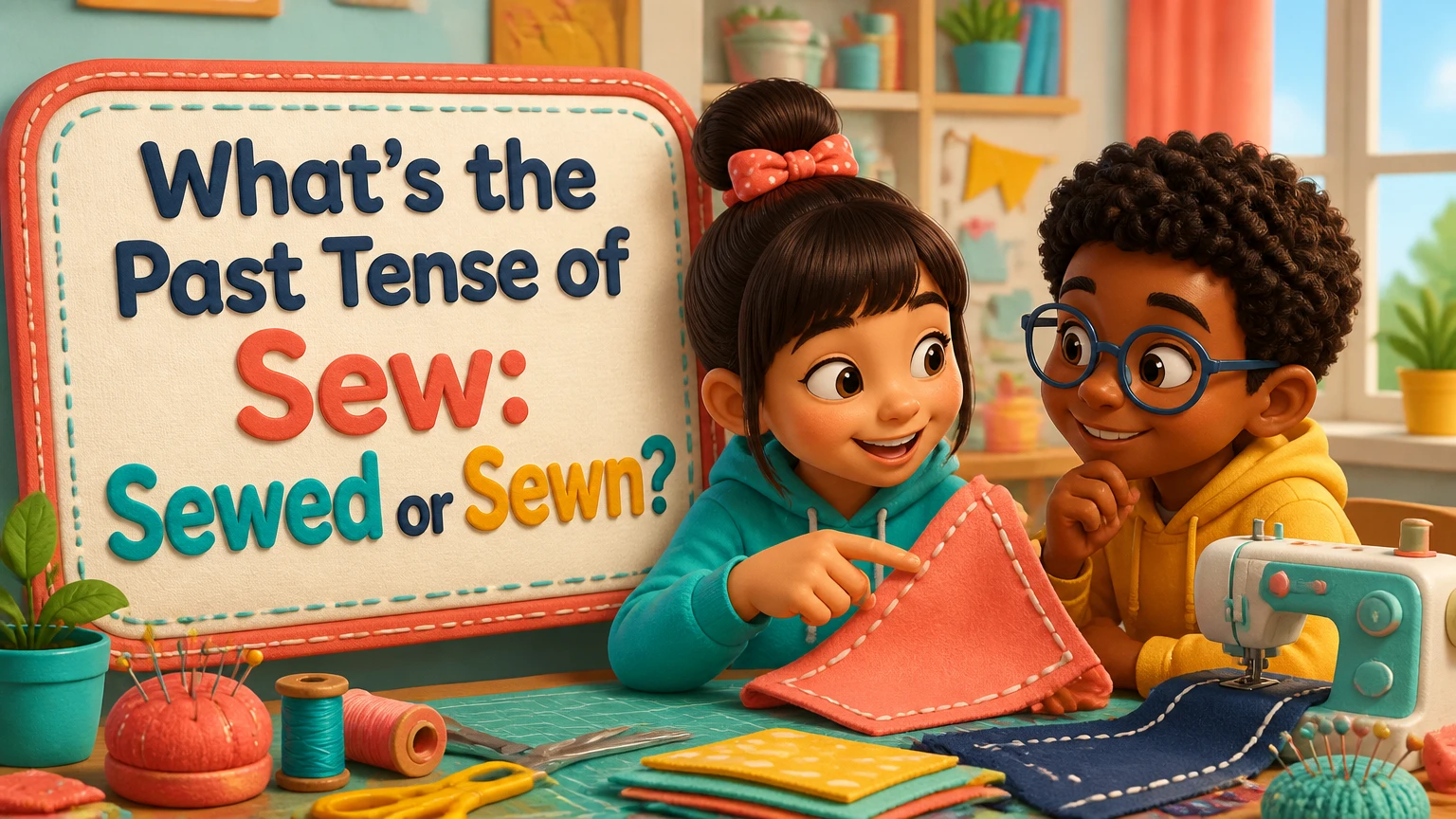
The simple past tense of sew is sewed: “I sewed a button onto my coat yesterday.” Sewn is usually the past participle, used after has, have, or had, as in “She has sewn three quilts,” and as an adjective, as in “a hand-sewn dress.” Sewed can also function as a past participle, but sewn is the usual modern choice.
Key Facts at a Glance
- Sewed is the standard simple past tense of sew.
- Sewn is the most common past participle of sew.
- Sewed is also grammatically possible after has, have, or had, especially in some American usage.
- Use sewn in compounds such as hand-sewn, machine-sewn, and newly sewn.
- “I sewn a shirt yesterday” is incorrect because simple past requires sewed.
- The verb sew means to join material with a needle and thread; it is pronounced like so, not like “sow” when referring to planting seeds.
What Is the Past Tense of Sew?
The past tense of sew is sewed. Use sewed when describing a completed action in the past without a perfect-tense helper verb: “Maria sewed the torn pocket last night.” The form sewn does not normally work as the standalone simple past.
English verbs have several forms that perform different grammatical jobs. The fact that sew has both sewed and sewn does not mean the two forms are interchangeable in every sentence.
| Verb form | Word | Main grammatical function | Example |
|---|---|---|---|
| Base form | sew | Present, infinitive, command | “I can sew a hem.” |
| Third-person present | sews | Present with he, she, or it | “He sews costumes.” |
| Simple past | sewed | Completed past action | “She sewed a patch.” |
| Past participle | sewn, sewed | Perfect or passive construction | “They have sewn the lining.” |
| Present participle | sewing | Progressive form or gerund | “They are sewing.” |
The safest rule for learners is simple: use sewed for a completed past action and sewn after has, have, or had. That rule produces standard, natural English in schoolwork, professional writing, and everyday conversation.
How Do Sewed and Sewn Work Grammatically?
Sewed names a past action directly, while sewn normally needs a helper verb or functions as an adjective. The difference comes from the distinction between the simple past and the past participle, not from a difference in the sewing method or the material involved.
Simple past: use sewed
The simple past contains the main verb by itself:
- “I sewed the button on Tuesday.”
- “The tailor sewed a new sleeve.”
- “We sewed the costume by hand.”
- “They sewed the label inside the jacket.”
Negative sentences use did not sew, not did not sewed, because did already carries the past tense:
- Correct: “I did not sew the hem.”
- Incorrect: “I did not sewed the hem.”
Questions follow the same pattern:
- Correct: “Did you sew the pocket?”
- Incorrect: “Did you sewed the pocket?”
Perfect tenses: usually use sewn
The past participle appears with has, have, or had:
- “I have sewn four pillow covers.”
- “She has sewn the opening closed.”
- “They had sewn the costumes before rehearsal.”
- “We will have sewn the last seam by noon.”
The helper verb indicates the tense. Sewn identifies the completed action as a participle.
Passive voice: usually use sewn
Passive sentences focus on the item receiving the action:
- “The dress was sewn in Italy.”
- “The samples were sewn by hand.”
- “The torn fabric had been sewn before inspection.”
- “The seam will be sewn with polyester thread.”
Was sewed and were sewed can occur, especially when writers treat sewed as an alternative past participle. However, was sewn and were sewn are more widely accepted and usually sound more natural.
Is Sewed or Sewn the Past Participle?
Sewn is the preferred past participle in most edited English, although sewed is also recorded as a past participle. A writer choosing the most broadly understood form should use sewn after perfect-tense auxiliaries and in passive constructions.
| Sentence pattern | Preferred form | Example |
|---|---|---|
| Simple past | sewed | “Lena sewed the curtain.” |
| Present perfect | sewn | “Lena has sewn the curtain.” |
| Past perfect | sewn | “Lena had sewn the curtain.” |
| Future perfect | sewn | “Lena will have sewn the curtain.” |
| Passive voice | sewn | “The curtain was sewn overnight.” |
| Participial adjective | sewn | “The finely sewn curtain looked precise.” |
A sentence such as “I have sewed a quilt” is not automatically impossible. Major dictionaries record sewed as an alternative past participle, and some speakers use it naturally. The form is less consistent across dialects and editorial styles, so I have sewn a quilt remains the safer choice when clarity and formal standard usage matter.
Can Sewn Be an Adjective?
Sewn can function as an adjective when it describes a completed or constructed item. The adjective commonly appears before a noun or after a linking verb, particularly in compounds that identify how an object was made.
Examples include:
- “a hand-sewn leather wallet”
- “a machine-sewn blanket”
- “a carefully sewn seam”
- “The buttons are securely sewn.”
- “The costume has a sewn-in label.”
- “The opening was sewn shut.”
The adjective sewn does not necessarily require a helper verb when it modifies a noun. “A sewn seam” is grammatical because sewn describes the seam. “I sewn the seam” is not grammatical standard simple past because the sentence uses sewn as the main verb without an auxiliary.
Hand-sewn, hand-sewed, or hand sewn?
Hand-sewn is the usual compound adjective before a noun: “a hand-sewn quilt.” Hand-sewed may appear in some dictionaries or regional writing, but it is less common in product descriptions and edited prose.
| Expression | Typical status | Example |
|---|---|---|
| hand-sewn quilt | Preferred compound adjective | “She bought a hand-sewn quilt.” |
| machine-sewn seam | Preferred compound adjective | “The machine-sewn seam was straight.” |
| hand-sewed the quilt | Standard simple past | “She hand-sewed the quilt.” |
| hand-sewed quilt | Possible but less usual adjective | “The hand-sewed quilt was displayed.” |
The hyphen depends on position. Use hand-sewn quilt before the noun. In “the quilt was hand sewn,” many style guides omit the hyphen because the phrase follows the noun, although house styles differ.
What Does Sew Mean?
The verb sew means to join, attach, repair, or decorate material with a needle and thread. A person can sew fabric, leather, buttons, patches, seams, hems, labels, and decorative patterns.
Common constructions include:
- sew something onto something: “She sewed a patch onto her jeans.”
- sew something into something: “The maker sewed a pocket into the lining.”
- sew something shut: “The nurse sewed the wound shut.”
- sew something up: “The tailor sewed up the torn seam.”
- sew by hand: “He sewed the button by hand.”
- sew with a machine: “The factory sews jackets with industrial machines.”
The construction sew up can be literal or figurative. “The nurse sewed up the cut” describes stitches applied to an injury, while “The company sewed up the contract” is an idiom meaning that the company secured or finalized an agreement.
How Do You Pronounce Sew?
Sew is pronounced like so in the clothing-related verb. The past form sewed is commonly pronounced like sohd, while sewn is pronounced like sohn.
| Word | Meaning | Common pronunciation |
|---|---|---|
| sew | Join with needle and thread | Like “so” |
| sewed | Simple past of sew | Like “sohd” |
| sewn | Past participle of sew | Like “sohn” |
| sow | Plant seeds | Usually “sow” as in “cow” |
| so | To such a degree or therefore | Like “so” |
Spelling creates much of the confusion. Sew, so, and sow can sound alike in some contexts, but their meanings and grammatical uses differ.
What Is the Difference Between Sew, Sow, and So?
Sew concerns needlework, sow concerns planting seeds, and so expresses degree, result, or agreement. The words may sound similar, but their past forms are different.
| Word | Meaning | Simple past | Example |
|---|---|---|---|
| sew | Join material with thread | sewed | “She sewed a button.” |
| sow | Plant seeds | sowed, sometimes sown | “He sowed the seeds.” |
| so | Express degree or result | No ordinary verb past form | “The fabric was so soft.” |
| stitch | Join with stitches | stitched | “She stitched the tear.” |
The sentence “She sowed a patch onto her coat” is incorrect because patches are attached by sewing, not planting. The correct sentence is “She sewed a patch onto her coat.”
When Should You Use Sewed After Have or Had?
Use sewn as the default after have, has, or had, but recognize that sewed can function as an alternative past participle in some varieties of English. The choice is usually one of standard preference and register rather than a difference in meaning.
| Version | Grammatical status | Register and recommendation |
|---|---|---|
| “I have sewn the patch.” | Standard and widely preferred | Best general choice |
| “I have sewed the patch.” | Recorded alternative participle | Acceptable for some speakers |
| “She had sewn the lining.” | Standard and natural | Preferred in formal writing |
| “She had sewed the lining.” | Less common alternative | Avoid if writing for a broad audience |
| “The lining was sewn in.” | Standard passive | Preferred |
| “The lining was sewed in.” | Possible variation | Less widely preferred |
The practical editorial rule is to reserve sewed for simple past and select sewn everywhere a participle is required. Native speakers may accept both in some contexts, but readers rarely question sewn.
Is “I Sewed” or “I Sewn” Correct?
“I sewed” is correct when the sentence describes a simple past action. “I sewn” is incorrect in standard English because sewn requires a helping verb such as have, had, or was.
| Incorrect sentence | Correct replacement | Reason |
|---|---|---|
| “I sewn a dress yesterday.” | “I sewed a dress yesterday.” | Simple past requires sewed |
| “I have sewed a dress.” | “I have sewn a dress.” | Sewn is the preferred participle |
| “I sewn the rip closed.” | “I sewed the rip closed.” | No auxiliary is present |
| “The rip was sewed closed.” | “The rip was sewn closed.” | Sewn is the usual passive form |
| “Did you sewed the button?” | “Did you sew the button?” | Did takes the base form |
One reliable test is to remove the helper verb. If the sentence says yesterday, last week, or in 2024 and contains no auxiliary, choose sewed. If the sentence contains has, have, had, or a passive form of be, choose sewn in most contexts.
Does the Sewing Method Change the Verb Form?
Hand sewing, domestic-machine sewing, and industrial sewing all use the same verb forms. The production method changes the description of the work, not the past tense: “She sewed by hand,” “the machine sewed the seam,” and “the factory sewed 500 labels.”
| Sewing context | Simple past example | Preferred participle example |
|---|---|---|
| Hand sewing | “Mina sewed the bead by hand.” | “The hand-sewn beadwork was detailed.” |
| Home machine | “I sewed the hem on my machine.” | “The machine-sewn hem was even.” |
| Industrial production | “The factory sewed 500 units.” | “The factory-sewn panels passed inspection.” |
| Medical suturing | “The surgeon sewed the cut.” | “The wound was sewn closed.” |
The word stitched is often a useful alternative, especially when discussing embroidery, visible seams, or medical sutures. It does not replace sewed in every sentence, because sew can describe the broader process of joining material.
Which Form Should Students and Editors Choose?
Students should use sewed for the simple past and sewn for the past participle or adjective. Editors who want the least controversial wording should apply the same rule, because the distinction matches the dominant pattern in contemporary standard English.
Student rule
Memorize these two examples:
- “Yesterday, I sewed a skirt.”
- “I have sewn a skirt.”
The same pattern works with nearly every ordinary sentence. Do not write did sewed, because did already marks past time. Do not write I sewn, because sewn is not normally a standalone simple past verb.
Professional writing rule
Use sewn in product descriptions, technical documentation, labels, and formal prose:
- “The hand-sewn cover uses cotton thread.”
- “The panels were sewn with a lockstitch.”
- “The manufacturer has sewn the care label into the side seam.”
A product label reading hand-sewn follows established English usage and avoids the distracting appearance of hand-sewed as an attributive adjective.
Regional variation
English permits variation in participle choice. Some American speakers use sewed after have or had, while other speakers strongly prefer sewn. Dictionaries document both forms, but frequency, style, and audience still matter.
The variation does not make I sewn a shirt yesterday acceptable in standard edited English. That sentence lacks the auxiliary required by the participle.
What Are the Most Common Errors?
The most common errors involve confusing tense with participle form, applying -ed after an auxiliary, or treating a participle as an independent past-tense verb.
- Using sewn as simple past:
Incorrect: “Last night, I sewn the pocket.”
Correct: “Last night, I sewed the pocket.” - Adding -ed after did:
Incorrect: “Did you sewed the button?”
Correct: “Did you sew the button?” - Using sewed as the preferred adjective:
Less natural: “a hand-sewed blanket.”
Preferred: “a hand-sewn blanket.” - Confusing sew and sow:
Incorrect: “She sowed a patch onto the sleeve.”
Correct: “She sewed a patch onto the sleeve.” - Confusing sew and stitch:
“Stitched” can describe a visible line of stitches, but sewed describes the act of joining material. Context determines the better verb.
An experienced copyeditor checks the auxiliary before checking the spelling. Have sewn and was sewn contain participles; sewed without an auxiliary normally marks the simple past.
Can Sewed and Sewn Ever Be Interchanged?
Sewed and sewn can overlap when sewed is used as an alternative past participle, but they cannot be exchanged freely in standard sentence patterns. Sewed is secure in the simple past, while sewn is the safer participle and adjective.
| Intended meaning | Preferred sentence | Alternative or error |
|---|---|---|
| Completed past action | “She sewed the seam.” | “She sewn the seam” is incorrect |
| Present perfect | “She has sewn the seam.” | “She has sewed the seam” is less preferred |
| Past perfect | “She had sewn the seam.” | “She had sewed the seam” is variable |
| Description before noun | “A sewn seam held.” | “A sewed seam” sounds unusual |
| Passive construction | “The seam was sewn.” | “The seam was sewed” is less common |
The counterintuitive point is that sewed is more regular but not always more suitable. English speakers often favor the irregular-looking sewn when the word functions as a participle or adjective, just as they prefer written over wrote after has.
What Is the Full Conjugation of Sew?
The core conjugation of sew is predictable once the three key forms are memorized: sew, sewed, and sewn. The present participle is sewing, and the third-person singular present is sews.
| Tense or construction | Form | Example |
|---|---|---|
| Present simple | sew, sews | “I sew; she sews.” |
| Past simple | sewed | “They sewed the patch.” |
| Present progressive | am, is, are sewing | “He is sewing now.” |
| Past progressive | was, were sewing | “We were sewing at noon.” |
| Present perfect | has, have sewn | “She has sewn the hem.” |
| Past perfect | had sewn | “They had sewn the costumes.” |
| Future | will sew | “I will sew the lining.” |
| Infinitive | to sew | “I want to sew.” |
| Gerund | sewing | “Sewing takes patience.” |
| Passive | be sewn | “The label must be sewn in.” |
The form sewing drops no additional letter from sew. The spelling remains sewing, not sewwing, because the final w is retained before -ing.
Frequently Asked Questions
Is “sewed” a real word?
Yes. Sewed is the standard simple past form of sew, as in “She sewed the button yesterday.” Dictionaries also record sewed as an alternative past participle, although sewn is more common after has, have, and had, and in passive or adjectival constructions.
Is “sewn” a real word?
Yes. Sewn is the most widely preferred past participle of sew. Use it in sentences such as “I have sewn the patch,” “the lining was sewn in,” and “a hand-sewn garment.” Do not normally use sewn alone as the simple past.
What is the past tense of sewing?
Sewing is not a tense; it is the present participle or gerund. The past tense of the verb is sewed: “I sewed yesterday.” For an ongoing past action, use was sewing: “I was sewing when the phone rang.”
Is “I have sewed” grammatically correct?
“I have sewed” is grammatically possible because sewed is recorded as an alternative past participle. However, “I have sewn” is more common and more broadly accepted in formal writing. Use I have sewn when you want the safest standard form.
Is “sewn” the same as “stitched”?
The words overlap but are not identical. Sewn refers broadly to joining or attaching material with thread, while stitched often emphasizes individual stitches, visible seams, embroidery, or sutures. A jacket can be sewn together and have decorative stitching on its collar.
What is the past tense of sow?
The past tense of sow, meaning to plant seeds, is usually sowed. Its past participle can be sown or sowed, depending on the meaning and variety of English. “The farmer sowed the seeds” has nothing to do with sew, the needle-and-thread verb.
The Bottom Line
The answer to whats the past tense of sew sewed or sewn is sewed for the simple past: “I sewed a button onto my shirt.” Use sewn as the usual past participle after has, have, or had, and as an adjective in phrases such as hand-sewn and machine-sewn. Although sewed can also be a past participle, sewed for simple past, sewn for participle or adjective is the clearest rule.