
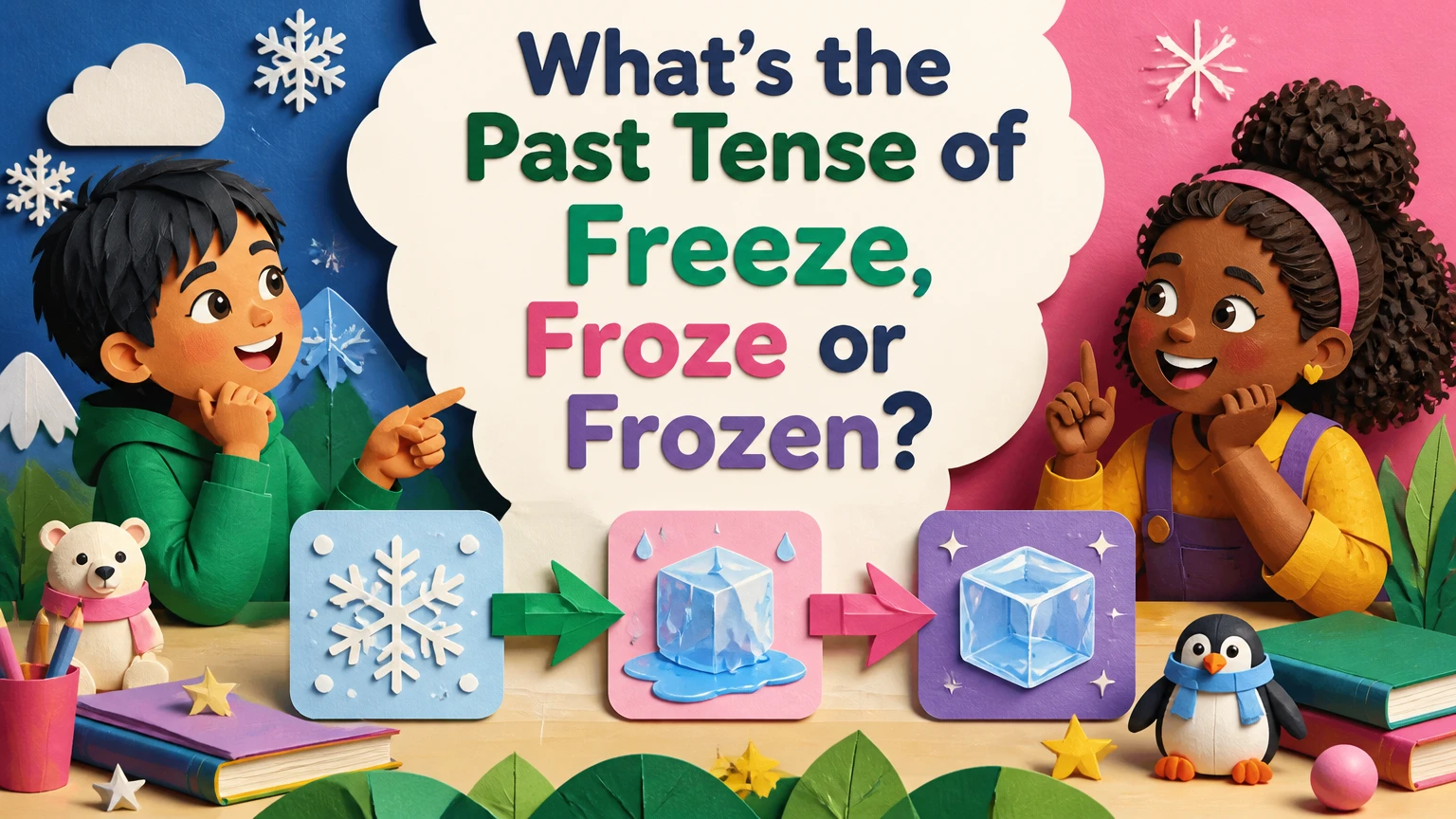
The past tense of freeze is froze. The past participle is frozen, so write “The lake froze last night” but “The lake has frozen.” Frozen also works as an adjective, while freezed is not the standard past-tense form in modern English.
Key Facts at a Glance
- Freeze is the base form: “Water can freeze.”
- Froze is the simple past tense: “The pipes froze.”
- Frozen is the past participle: “The pipes have frozen.”
- Frozen can also be an adjective: “The pipes are frozen.”
- Freezed is not the standard form in edited English.
- The distinction depends on the grammar around the verb, not only on when the action happened.
Is Froze or Frozen the Past Tense?
Froze is the simple past tense of freeze, while frozen is the past participle. Use froze alone for a completed event in the past, and use frozen with an auxiliary verb such as has, have, had, or be.
| Verb form | Grammatical name | Typical construction | Example |
|---|---|---|---|
| freeze | Base form | can, will, do, present plural | “Roads can freeze.” |
| freezes | Third-person present | he, she, it | “The pond freezes quickly.” |
| froze | Simple past | completed past event | “The pond froze overnight.” |
| frozen | Past participle | have, be, become | “The pond has frozen.” |
| freezing | Present participle or gerund | continuous tense or noun | “The pond is freezing.” |
The fastest test is to inspect the words before the verb. If the sentence uses did, the main verb returns to freeze, as in “Did the water freeze?” If the sentence uses has, have, or had, use frozen, as in “The water has frozen.”
Why does freeze change to froze and frozen?
Freeze is an irregular verb because English does not form its past tense by adding -ed. The vowel changes in freeze, froze, and frozen, a pattern inherited from older Germanic verb classes.
Regular verbs follow a predictable pattern:
- walk → walked
- clean → cleaned
- open → opened
Irregular verbs preserve older patterns or developed forms that do not follow the productive -ed rule:
- speak → spoke → spoken
- break → broke → broken
- choose → chose → chosen
- freeze → froze → frozen
The spelling change also affects pronunciation. Freeze has the long vowel sound in these, while froze rhymes with goes. Frozen begins with the same vowel sound as froze but adds a second syllable.
What Is the Simple Past Form of Freeze?
The simple past form is froze for every subject. Unlike present-tense freezes, simple past froze does not add -s for he, she, or it.
| Subject | Correct simple past sentence | Incorrect form |
|---|---|---|
| I | “I froze the leftovers.” | “I freezed the leftovers.” |
| You | “You froze the screen.” | “You freezed the screen.” |
| He or she | “She froze during the interview.” | “She freezed during the interview.” |
| We | “We froze the samples.” | “We freezed the samples.” |
| They | “They froze the account.” | “They freezed the account.” |
Simple past froze can describe a physical change, an intentional action, an involuntary reaction, or a figurative event. The meaning comes from the object and context.
- “The pond froze after two nights below freezing.”
- “The laboratory froze the tissue at -80°C.”
- “The witness froze when the alarm sounded.”
- “The company froze hiring in March.”
How do you use froze in a sentence?
Use froze when the sentence presents the action as completed at a definite or understood past time. The simple past does not require has, have, or had.
Common time markers include yesterday, last winter, two hours ago, in 2022, and when the temperature fell. A time marker is not mandatory, but the event must be framed as past and complete.
- “The windshield froze overnight.”
- “My laptop froze during the update.”
- “The child froze at the sound of the dog.”
- “The mechanic froze the damaged account card.”
- “The river froze earlier than usual this year.”
A frequent mistake is using froze after a perfect-tense auxiliary. “The screen has froze” combines the wrong verb form with has. The standard correction is “The screen has frozen.”
What Is the Past Participle of Freeze?
The past participle of freeze is frozen. English uses frozen after has, have, or had in perfect constructions and after forms of be in many passive constructions.
| Construction | Auxiliary pattern | Correct example |
|---|---|---|
| Present perfect | has or have + frozen | “The lake has frozen.” |
| Past perfect | had + frozen | “The lake had frozen before dawn.” |
| Future perfect | will have + frozen | “The lake will have frozen by January.” |
| Passive voice | was or were + frozen | “The samples were frozen.” |
| Modal perfect | should have + frozen | “The pipes should have frozen.” |
The participle does not independently mark simple past time. In “The lake has frozen,” has carries the present-tense auxiliary, while frozen identifies the completed event in relation to the present. In “The lake had frozen,” had places the completed event before another past event.
Which form follows has, have, or had?
Use frozen, never froze, after has, have, or had when the phrase forms a perfect tense. This rule applies regardless of whether the subject is singular or plural.
- Correct: “The pipes have frozen.”
- Correct: “The pipe has frozen.”
- Correct: “The pipes had frozen.”
- Incorrect: “The pipes have froze.”
- Incorrect: “The pipe has froze.”
The same pattern appears with modal phrases:
- “The water may have frozen.”
- “The screen could have frozen.”
- “The account might have frozen.”
- “The engine should have frozen.”
A useful editing method is to remove the auxiliary temporarily. If the sentence means “The event happened before now or before another event,” retain frozen. If the sentence has no perfect auxiliary and simply narrates a completed past event, use froze.
When Is Frozen an Adjective?
Frozen is an adjective when it describes a condition rather than functioning as part of a verb phrase. The same spelling can represent either a past participle or an adjective, so the sentence’s meaning and structure determine the classification.
Compare these examples:
- “The lake has frozen.”
Here, frozen forms the present perfect verb phrase with has. - “The lake is frozen.”
Here, frozen describes the lake’s current state, although the construction can also be analyzed as a resultative passive. - “We bought frozen berries.”
Here, frozen modifies the noun berries. - “The account remains frozen.”
Here, frozen describes the account’s status.
Adjectival frozen can describe physical temperature, immobility, emotional reaction, financial restriction, or lack of movement.
| Meaning | Noun modified or described | Example |
|---|---|---|
| Solid from cold | water | “Frozen water formed the ice.” |
| Stored at low temperature | food | “The store sells frozen vegetables.” |
| Unable to move | computer screen | “The frozen screen ignored every click.” |
| Emotionally motionless | person | “He stood frozen in fear.” |
| Restricted | bank account | “The frozen account required verification.” |
The adjective does not automatically mean the action happened at a specific past time. “Frozen food” describes a category or condition, not necessarily an event that the speaker is narrating.
Is Freezed Correct English?
Freezed is not the standard simple past or past participle of freeze. Standard edited English uses froze for the simple past and frozen for the past participle.
The error occurs because many English verbs are regular:
- heat → heated
- cool → cooled
- melt → melted
Speakers may apply the same pattern to freeze, producing freezed. Children, language learners, informal online writers, and speech-to-text systems sometimes generate the form, but its occurrence does not make it standard in formal writing.
Use these corrections:
| Nonstandard sentence | Standard correction |
|---|---|
| “The lake freezed last night.” | “The lake froze last night.” |
| “The lake has freezed.” | “The lake has frozen.” |
| “The server freezed again.” | “The server froze again.” |
| “The food was freezed.” | “The food was frozen.” |
A narrow exception exists in specialized or dialectal language, where speakers may create regularized forms for technical meanings. That variation does not change the standard rule expected in schoolwork, professional documents, journalism, or edited online content.
How Do Questions and Negatives Work?
Questions and negatives use freeze, not froze, after the auxiliary did. The auxiliary carries the past tense, so the main verb returns to its base form.
| Function | Correct structure | Example |
|---|---|---|
| Past question | Did + subject + freeze | “Did the pipes freeze?” |
| Past negative | Did not + freeze | “The pipes did not freeze.” |
| Past contraction | Didn’t + freeze | “The pipes didn’t freeze.” |
| Present question | Does + subject + freeze | “Does the pipe freeze?” |
| Present negative | Does not + freeze | “The pipe does not freeze.” |
| Modal question | Could + subject + freeze | “Could the pipe freeze?” |
Do not write “Did the pipes froze?” The form did already marks the past, so a second past marker on froze is ungrammatical in standard English.
The same principle applies to emphatic statements:
- “The pipe did freeze.”
- “The computer did freeze during the test.”
- “The lake did freeze despite the salt.”
In these examples, did provides past tense and freeze remains the bare infinitive.
How Does Passive Voice Use Frozen?
Passive voice normally uses frozen after a form of be, because the construction requires a past participle. The object of an active sentence becomes the subject of the passive sentence.
| Active sentence | Passive sentence |
|---|---|
| “The technician froze the sample.” | “The sample was frozen by the technician.” |
| “The cold weather froze the pipes.” | “The pipes were frozen by the cold weather.” |
| “The company froze the account.” | “The account was frozen by the company.” |
| “The machine has frozen the mixture.” | “The mixture has been frozen by the machine.” |
“Was froze” is not the standard passive construction. The correct phrase is was frozen.
However, froze is correct when the sentence is active:
- Active: “The technician froze the sample.”
- Passive: “The sample was frozen.”
- Active: “The cold froze the pipes.”
- Passive: “The pipes were frozen.”
The difference is grammatical voice, not merely the time of the event. Both sentences can describe a past action, but passive voice requires the participle.
What Are the Full Forms of Freeze?
The main forms of freeze are freeze, freezes, froze, frozen, and freezing. These forms cover simple tenses, continuous constructions, perfect tenses, participial phrases, and nouns.
| Tense or function | Form | Example |
|---|---|---|
| Base form | freeze | “Ice can freeze solid.” |
| Present, first person | freeze | “I freeze excess soup.” |
| Present, third-person singular | freezes | “The freezer freezes food quickly.” |
| Simple past | froze | “The freezer froze the food.” |
| Past participle | frozen | “The food has frozen.” |
| Present participle | freezing | “The food is freezing.” |
| Gerund | freezing | “Freezing food saves time.” |
| Imperative | freeze | “Freeze the sample immediately.” |
The form freezing follows the normal spelling rule for verbs ending in silent e: the final e is removed before -ing. The spelling does not become freeezing.
How are freeze, froze, and frozen pronounced?
Freeze is pronounced /friːz/, froze is pronounced /froʊz/, and frozen is pronounced /ˈfroʊzən/ in common American English. The final consonant in freeze is a voiced z sound, not an unvoiced s sound.
| Spelling | Common pronunciation | Rhymes approximately with |
|---|---|---|
| freeze | /friːz/ | knees |
| froze | /froʊz/ | goes |
| frozen | /ˈfroʊzən/ | chosen |
| freezing | /ˈfriːzɪŋ/ | pleasing |
In many accents, froze and the first syllable of frozen share the same vowel. The additional syllable in frozen helps distinguish the participle in speech.
Can Freeze Have a Figurative Meaning?
Freeze can describe a figurative stoppage or sudden inability to act, not only a change from liquid to solid. The forms still follow the same grammar: froze for simple past and frozen after perfect or passive auxiliaries.
| Figurative meaning | Simple past example | Perfect or passive example |
|---|---|---|
| Stop responding | “The app froze.” | “The app has frozen.” |
| Become unable to speak | “She froze during the interview.” | “She has frozen under pressure before.” |
| Stop spending or hiring | “The agency froze hiring.” | “Hiring has been frozen.” |
| Block movement | “The negotiation froze.” | “The negotiation became frozen.” |
| Restrict funds | “The bank froze the account.” | “The account was frozen.” |
Phrasal verbs add further meanings:
- freeze up: become unable to respond or operate
“I froze up during the presentation.” - freeze over: develop a layer of ice
“The pond froze over.” - freeze out: exclude someone
“The group froze him out of the discussion.” - freeze out in business: deliberately prevent participation
“The larger company froze out smaller suppliers.”
The particle remains separate in many ordinary sentences, while the verb form changes normally. “The computer froze up” and “The computer has frozen up” follow the same past-versus-participle distinction.
What Does Freeze Mean in Scientific Contexts?
In science, freeze means that a substance changes from a liquid to a solid as thermal energy leaves the material. The grammar remains unchanged: “The solution froze” uses simple past, while “The solution has frozen” uses the past participle.
Pure water freezes at 0°C, or 32°F, at standard atmospheric pressure, but dissolved substances and pressure alter the freezing point. Salt lowers water’s freezing point, which explains its use on roads and in ice-making mixtures.
Freezing does not always occur exactly at the nominal freezing point. A very clean liquid can remain liquid below its normal freezing temperature until nucleation begins, a condition called supercooling. Once solidification starts, crystal growth releases latent heat, temporarily slowing further temperature decline.
Scientific context can make the verb appear in several forms:
- “The sample froze at -12°C.”
- “The sample has frozen completely.”
- “The sample was frozen before testing.”
- “The sample is freezing inside the chamber.”
The temperature does not determine the verb form. Sentence structure does.
What is the difference between freeze and freeze-dry?
Freeze changes a liquid or moisture-containing material into a solid, while freeze-dry removes ice by sublimation under reduced pressure. The two processes share low-temperature stages but produce different outcomes.
| Process | Main phase change | Typical purpose | Example |
|---|---|---|---|
| Freeze | Liquid to solid | Preserve or solidify material | “The broth froze.” |
| Freeze-dry | Ice to vapor | Remove moisture at low heat | “The fruit was freeze-dried.” |
| Chill | Liquid remains liquid | Lower temperature without solidifying | “The drink chilled.” |
| Thaw | Solid to liquid | Reverse ordinary freezing | “The meat thawed overnight.” |
The past forms remain regular for freeze-dry in ordinary usage:
- “The manufacturer freeze-dried the medicine.”
- “The manufacturer has freeze-dried the medicine.”
That compound should not be confused with the irregular forms of the standalone verb freeze.
What Mistakes Do Writers Make With Froze and Frozen?
The most common mistakes involve using a past participle as though it were simple past, using a simple past form after an auxiliary, or regularizing the verb as freezed. Each error has a short structural correction.
- Replace “freezed” with “froze” in simple past statements.
Incorrect: “The river freezed.”
Correct: “The river froze.” - Replace “has froze” with “has frozen.”
Incorrect: “The pipe has froze.”
Correct: “The pipe has frozen.” - Replace “was froze” with “was frozen” in passive voice.
Incorrect: “The sample was froze.”
Correct: “The sample was frozen.” - Use “freeze” after did.
Incorrect: “Did the screen froze?”
Correct: “Did the screen freeze?” - Use “froze” without an unnecessary auxiliary in simple past.
Incorrect: “The lake did froze overnight.”
Correct: “The lake froze overnight.”
Emphatic alternative: “The lake did freeze overnight.” - Do not treat every instance of “frozen” as a past-tense verb.
In “frozen vegetables,” frozen is an adjective modifying vegetables.
A practical editor’s rule is to circle the helper verb first. Did takes freeze. Has, have, and had take frozen. A form of be commonly takes frozen in passive constructions, while froze works directly as the simple past.
When Should You Use Each Form?
Choose froze when the sentence reports a completed past event without a perfect or passive auxiliary. Choose frozen when has, have, or had creates a perfect tense, when a form of be creates a passive or resultative construction, or when the word describes a noun.
| Intended meaning | Best form | Model sentence |
|---|---|---|
| Past event last night | froze | “The pipes froze last night.” |
| Event completed by now | has frozen | “The pond has frozen.” |
| Event completed before another past event | had frozen | “The pond had frozen before sunrise.” |
| Passive treatment | was frozen | “The sample was frozen at -20°C.” |
| Current condition | is frozen | “The valve is frozen shut.” |
| Question about a past event | did freeze | “Did the valve freeze?” |
| Ongoing change | is freezing | “The solution is freezing now.” |
The decision depends on both tense and construction. “The account froze” means the account stopped functioning or became restricted. “The account was frozen” emphasizes an action imposed on the account, usually by an institution or administrator.
FAQ
Is the past tense of freeze the same in British and American English?
Yes. Standard British and American English use froze as the simple past and frozen as the past participle. Regional pronunciation may differ slightly, but the standard spellings and grammatical functions remain the same.
Can I say “the water was froze”?
No. In standard English, use “the water was frozen.” The phrase was frozen uses a form of be with the past participle, which is required for the ordinary passive construction. Use “the water froze” when the sentence is active and has no passive auxiliary.
Is “freeze” a regular or irregular verb?
Freeze is an irregular verb. Its principal forms are freeze, froze, and frozen, rather than a regular -ed sequence. The related form freezing follows the usual spelling rule that removes the final silent e before adding -ing.
What is the opposite of freeze?
The ordinary physical opposite of freeze is thaw, which means to become unfrozen or return from solid to liquid. In some contexts, melt is also appropriate, especially when heat causes a solid to become liquid. “The ice thawed” and “the ice melted” are both standard, with slightly different emphasis.
What is the past tense of “freeze up”?
The past tense is froze up, and the past participle is frozen up. For example, write “My computer froze up during the call” and “My computer has frozen up twice today.” The particle up does not alter the irregular verb pattern.
What is the correct answer to “whats the past tense of freeze froze or frozen”?
The correct answer is froze. Frozen is not the simple past; it is the past participle and sometimes an adjective. Write “The lake froze yesterday,” but write “The lake has frozen” or “The lake is frozen” when the surrounding construction requires frozen.
The Bottom Line
The past tense of freeze is froze, and the past participle is frozen. Use “froze” for a completed past action, “frozen” after has, have, had, or a passive form of be, and “freeze” after did. If you are deciding whether froze or frozen belongs in a sentence, inspect the auxiliary verb before choosing the form.


