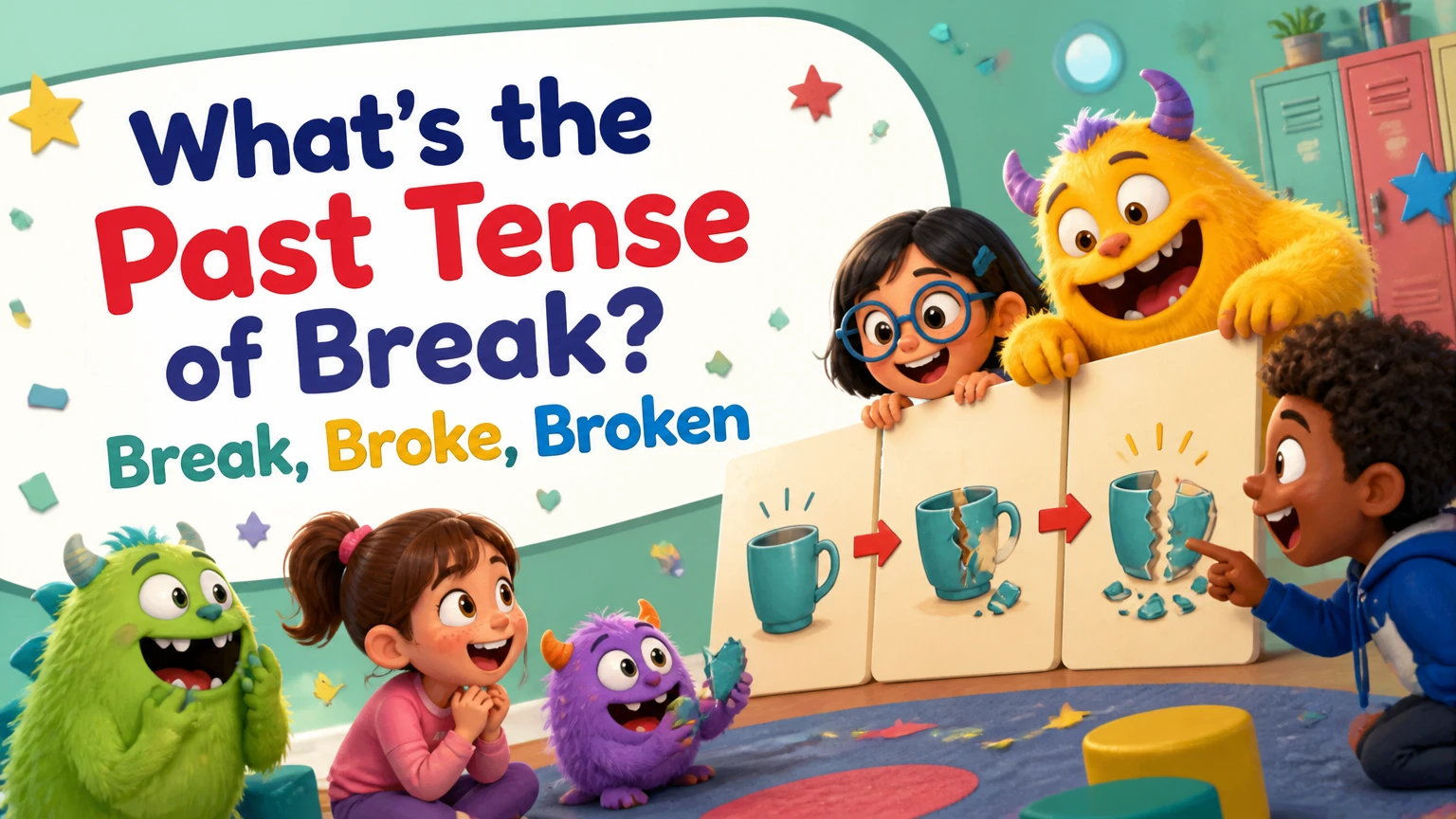
The past tense of break is broke, while broken is the past participle. Say I broke the glass yesterday, but I have broken the glass when a perfect auxiliary such as have or has appears. Break is an irregular verb, so breaked is not the standard past form.
Key Facts at a Glance
- Break is the base form: Please do not break the seal.
- Broke is the simple past: Maya broke the seal yesterday.
- Broken is the past participle: Maya has broken the seal.
- Break changes its vowel rather than taking the regular -ed ending.
- Broken follows have, has, or had in perfect constructions.
- Broken can also function as an adjective: The broken seal was easy to replace.
What Is the Past Tense of Break?
The simple past tense of break is broke. The past participle is broken, so the complete principal-part pattern is break, broke, broken.
The difference depends on the grammar around the verb. A simple past clause normally uses broke by itself: The branch broke during the storm. A perfect clause uses broken after an auxiliary: The branch has broken during the storm. The first sentence presents a completed past event; the second connects the event to the present.
The verb can describe physical damage, interruption, emotional harm, rule violations, and changes in continuity. Those meanings do not change its irregular pattern.
| Verb form | Grammatical name | Example | Main function |
|---|---|---|---|
| break | Base form | Birds break shells | Present, infinitive, imperative |
| broke | Simple past | Birds broke shells | Completed past event |
| broken | Past participle | Birds have broken shells | Perfect or passive construction |
| breaking | Present participle | Birds are breaking shells | Progressive construction |
| breaks | Third-person singular | The machine breaks seals | Present simple with he, she, or it |
When Do You Use Broke?
Use broke for a completed event in the past, usually with a past-time expression or a clearly finished context. The form works without have, has, or had.
Examples include:
- I broke my glasses this morning.
- The mechanic broke the bolt while removing it.
- Nadia broke the school record in 2019.
- The child broke the chocolate bar into four pieces.
- The company broke its agreement last month.
The simple past can describe a single event, a sequence, or a repeated past action. In a narrative, several events can use broke because each action occurs within the past storyline: The lock broke, the alarm sounded, and the guard called the owner.
A finished time marker strongly favors the simple past. Common markers include yesterday, last night, two hours ago, in 2020, and when I was young. English speakers may omit the time marker when the past context is already obvious.
How does broke work in questions and negatives?
Questions and negatives use the base form break after the auxiliary did, not broke. The auxiliary carries the past tense.
| Structure | Correct example | Incorrect example |
|---|---|---|
| Positive statement | She broke the handle | She breaked the handle |
| Negative statement | She did not break the handle | She did not broke the handle |
| Yes-or-no question | Did she break the handle? | Did she broke the handle? |
| Wh-question | Why did she break the handle? | Why did she broke the handle? |
| Short answer | Yes, she did | Yes, she broke did |
The rule is mechanical: one clause needs one marked past-tense element. In Did she break it?, did marks the past, so break remains in its base form. In She broke it, the main verb carries the past marking.
When Do You Use Broken?
Use broken as a past participle after have, has, or had, and in passive constructions after forms of be. Use broken without an auxiliary when it functions as an adjective.
Perfect examples:
- I have broken the hinge.
- The technician has broken the old seal.
- They had broken the code before the security team arrived.
- We have never broken that rule.
Passive examples:
- The window was broken by a baseball.
- Several chairs were broken during the move.
- The contract had been broken before negotiations resumed.
Adjectival examples:
- A broken screen can cut your finger.
- The broken mechanism needs a replacement part.
- He apologized for the broken promise.
The same spelling can represent different grammatical roles. In The window was broken by hail, broken belongs to a passive verb phrase. In The broken window faced the street, broken modifies window as an adjective.
What is the difference between broke and broken?
Broke is the simple past form, while broken is the past participle. Choose broke for a completed past clause without a perfect or passive auxiliary, and choose broken after have, has, had, or a form of be when the construction requires a participle.
| Meaning | Correct form | Example |
|---|---|---|
| Finished event | broke | The glass broke at noon |
| Present result | has broken | The glass has broken |
| Earlier past event | had broken | The glass had broken before lunch |
| Passive event | was broken | The glass was broken by hail |
| Description | broken | Remove the broken glass |
| Modal construction | break | The glass might break |
A reliable substitution test is to inspect the word before the verb. Have, has, and had require broken: has broken. Did requires break: did break. A plain past statement generally takes broke: the glass broke.
Why Is Break an Irregular Verb?
Break is irregular because its past forms do not use the regular -ed ending. Its vowel changes across the principal parts: break, broke, broken.
English inherited this pattern from older Germanic verb systems. Traditional grammar sometimes calls verbs with internal vowel changes “strong verbs,” although modern learner references usually use the broader term irregular verbs. The historical explanation helps classify the pattern, but memorizing the three forms is more useful for everyday writing.
| Regular verb pattern | Irregular break pattern | Past form |
|---|---|---|
| walk, walked, walked | break, broke, broken | Internal vowel change |
| open, opened, opened | speak, spoke, spoken | Related irregular pattern |
| wash, washed, washed | choose, chose, chosen | Internal vowel change |
| clean, cleaned, cleaned | take, took, taken | Internal vowel change |
Is breaked a correct word?
Breaked is not the standard simple past or past participle of break in modern standard English. Use broke for the simple past and broken for the participle.
| Common error | Standard correction | Reason |
|---|---|---|
| I breaked the toy | I broke the toy | Simple past requires broke |
| I have broke the toy | I have broken the toy | Perfect auxiliary requires broken |
| He broken the toy | He broke the toy | No auxiliary appears |
| Did she broke it? | Did she break it? | Did requires the base form |
| The toy was broke | The toy was broken | Passive voice requires the participle |
A learner may produce breaked by applying the productive regular-verb rule, as in talked or jumped. The error is understandable, but standard English treats break as irregular.
How Do You Conjugate Break Across Tenses?
The verb break keeps the same irregular core while auxiliary verbs express tense and aspect. Broke belongs mainly to the simple past, whereas broken appears in perfect, passive, and adjectival constructions.
| Tense or aspect | Standard form | Example |
|---|---|---|
| Present simple | break or breaks | I break it; she breaks it |
| Past simple | broke | She broke it yesterday |
| Present progressive | am/is/are breaking | She is breaking it now |
| Past progressive | was/were breaking | She was breaking it carefully |
| Present perfect | have/has broken | She has broken it already |
| Past perfect | had broken | She had broken it before noon |
| Future | will break | She will break the seal |
| Modal | can/might/should break | It might break under pressure |
The progressive form uses breaking, not broke or broken, after a form of be. The future and modal forms use the base form break because will, can, and similar auxiliaries control the tense or modality.
How do perfect tenses change the meaning?
The present perfect has broken connects a past event with the present, while the past perfect had broken places the event before another past reference point. The simple past broke usually treats the event as part of a finished past timeframe.
Compare these sentences:
- The printer broke yesterday. The event is located in a finished past period.
- The printer has broken. The current consequence is that the printer does not work.
- The printer had broken before the presentation began. The breaking happened first.
- The printer will break if the cable remains loose. The event is hypothetical or future.
Time markers matter. Yesterday normally pairs with broke, while already can pair with has broken or had broken, depending on the reference time.
How Does Break Work in Passive Voice?
Passive voice uses a form of be plus broken, because broken is the past participle. The passive construction emphasizes the damaged object or affected person rather than the agent that caused the action.
| Passive tense | Form | Example |
|---|---|---|
| Present simple | is/are broken | Rules are broken every day |
| Past simple | was/were broken | The window was broken last night |
| Present perfect | has/have been broken | The seal has been broken |
| Past perfect | had been broken | The lock had been broken earlier |
| Future | will be broken | The record will be broken soon |
The agent can appear after by: The window was broken by hail. If the cause is unknown, obvious, or unimportant, omit it: The window was broken during the night.
A common mistake is using broke after was in a standard passive sentence. The vase was broke is incorrect in formal standard English. The correct sentence is The vase was broken.
What Meanings Can Break Have?
Break has several related meanings, and the past forms remain broke and broken in each meaning. The object or surrounding phrase identifies the intended sense.
| Meaning | Past example | Participle example |
|---|---|---|
| Damage physically | She broke the cup | She has broken the cup |
| Stop functioning | The engine broke down | The engine has broken down |
| End a relationship | They broke up | They have broken up |
| Violate a rule | He broke the law | He has broken the law |
| Exceed a record | She broke the record | She has broken the record |
| Enter by force | Thieves broke into the shop | Thieves have broken into the shop |
| Begin suddenly | War broke out | War has broken out |
| Solve or overcome | The team broke through | The team has broken through |
The phrase break down does not mean the same thing as break alone. A car breaks down when it stops working, while a person breaks a window when they damage it. The tense changes the verb form, but the particle remains: broke down, has broken down.
What are the past forms of common break phrasal verbs?
Common phrasal verbs use broke in simple past clauses and broken after perfect auxiliaries. The particle stays attached to the meaning, not to the spelling of the verb.
| Phrasal verb | Simple past | Present perfect | Meaning |
|---|---|---|---|
| break down | broke down | has broken down | Stop working or collapse |
| break up | broke up | has broken up | End a relationship or divide |
| break out | broke out | has broken out | Begin suddenly or escape |
| break into | broke into | has broken into | Enter forcibly |
| break through | broke through | has broken through | Overcome an obstacle |
| break away | broke away | has broken away | Escape or separate |
Examples show the pattern clearly: The negotiations broke down, but the negotiations have broken down. A fire broke out, but a fire has broken out. The grammatical distinction is identical to the physical meaning.
How Is Broken Used as an Adjective?
Broken functions as an adjective when it describes a condition, state, or quality rather than forming a verb phrase. The adjective can describe physical objects, social systems, emotional states, promises, or abstract arrangements.
Physical examples include broken glass, a broken leg, and a broken keyboard. Abstract examples include a broken promise, a broken system, broken trust, and a broken agreement.
Context can create ambiguity:
- The broken door needs repair. Here broken describes the door.
- The door was broken by the wind. Here was broken is passive voice.
- The door has been broken for weeks. Here has been broken is a perfect construction with a continuing state.
Adjectival broken can also mean incomplete or interrupted, as in broken English, broken lines, and broken sleep. Those uses do not necessarily describe an object split into pieces.
What Is the Difference Between Break and Brake?
Break and brake are different words with different meanings, although they are homophones in many varieties of English. Break means damage, separate, interrupt, or violate; brake means a device or action used to slow or stop a vehicle.
| Word | Core meaning | Past form | Example |
|---|---|---|---|
| break | Damage or interrupt | broke | The cyclist broke the chain |
| brake | Slow or stop a vehicle | braked | The driver braked sharply |
| broken | Participle or adjective for break | broken | The chain is broken |
| braked | Past or participle for brake | braked | The car braked before the turn |
A vehicle can brake without anything breaking: The driver braked to avoid the obstacle. A mechanical fault can cause both events: The driver braked, but the cable broke.
Spelling the wrong word changes the meaning. The car broke suddenly usually means the car stopped functioning, while the car braked suddenly means the driver or braking system slowed it.
How Can You Choose Broke or Broken Quickly?
Use the following four-step check:
- Look for a time auxiliary. After have, has, or had, choose broken.
- Look for passive voice. After is, are, was, were, or been when the subject receives the action, choose broken.
- Look for did. After did or did not, choose the base form break.
- Use broke in an unassisted past statement. Say She broke the plate, not She broken the plate.
The fastest practical test is to read the entire verb phrase, not only the visible verb. English grammar assigns the past or participle role across auxiliaries, and the wrong form often becomes obvious when the auxiliary is identified.
Can broke and broken describe the same event?
Broke and broken can describe the same underlying event, but they present that event through different grammatical structures. Broke locates the event in the past; broken usually links it to an auxiliary or describes the resulting condition.
- Leo broke the window at 8 p.m.
- Leo has broken the window.
- The window was broken at 8 p.m.
- The broken window was boarded up.
The first sentence foregrounds Leo’s completed action. The second emphasizes the present consequence. The third foregrounds the window and can omit the agent. The fourth treats broken as a descriptive modifier.
How Do You Pronounce Break, Broke, and Broken?
In widely used American and British dictionary pronunciations, break is /breɪk/, broke is commonly /broʊk/ in American English and /brəʊk/ in many British varieties, and broken is commonly /ˈbroʊkən/ or /ˈbrəʊkən/.
The vowel in break resembles the sound in make. The vowel in broke resembles the sound in boat for many speakers. The first syllable of broken contains the same vowel as broke, while the second syllable is a reduced sound similar to uhn.
| Form | Common American pronunciation | Rhyming reference |
|---|---|---|
| break | /breɪk/ | make |
| broke | /broʊk/ | boat |
| broken | /ˈbroʊkən/ | spoken |
| breaking | /ˈbreɪkɪŋ/ | making |
Pronunciation does not determine the grammar. A learner who says broke accurately can still need broken after has. Form and sentence structure must be learned together.
What Are the Most Common Errors?
The most frequent errors involve treating break as regular or confusing the simple past with the participle. Correcting the auxiliary usually resolves the problem.
- I breaked my phone.
Correct: I broke my phone. - I have broke my phone.
Correct: I have broken my phone. - He broken the latch.
Correct: He broke the latch. - Did you broke the plate?
Correct: Did you break the plate? - The plate was broke.
Correct: The plate was broken. - She has break the rule.
Correct: She has broken the rule.
One useful editing rule is to circle every auxiliary in the sentence. If the sentence contains did, inspect the next verb for the base form. If it contains have, has, or had, inspect the next verb for the participle.
How Can You Memorize Break, Broke, Broken?
Memorize the three forms as one rhythm: break, broke, broken. Then practice the forms inside contrasting sentences, because isolated word lists do not show when an auxiliary is required.
Use this five-minute drill:
- Write Today I break the seal.
- Change it to Yesterday I broke the seal.
- Change it to I have broken the seal.
- Add a passive sentence: The seal was broken.
- Add a question: Did you break the seal?
Repeat the drill with window, record, rule, and promise. The method links form, meaning, and sentence structure.
Practice: choose break, broke, or broken
Complete each sentence with the correct form.
- The branch ___ during the storm yesterday.
- The branch has ___ near the base.
- Did the branch ___ the window?
- The branch was ___ by heavy snow.
- The company ___ its promise last year.
- The company has ___ its promise again.
Answers:
- broke
- broken
- break
- broken
- broke
- broken
The answer changes because the surrounding grammar changes. The subject or meaning does not determine the form by itself.
FAQ About Break, Broke, and Broken
Is broke the past tense or past participle of break?
Broke is the simple past tense of break, not the standard past participle. Use broke in She broke the vase yesterday. Use broken after have, has, or had, as in She has broken the vase.
Do Americans and British speakers use broke differently?
American and British speakers use broke and broken with the same standard grammatical distinction. Pronunciation differs for some speakers, especially the vowel in broke, but the conjugation remains break, broke, broken in both major varieties.
Can I say I have broke it?
In standard English, say I have broken it, not I have broke it. The auxiliary have requires a past participle, and broken is the past participle of break. Use I broke it when no perfect auxiliary appears.
Is broken always a verb?
Broken can be a verb form or an adjective. In The lock has been broken, broken is part of a passive perfect verb phrase. In the broken lock, broken is an adjective describing the lock’s condition.
What is the past tense of break down?
The simple past of break down is broke down, and its past participle is broken down. Write The car broke down yesterday and The car has broken down twice this month. The particle down remains in both forms.
What is the difference between broken and damaged?
Broken often suggests that something has fractured, stopped functioning, or lost its normal structure. Damaged is broader and can describe harm that does not make an object unusable. A scratched phone may be damaged without being broken; a cracked screen may be both.
The Bottom Line
The answer to whats the past tense of break break broke broken is broke for the simple past and broken for the past participle. Write I broke it yesterday, I have broken it, and it was broken. Never use breaked in standard English, and use break after did.