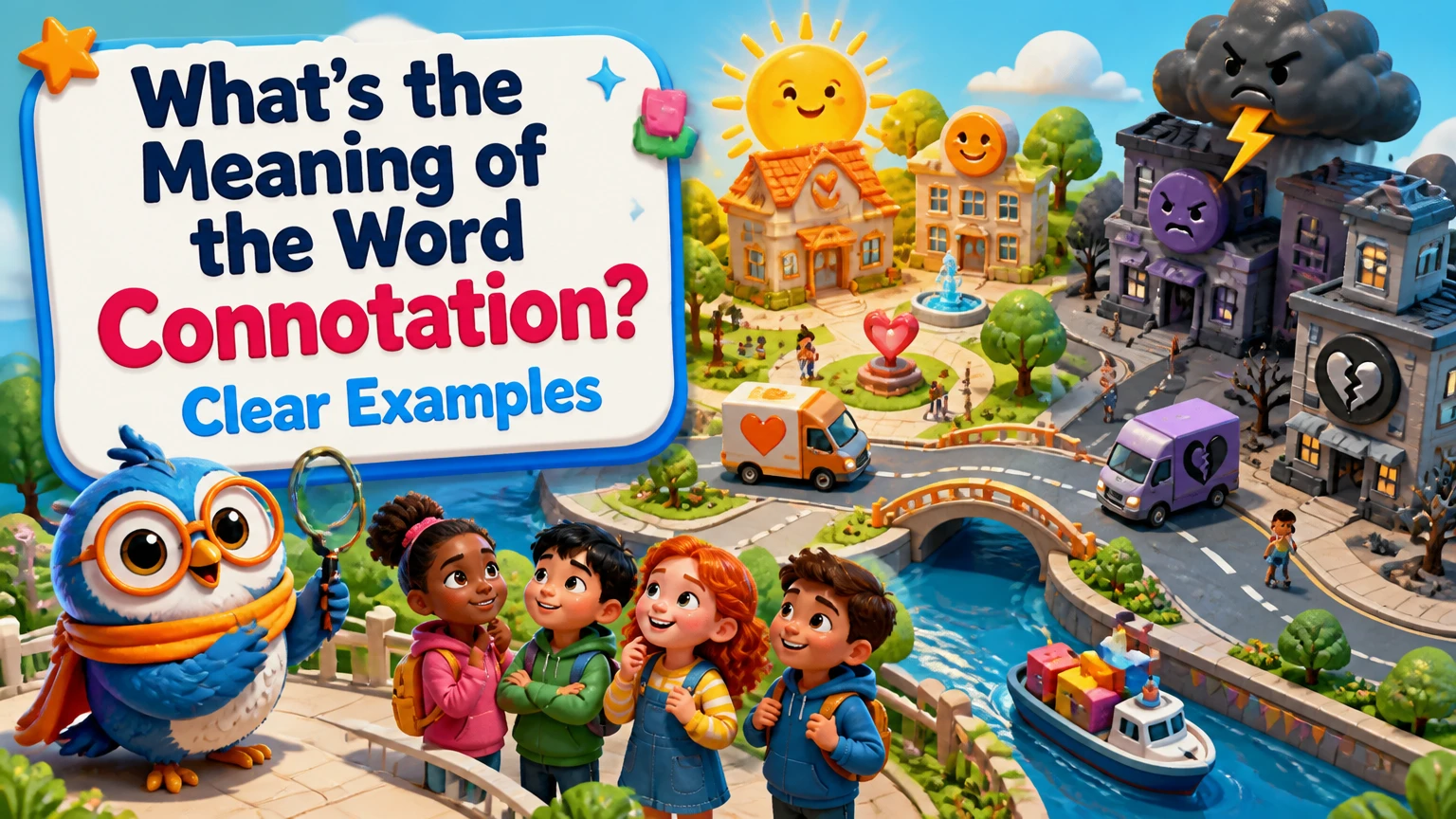
The word connotation means the emotional, cultural, or social association a word carries beyond its direct dictionary definition. Connotation shapes the feeling, attitude, or subtext attached to language, while denotation identifies the word’s literal reference. The same subject can therefore be described accurately with words that produce very different reactions.
Key Facts at a Glance
- Connotation is a word’s associated or implied meaning beyond its literal definition.
- Denotation is the direct, dictionary-level meaning of a word.
- A connotation may be positive, negative, neutral, or mixed, depending on context.
- Audience background, culture, age, profession, and personal experience can change interpretation.
- Synonyms often share denotation but differ in emotional force, formality, or social judgment.
- Writers can analyze connotation by checking literal fit, emotional valence, audience context, and communicative purpose.
What Does Connotation Mean?
Connotation is the extra meaning a word suggests through feelings, associations, social history, and context. The word “home,” for example, denotes a place where someone lives, but it can connote safety, family, belonging, or confinement. Those associations are not always stated directly, yet they influence how readers understand a message.
Connotative meaning operates alongside denotative meaning. A dictionary can explain what “childish” denotes, but the word commonly suggests immaturity or poor judgment. “Childlike” refers to a similar connection with childhood while often suggesting innocence, curiosity, or openness. The distinction is carried by association rather than by the basic subject matter.
Connotation is not a permanent emotional label attached to every word. Meaning changes according to the sentence, speaker, audience, region, historical period, and purpose. A word such as “bold” may praise a designer’s originality, but it may criticize a financial decision when the surrounding context suggests unnecessary risk.
A Simple Definition
A useful working definition is:
Connotation is the emotional or cultural meaning a word communicates in addition to what the word literally identifies.
The literal meaning answers, “What does this word refer to?” Connotation answers, “What attitude or feeling does this word invite the audience to attach to that subject?”
What Is the Difference Between Denotation and Connotation?
Denotation is a word’s explicit reference, whereas connotation is the set of feelings and associations connected to that reference. Denotation helps establish factual accuracy; connotation influences tone, judgment, and audience response.
| Feature | Denotation | Connotation |
|---|---|---|
| Meaning type | Literal or explicit | Implied or associated |
| Main source | Dictionary usage and shared reference | Culture, context, history, and experience |
| Example: “residence” | A place where someone lives | Formal, bureaucratic, impersonal |
| Example: “home” | A place where someone lives | Familiarity, comfort, belonging |
| Stability | Usually comparatively stable | More fluid across groups and eras |
| Main risk | Technical ambiguity | Bias, offense, or unintended subtext |
Denotation and connotation are not competing definitions. They are two layers of meaning operating in the same expression. The word “speculator” may denote someone who buys or sells assets in expectation of profit, but it can connote excessive risk or opportunism. “Investor” often carries a more responsible association even when the financial activity overlaps.
Why the Distinction Matters
A sentence can be factually correct while still communicating an unwanted attitude. Calling a neighborhood “cheap” may indicate a low price, yet many readers hear poor quality or low status. “Affordable” preserves the price-related information while adding an association with accessibility.
Formal writing does not eliminate connotation. Scientific, legal, and administrative documents still contain words with social and emotional effects. Formal contexts usually require deliberate control of those effects rather than an assumption that language becomes neutral automatically.
What Are the Main Types of Connotation?
The main functional types are positive, negative, and neutral connotation, although a word can carry mixed or audience-specific associations. Positive connotations support approval, negative connotations invite criticism, and neutral connotations minimize overt evaluation.
| Type | Typical effect | Example word | Common association |
|---|---|---|---|
| Positive | Encourages approval | “Courageous” | Bravery and moral strength |
| Negative | Encourages disapproval | “Reckless” | Carelessness and danger |
| Neutral | Limits evaluation | “Risk-taking” | Willingness to accept uncertainty |
| Positive | Adds prestige | “Vintage” | Age, quality, and character |
| Negative | Suggests deficiency | “Old-fashioned” | Outdated ideas or methods |
| Mixed | Depends on audience | “Traditional” | Stability for some, resistance for others |
Positive Connotation
Positive connotation gives a subject an approving or attractive frame. “Meticulous” can describe careful attention to detail, while “fussy” may describe similar behavior as excessive or irritating. “Courageous” can praise a person who accepts danger for a reason, whereas “reckless” can condemn a person whose behavior lacks adequate judgment.
Positive wording is useful in invitations, recommendations, product descriptions, diplomacy, and motivational writing. It becomes misleading when favorable associations conceal material facts. A marketer should not use “natural” as a substitute for evidence about safety, ingredients, or environmental impact.
Negative Connotation
Negative connotation adds criticism, suspicion, danger, or social disapproval. “Nosy” and “curious” may refer to an interest in other people’s affairs, but “nosy” frames that interest as intrusive. “Stubborn” and “persistent” can describe continued effort, yet the former suggests an unwillingness to respond to evidence.
Negative language has legitimate uses in criticism, satire, political argument, and fiction. The writer should identify whether the negative association describes observable conduct or merely pressures the audience to reject a person or idea.
Neutral Connotation
Neutral connotation minimizes emotional direction, although completely neutral language is difficult to guarantee. “Informed” gives less evaluative force than “brainwashed,” and “unmarried” identifies legal or social status without automatically implying loneliness or romantic failure.
Neutral terms are useful in scientific reports, incident records, news writing, and policy documents. They do not guarantee objectivity. Selecting which facts to include, how to order them, and whose description to quote can still shape interpretation.
How Do Examples Reveal Connotation?
Words with similar denotations can create sharply different impressions because their associations differ. Comparing near-synonyms in the same sentence makes connotative differences easier to detect.
| Shared subject | More favorable wording | More unfavorable wording | Main difference |
|---|---|---|---|
| Low body weight | “Slender” | “Scrawny” | Grace and health versus weakness |
| Low price | “Inexpensive” | “Cheap” | Affordability versus inferior quality |
| Strong effort | “Persistent” | “Stubborn” | Determination versus inflexibility |
| Information gathering | “Curious” | “Nosy” | Interest versus intrusion |
| Older object | “Vintage” | “Outdated” | Character and value versus obsolescence |
| Political persuasion | “Advocacy” | “Propaganda” | Public support versus manipulation |
Consider these sentences:
- “The slender athlete completed the race.”
- “The scrawny athlete completed the race.”
- “The company offers inexpensive equipment.”
- “The company sells cheap equipment.”
The core facts may overlap. The reader’s evaluation does not. Connotation can therefore change perceived credibility, status, intent, and emotional tone without changing the basic event described.
How Does Context Change a Word’s Connotation?
Context changes connotation by supplying the audience with information about speaker intent, subject matter, relationship, and consequences. The same word may sound complimentary in one setting and insulting in another because surrounding language determines which association becomes most relevant.
“Ambitious” can praise a student’s goals, criticize a colleague’s self-promotion, or describe a project whose scope exceeds its budget. “Aggressive” may describe an effective sales schedule, a hostile negotiation style, or a rapidly growing medical condition. The surrounding nouns and verbs narrow the interpretation.
Audience context matters as well. A technical term may sound neutral to specialists but intimidating to general readers. A phrase accepted within one community may be offensive when used by outsiders. Geographic varieties of English also assign different associations to words, idioms, and levels of formality.
Context Tests for Writers
Ask four questions before finalizing a loaded word:
- Who will read it? Identify age, profession, language background, region, and relevant community membership.
- What relationship exists? Familiar language can sound warm among friends but disrespectful in a workplace.
- What action should the reader take? Persuasion, description, warning, and documentation require different emotional thresholds.
- What nearby words reinforce the association? “Firm deadline” sounds organized; “punishing deadline” suggests unreasonable pressure.
How Do You Identify Connotation in Four Steps?
Identify connotation by separating literal fit from emotional effect, then testing the word against its audience and purpose. The four-step process takes a few minutes for a paragraph and prevents many avoidable tone errors.
Step 1: Identify the Denotation
Write the plain dictionary meaning in your own words. Confirm that the word accurately describes the person, object, action, or condition. A favorable word is still wrong if it changes the facts.
For example, “economical” may suggest efficient use of resources, while “cheap” primarily indicates low price. Choose the word according to the fact you need to communicate.
Step 2: Assess Emotional Valence
Classify the likely association as positive, negative, neutral, or mixed. Test the word beside two alternatives with the same basic reference.
A practical substitution test compares “confident,” “assertive,” and “bossy.” The first may imply self-assurance, the second directness, and the third excessive control. The comparison reveals the emotional gradient.
Step 3: Analyze Audience Context
Ask how different readers could decode the term. Check regional dictionaries, professional usage, corpus examples, and feedback from members of the intended audience when the wording involves identity, disability, race, gender, politics, religion, or historical trauma.
No dictionary can predict every audience reaction. Dictionaries describe usage; they do not remove cultural context.
Step 4: Align the Word With the Purpose
Replace the original term if its emotional direction conflicts with the communication goal. Then read the entire sentence aloud, because neighboring words can intensify or weaken the selected association.
A writer describing rapid company growth might choose “ambitious expansion” when praising scale, “rapid expansion” when documenting pace, or “unchecked expansion” when warning about risk. Each phrase can fit related facts while expressing a different judgment.
Are Connotation, Tone, Implication, and Symbolism the Same?
Connotation, tone, implication, and symbolism are related but distinct language concepts. Connotation belongs mainly to a word or phrase, tone describes the attitude of a larger speaker or text, implication is an unstated conclusion, and symbolism uses an object or image to represent an additional idea.
| Term | Unit of analysis | Meaning | Example |
|---|---|---|---|
| Denotation | Word or phrase | Literal reference | “Rose” means a flowering plant |
| Connotation | Word or phrase | Associated feeling or value | “Rose” may suggest romance |
| Tone | Sentence, passage, or work | Speaker’s attitude | A sarcastic, respectful, or anxious tone |
| Implication | Statement or exchange | Unstated suggestion | “You arrived early” may imply surprise |
| Symbolism | Image, object, or event | Representational meaning | A rose representing love |
A poem can use the connotation of “rusted” to suggest age or decay, create a pessimistic tone through repeated negative imagery, and imply that a relationship is deteriorating. The concepts interact, but replacing one term with another weakens analysis.
Connotation in Literature
Literary connotation allows authors to create subtext without explaining every emotion directly. “The house watched the road” gives a building an ominous association through personification and context. “A warm kitchen” may establish comfort before any character says that the family feels safe.
Literary interpretation requires evidence from the text. A reader’s personal association can be valid as a response, but a strong analysis connects the proposed connotation to repeated images, word choice, setting, characterization, or historical context.
Can Connotations Change Over Time or Across Cultures?
Connotations change when communities alter how they use, evaluate, reclaim, or encounter a word. Changes can occur across generations, regions, professions, media environments, and social groups, so no universal 15-30-year timetable accurately predicts a meaning shift.
“Nerd” and “geek” demonstrate partial change in English. Both terms historically carried stronger associations with social awkwardness or unusual interests, while technology, entertainment, and online communities helped some speakers use them as positive identity labels. The older negative association has not disappeared for every speaker.
Reclamation also produces group-specific meanings. A term used positively by members of a community may remain offensive when used by outsiders, because speaker identity and historical power affect interpretation. Translation creates another difficulty: a direct equivalent may preserve denotation while losing politeness, status, humor, or taboo level.
A careful writer should avoid presenting one culture’s associations as universal. Test important names, slogans, job titles, and public statements with readers from the relevant markets before publication.
How Should Professionals Control Connotation?
Professionals should match word choice to audience risk, factual purpose, and the cost of misunderstanding. Marketing can use positive associations to make a product attractive, while legal, scientific, and journalistic writing usually needs language that limits unsupported judgment.
For Authors and Content Writers
Use connotation to establish character, conflict, setting, and subtext. A narrator who calls a house “a shelter” rather than “a home” may reveal emotional distance. A content writer should still distinguish vivid language from unsupported claims, especially in health, finance, and safety topics.
For Marketers and Brand Strategists
Test names and slogans with the actual demographic and geographic markets. Screen for slang, pronunciation, translation, political associations, trademark conflicts, and unintended meanings before investing in packaging or media.
Focus groups are useful for discovering associations, but they do not predict every response. Combine qualitative interviews with controlled surveys and review from local language specialists.
For Formal and Academic Writers
Prefer terms that identify observable facts. Replace “failed experiment” with “the experiment did not support the hypothesis” when the evidence concerns a result rather than a researcher’s competence. Replace “biased participants” with a specific description of sampling or response behavior when that is what the data establishes.
For English Learners
Learn denotation first, then record the situations in which native speakers use a term. A learner’s dictionary, example corpus, subtitles, workplace feedback, and parallel sentences can reveal register and emotional force more reliably than a synonym list.
What Are the Most Common Connotation Mistakes?
The most common mistakes are treating synonyms as interchangeable, assuming neutrality, ignoring cultural variation, and allowing emotional language to outrun the evidence. These errors often survive proofreading because grammar and spelling remain correct.
The Synonym Trap
A thesaurus may group “investor” and “speculator,” but the terms do not create the same impression. A synonym is a possible replacement, not a guaranteed equivalent.
Confusing Intention With Effect
A speaker may intend “aggressive” to mean energetic, yet listeners may hear hostile or dangerous. Communication is judged by the interaction between intention, wording, and audience interpretation.
Assuming Dictionary Meaning Is Neutral
“Normal,” “clean,” “professional,” and “simple” can carry social judgments depending on what they contrast with. A writer should name the measurable feature instead of treating one group’s preference as a universal standard.
Ignoring Register
“Kids,” “children,” and “minors” overlap in reference but differ in informality, institutional precision, and possible legal implications. Register is part of connotative meaning because it signals relationship and setting.
Overcorrecting Toward Vague Positivity
Replacing every negative term with a flattering phrase can hide relevant information. “Affordable” should not conceal poor durability, and “challenging” should not obscure a documented safety hazard. Precision comes before pleasantness.
How Do You Fix an Unintended Connotation?
Fix an unintended connotation by identifying the disputed word, stating the intended fact, replacing the loaded term, and testing the revision with representative readers. A quick clarification works best when it names the ambiguity instead of defending the writer’s intention.
Use this repair sequence:
- Pause and isolate the trigger. Compare the audience reaction with the exact words that caused it.
- State the intended denotation. Explain the measurable fact without repeating the loaded label as the only description.
- Choose a narrower substitute. Replace “aggressive growth” with “a planned 25% increase in annual capacity” if the number is the relevant fact.
- Review the surrounding sentence. Adjectives, metaphors, headlines, and images may preserve the unwanted association.
- Test before re-release. Ask readers from the target audience what the revised wording suggests and why.
A correction should not pretend that context eliminates the original effect. If a public statement created a harmful association, transparent clarification and consistent future wording are more credible than insisting that readers misunderstood.
When Is Connotative Language Useful, and When Is It Risky?
Connotative language is useful when emotion, identity, persuasion, or literary subtext is part of the communication goal; it is risky when readers need precise, auditable information. The right choice depends on whether interpretation adds value or creates uncertainty.
| Situation | Preferred wording style | Example | Main reason |
|---|---|---|---|
| Product advertisement | Positive but accurate | “Lightweight laptop” | Creates appeal with a verifiable feature |
| Safety warning | Direct and specific | “Toxic if inhaled” | Reduces interpretive delay |
| Literary fiction | Deliberately suggestive | “A hollow victory” | Builds theme and emotional subtext |
| Legal contract | Defined and narrow | “Written notice within 30 days” | Limits disputes |
| News report | Attributed and precise | “The regulator rejected the application” | Separates fact from judgment |
| Personal message | Relationship-sensitive | “I felt overlooked” | Communicates emotion without accusation |
The limitation is important: connotation cannot reliably replace evidence. A word can make a claim feel trustworthy, modern, ethical, or dangerous, but the association does not prove the underlying claim.
Expert Rules for Choosing Better Words
Experienced editors usually improve connotation by narrowing the factual claim before selecting its emotional register. Three practical rules prevent more problems than searching for a perfect synonym.
- Name the measurable feature first. “A 12% price reduction” is clearer than “an incredible deal,” and the writer can add persuasion without hiding the number.
- Treat audience disagreement as data. If readers split sharply over a term, the word may be carrying identity or political associations that require definition.
- Use paired alternatives during editing. Compare a favorable, neutral, and unfavorable version of the same sentence to expose the implied judgment.
- Do not confuse familiar language with universal language. A phrase that feels ordinary within one workplace, age group, or country may sound dismissive elsewhere.
Frequently Asked Questions
Is connotation always emotional?
No. Connotation can involve social status, formality, cultural identity, historical memory, or implied judgment without producing a strong conscious emotion. “Residence” and “home” may refer to the same place, but “residence” sounds institutional while “home” suggests familiarity or belonging.
Can one word have positive and negative connotations?
Yes. A word can have different or mixed connotations across audiences and situations. “Traditional” may suggest continuity and trust to one reader, but resistance to change to another. The sentence, speaker, cultural setting, and topic determine which association becomes most prominent.
What is the opposite of connotation?
Denotation is the usual contrasting concept, although denotation is not a strict opposite. Denotation identifies a word’s literal reference, while connotation adds associated meanings. A complete interpretation often requires both layers rather than choosing one and ignoring the other.
How is connotation used in advertising?
Advertising uses connotation to connect a product with values such as safety, status, freedom, convenience, or environmental responsibility. The technique becomes misleading when positive associations substitute for evidence. Terms such as “natural,” “premium,” or “clean” need clear definitions when consumers could interpret them as safety or quality guarantees.
Does connotation matter in translation?
Yes. Translation can preserve a literal reference while changing politeness, humor, social status, taboo level, or emotional force. Professional translators examine the target culture, audience, genre, and purpose rather than replacing each source word with the nearest dictionary equivalent.
How can I remember the difference between denotation and connotation?
Remember denotation as the dictionary description and connotation as the connection attached to it. “Snake” denotes a reptile, while it may connote danger, deceit, healing, or renewal depending on the culture and context.
The Bottom Line
Connotation is the meaning a word suggests beyond its literal definition, while denotation is the direct meaning the word identifies. Connotation affects tone, social judgment, persuasion, literary subtext, and audience trust. To choose language accurately, verify the denotation, assess the emotional and cultural associations, test the audience context, and select wording that matches the communication purpose. Understanding what’s the meaning of the word connotation helps readers interpret subtext and helps writers control what their words imply.