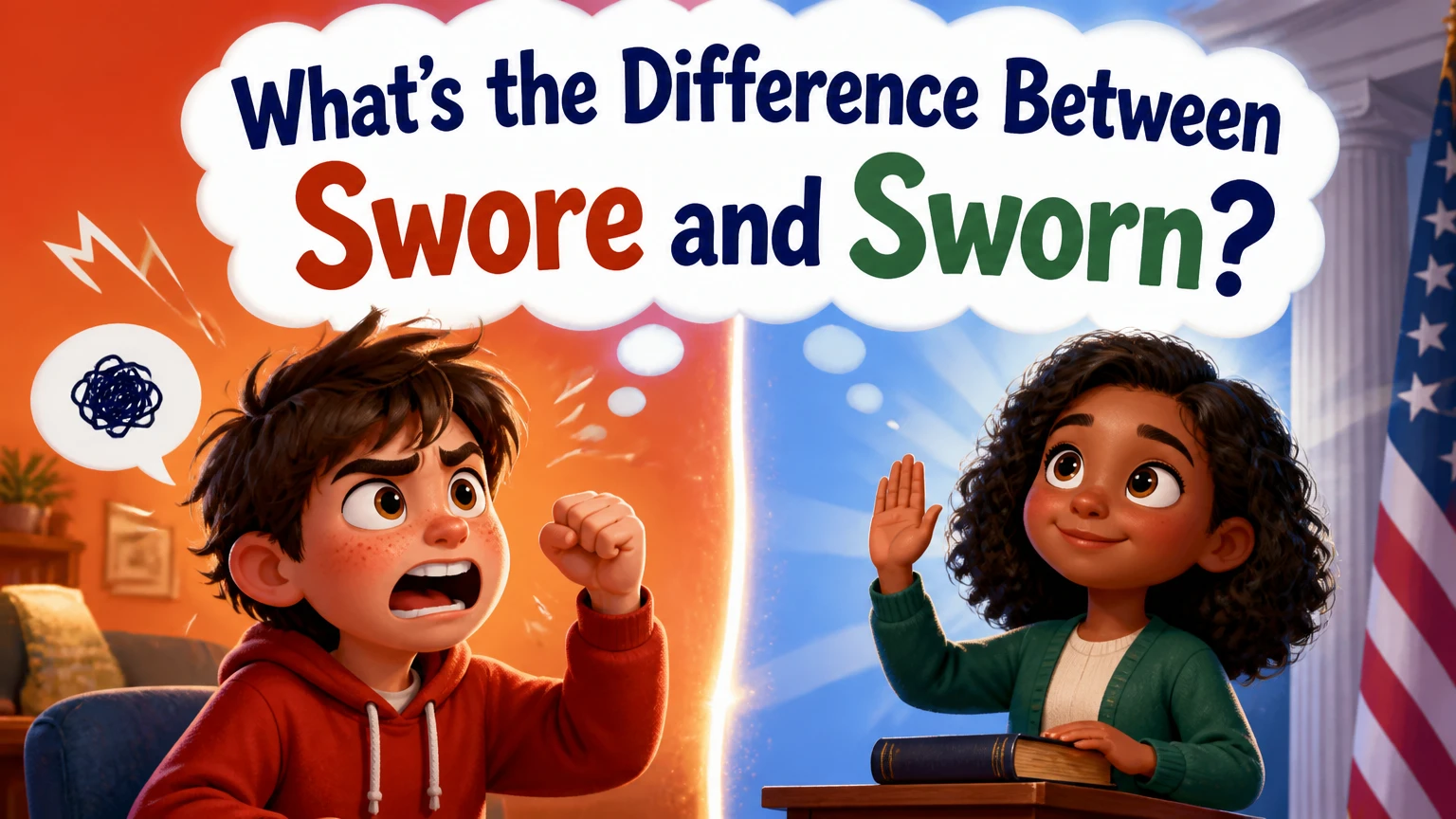
Swore is the simple past tense of swear, while sworn is its past participle. Use swore for a completed past action without a helping verb, as in “She swore she was ready.” Use sworn after have, has, or had, in passive constructions such as “He was sworn in,” or as an adjective in “sworn enemies.”
Key Facts at a Glance
Swore is the simple past form of swear: “I swore an oath yesterday.”
Sworn is the past participle: “I have sworn an oath.”
The perfect tenses use have sworn, has sworn, or had sworn.
The passive voice uses forms such as was sworn and were sworn.
Sworn can work as an adjective in phrases such as sworn statement and sworn enemy.
The answer to “which is the past tense of swear?” is swore when the question means simple past.
What Is the Difference Between Swore and Sworn?
The core difference is grammatical form: swore is a finite simple-past verb, while sworn is a past participle that normally needs an auxiliary verb or functions adjectivally. Both forms describe an earlier act of swearing, but they place that act in different grammatical structures.
| Form | Grammatical role | Typical pattern | Example |
|---|---|---|---|
| swear | Base form or present tense | I/you/we/they swear | “They swear the account is accurate.” |
| swears | Third-person present | He/she/it swears | “The witness swears to the truth.” |
| swore | Simple past | Subject + swore | “The witness swore yesterday.” |
| sworn | Past participle | have/has/had + sworn | “The witness has sworn an oath.” |
| sworn | Passive participle or adjective | was/were sworn, sworn + noun | “The witness was sworn in.” |
The distinction resembles other irregular verb patterns. Speak, spoke, spoken and break, broke, broken also use one form for simple past and another for the past participle. English does not use sworn as the ordinary standalone simple past in standard modern usage.
When Should You Use Swore?
Use swore when the act happened in the past and the sentence does not require a perfect or passive construction. The simple past normally presents the event as a completed fact, often with a finished-time expression such as yesterday, last year, or during the hearing.
Examples include:
- “I swore I had locked the door.”
- “Maya swore an oath before the judge.”
- “They swore never to reveal the password.”
- “He swore at the driver after the collision.”
- “The children swore they had not touched the equipment.”
The verb swear has several meanings. It can mean making a solemn promise, making a strong claim, using profanity, or formally taking an oath. The form swore remains the simple past for each meaning.
| Meaning of swear | Simple-past example | Time signal |
|---|---|---|
| Make a promise | “She swore to return.” | “That morning” |
| Make a claim | “He swore the report was genuine.” | “At the hearing” |
| Use profanity | “The mechanic swore at the broken bolt.” | “Earlier today” |
| Take an oath | “The witness swore on the record.” | “Before testimony” |
A practical editing test is simple: remove any helping verb and read the sentence aloud. “I swore the statement was accurate” is complete. “I sworn the statement was accurate” is not standard English.
When Should You Use Sworn?
Use sworn when the sentence contains a perfect-tense auxiliary, a passive construction, or an adjectival phrase. The word sworn cannot normally express the ordinary simple past by itself, but it is the required participle in structures that connect the earlier action to another verb or grammatical focus.
Perfect tenses with sworn
Perfect constructions use have sworn, has sworn, or had sworn. The auxiliary carries the tense, while sworn supplies the participle.
- “I have sworn to protect the records.”
- “She has sworn that the account is true.”
- “They had sworn an oath before the ceremony began.”
- “He will have sworn the affidavit by Friday.”
The time relationship changes with the auxiliary:
| Construction | Time relationship | Example |
|---|---|---|
| have sworn | Past action connected to the present | “We have sworn to keep quiet.” |
| has sworn | Same relationship with third-person singular subject | “The director has sworn to cooperate.” |
| had sworn | Earlier than another past event | “She had sworn before the trial started.” |
| will have sworn | Completed before a future point | “The panel will have sworn the witness by noon.” |
The sentence “He has swore to tell the truth” is incorrect in standard English because has requires the past participle sworn, not the simple past swore.
Passive constructions with sworn
Use sworn in passive voice when the subject receives the action. The phrase sworn in is especially common for witnesses, jurors, judges, ministers, and public officials.
- “The witness was sworn in at 9 a.m.”
- “The jurors were sworn in before opening statements.”
- “The new mayor was sworn into office on Monday.”
- “All witnesses must be sworn before giving evidence.”
The active and passive versions emphasize different participants:
- Active: “The clerk swore in the witness.”
- Passive: “The witness was sworn in by the clerk.”
In the active sentence, the clerk performs the action. In the passive sentence, the witness becomes the grammatical subject. This is why “The witness swore in” usually sounds incomplete or incorrect when the intended meaning is that officials administered the oath.
What Is the Difference Between “I Swore” and “I Have Sworn”?
“I swore” reports a completed past event, while “I have sworn” presents a past act as relevant to the present or as part of a current commitment. The choice depends on the time frame and the relationship between the past action and the current situation.
| Sentence | Form | Meaning |
|---|---|---|
| “I swore yesterday.” | Simple past | The event occurred at a specified past time |
| “I have sworn to help.” | Present perfect | The commitment remains relevant now |
| “I had sworn to help.” | Past perfect | The commitment preceded another past event |
| “I was sworn in yesterday.” | Passive past | Someone administered an oath to me |
| “I am sworn to secrecy.” | Adjectival/passive | I am bound by an oath now |
A finished-time expression usually favors the simple past: “She swore during the hearing last Tuesday.” Present perfect generally avoids a finished-time expression in standard usage, so “She has sworn during the hearing last Tuesday” should be replaced with “She swore during the hearing last Tuesday.”
Can Sworn Be Used Without Have, Has, or Had?
Sworn can appear without have, has, or had when another auxiliary forms the passive voice or when sworn acts as an adjective. The shortcut “use swore whenever no auxiliary appears immediately before it” is useful for basic exercises, but it is not a complete grammar rule.
Examples without have, has, or had include:
- “The witness was sworn before testimony.”
- “They are sworn enemies.”
- “She signed a sworn statement.”
- “He remained sworn to secrecy.”
The expression sworn statement is adjectival: sworn describes the statement’s formal status. It does not mean that sworn is functioning as the sentence’s simple past verb.
This distinction matters in editing. “She sworn an affidavit” is incorrect if the intended structure is simple past. “She submitted a sworn affidavit” is correct because sworn modifies affidavit. “She had sworn an affidavit” is also correct because had forms the past perfect.
Is “Swore” or “Sworn” Correct in Legal English?
Legal English uses sworn for documents, testimony, witnesses, and people bound by an oath, while swore describes a person’s completed act of taking or making the oath. The correct word depends on whether the sentence focuses on the action or the legal status created by that action.
| Legal expression | Correct form | Why it is used |
|---|---|---|
| sworn statement | sworn | The statement has been made under oath |
| sworn testimony | sworn | The testimony was given under oath |
| sworn affidavit | sworn | The affidavit was formally affirmed or sworn |
| swore an oath | swore | The person performed the past action |
| was sworn in | sworn | Passive construction for formal induction |
| sworn witness | sworn | The witness has taken an oath |
For example, “The applicant swore that the information was accurate” describes the applicant’s action. “The applicant submitted a sworn statement” describes the document. “The applicant was sworn in before answering questions” uses passive voice.
Legal requirements vary by jurisdiction. A court, notary, commissioner for oaths, or other authorized official may administer an oath or affirmation, and the validity of a document depends on local rules rather than on the choice between swore and sworn. Grammar identifies the form; it does not determine whether an affidavit is legally sufficient.
How Do You Choose Between Swore and Sworn?
Choose swore for an independent simple-past action, and choose sworn after a perfect auxiliary, in passive voice, or before a noun as an adjective. A four-step test resolves most sentences accurately.
- Ask whether the action is simple past.
If the subject directly performed the completed action, use swore: “The defendant swore under oath.” - Look for have, has, or had.
These auxiliaries require sworn: “The defendant had sworn under oath.” - Check whether the subject receives the action.
Use sworn in passive forms: “The defendant was sworn before testifying.” - Check whether the word modifies a noun.
Use sworn adjectivally: “The defendant gave a sworn declaration.”
A useful substitution test compares swear with a familiar regular verb:
- “I walked yesterday” corresponds to “I swore yesterday.”
- “I have walked” corresponds to “I have sworn.”
- “I was walked” is passive, just as “I was sworn” is passive.
The test is not perfect for every idiom, but it identifies the grammatical role quickly.
What Are the Common Mistakes With Swore and Sworn?
The most common errors are using the participle as a standalone past verb and using the simple past after a perfect auxiliary. Correcting those errors requires identifying which word carries tense in the verb phrase.
| Incorrect sentence | Correct sentence | Explanation |
|---|---|---|
| “I sworn I saw him.” | “I swore I saw him.” | Simple past needs swore |
| “She has swore to help.” | “She has sworn to help.” | Has requires a participle |
| “He had swore an oath.” | “He had sworn an oath.” | Had forms past perfect |
| “The witness swore in.” | “The witness was sworn in.” | The witness receives the action |
| “They filed a swore statement.” | “They filed a sworn statement.” | Sworn modifies statement |
| “She sworn at the referee.” | “She swore at the referee.” | Profanity meaning still uses simple past |
One counterintuitive point is that was does not always mean swore should follow it. “She was swearing” uses the present participle in a progressive construction, while “She was sworn” uses the past participle in a passive construction. The auxiliary must be interpreted with the form that follows it.
Another expert editing rule concerns “to.” The infinitive is to swear, not to swore or to sworn. After a modal verb, use the base form: “He will swear,” “She can swear,” and “They must swear.”
How Do Swore and Sworn Compare With Similar Irregular Verbs?
Swore matches the simple-past slot occupied by spoke and broke, while sworn matches the participle slot occupied by spoken and broken. Comparing the complete forms helps learners recognize a recurring English pattern instead of memorizing one isolated verb.
| Base form | Simple past | Past participle | Example with participle |
|---|---|---|---|
| swear | swore | sworn | “I have sworn.” |
| speak | spoke | spoken | “I have spoken.” |
| break | broke | broken | “The seal was broken.” |
| write | wrote | written | “She has written.” |
| choose | chose | chosen | “They had chosen.” |
The same structural test applies to each row. “She wrote the letter” is simple past, but “She has written the letter” uses a participle. “He spoke clearly” differs from “He has spoken clearly” in the same way that “I swore” differs from “I have sworn.”
How are swore and sworn pronounced?
In common standard pronunciation, swore is pronounced approximately “swor,” while sworn is pronounced approximately “sworn,” with a final n sound. The vowel can vary by accent, especially between rhotic North American English and non-rhotic varieties of British English.
| Word | Approximate pronunciation | Final sound | Example |
|---|---|---|---|
| swear | “swair” | r may be pronounced | “I swear it is true.” |
| swore | “swor” | Usually no final n | “I swore yesterday.” |
| sworn | “sworn” | n is pronounced | “I have sworn.” |
| swearing | “swair-ing” | -ing ending | “They were swearing.” |
The words are not interchangeable in speech. The audible n in sworn can help learners distinguish “I swore” from “I have sworn,” although accent differences may alter the vowel quality.
When Does Swore Sound More Natural Than Sworn?
Swore is more natural in a chronological story, a report of a specific event, or a sentence with a finished past-time marker. Sworn is more natural when the sentence emphasizes an existing commitment, a formal status, or the relationship between two events.
Compare these pairs:
- “At 8 p.m., Liam swore he was innocent.”
The sentence reports a past statement. - “Liam has sworn he is innocent.”
The sentence presents that claim as relevant now. - “The officer swore the witness in.”
The officer performed the action. - “The witness was sworn in by the officer.”
The witness received the action. - “Nora swore never to return.”
Nora made the promise. - “Nora remained sworn to secrecy.”
Nora’s current condition or obligation is emphasized.
Writers sometimes choose the perfect form to stress continuing relevance, but the choice should match the intended timeline. Present perfect is not simply a more formal replacement for simple past.
Is “I Sworn” Ever Correct?
“I sworn” is not correct as a standard independent verb phrase, but sworn can be correct after an auxiliary or as part of a noun phrase. The correct alternatives are “I swore,” “I have sworn,” “I had sworn,” and “I was sworn,” depending on meaning.
| Intended meaning | Correct wording |
|---|---|
| Completed past claim | “I swore it was true.” |
| Current commitment | “I have sworn to tell the truth.” |
| Earlier past commitment | “I had sworn to remain silent.” |
| Formal induction | “I was sworn in yesterday.” |
| Description of a document | “I signed a sworn declaration.” |
The phrase “I sworn” may appear in dialect, historical writing, or nonstandard speech, but it is not the recommended form for formal, academic, business, or legal writing. Standard English requires either the simple past swore or an auxiliary plus the participle sworn.
The Bottom Line: Which Form Should You Use?
The answer to “whats the difference between swore and sworn which is the past tense of swear” is direct: swore is the simple past tense of swear, and sworn is the past participle. Write “I swore” for a completed past action, “I have sworn” for a perfect construction, “I was sworn in” for passive voice, and “a sworn statement” when the word modifies a noun.
Use this final checklist:
- Past action by the subject: swore
- After have, has, or had: sworn
- After was, were, is, or are in passive voice: sworn
- Before a noun: sworn
- After will, can, must, or to: swear
Frequently Asked Questions
Is swore the past tense of swear?
Yes. Swore is the simple past tense of swear: “She swore she had seen the document.” The form changes to sworn when a perfect auxiliary is present, as in “She has sworn she saw the document,” or when passive voice or an adjective requires the past participle.
Is sworn past tense or past participle?
Sworn is the past participle, not the ordinary simple past tense. English uses sworn with have, has, or had in perfect tenses, with forms of be in passive constructions, and before nouns in expressions such as sworn testimony.
Should I write “I swore” or “I have sworn”?
Write I swore when you are reporting a completed event, especially with a finished time such as “yesterday” or “during the trial.” Write I have sworn when the commitment or statement remains relevant now, or when the sentence is a present-perfect construction.
Is “sworn statement” correct?
Yes. Sworn statement is the standard expression because sworn describes a statement made under oath or formal affirmation. Swore statement is incorrect. The verb form can still be swore in a sentence such as “The applicant swore that the statement was accurate.”
What is the past participle of swear?
The past participle of swear is sworn. The complete principal parts are swear, swore, sworn. For example: “I swear now,” “I swore yesterday,” and “I have sworn before.”
Is “swore in” or “sworn in” correct?
Both can be correct in different structures. Use swore in when the subject actively administered the oath: “The clerk swore in the witness.” Use was sworn in or were sworn in when the witness or official received the action: “The witness was sworn in.”