
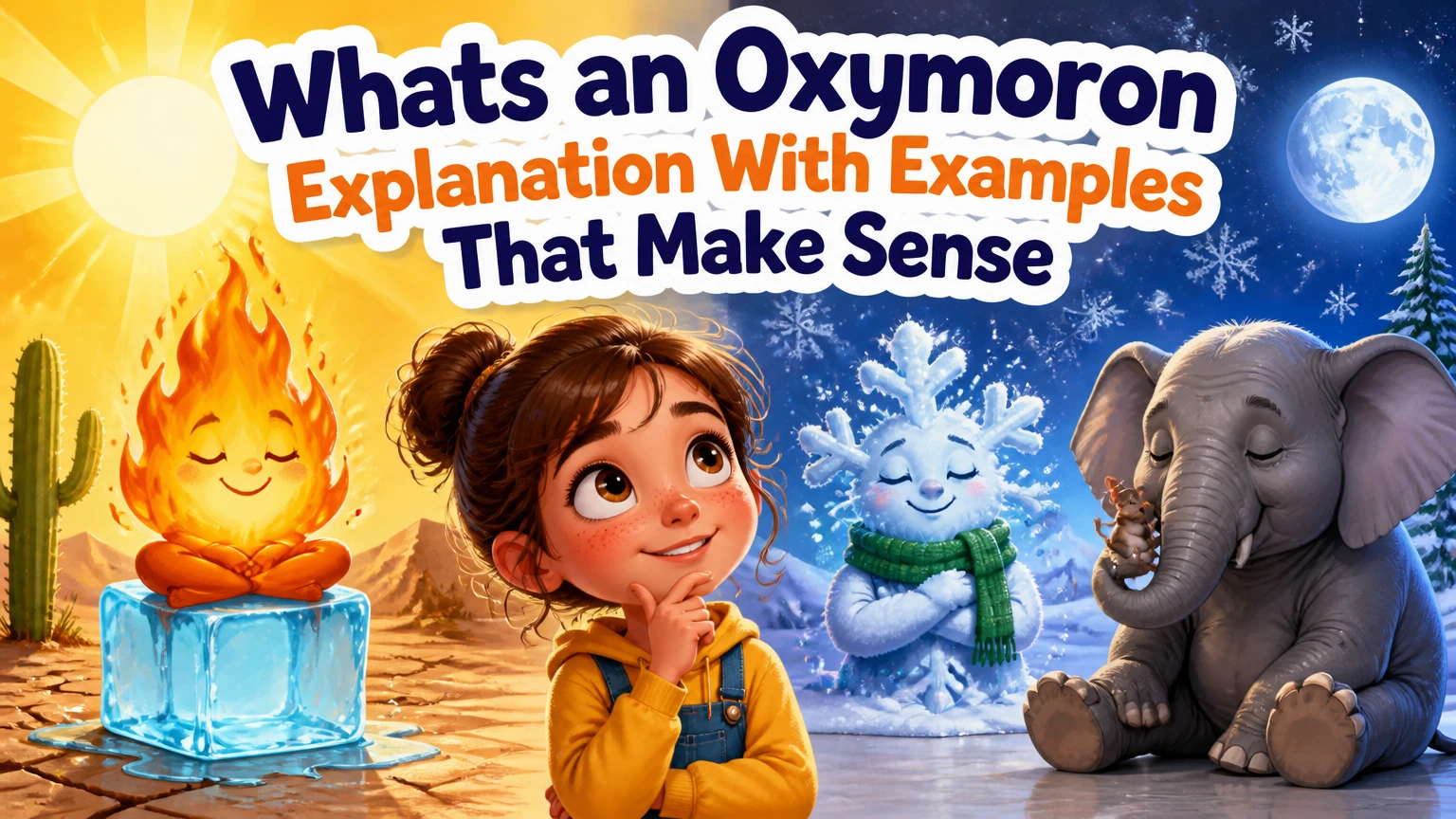
An oxymoron is a figure of speech that places two apparently contradictory words together to express a more precise, vivid, or surprising meaning. In “deafening silence,” silence is not literally loud; the phrase describes silence so intense that it feels overwhelming. Oxymorons compress a conflict of ideas into a memorable expression.
Key Facts at a Glance
An oxymoron combines apparently opposing terms in one phrase.
The contradiction usually produces a contextual meaning rather than a logical error.
“Deafening silence” is an oxymoron because extreme silence can feel overwhelming.
A paradox is usually a complete idea, while an oxymoron is usually a short phrase.
“Jumbo shrimp” is a conventional oxymoron because “jumbo” and “shrimp” conflict in size.
An effective oxymoron should create a meaningful tension, not random nonsense.
What Is an Oxymoron?
An oxymoron is a compact expression that joins words with conflicting or apparently incompatible meanings. The combination makes readers hold two ideas together, then interpret the phrase through context, tone, scale, or human experience.
The word oxymoron comes from the Greek oxymōron, traditionally analyzed as oxys, meaning “sharp,” and mōros, meaning “dull” or “foolish.” The term is therefore self-referential: the name for a contradictory expression contains a contradiction.
An oxymoron is not always a strict pair of dictionary opposites. “Bittersweet” combines two contrasting tastes, while “original copy” combines originality with duplication. The terms conflict at one level but can coexist at another. A copy may be an original document, and an experience may contain both pleasure and sadness.
What does an oxymoron do?
An oxymoron creates semantic tension. The first word establishes an expectation, and the second word disrupts it, forcing the reader to search for a qualified meaning.
Consider these examples:
- Deafening silence: silence that feels oppressive or overwhelming.
- Bittersweet memory: a memory that produces happiness and sadness.
- Open secret: information widely known but not officially acknowledged.
- Cruel kindness: an apparently kind action that causes pain or humiliation.
- Seriously funny: something genuinely humorous rather than merely mildly amusing.
The strongest examples do more than place opposites side by side. They reveal a complicated condition that ordinary literal language would describe less efficiently.
How Does an Oxymoron Work?
An oxymoron works through a two-stage process: literal conflict followed by contextual resolution. Readers first notice that the words do not comfortably fit together, then use the surrounding situation to understand the intended relationship.
In “controlled chaos,” controlled suggests order and chaos suggests disorder. The phrase can describe a busy emergency department, a rehearsed stage performance, or a creative process with deliberate boundaries. Context supplies the connection.
Literal contradiction versus figurative tension
A literal contradiction says that two conditions cannot exist together under the same definition and circumstances. A figurative oxymoron uses a conflict to describe a real experience more accurately.
| Expression | Surface conflict | Interpreted meaning | Classification |
|---|---|---|---|
| Deafening silence | Silence cannot produce sound | Overwhelming or absolute quiet | Oxymoron |
| Original copy | A copy appears non-original | The first version of a reproduced document | Oxymoron |
| Rectangular circle | A rectangle cannot be a circle | No coherent secondary meaning | Contradiction |
| Bittersweet victory | Victory is positive, bitterness is negative | Success accompanied by loss | Oxymoron |
| Purple yellow | Colors may coexist without contradiction | Two colors named together | Not normally an oxymoron |
| Living dead | Living and dead conflict biologically | Zombie, emotionally numb person, or fictional being | Context-dependent |
A phrase becomes rhetorically useful when the apparent conflict points to an identifiable situation. “Rectangular circle” fails because it normally offers no interpretable meaning beyond impossibility.
Why does context matter?
Context determines whether a phrase is poetic, humorous, technical, idiomatic, or simply inaccurate. “Plastic glass” can be an oxymoron when glass means a drinking vessel made from plastic, but it is not necessarily contradictory because “glass” also means a container rather than a material.
That distinction matters in editing. Do not label every unusual noun combination an oxymoron. Ask what the phrase means in the sentence, not only what each word means in isolation.
What Are the Main Types of Oxymorons?
Oxymorons occur in several grammatical patterns, although adjective-plus-noun phrases are the most familiar. The category depends on the relationship between the words, not on a requirement that every example contain exactly two words.
| Type | Common structure | Examples | Typical effect |
|---|---|---|---|
| Descriptive | Adjective + noun | Deafening silence, open secret | Vivid description |
| Conceptual | Noun + noun | Love-hate relationship, student-teacher | Complicated relationship |
| Compound | Combined lexical form | Bittersweet, frenemy | Compressed contrast |
| Verbal | Verb + adjective or adverb | Act naturally, hurry slowly | Comic or practical tension |
| Idiomatic | Conventional phrase | Alone together, seriously funny | Familiar rhetorical effect |
Adjective-plus-noun oxymorons
The adjective-plus-noun pattern places a modifier against the expected nature of a noun. Examples include:
- Civil war: organized conflict within one political community.
- Liquid gas: a gas stored in liquid form under pressure or at low temperature.
- Virtual reality: a computer-generated environment experienced as if present.
- Exact estimate: an estimate presented with unusually precise boundaries.
- Passive aggression: hostility expressed indirectly rather than openly.
- Friendly fire: accidental attack on people from the same side.
Some examples are more rhetorically striking than others. “Deafening silence” remains expressive, while “civil war” has become an established historical and political term.
Noun-plus-noun and compound forms
Noun combinations often describe divided identity or mixed qualities. A love-hate relationship contains affection and hostility toward the same person, activity, or object. A player-coach performs as both participant and leader.
Compound oxymorons can become ordinary vocabulary. Bittersweet, frenemy, and mockumentary are understood quickly because repeated use has stabilized their meanings. Their contradiction remains part of their history, even when speakers no longer experience the phrase as surprising.
Conversational and idiomatic oxymorons
Everyday speech contains expressions that sound contradictory but communicate efficiently:
- Act natural: deliberately behave in a way that appears unplanned.
- Alone together: share physical space while remaining emotionally separate.
- Clearly confused: visibly uncertain despite the adverb “clearly.”
- Minor miracle: an event that is unusually fortunate but not supernatural.
- Accidentally on purpose: an action presented as unintended but partly deliberate.
- Pretty ugly: unattractive in a noticeable or extreme way.
These expressions may sound humorous, sarcastic, or informal. Use them selectively in formal writing because some readers may regard them as clichés rather than fresh imagery.
What Are Common Oxymoron Examples?
Common oxymorons describe mixed emotions, conflicting social conditions, impossible-seeming actions, or deliberately qualified judgments. Meaning depends on the phrase’s established usage and the sentence surrounding it.
| Oxymoron | Contrasting terms | Meaning in context | Example sentence |
|---|---|---|---|
| Deafening silence | Deafening + silence | Overwhelming quiet | A deafening silence followed the verdict. |
| Bittersweet ending | Bitter + sweet | Pleasure mixed with sadness | Graduation was a bittersweet ending. |
| Open secret | Open + secret | Widely known but unofficial | The merger was an open secret. |
| Original copy | Original + copy | First document reproduced from a source | Keep the original copy in the archive. |
| Living history | Living + history | Past preserved through present people | The museum presents living history. |
| Virtual reality | Virtual + reality | Simulated environment experienced as real | The headset creates virtual reality. |
| Jumbo shrimp | Jumbo + shrimp | A very large shrimp relative to its kind | The restaurant serves jumbo shrimp. |
| Controlled chaos | Controlled + chaos | Disorder managed within limits | The rehearsal looked like controlled chaos. |
Which oxymorons describe emotions?
Emotional oxymorons communicate ambivalence, where two feelings genuinely occur together. Useful examples include bittersweet joy, loving hate, painful pleasure, hopeful despair, and joyful tears.
“Bittersweet” is especially effective because many important experiences contain gain and loss at once. A retirement party may feel celebratory because a career has ended successfully and sad because daily relationships will change.
Writers should avoid adding an oxymoron merely to sound sophisticated. “Happy sadness” may be understandable, but “bittersweet relief” usually conveys the mixed emotion more precisely because relief identifies the positive feeling and bitter qualifies it.
Which oxymorons are humorous?
Humorous oxymorons expose an absurd combination or create a deliberately self-undermining description. Examples include military intelligence, jumbo shrimp, working vacation, act naturally, and pretty ugly.
Humor depends heavily on audience knowledge. “Military intelligence” works as a political or cultural joke because intelligence is expected from a military organization, while the phrase can also be interpreted literally as intelligence work performed by the military. The double reading creates the effect.
What Is the Difference Between an Oxymoron, Paradox, and Antithesis?
An oxymoron is usually a compressed phrase, a paradox is a seemingly self-contradictory idea, and antithesis places contrasting ideas into a balanced grammatical structure. The three devices overlap because all create contrast, but their scale and function differ.
| Device | Usual size | Main mechanism | Example | Primary effect |
|---|---|---|---|---|
| Oxymoron | Word or short phrase | Contradictory terms joined closely | Deafening silence | Vivid compression |
| Paradox | Sentence or proposition | Apparent impossibility containing insight | The only constant is change | Reflection |
| Antithesis | Parallel clause or sentence | Balanced opposition | To err is human; to forgive, divine | Emphasis and rhythm |
| Irony | Statement, event, or situation | Meaning differs from expectation | A fire station burns down | Surprise or criticism |
| Juxtaposition | Words, images, or scenes | Contrast through placement | Wealth beside poverty | Comparison |
Is an oxymoron a type of paradox?
An oxymoron can be considered a highly compressed form of paradox in broad rhetorical analysis, but the terms are not interchangeable in ordinary grammar instruction. “Deafening silence” is a phrase; “The more you learn, the less you know” is a complete paradoxical proposition.
A paradox often requires reasoning across an entire sentence or argument. An oxymoron creates its tension locally, usually through two adjacent words. Calling every paradox an oxymoron makes the analysis less precise.
How is antithesis different?
Antithesis contrasts two ideas through parallel structure, often across a clause or sentence. John F. Kennedy’s “Ask not what your country can do for you, ask what you can do for your country” uses antithesis because the two clauses mirror each other while reversing the relationship between citizen and country.
An oxymoron does not require parallel clauses. “Bitter victory” creates contrast inside a short noun phrase. Antithesis is therefore structural and extended; oxymoron is compressed and lexical.
How Can You Identify an Oxymoron?
Identify an oxymoron by testing whether two nearby terms conflict on the surface but combine to express a recognizable meaning in context. A useful five-step test prevents confusion with factual errors, ordinary contrast, and paradox.
- Locate the paired terms. Find the words that appear to conflict, such as open and secret.
- State each literal meaning. Write what each term would mean independently.
- Check the contradiction. Decide whether the words conflict in quality, category, action, or expectation.
- Search for contextual resolution. Ask whether the phrase describes a real mixed condition or an established idiom.
- Test the sentence aloud. If the phrase communicates a specific idea efficiently, it probably functions as an oxymoron.
The test produces different results for different phrases. “Open secret” passes because the information is public while remaining unofficial. “Blue square” fails because the color and shape do not conflict.
Is “jumbo shrimp” an oxymoron?
“Jumbo shrimp” is a conventional oxymoron because jumbo means unusually large while shrimp can suggest smallness. The expression remains logically possible because shrimp vary in size and are often compared with other shrimp, not with whales or large animals.
The phrase also demonstrates why dictionary meanings and cultural associations differ. In biology, “shrimp” names a group of crustaceans; in ordinary English, the word can also mean a small person or thing. The rhetorical contradiction depends mainly on the second association.
How Do You Write an Effective Oxymoron?
Write an effective oxymoron by pairing a familiar expectation with a meaningful exception, then placing the phrase in a context that explains the tension. The best process takes about 5-10 minutes for a simple sentence and longer for poetry, branding, or formal speeches.
Five steps for creating one
- Choose the concept. Decide whether you want to express mixed emotion, managed disorder, social hypocrisy, or unusual scale.
- List associated words. For “success,” brainstorm victory, loss, pressure, relief, sacrifice, and regret.
- Find a conflict. Pair terms such as “victory” and “regret” or “relief” and “pain.”
- Remove accidental nonsense. Keep combinations that reveal a situation, not random incompatibilities.
- Place the phrase in a sentence. Context should make the intended meaning apparent without a paragraph of explanation.
For example, a writer describing a promotion after a colleague’s departure might choose lonely success. The phrase is not a strict dictionary contradiction, but it creates a clear tension. A sentence such as “Her lonely success felt undeserved without the colleague who trained her” resolves that tension.
How should punctuation work?
Most short oxymorons need no punctuation: “The room fell into deafening silence.” A hyphen may be appropriate when the expression functions as a compound modifier before a noun, as in “a bittersweet farewell,” although standard dictionaries determine whether a compound is normally closed, hyphenated, or open.
Do not insert quotation marks around an ordinary oxymoron. Quotation marks can suggest irony or skepticism, changing the writer’s attitude toward the phrase.
Where Are Oxymorons Used?
Oxymorons appear in literature, journalism, advertising, political speech, academic analysis, and ordinary conversation. Each setting rewards a different degree of novelty, clarity, and informality.
| Context | Suitable examples | Recommended purpose | Main risk |
|---|---|---|---|
| School essay | Bittersweet memory, cruel kindness | Analyze complexity | Sounding decorative |
| Fiction | Tender violence, beautiful ruin | Character and atmosphere | Overwriting |
| Speech | Open secret, controlled growth | Make a point memorable | Becoming a cliché |
| Advertising | Affordable luxury, authentic replica | Signal tension or positioning | Appearing deceptive |
| Journalism | Civil war, silent protest | Describe qualified conditions | Ambiguous wording |
| Conversation | Working vacation, pretty ugly | Humor or emphasis | Informal tone |
How do students use oxymorons in essays?
Students can use oxymorons to analyze a character, theme, narrator, or historical condition, but the phrase should support an argument rather than replace one. “Cruel kindness” may describe a character who helps someone while controlling or humiliating them.
A strong analysis identifies the two conflicting terms, explains their contextual meaning, and connects the tension to the text’s larger theme. A weak analysis merely labels “bittersweet” an oxymoron without explaining why the experience contains both emotional qualities.
How do marketers and speakers use them?
Marketers use oxymorons to position a product between two desirable qualities, such as affordable luxury or authentic replica. The strategy is effective only when the product evidence supports both claims. “Affordable luxury” becomes misleading when the price is high and the quality is ordinary.
Speakers use phrases such as controlled growth, constructive criticism, and open secret to make complicated situations memorable. A speaker should pause briefly after a strong oxymoron so listeners can process the contrast. Repeated use produces a slogan-like effect and weakens the device.
What Mistakes Should Writers Avoid?
The most common oxymoron mistakes are confusing an oxymoron with any contrast, forcing meaningless word pairs, relying on clichés, and using too many in close succession. Revision should prioritize interpretability over cleverness.
Mistake 1: Calling every contrast an oxymoron
“Hot and cold” is a contrast, not usually an oxymoron, because the words are presented as separate alternatives. “Freezing heat” creates oxymoronic tension because the two qualities modify the same experience.
Mistake 2: Creating factual impossibility
“Triangular square” does not normally create insight. It names incompatible geometric categories. Unless a fictional, comic, or metaphorical context supplies a meaning, the phrase is simply incorrect.
Mistake 3: Using a cliché without a reason
Expressions such as old news, larger than life, and same difference are recognizable, but their familiarity can make them less expressive. Use a conventional phrase when clarity matters; invent a fresher phrase when the writing needs a distinctive image.
Mistake 4: Overcrowding a paragraph
One carefully placed oxymoron can sharpen a paragraph. Four or five competing contradictions can make the prose feel artificial and obscure the central point.
Mistake 5: Ignoring register
“Military intelligence” may suit satire but not a neutral policy report. “Affordable luxury” may suit advertising but require explanation in an academic essay. Match the phrase to the audience, purpose, and level of formality.
Are Some Oxymorons No Longer Experienced as Contradictions?
Some oxymorons become lexicalized, meaning repeated use gives the combination a stable meaning that speakers process as ordinary vocabulary. “Virtual reality,” “civil war,” and “passive resistance” may no longer feel surprising in technical or political writing.
Lexicalization does not erase the original semantic tension. It changes how quickly readers notice it. A literary writer may revive a familiar phrase by modifying it, such as “an unofficial open secret” or “a painfully bittersweet victory,” but extra modifiers should clarify rather than overstate.
Technical language also complicates classification. “Liquid gas” can describe a gas stored in liquid form, so the apparent contradiction reflects a change in physical state rather than a pure rhetorical invention. Scientific context may make the phrase precise instead of poetic.
Frequently Asked Questions
Can an oxymoron contain more than two words?
Yes. An oxymoron is defined by contradictory terms in close relationship, not by a strict two-word limit. “A painfully beautiful farewell” contains a contradiction between emotional pain and beauty, although the central oxymoronic pair is “painfully beautiful.” Longer phrases need clear context to remain readable.
What is the opposite of an oxymoron?
There is no single universally accepted rhetorical opposite of an oxymoron. A plain literal expression avoids semantic tension, while a tautology repeats the same idea, as in “added bonus” or “free gift.” A synonym-based phrase can also remove contrast, but rhetorical devices do not form a simple opposite pair.
Is irony the same as an oxymoron?
No. An oxymoron joins apparently contradictory terms, while irony involves a difference between expected and intended meaning, or between an expected outcome and an actual one. “Deafening silence” is an oxymoron. A fire station burning down is an ironic event, not an oxymoron.
Is “old news” an oxymoron?
“Old news” can function as an oxymoron when news means newly reported information and old means no longer current. In ordinary usage, however, “old news” is mainly an idiom meaning information that is already known. The phrase is a conventionalized oxymoron rather than a highly vivid original one.
Can oxymorons be used in formal writing?
Oxymorons can be effective in formal writing when they describe a genuine tension and the writer explains their relevance. Academic prose may use terms such as “civil disobedience,” “passive resistance,” or “productive failure,” but an essay should analyze the phrase instead of adding it as decoration.
How many oxymorons should appear in one paragraph?
One prominent oxymoron is usually enough for a short paragraph. A literary passage may support several, but each should perform a different descriptive function. If removing one phrase does not reduce precision, remove it. Concentration matters more than quantity.
The Bottom Line
An oxymoron combines apparently contradictory terms to express a meaningful condition, mixed emotion, or surprising relationship. “Deafening silence,” “bittersweet,” and “open secret” work because context reconciles their surface conflict. The most reliable way to identify an oxymoron is to test whether the contradiction produces a recognizable meaning rather than random impossibility.
An effective whats an oxymoron explanation with examples should therefore distinguish oxymorons from paradoxes, antithesis, irony, and ordinary contrasts. Use one when compressed tension improves clarity, analysis, humor, or imagery, and revise it when the phrase creates confusion instead of insight.


