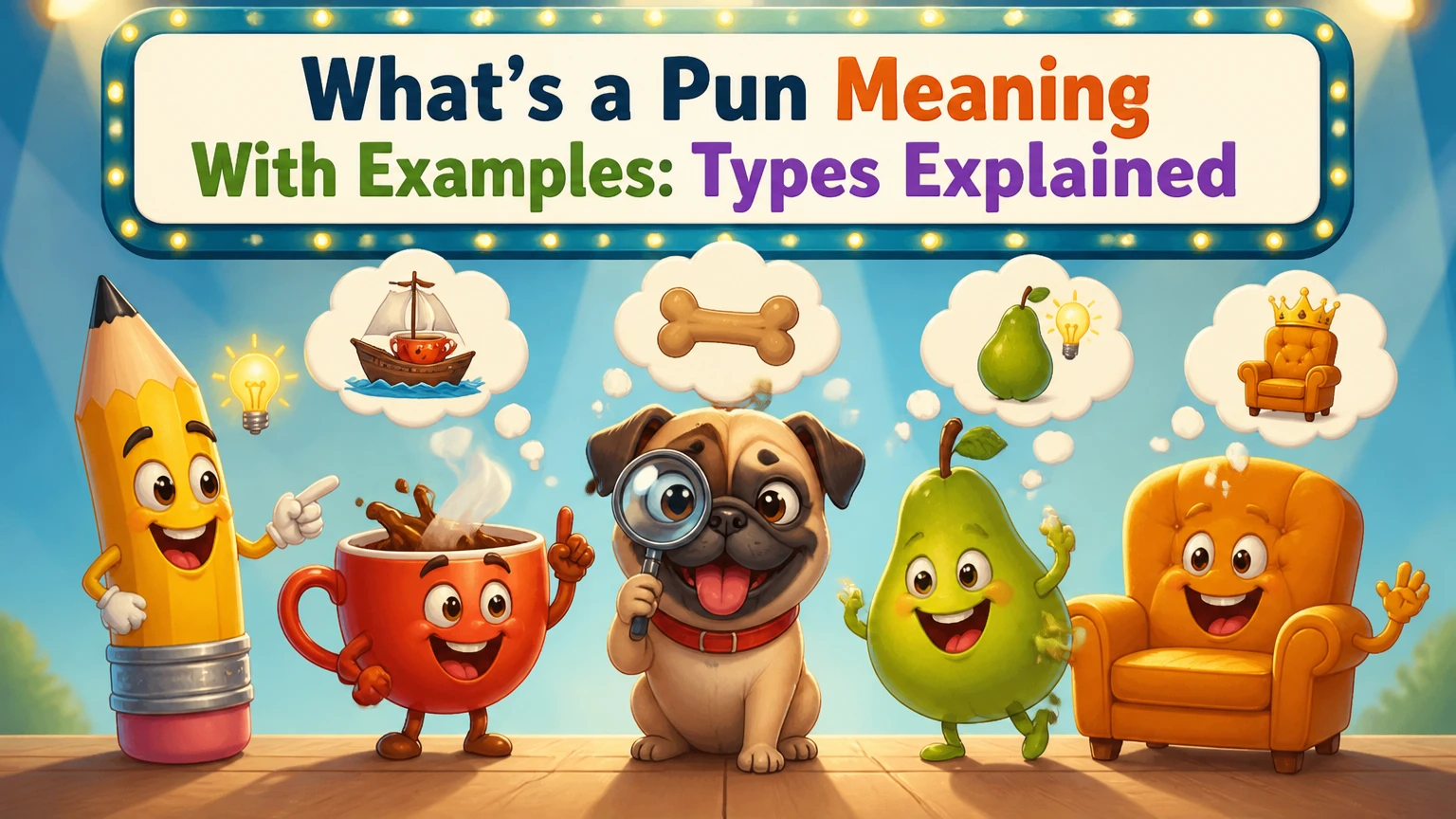
A pun is a form of wordplay that uses two or more meanings of a word, or words that sound or look alike, to create humor, surprise, or rhetorical emphasis. A pun makes one expression point toward different interpretations at the same time, as in “I’m outstanding in my field,” which can mean excellent at work or literally standing outdoors in a field.
Key Facts About Puns
- Paronomasia is the traditional rhetorical term for wordplay based on similar sounds or multiple meanings.
- A pun may depend on sound, spelling, meaning, visual imagery, or a combination of those features.
- “I lost interest” can mean losing financial interest or losing curiosity, making it a semantic pun.
- Homophones sound alike but usually have different spellings, such as flour and flower.
- Homographs share spelling but may have different meanings or pronunciations, such as bat for an animal and bat for sports equipment.
- A strong pun usually becomes understandable within one or two seconds after the listener reads or hears the key word.
What Does Pun Mean?
A pun means an expression that deliberately connects different meanings, pronunciations, or spellings to produce a humorous or rhetorical effect. The word pun describes both the technique and the individual example, while paronomasia is the more formal term used in rhetoric and literary criticism.
The defining feature is controlled ambiguity. A normal sentence guides a reader toward one interpretation, but a pun supplies a second interpretation that remains plausible. In “The bicycle could not stand on its own because it was two-tired,” tired means exhausted in ordinary English, while two-tired sounds like “two-tired” in the sense of having two tires.
A pun does not need to be a complete joke. A newspaper headline, brand name, poem, cartoon caption, or casual remark can all contain a pun. The wordplay may create laughter, reinforce a theme, make a phrase memorable, or invite the audience to notice a hidden connection.
Literal and Figurative Readings
The phrase “She is outstanding in her field” has two readings:
- Literal reading: She is standing outside in a field.
- Figurative reading: She is exceptionally skilled in her professional field.
The humor comes from the sudden shift between a physical location and an area of expertise. The sentence is grammatical under both readings, so the second meaning feels like a reinterpretation rather than an unrelated punchline.
How Do Puns Work?
Puns work by activating one expected meaning and then introducing a second meaning through a shared sound, spelling, or concept. The listener first follows the sentence normally, then revises or expands the interpretation when the wordplay becomes apparent.
A pun typically has four parts:
- A setup: The sentence establishes a likely meaning.
- A pivot word: One word carries another meaning or resembles another word.
- A second interpretation: The audience recognizes the alternate reading.
- A response: The result may be amusement, surprise, admiration, or a groan.
Consider “I used to be a banker, but I lost interest.” The setup suggests a career or financial story. The final word activates interest as both money earned on an account and attention or curiosity.
Puns often produce “groan” humor because the connection is easy to understand but deliberately concealed until the final word. The audience recognizes the construction immediately, which makes the joke feel both clever and predictable.
Why Are Puns Funny?
Puns are funny because they create a brief expectation error without requiring the audience to learn complex information. The listener predicts one meaning, discovers another, and mentally connects both interpretations in a short interval.
The response depends on context. A clever pun may amuse an audience familiar with the subject, while the same line may confuse people who do not know the relevant vocabulary. A pun about accounting requires less explanation for accountants than for young children, even when the wording is identical.
What Are the Main Types of Puns?
The main types of puns are homophonic, homographic, homonymic, compound, and visual puns. The categories overlap because “homonym” has different definitions in different linguistic traditions, but the table below uses the most practical distinctions for everyday English.
| Type | Main mechanism | Example | Best medium |
|---|---|---|---|
| Homophonic | Different words share pronunciation | “The baker kneaded the dough.” | Speech and informal writing |
| Homographic | Same spelling supports different meanings | “The fisherman went to the bank.” | Written language |
| Heterophonic | Same spelling, different pronunciation | “The wind was too strong to wind the sail.” | Reading aloud with context |
| Homonymic | Same form has unrelated meanings | “The crane lifted the crane.” | Short written or spoken lines |
| Visual | Image represents two readings | A potato sitting on a sofa as a “couch potato” | Cartoons and advertising |
| Compound | Several puns appear together | A sequence of related wordplays | Speeches and extended comedy |
Homophonic Puns
Homophonic puns use words that sound the same or nearly the same but differ in spelling or meaning. “The baker kneaded the dough” plays on kneaded, meaning worked by pressing, and needed, meaning required.
Other examples include:
- “I wondered why the baseball kept getting larger. Then it hit me.”
- “A bicycle can’t stand alone because it is two-tired.”
- “The florist sent a bouquet because she had a lot of stems to discuss.”
Homophonic puns often work best when heard aloud. In writing, readers may need spelling or punctuation to recognize the alternate word.
Homographic and Heterophonic Puns
A homograph is spelled the same as another word but may have a different meaning or pronunciation. A heterophonic pair is a more specific case in which the spelling is identical but pronunciation differs, such as tear in “a tear in the paper” and tear in “tear the paper.”
Examples include:
- “The fisherman sat on the bank.” The word bank can mean a financial institution or the edge of a river.
- “The wind was strong enough to wind the flag around the pole.” The first wind refers to moving air; the second refers to twisting or coiling.
- “The orchestra bass player watched a bass swim past the dock.” The first bass is an instrument or its player’s role; the second is a fish, with a different pronunciation in many varieties of English.
The distinction matters because the terms are often used loosely. Many general-audience explanations call any same-spelling, different-meaning word a homographic pun, even when pronunciation does not change.
Homonymic Puns
Homonymic puns use one word form with separate meanings. “The crane lifted the crane” can describe a machine lifting a bird, although the sentence becomes clearer with context.
“Time flies like an arrow; fruit flies like a banana” is a more complex example. The first clause treats flies as a verb and like as a comparison; the second treats flies as insects and like as a verb meaning enjoy.
Linguists disagree about whether homonyms must share spelling, pronunciation, or both. For practical writing, the important question is whether the audience can identify two established meanings without an unreasonable stretch.
Compound Puns
A compound pun contains two or more connected instances of wordplay. For example:
The x-ray technician sees right through people, keeps a skeletal staff, and has a bone-dry sense of humor.
The phrase combines see right through, skeletal, and bone-dry. Compound puns can establish a comic voice, but every added pun increases the risk of repetition and forced wording.
A useful editing rule is to keep one dominant pun per sentence unless the accumulation is the intended joke. Three unrelated puns usually feel like a vocabulary exercise rather than a crafted line.
Visual Puns
A visual pun combines an image with a phrase that has a literal and figurative interpretation. A potato sitting on a sofa illustrates “couch potato,” while a picture of a person made from money can represent “a well-spent figure.”
Visual puns appear in cartoons, packaging, logos, posters, social media graphics, and advertising. They can communicate quickly because the picture supplies one meaning while the caption or brand name supplies another.
Visual wordplay also creates accessibility challenges. Screen readers cannot interpret an image-based pun unless the alternative text describes both the image and the intended wordplay.
What Are Some Clear Pun Examples?
The following examples show different mechanisms rather than repeating one pattern. Each explanation identifies the pivot word and the two meanings involved.
| Pun example | Pivot | Meaning one | Meaning two |
|---|---|---|---|
| “I’m reading a book about anti-gravity. It’s impossible to put down.” | Put down | Place on a surface | Stop reading |
| “The clock was hungry, so it went back four seconds.” | Seconds | Units of time | Portions of food, in a wordplay extension |
| “The musician got arrested because she broke the law.” | Broke | Violated | Played a broken musical phrase |
| “A boiled egg is hard to beat.” | Beat | Defeat | Whisk or stir an egg |
| “The gardener planted a light bulb and hoped it would grow into a power plant.” | Plant | Put into soil | Industrial facility |
Some examples are tighter than others. “A boiled egg is hard to beat” has a compact, established connection between defeating an egg and beating it during preparation. The light-bulb example is more absurd, so it depends on visual imagination rather than a precise homophone.
Puns About Common Topics
Topic-based puns work when the subject offers vocabulary with ordinary and alternate meanings.
Food:
- “I relish the opportunity to discuss condiments.”
- “The chef had a lot on his plate.”
- “The tortilla refused to share because it was a little shellfish.”
Work:
- “The calendar’s days are numbered.”
- “The electrician had a shocking career.”
- “The employee was promoted because she had outstanding current events.”
Animals:
- “The dog’s favorite instrument is the trom-bone.”
- “The owl’s advice was a little hoot.”
- “The cat became a musician because it had perfect claws.”
The strongest examples use familiar words. A pun loses force when the audience must search for an obscure definition before understanding the connection.
How Do You Make a Pun?
To make a pun, choose a topic, list related vocabulary, find a word with a second meaning or similar sound, write a natural setup, and test the result with the intended audience. A usable first draft typically takes 5-15 minutes; a polished campaign line can require several rounds of editing.
Step 1: Choose a Subject
Start with a concrete topic such as coffee, bicycles, gardening, school, or weather. Concrete topics produce more usable nouns and verbs than abstract subjects.
For coffee, possible words include:
- bean
- brew
- roast
- grind
- grounds
- mug
- bitter
- latte
- steam
Step 2: Find the Meaning Bridge
Search for a word that connects the topic to a familiar expression. “Bean” can sound like been, producing “Where have you bean all my life?” The spelling signals the joke without changing the pronunciation.
Other bridges include:
- Grounds: coffee grounds and reasons or premises
- Brew: a drink and a shortened form of “bro”
- Roast: cooking coffee beans and mocking someone
- Mug: a cup and a person’s face
Step 3: Build a Natural Setup
The setup should sound like an ordinary sentence before the pivot appears. “I asked the coffee for an explanation, but it could not express itself” is weaker because express and espresso require an awkward transformation.
A tighter line is:
“The coffee filed a complaint because it was tired of being ground down.”
The sentence uses ground down literally for coffee and figuratively for exhaustion or mistreatment.
Step 4: Remove the Explanation
Do not explain the mechanism immediately after delivering the pun. A pause gives the audience time to recognize both meanings.
Written puns need slightly more support than spoken puns. Italics, spelling, an image, or a carefully chosen sentence can guide readers without spelling out the answer.
Step 5: Test Accuracy and Audience Fit
Check pronunciation, grammar, cultural familiarity, and tone. Ask one person in the target audience to interpret the line without coaching; if the intended connection takes more than a few seconds, simplify the wording.
How Is a Pun Different From Related Wordplay?
A pun overlaps with other comic and rhetorical devices, but the devices are not identical. A pun depends on a shared linguistic form or sound, whereas metaphor depends on comparison and irony depends on a contrast between expectation and meaning.
| Device | Defining feature | Example | Difference from a pun |
|---|---|---|---|
| Pun | Two meanings or similar forms | “I lost interest.” | Language form creates the dual reading |
| Double entendre | Phrase has two interpretations, often suggestive | “That instrument has a long neck.” | May rely on implication rather than word similarity |
| Metaphor | One thing is described as another | “Her voice is velvet.” | Comparison does not require two word meanings |
| Idiom | Conventional nonliteral phrase | “Break the ice.” | Meaning is established as a phrase, not necessarily humorous |
| Malapropism | Incorrect word resembles the intended word | “Dance a flamingo” for “flamenco” | The error is usually accidental or character-based |
| Spoonerism | Initial sounds are transposed | “You have hissed all my mystery lectures.” | Sound order changes rather than meaning multiplying |
The boundary between a pun and a double entendre can be fuzzy. In ordinary usage, people often call any humorous double meaning a pun, while literary analysis may reserve double entendre for a phrase carrying an additional implied or risqué meaning.
Where Are Puns Used?
Puns are used in conversation, literature, headlines, education, branding, advertising, cartoons, and names for events or businesses. The appropriate form depends on whether the audience hears, reads, or sees the message.
Shakespeare uses puns for humor, characterization, and thematic ambiguity. In Romeo and Juliet, Mercutio’s line about a wound being “not so deep as a well, nor so wide as a church-door” moves between literal injury and verbal wit during a serious scene.
Businesses use puns because short wordplay can make a name memorable:
- Bread Zeppelin: bakery name using the rock band Led Zeppelin
- Curl Up and Dye: hair salon name using “curl up and die”
- The Codfather: seafood business name using The Godfather
Marketing puns are useful when the product category makes the reference immediate. They are less effective when the audience must understand an obscure cultural reference, a regional pronunciation, and a visual joke at the same time.
Typical Commercial Time and Cost
The following figures are practitioner ranges, not universal industry standards. Rates vary by country, seniority, research requirements, legal review, and whether the work includes a full campaign.
| Deliverable | Typical time | Typical freelance cost | Usual output |
|---|---|---|---|
| Personal joke list | 10-30 minutes | $0-$50 | 10-25 rough lines |
| Social caption set | 1-2 hours | $50-$300 | 10-30 edited captions |
| Brand naming concepts | 4-12 hours | $300-$1,500 | 20-100 screened names |
| Campaign slogan package | 1-3 days | $1,000-$5,000 | Concepts, rationale, revisions |
Claims that every pun-based campaign increases click-through rate by a fixed percentage are not reliable without campaign-specific testing. A/B testing against a literal version is the defensible way to measure whether wordplay improves clicks, recall, conversion, or merely attracts attention.
Which Pun Type Should You Choose?
Choose a homophonic pun for speech, a homographic pun for print, a visual pun for image-led communication, and a semantic homonymic pun for natural conversation. Compound puns suit deliberately comic writing but usually need more editing and a tolerant audience.
| Audience or situation | Recommended form | Example use | Main risk |
|---|---|---|---|
| Children | Simple homophone | “What do clouds wear? Thunderwear.” | Familiarity with vocabulary |
| Stand-up comedy | Semantic homonym | “I lost interest.” | Audience misses the second meaning |
| Newspaper headline | Homograph or idiom | “Local bank goes under” | Ambiguous or insensitive framing |
| Brand identity | Visual plus phonetic | “Bread Zeppelin” | Trademark or cultural confusion |
| Poetry | Layered semantic pun | Repeated word with altered meaning | Overinterpretation |
| Classroom lesson | Labeled contrast | flower and flour | Students focus on spelling only |
Puns for Serious Situations
Puns are not suitable for every context. A pun may relieve tension in a classroom or make a public-information message memorable, but wordplay can appear dismissive during a death, disaster, medical crisis, or disciplinary announcement.
The subject, audience, and timing determine acceptability. A hospital campaign about bone health may intentionally use a skeletal pun, while a joke about a recent patient’s injury would cross a clear ethical boundary.
Why Do Some Puns Fail?
Puns fail when the alternate meaning is obscure, the pronunciation is inaccurate, the setup gives away the punchline, or the tone conflicts with the situation. A technically valid pun can still be ineffective if the audience lacks the vocabulary or cultural reference required to decode it.
Common failure modes include:
- Forced spelling: Changing a word beyond recognizable limits, such as treating catastrophe as “cat trophy” without visual support.
- Unclear pronunciation: Using a homophone that works in one accent but not another.
- Weak setup: Introducing both meanings so early that no surprise remains.
- Too many pivots: Packing several unrelated puns into one sentence.
- Over-explanation: Explaining the joke before the audience can process it.
- Wrong emotional register: Using comic wordplay during a solemn announcement.
- Translation dependence: Relying on an English sound match that disappears in another language.
A practical repair is to identify the pivot word, replace the surrounding sentence with simpler language, and remove every competing joke. The audience should know what the sentence means before the pun changes how they understand it.
Can Puns Be Translated?
Puns can be translated, but sound-based wordplay often requires adaptation rather than literal translation. A translator may preserve the original sound, preserve both meanings, replace the joke with a culturally equivalent pun, or explain the wordplay in a note.
Literal translation is most likely to fail with homophones and spelling-based jokes. Visual puns may survive better when the image and concept are internationally recognizable, although idioms and cultural references still require local judgment.
Professional translators sometimes use the term transcreation for this process. Transcreation prioritizes function, tone, and audience response over the exact wording of the source, which is usually the right approach for advertising and comedy.
What Is the History of Pun Wordplay?
Pun wordplay appears in ancient rhetoric, religious writing, drama, poetry, advertising, and popular comedy. The formal term paronomasia comes from Greek and refers broadly to a play on words based on similarity of sound or form.
Shakespeare used puns for several purposes rather than humor alone. A pun can reveal a character’s wit, create a double layer of meaning, delay interpretation, or make a serious idea memorable. Modern headlines and brand names continue the same technique in shorter formats.
Puns also occur across languages, but each language has its own sound inventory, idioms, spelling conventions, and cultural references. A pun that seems universal usually depends on a shared image or concept rather than an identical linguistic structure.
What Are the Limits of Puns?
Puns are poor tools when the message must be interpreted instantly, translated literally, or understood identically by people with different language backgrounds. Puns can also reduce clarity in safety instructions, legal documents, medical directions, and emergency communication.
Accessibility adds another limitation. Captions may preserve the words but lose the sound distinction, while screen readers cannot automatically explain an image-based pun. Writers should provide meaningful alternative text and avoid making essential information depend on the pun.
Puns are also not automatically clever because they contain two meanings. A natural sentence with a precise pivot usually works better than an elaborate line built to accommodate a rhyme or spelling trick.
How Can You Tell Whether a Sentence Contains a Pun?
A sentence contains a pun when one word or phrase supports at least two recognizable interpretations that matter to the sentence. The interpretations may differ by definition, spelling, pronunciation, or visual representation.
Use this four-question test:
- Does a specific word create the shift?
- Are both meanings established in dictionaries or ordinary usage?
- Does the surrounding sentence support both readings?
- Would the audience recognize the connection without a long explanation?
If the answer to the first three questions is yes but the fourth is no, the line may be a private association rather than an effective pun. If the word is used incorrectly, the result is closer to a malapropism or forced joke.
FAQ
Is a pun always meant to be funny?
No. Puns can create humor, but writers also use them for emphasis, irony, memorability, characterization, and ambiguity. A poem may use a repeated word in two senses without producing laughter, while a business name may use a pun to improve recall rather than tell a complete joke.
What is the simplest example of a pun?
“I used to be a banker, but I lost interest” is a simple semantic pun. Interest can mean money earned from an account or curiosity and attention. The sentence works because the banking context establishes the financial meaning before the final phrase invites the second interpretation.
Are dad jokes usually puns?
Many dad jokes are puns, especially short jokes based on homophones, double meanings, or literal interpretations of idioms. Dad jokes are a style of accessible, low-risk humor rather than a linguistic category, so some dad jokes use exaggeration, riddles, or absurdity without containing a pun.
What is the difference between a pun and a homophone?
A homophone is a word that sounds like another word, such as flower and flour. A pun is the deliberate use of such a sound relationship, or another double meaning, for an effect. Homophones are raw language features; puns are crafted uses of those features.
Can one word have more than two meanings in a pun?
Yes. A compound or extended pun can activate three or more meanings, although clarity usually decreases as more interpretations are added. Writers should establish the dominant meaning first and ensure that each additional reading contributes to the joke, image, argument, or character.
What does “pun intended” mean?
“Pun intended” signals that the speaker deliberately used a word with a second meaning. People sometimes add it after an accidental pun, but the phrase can also draw attention to intentional wordplay. In polished writing, the phrase is usually unnecessary because the audience should recognize the construction independently.
The Bottom Line
A pun is deliberate wordplay built from multiple meanings, similar sounds, identical spellings, or visual ambiguity. The clearest examples create one expected interpretation and then reveal another through a precise pivot word. To write an effective pun, choose familiar vocabulary, preserve natural grammar, match the form to the medium, and remove any explanation the audience does not need. The answer to “whats a pun meaning with examples” is therefore simple: a pun is language designed to mean two related things at once, usually for humor, emphasis, or memorability.