
Welcome, Learners!
Every sentence tells a story — and nouns are its building blocks. A noun is a word that names a person, place, thing, or idea, serving as one of the most essential parts of speech in English grammar.
From naming a beloved teacher to expressing an abstract thought like freedom or justice, nouns shape how we communicate. They can lead a sentence as a subject, follow an action as an object, or complete a thought as a complement.
Ready to explore common, proper, concrete, abstract, collective, and count/uncount nouns? Let’s begin!
Types of Nouns
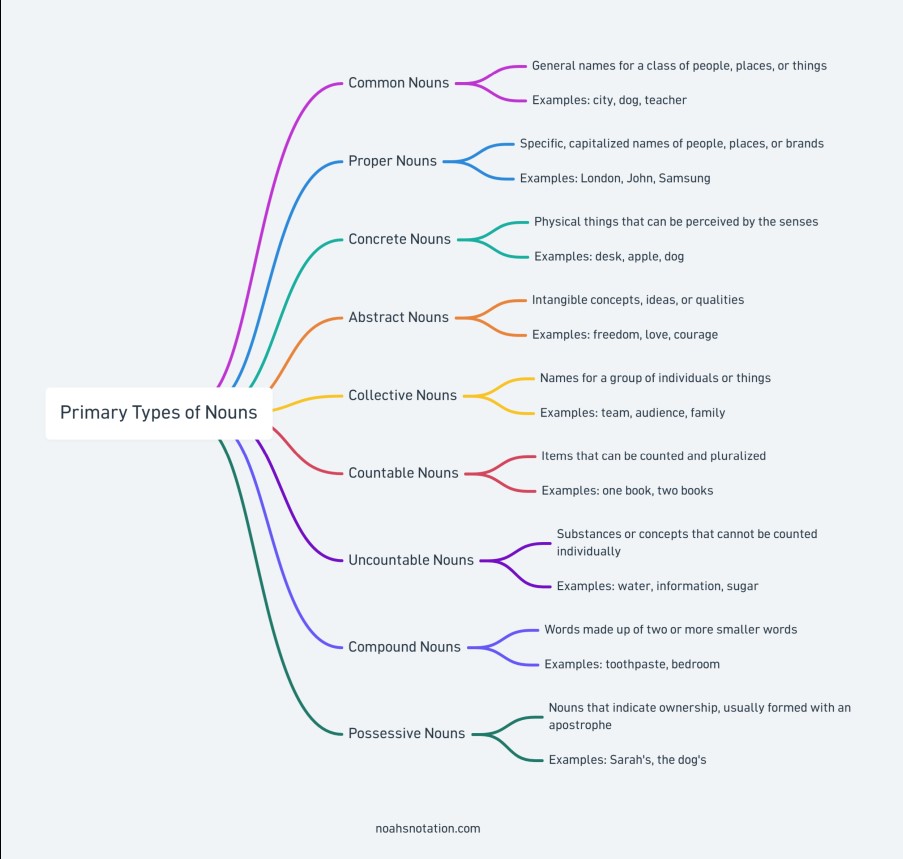
Nouns come in many forms — each with its own unique role in making our language clearer, richer, and more expressive! Lets explore the types.
What Is Proper Noun – Explanation With Examples
A proper noun is a specific name used to identify a particular person, place, thing, or idea. Unlike common nouns, proper nouns always begin with a capital letter, no matter where they appear in a sentence. These nouns help us point to exact names instead of general items, making our communication more clear and precise. For example, instead of saying “city,” we say “Dhaka,” which is a proper noun because it names a specific place.
Examples of Proper Nouns
Example 01
Rahim is my best friend.
Here, “Rahim” is a proper noun because it names a specific person.
Example 02
I live in Dhaka.
“Dhaka” is a proper noun as it refers to a particular city.
Example 03
We visited the Padma River.
“Padma River” is a proper noun because it names a specific river.
Example 04
Monday is my favorite day.
“Monday” is a proper noun as it is the name of a specific day.
Example 05
I read the Quran every day.
“Quran” is a proper noun because it is the name of a holy book.
Example Sentences
1. Karim went to school early today.
“Karim” is a proper noun because it names a specific person.
2. We are planning to visit Cox’s Bazar this winter.
“Cox’s Bazar” is a proper noun as it refers to a specific place.
3. My brother studies at Dhaka University.
“Dhaka University” is a proper noun because it is the exact name of an institution.
4. Friday is a holiday in our country.
“Friday” is a proper noun as it is the name of a specific day.
What Is Common Noun – Explanation With Examples
A common noun is a general name used to refer to a person, place, thing, or idea. Unlike proper nouns, common nouns do not name something specific and are not usually capitalized unless they begin a sentence. These nouns help us talk about things in a broad and general way. For example, words like “city,” “teacher,” or “book” are common nouns because they do not point to a particular name.
Examples of Common Nouns
Example 01
The boy is playing in the field.
“boy” is a common noun because it refers to a general person, not a specific name.
Example 02
I saw a dog on the street.
“dog” is a common noun as it refers to any animal, not a specific one.
Example 03
She is reading a book.
“book” is a common noun because it refers to any general object.
Example 04
We visited a park yesterday.
“park” is a common noun as it refers to any place, not a specific one.
Example 05
My teacher explained the lesson well.
“teacher” is a common noun because it refers to a general profession.
Example Sentences
1. The girl is singing beautifully.
“girl” is a common noun because it refers to any general person.
2. He bought a new car yesterday.
“car” is a common noun as it refers to any vehicle, not a specific one.
3. The school is closed today.
“school” is a common noun because it refers to a general place.
4. She has a cute cat at home.
“cat” is a common noun as it refers to any animal.
What Is Concrete Noun – Explanation With Examples
A concrete noun is a type of noun that refers to things we can experience through our five senses—seeing, hearing, touching, tasting, or smelling. These nouns represent physical objects that exist in real life and can be directly observed or felt.
In simple terms, if you can sense something with your body, it is likely a concrete noun. For example, items like “apple,” “car,” or “music” are concrete nouns because we can see, touch, or hear them. These nouns make our communication more vivid and easy to understand.
Examples of Concrete Nouns
Example 01
I ate an apple.
“apple” is a concrete noun because it is something we can see and taste.
Example 02
The car is very fast.
“car” is a concrete noun as it is a physical object we can see and touch.
Example 03
I heard a beautiful song.
“song” is a concrete noun because we can hear it.
Example 04
The flower smells nice.
“flower” is a concrete noun as we can see and smell it.
Example 05
The table is made of wood.
“table” is a concrete noun because it is something we can touch and see.
Example Sentences
1. The child is playing with a toy.
“child” is a concrete noun because we can see and hear the person.
2. She drank a glass of water.
“water” is a concrete noun as we can see and taste it.
3. The dog is barking loudly.
“dog” is a concrete noun because it is a physical animal we can see and hear.
4. He bought a new phone.
“phone” is a concrete noun as it is something we can touch and see.
What Is Abstract Noun – Explanation With Examples
An abstract noun is a type of noun that refers to ideas, feelings, qualities, or concepts that we cannot see, touch, hear, taste, or smell. These nouns do not have a physical form, but they exist in our thoughts, emotions, or experiences.
In simple terms, abstract nouns are things we can feel or think about but cannot physically interact with. Words like “love,” “happiness,” or “freedom” are abstract nouns because they represent emotions or ideas rather than tangible objects. They help us express inner feelings and deeper meanings in language.
Examples of Abstract Nouns
Example 01
Love is a powerful emotion.
“Love” is an abstract noun because it is a feeling we cannot touch or see.
Example 02
Happiness makes life beautiful.
“Happiness” is an abstract noun as it represents an emotion.
Example 03
Freedom is everyone’s right.
“Freedom” is an abstract noun because it is an idea, not a physical thing.
Example 04
Honesty is the best policy.
“Honesty” is an abstract noun as it describes a quality.
Example 05
Knowledge is very important.
“Knowledge” is an abstract noun because it refers to understanding or awareness.
Example Sentences
1. Bravery is admired by everyone.
“Bravery” is an abstract noun because it represents a quality.
2. She felt great joy after hearing the news.
“joy” is an abstract noun as it is an emotion.
3. Truth always wins in the end.
“Truth” is an abstract noun because it is an idea.
4. His kindness touched everyone.
“kindness” is an abstract noun as it describes a quality.
What Is Collective Noun – Explanation With Examples
A collective noun is a type of noun that refers to a group of people, animals, or things considered as a single unit. Instead of naming individuals separately, it names them as a whole group.
In simple terms, collective nouns help us describe many things or people together in one word. For example, “team,” “family,” or “flock” are collective nouns because they represent a group acting or existing as one unit.
Examples of Collective Nouns
Example 01
A team is playing well.
“team” is a collective noun because it represents a group of players acting as one unit.
Example 02
A family is sitting together.
“family” is a collective noun as it refers to a group of related people.
Example 03
A flock of birds is flying.
“flock” is a collective noun because it describes a group of birds.
Example 04
A class is studying English.
“class” is a collective noun as it refers to a group of students.
Example 05
A herd of cows is grazing.
“herd” is a collective noun because it represents a group of animals.
Example Sentences
1. The crowd is cheering loudly.
“crowd” is a collective noun because it refers to a group of people.
2. A bunch of grapes is on the table.
“bunch” is a collective noun as it represents a group of grapes.
3. The committee made an important decision.
“committee” is a collective noun because it refers to a group of members.
4. A pack of wolves is hunting.
“pack” is a collective noun as it represents a group of animals.
What Is Countable Noun – Explanation With Examples
A countable noun is a type of noun that refers to things which can be counted as individual units. These nouns have both singular and plural forms, such as “book/books” or “apple/apples.”
In simple terms, countable nouns are things we can easily count using numbers. We can say one, two, three, and so on. For example, “pen,” “student,” and “chair” are countable nouns because we can count them individually.
Examples of Countable Nouns
Example 01
I have three books.
“books” is a countable noun because we can count them individually.
Example 02
She bought two apples.
“apples” is a countable noun as each apple can be counted separately.
Example 03
There are five students in the room.
“students” is a countable noun because we can count each person.
Example 04
I need a new pen.
“pen” is a countable noun as it can be counted individually.
Example 05
He has two cars.
“cars” is a countable noun because we can count each vehicle.
Example Sentences
1. I saw four birds on the tree.
“birds” is a countable noun because we can count each bird separately.
2. She has one bag with her.
“bag” is a countable noun as it can be counted as a single item.
3. There are many chairs in the hall.
“chairs” is a countable noun because each chair can be counted.
4. He ate two biscuits.
“biscuits” is a countable noun as we can count each piece.
What Is Uncountable Noun – Explanation With Examples
An uncountable noun is a type of noun that refers to things which cannot be counted as separate units. These nouns do not have a plural form and are usually treated as a whole or mass.
In simple terms, uncountable nouns are things we cannot count using numbers individually. Instead, we measure or describe them in quantity. For example, “water,” “rice,” and “information” are uncountable nouns because we cannot say one, two, or three of them in their basic form.
Examples of Uncountable Nouns
Example 01
Water is essential for life.
“water” is an uncountable noun because it cannot be counted individually.
Example 02
We need some rice for dinner.
“rice” is an uncountable noun as it is measured, not counted one by one.
Example 03
She gave me useful information.
“information” is an uncountable noun because it has no plural form in normal usage.
Example 04
He needs more milk.
“milk” is an uncountable noun as it is treated as a mass, not individual units.
Example 05
We should respect honesty.
“honesty” is an uncountable noun because it represents an abstract quality.
Example Sentences
1. The glass is full of milk.
“milk” is an uncountable noun because it cannot be counted as separate units.
2. There is some sugar in the jar.
“sugar” is an uncountable noun as it is measured, not counted individually.
3. She gave me important advice.
“advice” is an uncountable noun because it has no plural form in general use.
4. We cannot live without air.
“air” is an uncountable noun as it is a mass substance.
What Is Compound Noun – Explanation With Examples
A compound noun is a type of noun that is formed by combining two or more words to create a new meaning. These words work together as a single noun and represent one idea, person, place, or thing.
In simple terms, compound nouns are made when two separate words join to form a completely new word with a different meaning. For example, “toothbrush,” “notebook,” and “sunflower” are compound nouns because each is made from more than one word but represents a single concept.
Examples of Compound Nouns
Example 01
I use a toothbrush every morning.
“toothbrush” is a compound noun because it combines two words to form one item used for cleaning teeth.
Example 02
She wrote everything in her notebook.
“notebook” is a compound noun as it is made from “note” and “book” forming a single object.
Example 03
The sunflower is very beautiful.
“sunflower” is a compound noun because it combines “sun” and “flower” into one plant name.
Example 04
He forgot his laptop bag at home.
“laptop bag” is a compound noun as it combines two words to describe one object.
Example 05
I saw a railway station nearby.
“railway station” is a compound noun because it is made of two words representing one place.
Example Sentences
1. The blackboard is clean.
“blackboard” is a compound noun because it is formed from two words describing one object.
2. She opened the classroom door.
“classroom” is a compound noun as it combines “class” and “room” into one place.
3. I lost my wallet yesterday.
“wallet” is a compound noun because it refers to a single object formed from a combined idea of holding money.
4. The football match was exciting.
“football” is a compound noun as it combines “foot” and “ball” into one game.
What Is Possessive Noun – Explanation With Examples
A possessive noun is a type of noun that shows ownership or possession. It tells us who something belongs to by adding an apostrophe (’) or ’s to the noun. These nouns help us clearly understand relationships between people, animals, or things and what they own or are connected to.
In simple terms, possessive nouns show “belonging.” For example, “Rahim’s book” means the book belongs to Rahim, and “the dog’s bone” means the bone belongs to the dog. This makes sentences more specific and meaningful.
Examples of Possessive Nouns
Example 01
Rahim’s book is on the table.
“Rahim’s” is a possessive noun because it shows the book belongs to Rahim.
Example 02
The girl’s bag is red.
“girl’s” is a possessive noun as it shows the bag belongs to the girl.
Example 03
The cat’s milk is in the bowl.
“cat’s” is a possessive noun because it shows ownership of the milk.
Example 04
My friend’s house is near school.
“friend’s” is a possessive noun as it shows the house belongs to my friend.
Example 05
The teacher’s advice was helpful.
“teacher’s” is a possessive noun because it shows the advice comes from the teacher.
Example Sentences
1. Ali’s pen is missing.
“Ali’s” is a possessive noun because it shows the pen belongs to Ali.
2. The student’s answer is correct.
“student’s” is a possessive noun as it shows ownership of the answer.
3. We visited my uncle’s farm.
“uncle’s” is a possessive noun because it shows the farm belongs to my uncle.
4. The dog’s tail is wagging.
“dog’s” is a possessive noun as it shows the tail belongs to the dog.
Types of Nouns – Worksheet Practice
Choose the correct noun type for each word
Your Turn Now!
Now that you have a solid grip on nouns, it is time to put that knowledge to work! Grab the worksheet attached to this post, work through the exercises, and challenge yourself to get every answer right.
The more you practice, the more confident you become. Once you are done, share your thoughts, scores, or questions in the comments below — we would love to hear from you!