
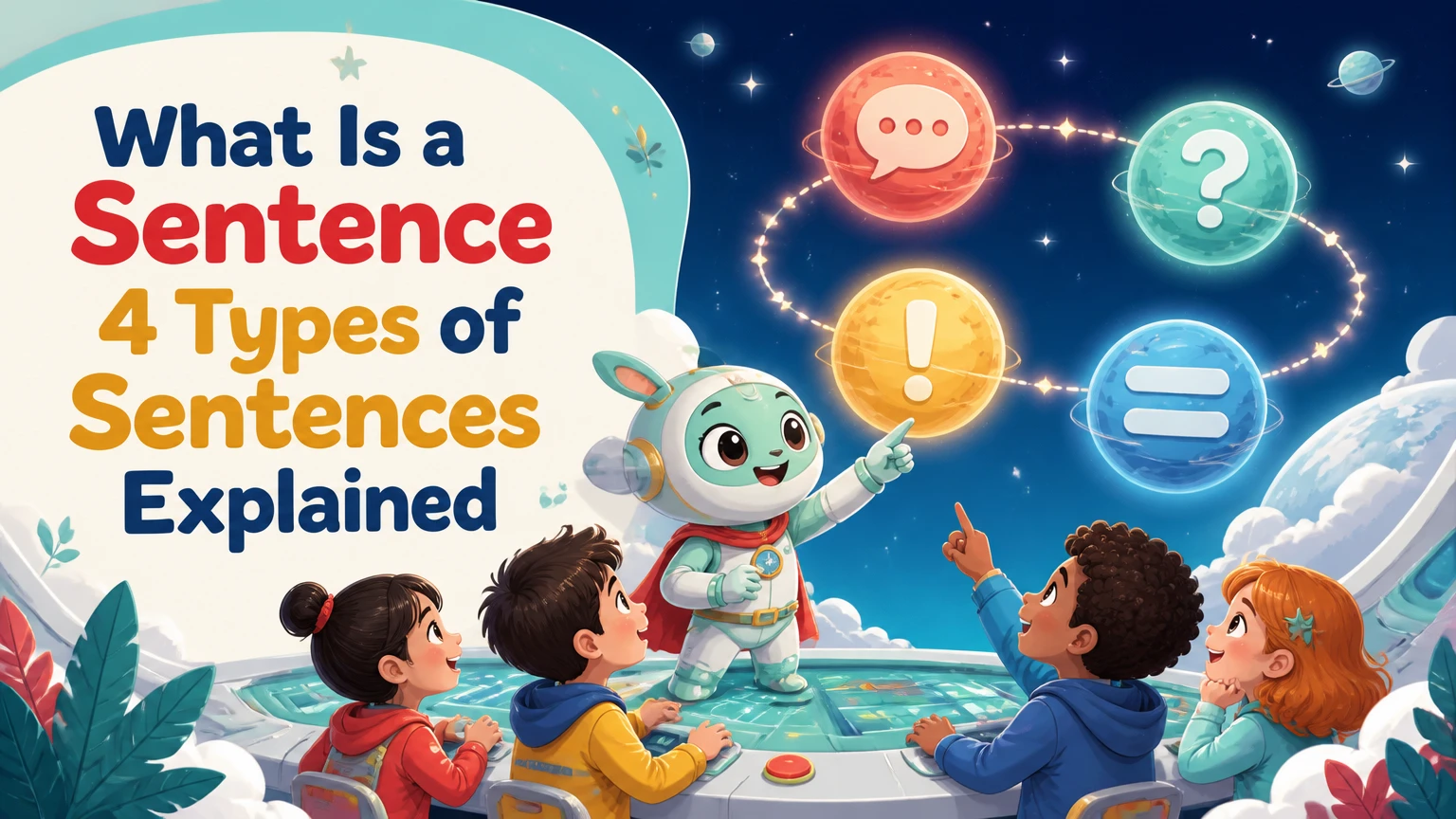
A sentence is a grammatically complete group of words that communicates a complete thought. In English, the four sentence types by purpose are declarative, interrogative, imperative, and exclamatory; sentences also have four structural patterns: simple, compound, complex, and compound-complex.
Key Facts at a Glance
A complete sentence normally contains a subject and a predicate.
Declarative sentences state information and usually end with a period.
Interrogative sentences ask questions and end with a question mark.
Imperative sentences give commands, requests, advice, or instructions.
Exclamatory sentences express strong feeling and end with an exclamation point.
Purpose and structure are separate classifications, so one sentence can have both types.
What Is a Sentence?
A sentence is an independent grammatical unit with a subject, a predicate, and a complete meaning. The subject identifies who or what the sentence concerns, while the predicate contains the verb and tells what the subject does, is, has, or experiences.
“Birds migrate” is a sentence because birds is the subject and migrate is the predicate. “When birds migrate” is not complete because when makes the clause dependent on another thought.
Sentence length does not determine grammatical completeness. “Run!” is a complete imperative sentence even though it has one visible word. The subject you is understood: “You run!”
A sentence can contain several words, clauses, or phrases, but every complete sentence must express an independent thought. A long group of words without a complete thought remains a fragment.
What Are the Main Parts of a Sentence?
| Sentence part | Function | Example | Required status |
|---|---|---|---|
| Subject | Names the topic or actor | The students | Usually explicit |
| Predicate | States action or condition | completed the exercise | Required |
| Verb | Expresses action or state | completed | Required |
| Complete thought | Makes the message independent | The students completed the exercise. | Required |
| Object | Receives the action | the exercise | Optional |
The subject may be compound, as in “Maria and Daniel presented the findings.” The predicate may also be compound, as in “Maria researched and presented the findings.” Compound elements do not automatically make a sentence compound because sentence structure depends on clauses, not merely on the number of subjects or verbs.
What Are the Four Types of Sentences by Purpose?
The four functional sentence types are declarative, interrogative, imperative, and exclamatory. Functional classification describes what a sentence does in communication: state information, ask for information, direct behavior, or express strong emotion.
| Sentence type | Primary purpose | Typical punctuation | Example |
|---|---|---|---|
| Declarative | States a fact, idea, or opinion | Period | The team finished the analysis. |
| Interrogative | Asks for information or confirmation | Question mark | Did the team finish the analysis? |
| Imperative | Gives a command, request, or instruction | Period or exclamation point | Review the analysis. |
| Exclamatory | Expresses strong emotion or surprise | Exclamation point | The team finished early! |
Punctuation provides a useful clue, but punctuation alone cannot identify every sentence accurately. An imperative sentence can end with a period or exclamation point, and an exclamatory sentence can begin with what or how without functioning as a question.
1. What Is a Declarative Sentence?
A declarative sentence makes a statement by presenting information, a fact, an observation, or an opinion. Declarative sentences usually end with a period and form the dominant sentence type in reports, essays, instructions, and ordinary explanations.
Examples include:
- The library closes at six o’clock.
- The revised schedule is more practical.
- I do not agree with the recommendation.
- The experiment produced consistent results.
A declarative sentence may be affirmative or negative. “The device works” and “The device does not work” are both declarative because both state information rather than ask, command, or exclaim.
Indirect questions can also be declarative. “She asked whether the meeting had started” reports a question but does not ask the reader directly, so it ends with a period.
2. What Is an Interrogative Sentence?
An interrogative sentence asks a question and normally ends with a question mark. English questions may request information, offer alternatives, seek confirmation, or ask about a person, object, time, reason, or method.
Common forms include:
- Yes/no question: Did the shipment arrive?
- Wh-question: When did the shipment arrive?
- Alternative question: Did the shipment arrive today or yesterday?
- Tag question: The shipment arrived, didn’t it?
- Rhetorical question: Who would ignore that warning?
Many interrogative sentences invert the usual subject-verb order by placing an auxiliary verb before the subject: “Did you finish?” In a wh-question, the question word usually comes first: “Why did you leave?”
Rhetorical questions are grammatically interrogative but do not necessarily seek an answer. A writer may use one to emphasize an obvious conclusion, although repeated rhetorical questions can make formal writing sound argumentative.
3. What Is an Imperative Sentence?
An imperative sentence gives a command, request, direction, warning, instruction, or piece of advice. The subject is usually the understood pronoun you, so the sentence often begins with the base form of a verb.
Examples include:
- Close the window.
- Please attach the receipt.
- Take two measurements before recording the result.
- Do not touch the exposed wire.
- Be careful on the wet floor.
Imperatives generally end with a period in neutral writing. An exclamation point signals urgency or heightened force: “Stop!” The punctuation changes the tone, but the communicative purpose remains a command.
Polite words such as please do not change the sentence’s functional category. “Please send the file” remains imperative because it directs the reader to perform an action.
4. What Is an Exclamatory Sentence?
An exclamatory sentence expresses strong feeling, such as surprise, excitement, anger, fear, admiration, or urgency. Exclamatory sentences end with an exclamation point, but the punctuation should support genuine emphasis rather than replace precise wording.
Examples include:
- We reached the summit!
- What an extraordinary result!
- How quickly the weather changed!
- I cannot believe the server recovered!
An exclamatory sentence can have the same word order as a declarative sentence. “The concert was excellent.” is declarative, while “The concert was excellent!” is exclamatory because the punctuation and context communicate heightened emotion.
Exclamatory words do not always create exclamatory sentences. “What time does the train leave?” is interrogative because it requests information. “What a beautiful view!” is exclamatory because it expresses admiration.
How Are Sentences Classified by Structure?
Structural classification depends on the number and relationship of clauses in a sentence. An independent clause can stand alone as a complete sentence, while a dependent clause contains a subject and verb but cannot express a complete thought independently.
| Structure | Clause pattern | Common joining method | Example |
|---|---|---|---|
| Simple | One independent clause | No clause connector required | The analyst checked the figures. |
| Compound | Two or more independent clauses | FANBOYS, semicolon, or conjunctive adverb | The analyst checked the figures, and the editor approved them. |
| Complex | One independent and at least one dependent clause | Subordinator or relative pronoun | Because the figures changed, the analyst repeated the test. |
| Compound-complex | At least two independent and one dependent clause | Coordination plus subordination | Because the figures changed, the analyst repeated the test, and the editor reviewed them. |
A clause count, not a word count, determines structural type. “The experienced researcher and careful editor reviewed the report” is simple because it has one independent clause, despite having multiple descriptive elements.
What Is a Simple Sentence?
A simple sentence contains one independent clause. It may have a compound subject, compound verb, object, or modifier, but it does not contain two independent clauses.
Examples:
- The manager approved the budget.
- The manager and assistant approved the budget.
- The manager approved and circulated the budget.
- After lunch, the manager approved the budget.
The last example contains the introductory phrase after lunch, not a dependent clause. Simple sentences work well for definitions, warnings, transitions, and important conclusions because their grammatical relationship is easy to process.
What Is a Compound Sentence?
A compound sentence contains at least two independent clauses joined correctly. The most familiar connectors are the coordinating conjunctions remembered by the acronym FANBOYS: for, and, nor, but, or, yet, and so.
Correct examples:
- The forecast changed, but the team kept the original deadline.
- The forecast changed; the team kept the original deadline.
- The forecast changed. The team kept the original deadline.
When a coordinating conjunction joins two independent clauses, place a comma before the conjunction. A semicolon can join closely related independent clauses without a conjunction.
A comma alone cannot join two independent clauses. “The forecast changed, the team kept the deadline” is a comma splice.
What Is a Complex Sentence?
A complex sentence contains one independent clause and at least one dependent clause. Subordinating conjunctions such as because, although, if, when, while, and unless signal many dependent clauses.
Examples:
- Although the forecast changed, the team kept the deadline.
- The team kept the deadline although the forecast changed.
- The team kept the deadline because the client needed certainty.
When a dependent clause comes first, a comma commonly separates it from the independent clause. When the dependent clause follows, the comma is often unnecessary unless the writer intends a strong pause or the clause is nonessential.
Relative pronouns such as which, that, who, and whose can also introduce dependent clauses: “The report that arrived this morning contains the corrected figures.”
What Is a Compound-Complex Sentence?
A compound-complex sentence contains at least two independent clauses and at least one dependent clause. It combines coordination and subordination, allowing a writer to connect several ideas while showing that one idea depends grammatically on another.
Example:
“Although the forecast changed, the team kept the deadline, and the client approved the plan.”
The dependent clause is Although the forecast changed. The independent clauses are the team kept the deadline and the client approved the plan. Writers should use this structure when the relationships are clear; adding clauses merely to make a sentence longer can obscure the main point.
Can One Sentence Have Two Types?
One sentence can have a functional type and a structural type at the same time. The classifications answer different questions: purpose asks what the sentence does, while structure asks how many clauses it contains.
| Example | Purpose | Structure | Reason |
|---|---|---|---|
| The report is complete. | Declarative | Simple | One independent clause |
| Did you review the report? | Interrogative | Simple | One independent clause |
| Review the report before noon. | Imperative | Complex | Main command plus dependent time clause |
| Although we were late, we finished! | Exclamatory | Complex | Dependent clause plus emotional statement |
| The report is complete, and the editor approved it. | Declarative | Compound | Two independent clauses |
This dual system prevents a common misunderstanding. “Simple” does not mean short, and “exclamatory” does not describe clause structure. A sentence may be compound and interrogative, or complex and imperative.
How Do You Identify a Sentence Type?
Identify a sentence type by determining its purpose first, then checking its clause structure. This two-stage method avoids confusing punctuation with grammar.
- Find the complete thought. Check whether the words can stand independently.
- Locate the subject and verb. Include an implied you when the sentence gives a command.
- Ask what the sentence does. Does it state, ask, direct, or express strong emotion?
- Count independent clauses. One indicates simple structure; two or more indicate compound structure.
- Find dependent markers. Words such as because or although often introduce dependent clauses.
- Check punctuation. Confirm that the punctuation matches the sentence’s purpose and joining method.
For example, “When the alarm sounded, leave the building immediately” is imperative and complex. The main clause gives an instruction, while when the alarm sounded supplies a dependent condition.
What Punctuation Does Each Sentence Type Use?
Declarative sentences generally end with periods, interrogative sentences end with question marks, and exclamatory sentences end with exclamation points. Imperative sentences normally end with periods, although an exclamation point adds urgency.
| Purpose | Neutral punctuation | Emphatic punctuation | Example |
|---|---|---|---|
| Declarative | Period | Rarely exclamation point | The results are ready. |
| Interrogative | Question mark | Double punctuation is informal | Are the results ready? |
| Imperative | Period | Exclamation point | Submit the results. Submit them now! |
| Exclamatory | Exclamation point | Avoid repeated marks in formal writing | The results are ready! |
Punctuation cannot repair an incomplete clause. “Because the results are ready.” remains a fragment even though it ends with a period. Likewise, changing the comma in a run-on to a question mark may alter meaning without correcting the underlying grammar.
How Should Sentence Types Be Used in Different Contexts?
Academic writing primarily uses declarative sentences, with complex structures for qualifications and evidence. Business writing benefits from direct declarative statements and carefully worded imperatives, while creative and promotional writing can use interrogatives and exclamatories for rhythm and emotional effect.
| Context | Useful purpose types | Useful structures | Practical example |
|---|---|---|---|
| Academic essay | Declarative, occasional interrogative | Complex, compound-complex | Although results varied, the pattern remained significant. |
| Technical manual | Declarative, imperative | Simple, complex | Press the reset button after the indicator turns green. |
| Business email | Declarative, imperative | Simple, compound | Please confirm the delivery date by Friday. |
| Marketing copy | Declarative, interrogative, exclamatory | Simple, compound | Need faster reporting? Start with one dashboard. |
| Fiction and narrative | All four | All four structures | The door opened, and everyone froze. |
Sentence variety should serve meaning. A short simple sentence can emphasize a conclusion, while a complex sentence can show cause, contrast, timing, or condition. Variety becomes counterproductive when readers must decode elaborate syntax to find the main action.
How Long Should an English Sentence Be?
A practical business-writing target is approximately 15-20 words per sentence, but no universal sentence-length rule applies to every genre. Sentences above 25-30 words deserve a clarity check, especially when they contain several clauses, technical terms, or nested qualifications.
The U.S. government’s plain-language guidance recommends writing for the audience and using clear, concise language rather than enforcing one fixed sentence length. Shorter sentences often suit instructions; longer sentences can express relationships that would sound choppy when split apart.
Measure sentence length during revision, not composition. A 30-word sentence with one clear subject and one logical relationship may be easier to understand than three eight-word sentences with disconnected ideas.
How Do You Fix Common Sentence Errors?
The most common sentence errors are fragments, run-ons, comma splices, and faulty clause connections. Repair each error by identifying the intended relationship between ideas, then choosing a period, semicolon, coordinating conjunction, or subordinating conjunction.
| Error | Incorrect example | Reliable repair | Correct example |
|---|---|---|---|
| Fragment | Because the server failed. | Add an independent clause | Because the server failed, the launch was delayed. |
| Comma splice | The server failed, the launch was delayed. | Use semicolon or conjunction | The server failed, so the launch was delayed. |
| Run-on | The server failed the launch was delayed. | Add punctuation | The server failed; the launch was delayed. |
| Misplaced modifier | Running quickly, the finish line appeared. | Give the modifier the right subject | Running quickly, Maya reached the finish line. |
What Is a Sentence Fragment?
A sentence fragment is an incomplete group of words presented as a sentence. A fragment may lack a subject, a finite verb, or an independent clause, and it often begins with a subordinating word such as because, although, or when.
Wrong: “Although the evidence was limited.”
Correct: “Although the evidence was limited, the committee issued a recommendation.”
Intentional fragments can work in advertising, fiction, and informal writing for emphasis, such as “No second chances.” Formal academic and professional writing usually requires complete sentences unless the fragment is a deliberate heading or label.
What Is a Run-On Sentence or Comma Splice?
A run-on sentence incorrectly joins two independent clauses without suitable punctuation or with only a comma. A comma splice is a specific run-on in which a comma joins the clauses without a coordinating conjunction.
Three standard repairs are available:
- Split the clauses with a period: “The interface is fast. The application is stable.”
- Join them with a semicolon: “The interface is fast; the application is stable.”
- Add a coordinating conjunction: “The interface is fast, and the application is stable.”
Choose the repair according to meaning. A semicolon signals a close relationship, while a period gives each idea greater independence.
How Do You Avoid Monotonous Sentence Structure?
Avoid monotonous prose by varying sentence length, openings, clause patterns, and information order while preserving a clear subject and main verb. Repeating several simple subject-verb sentences can create a mechanical rhythm, but replacing every short sentence with a long compound-complex sentence creates unnecessary density.
A practical revision pass can follow this sequence:
- Mark every sentence with its structural type.
- Locate three or more consecutive sentences with the same pattern.
- Combine only ideas with a clear logical relationship.
- Split overloaded sentences at the main clause boundary.
- Read the paragraph aloud to detect repetitive rhythm.
A useful practitioner rule is to protect one short sentence near an important conclusion. Brevity creates contrast, so every sentence should not be optimized toward the same length.
What Are the Most Common Classification Mistakes?
The most common mistake is treating sentence purpose and sentence structure as competing categories. They are separate dimensions, so a sentence can be declarative and complex, interrogative and compound, or imperative and simple.
Other frequent errors include:
- Calling every sentence ending in an exclamation point exclamatory, even when it gives a command.
- Calling a sentence compound because it contains two verbs.
- Treating a dependent clause as a complete sentence.
- Assuming every question begins with do, does, or did.
- Using a comma before every subordinating clause, regardless of its position.
- Confusing an exclamatory sentence with any sentence containing an emotional word.
The strongest diagnostic is meaning plus clause structure. Punctuation confirms the diagnosis but does not replace it.
FAQ
Is a sentence always a complete thought?
A standard sentence must express an independent thought, although literary dialogue and advertising sometimes use intentional fragments. “The package arrived” is complete; “When the package arrived” is dependent and requires another clause, such as “When the package arrived, we opened it.”
What is the difference between a phrase and a clause?
A phrase is a group of related words without a complete subject-verb relationship, while a clause contains a subject and a verb. “After the meeting” is a phrase; “after the meeting ended” is a dependent clause because it contains meeting and ended but cannot stand alone.
Can an imperative sentence have a visible subject?
Yes. Imperatives usually omit the subject you, but a speaker may state it for emphasis or contrast: “You take the left path.” The sentence remains imperative because it directs someone to act. The subject may also appear in forms such as “Everybody be quiet.”
Can a question be declarative?
A direct question is interrogative, but a sentence that reports or embeds a question is usually declarative. “Where is the key?” asks directly. “She wondered where the key was” states what she wondered and ends with a period.
Are simple sentences suitable for academic writing?
Simple sentences are suitable for academic writing when they present a definition, result, claim, or transition clearly. Academic prose also needs complex structures to express evidence, limitation, contrast, and cause. The best choice depends on the relationship between ideas, not on a preference for long sentences.
What is the easiest way to remember the four types?
Remember the functional sequence statement, question, command, exclamation. The grammatical names are declarative, interrogative, imperative, and exclamatory. Ask what the sentence is trying to do, then verify the ending punctuation and clause structure.
The Bottom Line
A sentence is a complete grammatical expression of an independent thought, usually built from a subject and predicate. The four types of sentences by purpose are declarative, interrogative, imperative, and exclamatory, while simple, compound, complex, and compound-complex describe structure. To identify any sentence accurately, determine its purpose first, count its clauses second, and check punctuation last.


