
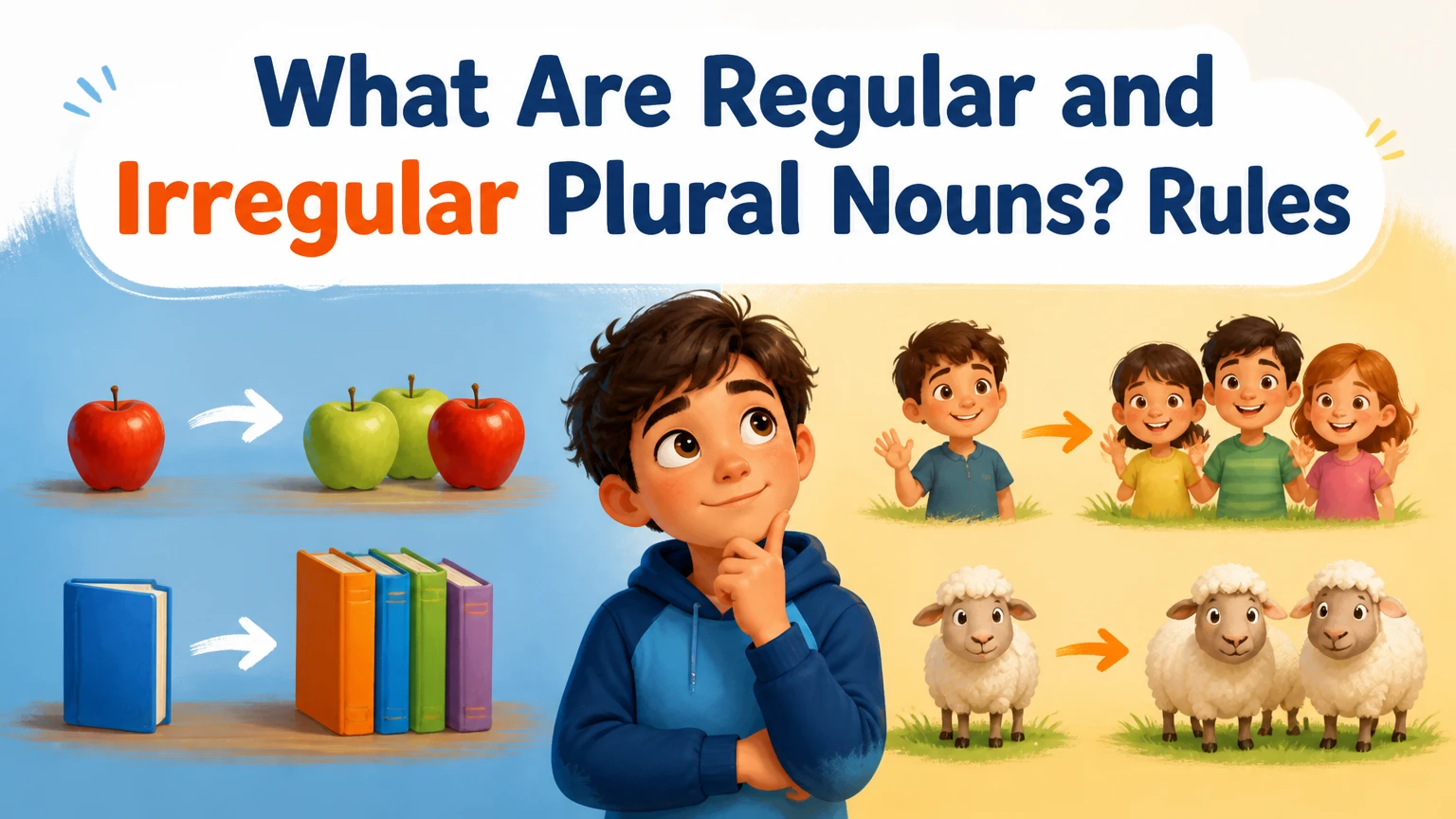
Regular plural nouns form their plural by following a predictable spelling pattern, usually adding -s or -es to a singular noun. Irregular plural nouns use a different pattern, such as changing an internal vowel, adding an unusual ending, changing the entire word, or keeping the same form, as in cat/cats versus child/children and sheep/sheep.
Key Facts
A plural noun names more than one person, place, object, animal, or idea.
Most English nouns form regular plurals with -s, as in book/books.
Nouns ending in a sibilant sound often take -es, as in box/boxes.
Irregular plurals may change the word internally, as in foot/feet, or add an old ending, as in child/children.
Some nouns have identical singular and plural forms, including sheep, deer, series, and species.
A noun’s final letters do not always predict its plural, so dictionaries and usage determine some exceptions.
What Is a Plural Noun?
A plural noun refers to two or more entities, while a singular noun refers to one entity. In one apple, apple is singular; in five apples, apples is plural. Plurality can describe people, physical objects, animals, places, substances, or abstract ideas.
English marks plurality mainly through the noun’s form and through surrounding words. Determiners such as one, a, and each usually introduce singular nouns, while two, many, several, and those usually introduce plural nouns.
| Number | Noun phrase | Example sentence | Noun form |
|---|---|---|---|
| Singular | one book | One book is missing. | book |
| Plural | two books | Two books are missing. | books |
| Singular | a child | A child is waiting. | child |
| Plural | several children | Several children are waiting. | children |
| Singular | one sheep | One sheep is outside. | sheep |
| Plural | six sheep | Six sheep are outside. | sheep |
Plural nouns also affect subject-verb agreement. A singular subject normally takes is, was, or a singular present-tense verb, whereas a plural subject takes are, were, or the base verb: The student writes becomes The students write.
What Is a Regular Plural Noun?
A regular plural noun follows a productive English spelling rule that speakers can apply to many unfamiliar nouns. The default rule adds -s, as in lamp/lamps, river/rivers, and idea/ideas.
Regular does not mean that every noun has the same pronunciation. The written ending may be -s or -es, but the spoken ending can be /s/, /z/, or /ɪz/. The spelling rule and the pronunciation rule work together.
What Is an Irregular Plural Noun?
An irregular plural noun does not form its plural through the ordinary -s or -es pattern. The noun may change a vowel, replace its ending, add a historical suffix, remain unchanged, or use a borrowed plural.
Examples include man/men, mouse/mice, person/people, child/children, sheep/sheep, and analysis/analyses. Irregular forms often preserve older English or Latin and Greek patterns, but learners generally need to remember them as individual vocabulary items or pattern groups.
How Do Regular Plural Nouns Work?
Regular plural nouns usually follow the singular noun’s final letter or sound. Add -s to most nouns, add -es after certain sibilant sounds, and change consonant + y to -ies. The spelling of nouns ending in -o and -f requires special attention because those endings have many exceptions.
| Singular ending | Regular formation | Singular example | Plural example |
|---|---|---|---|
| Most endings | Add -s | car | cars |
| -s, -ss, -sh, -ch, -x | Add -es | dish | dishes |
| Consonant + y | Change y to -ies | city | cities |
| Vowel + y | Add -s | toy | toys |
| Many consonant + o nouns | Add -es | potato | potatoes |
| Many vowel + o nouns | Add -s | video | videos |
When Do You Add -s?
Add -s to most nouns that do not end in a sibilant sound or a consonant followed by y. Examples include chair/chairs, phone/phones, tree/trees, lesson/lessons, and computer/computers.
Nouns ending in a vowel plus y also take -s. The vowel remains part of the spelling: day/days, key/keys, boy/boys, and monkey/monkeys. The incorrect forms daies, keies, and monkies result from applying the consonant + y rule too broadly.
When Do You Add -es?
Add -es to many nouns ending in s, ss, sh, ch, x, or z. The extra vowel creates a pronounceable syllable after a sibilant sound: bus/buses, class/classes, brush/brushes, church/churches, box/boxes, and quiz/quizzes.
The rule is based partly on sound, not only letters. For example, stomach takes -s in stomachs because its final sound is /k/, while church takes -es because its final sound is /tʃ/.
How Does the -y Rule Work?
Change a final consonant + y to -ies, but keep the y after a vowel. Thus, baby becomes babies, while boy becomes boys. The decisive feature is the letter immediately before y.
| Singular | Letter before y | Plural | Reason |
|---|---|---|---|
| baby | b, consonant | babies | Change y to -ies |
| party | t, consonant | parties | Change y to -ies |
| city | t, consonant | cities | Change y to -ies |
| boy | o, vowel | boys | Add -s |
| day | a, vowel | days | Add -s |
| key | e, vowel | keys | Add -s |
Proper names and abbreviations may keep their original form or use a different convention. The Kennedys changes y to -ys, not -ies, because the name is treated as a family name. Style guides may differ for names, so preserve the established spelling when one exists.
Are Nouns Ending in -o Predictable?
Nouns ending in -o are only partly predictable. Many words ending in consonant + o take -es, including hero/heroes, potato/potatoes, and tomato/tomatoes. Other words take -s, including photo/photos, piano/pianos, solo/solos, and auto/autos.
The safest rule is lexical rather than absolute: learn common -o nouns individually or check a dictionary. English has borrowed -o words from several languages, so spelling reflects usage history rather than one consistent modern rule.
How Are Regular Plurals Pronounced?
Regular plural endings have three principal pronunciations: /s/, /z/, and /ɪz/. The ending is pronounced /ɪz/ after a sibilant sound, /s/ after most voiceless consonants, and /z/ after vowels and voiced consonants.
| Final sound of singular | Plural sound | Example | Pronunciation pattern |
|---|---|---|---|
| Voiceless sound other than sibilant | /s/ | cat/cats | /kæts/ |
| Vowel or voiced consonant | /z/ | dog/dogs | /dɒɡz/ |
| Sibilant sound | /ɪz/ | box/boxes | /ˈbɒksɪz/ |
| Sibilant sound | /ɪz/ | judge/judges | /ˈdʒʌdʒɪz/ |
Pronunciation matters in conversation because boxs would be difficult to say without an extra vowel sound. The written form boxes represents that additional syllable. Learners who memorize only spelling can still produce incorrect spoken plurals.
How Do Irregular Plural Nouns Work?
Irregular plural nouns use several recurring patterns, but no single rule predicts every form. The most useful groups include vowel changes, new endings, unchanged forms, complete replacements, and classical borrowings.
| Irregular pattern | Singular | Plural | Typical explanation |
|---|---|---|---|
| Internal vowel change | man | men | Historical Germanic vowel change |
| Internal vowel change | foot | feet | Historical Germanic vowel change |
| Added -en | child | children | Old English historical ending |
| Added -en | ox | oxen | Retained older plural |
| Complete replacement | person | people | Different historical form |
| No visible change | deer | deer | Zero plural |
| Greek plural | criterion | criteria | Classical borrowed form |
| Latin plural | bacterium | bacteria | Classical borrowed form |
Which Plurals Change Their Vowels?
Several common Germanic nouns change an internal vowel rather than adding a suffix. Important examples include man/men, woman/women, foot/feet, tooth/teeth, goose/geese, and mouse/mice.
The spelling of woman/women changes internally, but pronunciation also changes: woman is commonly /ˈwʊmən/, while women is /ˈwɪmɪn/. These forms must be learned as complete pairs because the modern vowel alternations are not productive for new nouns.
Which Nouns Use -en or Another New Ending?
A small group uses -en, including child/children, ox/oxen, and brother/brethren in a specialized religious or organizational sense. Other nouns replace the whole form: person/people, mouse/mice, and die/dice.
Some irregular plurals combine patterns. Child/children changes the stem and adds an ending, while brethren has a restricted meaning and should not replace the ordinary plural brothers in every context.
Which Nouns Stay the Same in Singular and Plural?
Zero-plural nouns have identical singular and plural forms. Common examples include sheep, deer, fish, aircraft, series, species, and offspring.
Context determines number: one species is endangered uses singular agreement, while several species are endangered uses plural agreement. Fish normally refers to more than one fish of the same or unspecified kind; fishes is appropriate when discussing multiple species or varieties.
What Is the Difference Between Regular and Irregular Plural Nouns?
Regular plural nouns have a predictable formation rule, while irregular plural nouns require a particular spelling or vocabulary pattern. Regular nouns usually add -s or -es; irregular nouns may alter the stem, use a historical ending, remain unchanged, or preserve a classical form.
| Feature | Regular plural | Irregular plural | Example |
|---|---|---|---|
| Main process | Add a predictable suffix | Change stem or ending | book/books, foot/feet |
| Memorization | Usually low | Usually higher | car/cars, child/children |
| Productivity | Applies to new nouns | Rarely applies to new nouns | podcast/podcasts |
| Spelling predictability | Often high | Variable | box/boxes, mouse/mice |
| Pronunciation | /s/, /z/, or /ɪz/ | Form-specific | dogs, teeth |
| Typical source | Native modern pattern | Historical or borrowed pattern | tree/trees, analysis/analyses |
Regular and irregular are not quality judgments. Regular plurals are not more correct, and irregular plurals are not defective. Both systems are standard parts of English grammar.
How Do You Form a Plural Noun?
Use a five-step decision process: identify whether the noun has a known irregular form, inspect its ending, apply the relevant spelling rule, check pronunciation, and confirm the result in a reliable dictionary when the pattern is uncertain.
- Check for a known irregular form.
Ask whether the noun is child, person, mouse, sheep, analysis, or another commonly memorized exception. - Inspect the final spelling and sound.
Look for -s, -sh, -ch, -x, -z, consonant + y, vowel + y, or -o. - Apply the narrowest matching rule.
Use -es after sibilant sounds, -ies after consonant + y, and -s for most other nouns. - Check special endings.
Do not assume every -f noun becomes -ves or every -o noun becomes -oes. Compare roof/roofs with leaf/leaves, and photo/photos with potato/potatoes. - Check the sentence.
Confirm that the determiner and verb agree: These analyses are useful, not This analyses is useful.
What Are the Most Common Irregular Plurals?
The most useful irregular plurals are common everyday words rather than rare scientific terms. Learners should prioritize forms that occur in ordinary conversation, school writing, workplace documents, and instructions.
| Singular | Plural | Singular sentence | Plural sentence |
|---|---|---|---|
| person | people | One person called. | Several people called. |
| man | men | The man waited. | The men waited. |
| woman | women | The woman spoke. | The women spoke. |
| child | children | A child laughed. | The children laughed. |
| foot | feet | My foot hurts. | My feet hurt. |
| tooth | teeth | The tooth is loose. | Her teeth are healthy. |
| mouse | mice | A mouse escaped. | The mice escaped. |
| goose | geese | One goose landed. | Two geese landed. |
A practical learning method groups forms by structure. Study man/men, woman/women, and tooth/teeth together, then use each pair in a complete sentence. Spaced retrieval over several days is more reliable than copying a long list once.
Do -f and -fe Nouns Become -ves?
Some nouns ending in -f or -fe change to -ves, but the rule is not universal. Leaf/leaves, knife/knives, life/lives, wife/wives, and wolf/wolves use the change, while roof/roofs, chief/chiefs, belief/beliefs, and safe/safes keep -fs or -fes.
| Singular | Standard plural | Pattern | Usage note |
|---|---|---|---|
| leaf | leaves | -f to -ves | Common irregular pattern |
| knife | knives | -fe to -ves | Common irregular pattern |
| wolf | wolves | -f to -ves | Common irregular pattern |
| roof | roofs | Add -s | Important exception |
| chief | chiefs | Add -s | Important exception |
| belief | beliefs | Add -s | Abstract noun |
The historical explanation helps explain why the pattern exists, but it does not reliably predict modern spelling. Dictionary confirmation is the best method for unfamiliar words.
Do Latin and Greek Plurals Have to Be Used?
Latin and Greek plurals are sometimes preferred in academic, scientific, or technical writing, but modern English often accepts regularized alternatives. The correct choice depends on the noun, field, audience, and style guide.
| Singular | Classical plural | Modern alternative | Common context |
|---|---|---|---|
| analysis | analyses | Not usually regularized | Academic and scientific writing |
| criterion | criteria | Not usually regularized | Formal evaluation |
| phenomenon | phenomena | phenomenons is rare | Science and formal prose |
| bacterium | bacteria | bacteriums is uncommon | Biology |
| formula | formulae | formulas | Both widely used |
| index | indices | indexes | Mathematics versus general use |
| appendix | appendices | appendixes | Medicine versus general use |
| octopus | octopuses | octopi is common but etymologically debated | General English |
The form octopuses is the safest general-English plural. The frequently used octopi treats a Greek-derived word as though it were a Latin second-declension noun. Scientific communities may use octopodes, but that form is uncommon outside specialist writing.
How Do Compound Nouns Become Plural?
Compound nouns usually pluralize the principal noun, not automatically the final word. The principal noun carries the central meaning: mother-in-law/mothers-in-law, editor-in-chief/editors-in-chief, and passerby/passersby.
| Singular compound | Standard plural | Pluralized element | Example |
|---|---|---|---|
| mother-in-law | mothers-in-law | mother | Three mothers-in-law arrived. |
| editor-in-chief | editors-in-chief | editor | The editors-in-chief met. |
| attorney general | attorneys general | attorney | State attorneys general issued guidance. |
| runner-up | runners-up | runner | The runners-up received medals. |
| toothbrush | toothbrushes | Final compound ending | The toothbrushes are new. |
Closed compounds such as toothbrush normally follow ordinary spelling rules. Hyphenated and open compounds require attention to meaning and established usage.
What Is the Difference Between Plurals and Possessives?
A plural noun indicates more than one; a possessive noun indicates ownership, association, or relationship. Plural nouns do not require apostrophes, so students means more than one student, while student’s means something belonging to one student.
| Form | Meaning | Example |
|---|---|---|
| student | One student | The student arrived. |
| students | More than one student | The students arrived. |
| student’s | Belonging to one student | The student’s book is open. |
| students’ | Belonging to multiple students | The students’ books are open. |
The apostrophe test prevents a frequent editing error. If the word simply names a group, use the plural form without an apostrophe.
Which Plural Forms Have More Than One Accepted Version?
Several nouns have competing plural forms with different levels of formality, regional preference, or technical meaning. Both forms may be grammatical, but they are not always interchangeable in every context.
Data traditionally functions as the plural of datum in scientific writing, as in the data show a difference. Many organizations treat data as a mass noun and write the data is stored securely. Follow the publication’s style guide consistently.
Medium has media as a common plural when referring to communication channels, while mediums is also used for spiritual practitioners and some physical materials. Formulae and formulas are both accepted, but technical disciplines may prefer one.
What Mistakes Do Learners Make?
The most frequent errors come from applying a correct rule in the wrong environment. Learners write childs because they know the default -s rule, monkies because they ignore the vowel before y, or deers when the ordinary plural is deer.
- Adding -s to an irregular noun: write children, not childs.
- Changing every final y: write boys, not boies.
- Using -ves automatically: write roofs, not rooves, in standard general usage.
- Adding an apostrophe to a plural: write books, not book’s.
- Using a classical plural unnecessarily: write formulas when the audience does not require formulae.
- Ignoring agreement: write The criteria are clear, not The criteria is clear in formal usage.
- Pluralizing an uncountable noun: write pieces of information, not usually informations.
- Confusing spelling and pronunciation: pronounce boxes with two syllables, not as one compressed ending.
A useful editorial rule is to test the noun in a full phrase rather than in isolation. The phrase three pieces of advice exposes the error in three advices, while two kinds of fish clarifies why fishes may be unnecessary.
Can Every Noun Be Pluralized?
Not every noun commonly takes a plural form. Mass nouns such as advice, information, furniture, equipment, and research usually do not take ordinary plural -s in standard English.
Use a measure phrase or classifier instead: two pieces of advice, three items of equipment, several types of furniture, or four research projects. Some nouns can be countable in one meaning and uncountable in another, so context determines the correct construction.
Proper nouns can take plurals when referring to multiple people or entities with the same name, as in the two Michaels or the Smiths. Acronyms normally take a simple -s without an apostrophe: URLs, PDFs, and NGOs.
How Can You Remember Irregular Plurals?
Memorize irregular plurals in structural families, then retrieve them in sentences over spaced intervals. A learner can begin with approximately 25 high-frequency pairs, add less common forms later, and maintain a personal list of words that caused errors.
Useful groups include:
- Vowel changers: man/men, woman/women, foot/feet, tooth/teeth, goose/geese.
- Words ending in -en: child/children, ox/oxen.
- Zero plurals: sheep/sheep, deer/deer, species/species, series/series.
- Complete replacements: person/people, mouse/mice, good/goods in different meanings.
- Classical forms: analysis/analyses, criterion/criteria, phenomenon/phenomena.
Write a sentence from memory, wait one day, and test the form again after three to seven days. Spelling practice alone is less effective when the learner never connects the noun to a determiner and verb.
Frequently Asked Questions
Is “children” a regular or irregular plural?
Children is an irregular plural noun because it does not form by adding the ordinary -s or -es ending to child. The word contains the historical ending -ren and does not follow a productive rule that speakers apply to new nouns.
Is “fish” singular or plural?
Fish can be singular or plural. Use one fish for one animal and two fish for multiple fish, especially when discussing the same kind. Use fishes when emphasizing two or more species or varieties, as in the fishes of the Pacific Ocean.
Is “people” an irregular plural?
People is an irregular plural of person because the form changes completely rather than taking -s. Persons also exists, especially in legal, official, or formal contexts, but people is the normal plural in everyday English.
What is the plural of “woman”?
The plural of woman is women. The spelling changes internally, and pronunciation changes from approximately /ˈwʊmən/ to /ˈwɪmɪn/. The form womans is incorrect when referring to more than one adult female.
What is the plural of “series”?
Series has the same singular and plural form. Write one series is available and three series are available. The verb and determiner reveal the number, because the noun itself does not change.
Should formal writing use “data are”?
Formal scientific and academic writing traditionally treats data as plural and uses data are. Many business and general-English style guides treat data as a mass noun and use data is. Follow the governing style guide and apply one choice consistently.
The Bottom Line
Regular plural nouns usually add -s or -es, while irregular plural nouns change their spelling through vowel mutation, unusual endings, complete replacement, unchanged forms, or borrowed classical patterns. To determine the correct form, check for an irregular noun first, inspect the ending and sound, apply the narrowest rule, and verify exceptions such as roofs, photos, children, mice, and sheep. The distinction between regular and irregular plural nouns becomes manageable when common forms are learned in patterns and used in complete sentences.


