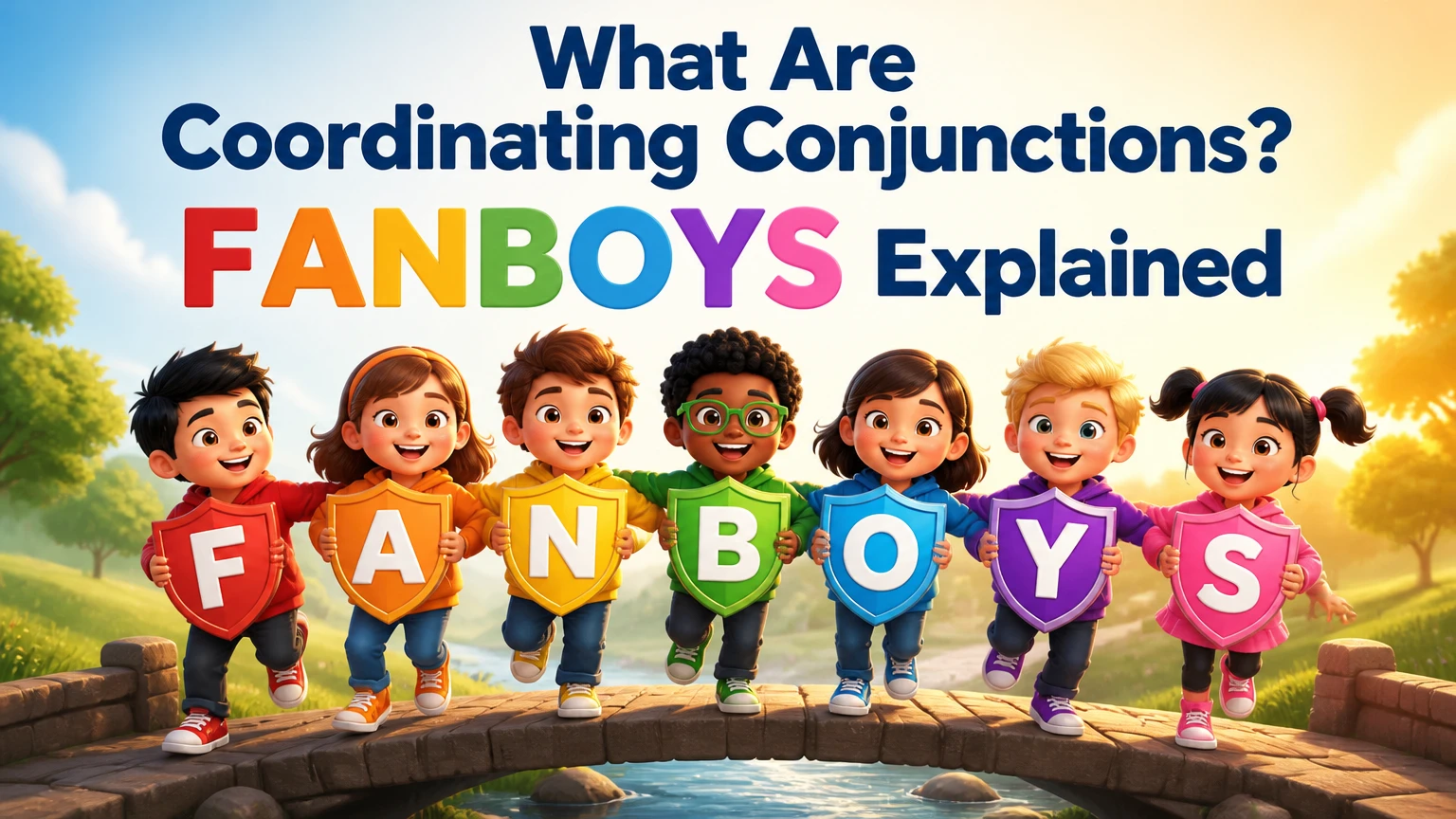
Coordinating conjunctions are words that connect grammatically equal elements, including words, phrases, and independent clauses. English has seven core coordinating conjunctions, remembered by the acronym FANBOYS: for, and, nor, but, or, yet, and so. Their meaning depends on the logical relationship between the elements they join.
Key Facts at a Glance
- A coordinating conjunction joins elements with the same grammatical status.
- FANBOYS means for, and, nor, but, or, yet, so.
- A comma usually comes before a coordinating conjunction when it joins two independent clauses.
- A comma usually does not come before the conjunction when it joins individual words or phrases.
- A coordinating conjunction does not make one clause dependent on another.
- Words such as however, therefore, and meanwhile are conjunctive adverbs, not coordinating conjunctions.
What Is a Coordinating Conjunction?
A coordinating conjunction connects two or more words, phrases, or independent clauses of equal grammatical rank. The conjunction creates a relationship between the connected elements without making either element grammatically subordinate to the other.
In “Maya and Luis arrived,” the conjunction and joins two nouns. In “Maya arrived early and waited outside,” it joins two verb phrases. In “Maya arrived early, and Luis waited outside,” it joins two independent clauses.
Coordination differs from subordination. The subordinating conjunction because makes a clause dependent in “because the road was closed.” The coordinating conjunction so connects two independent clauses in “The road was closed, so we turned back.”
How Can You Identify One?
A word is functioning as a coordinating conjunction when it links equivalent grammatical units and expresses a relationship such as addition, contrast, choice, reason, or result.
Use these tests:
- Locate the linked elements. Identify the words, phrases, or clauses on both sides.
- Check their grammatical role. The connected elements should perform the same type of function.
- Identify the relationship. Decide whether the meaning is additive, contrasting, alternative, negative, explanatory, or consequential.
- Test clause independence. If both sides contain a subject and a finite verb and can stand alone, they are independent clauses.
- Apply punctuation. Use a comma before the conjunction when two independent clauses are joined.
The independence test is useful but not perfect. A fragment can contain a subject and verb yet still depend on context, and a subject may be omitted from a coordinated phrase.
What Are the FANBOYS Conjunctions?
The seven coordinating conjunctions are for, and, nor, but, or, yet, and so. Each conjunction expresses a different logical connection, although some meanings overlap in particular sentences.
| Conjunction | Main relationship | Typical register | Example |
|---|---|---|---|
| for | Reason or explanation | Formal or literary | The meeting ended, for the room was closing. |
| and | Addition or sequence | Neutral | The report lists risks and controls. |
| nor | Additional negative alternative | Formal or neutral | She did not call, nor did she send a message. |
| but | Contrast or limitation | Neutral | The route was longer, but it was safer. |
| or | Choice or alternative | Neutral | Submit the form online or by mail. |
| yet | Unexpected contrast | Neutral to formal | The evidence was limited, yet the pattern was clear. |
| so | Result or consequence | Neutral | The server failed, so the team restored the backup. |
What Does “For” Mean?
The coordinating conjunction for introduces a reason or explanation and often means something similar to because. It generally follows the statement it explains: “The field was empty, for the match had been canceled.”
Modern speakers use for less often in ordinary conversation because it can sound formal, literary, or old-fashioned. Do not confuse this conjunction with the preposition for in “a gift for Ana” or the infinitive marker in “for Ana to read.”
How Does “Nor” Work?
The coordinating conjunction nor adds a second negative idea after an existing negative statement. In formal standard usage, an independent clause beginning with nor often uses subject-auxiliary inversion: “The device did not start, nor did the indicator light activate.”
The inversion resembles question order, but the sentence is not a question. With a shared subject, a simpler structure may be possible: “She neither called nor emailed.” The paired form neither…nor is a correlative conjunction structure, not a single coordinating conjunction.
When Should You Use “Yet” Instead of “But”?
Both yet and but express contrast, but yet often signals a more surprising or unexpected contrast. Compare “The task was difficult, but we completed it” with “The task was difficult, yet we completed it.” The second version gives the completion greater rhetorical force.
The difference is semantic rather than absolute. Writers should choose yet when the second idea conflicts with what the first idea leads readers to expect.
What Can Coordinating Conjunctions Join?
Coordinating conjunctions can join words, phrases, clauses, and larger sentence elements. The safest rule is to coordinate elements that have matching grammatical form and function.
| Construction | Joined elements | Correct example | Comma before conjunction |
|---|---|---|---|
| Nouns | Two subjects or objects | The nurse and the pharmacist agreed. | No |
| Adjectives | Two modifiers | The solution is practical and affordable. | No |
| Verb phrases | Two actions | Jordan checked the file and sent it. | No |
| Prepositional phrases | Two location or time phrases | We met in June or in July. | No |
| Independent clauses | Two complete thoughts | Jordan checked the file, and Priya sent it. | Yes |
| Dependent and independent clauses | Unequal clauses, usually not coordination | We left because the storm worsened. | Depends on structure |
Why Does Parallel Structure Matter?
Parallel structure means that coordinated elements use comparable grammatical forms. “The policy requires reviewing records and that employees sign forms” mixes a gerund phrase with a clause. A clearer revision is “The policy requires reviewing records and signing forms” or “The policy requires that employees review records and sign forms.”
Parallelism improves parsing because readers can predict the structure after the conjunction. It also prevents a conjunction from appearing to connect elements that do not actually have equal function.
When Do You Use a Comma Before a Coordinating Conjunction?
Use a comma before a coordinating conjunction when the conjunction joins two independent clauses. An independent clause contains a subject and a finite verb and can function as a complete sentence.
- Correct: The forecast changed, so the pilot delayed departure.
- Correct: The forecast changed and the pilot delayed departure.
- Incorrect in standard edited prose: The forecast changed, and delayed departure.
The second example does not need a comma because and joins two verb phrases with a shared subject. The final example is incorrect because the comma separates the subject from its predicate.
What Is the Comma Rule for Short Clauses?
Short independent clauses still may require a comma, but writers sometimes omit it when the clauses are very brief and closely connected: “Come in and sit down.” This sentence has a shared understood subject, so it is not a standard two-independent-clause construction.
For two clearly independent clauses, retain the comma even when each clause is short: “I called, but she declined.” In formal writing, the comma makes the boundary and logical relationship immediately visible.
When Is a Comma Unnecessary?
Do not place a comma before a coordinating conjunction merely because the conjunction is and, but, or or. The comma depends on the structure, not the word itself.
- No comma: The committee reviewed the evidence and approved the plan.
- No comma: Choose the red folder or the blue folder.
- No comma: The explanation was brief but convincing.
- Comma: The committee reviewed the evidence, and the board approved the plan.
A comma can be appropriate in a long or potentially confusing phrase even when the formal clause rule does not require one. Such punctuation is a readability choice, not evidence that every conjunction needs a comma.
How Are Coordinating and Subordinating Conjunctions Different?
Coordinating conjunctions connect equal grammatical units, while subordinating conjunctions introduce dependent clauses and establish an unequal relationship between ideas.
| Feature | Coordinating conjunction | Subordinating conjunction | Example |
|---|---|---|---|
| Grammatical relationship | Equal | Main clause plus dependent clause | and versus because |
| Common members | for, and, nor, but, or, yet, so | because, although, if, when | Different word sets |
| Clause pattern | Independent + independent | Independent + dependent | Two structural types |
| Typical punctuation | Comma before conjunction between clauses | Comma often follows an introductory dependent clause | Different rules |
| Meaning | Addition, contrast, choice, result | Cause, condition, time, concession | Different logic |
Compare these sentences:
- Coordination: The road flooded, so we returned.
- Subordination: We returned because the road flooded.
- Subordination: Although the road flooded, we continued.
The first sentence presents two coordinated independent clauses. The second and third sentences make one clause dependent by using because or although.
Are Correlative Conjunctions the Same?
Correlative conjunctions work in pairs, such as both…and, either…or, neither…nor, and not only…but also. They coordinate equivalent elements but are different from the single FANBOYS conjunctions.
- Both the manager and the technician attended.
- You can either call the office or send an email.
- The update is not only faster but also more stable.
Correlative conjunctions require especially careful parallelism. “She is either studying or works” is mismatched; “She is either studying or working” keeps both elements in the same form.
How Do You Use Coordinating Conjunctions in Compound Sentences?
A compound sentence contains at least two independent clauses joined by a coordinating conjunction, a semicolon, or another appropriate structure. The FANBOYS conjunction specifies the relationship between the complete thoughts.
| Relationship | Conjunction | Compound sentence | Meaning |
|---|---|---|---|
| Addition | and | The audit ended, and the team issued its report. | One fact follows another |
| Contrast | but | The sample was small, but the result was consistent. | Ideas conflict |
| Alternative | or | We can revise the draft, or we can postpone publication. | Options are presented |
| Result | so | The deadline moved, so the schedule changed. | Second clause follows from first |
| Explanation | for | The trail was closed, for heavy rain damaged the bridge. | Second clause explains first |
A compound sentence is not automatically better than two sentences. Use coordination when the relationship between ideas is important and the clauses are sufficiently related to belong together.
What Are the Most Common Errors?
Is a Comma Splice the Same as a Run-On Sentence?
A comma splice joins two independent clauses with only a comma. A run-on sentence joins independent clauses without adequate punctuation. Both errors obscure the boundary between complete thoughts.
- Comma splice: The battery was empty, the device stopped.
- Run-on: The battery was empty the device stopped.
- Correct with coordination: The battery was empty, so the device stopped.
- Correct with a semicolon: The battery was empty; the device stopped.
- Correct as two sentences: The battery was empty. The device stopped.
Choose the repair that matches the intended relationship. So indicates result, while a semicolon leaves the relationship more open.
Why Is “However” Often Punctuated Incorrectly?
However is usually a conjunctive adverb, not a coordinating conjunction. A comma alone cannot normally join two independent clauses with however.
- Incorrect: The sample was small, however the trend was clear.
- Correct: The sample was small; however, the trend was clear.
- Correct: The sample was small. However, the trend was clear.
- Correct with coordination: The sample was small, but the trend was clear.
The same principle applies to therefore, nevertheless, moreover, and meanwhile when they connect independent clauses.
Can a Sentence Begin With “And” or “But”?
A sentence can begin with and or but when the writer wants a strong connection, contrast, or conversational rhythm. The traditional prohibition is a style preference, not a universal rule of modern English grammar.
- The first trial failed. But the second trial succeeded.
- The route looked shorter. And it avoided the construction zone.
Academic and technical writers may prefer a more integrated structure when a sentence-initial conjunction creates a fragment-like rhythm. Sentence position should support clarity, emphasis, and the publication’s style guide.
How Should You Choose the Right Conjunction?
Choose a coordinating conjunction by identifying the precise logical relationship between the connected elements. Do not choose and as a default when the sentence actually expresses contrast, cause, or consequence.
- Use and for addition, sequence, or combined features.
- Use but for a direct contrast or limitation.
- Use yet for an unexpected contrast.
- Use or for alternatives and choices.
- Use nor to add a negative alternative.
- Use so for a result or consequence.
- Use for for an explanation, especially in formal or literary prose.
A useful editing test is to replace the conjunction with a short phrase. If but becomes “in contrast,” so becomes “as a result,” or for becomes “because,” the intended relationship becomes easier to verify.
What If No FANBOYS Word Fits?
Use a semicolon, period, subordinating conjunction, conjunctive adverb, or a more precise transition when FANBOYS does not express the intended relationship.
- Cause: The flight was canceled because ice covered the runway.
- Concession: Although the evidence was limited, the finding was useful.
- Formal contrast: The evidence was limited; however, the finding was useful.
- Independent statements: The evidence was limited. The finding was useful.
Coordinating conjunctions are not a complete transition system. Forcing and or but into every relationship can make technical prose logically vague.
What Are the Best Usage Rules for Different Situations?
| Situation | Preferred structure | Example | Main caution |
|---|---|---|---|
| Two nouns | Noun and noun | Tea and coffee are available. | Do not add a comma |
| Two actions, shared subject | Verb phrase and verb phrase | Lee opened and closed the gate. | Avoid unnecessary repetition |
| Two full thoughts | Clause, conjunction clause | Lee opened the gate, and Sam entered. | Use the comma |
| Formal contrast | Clause; however, clause | Costs rose; however, demand remained stable. | Do not use a comma splice |
| Multiple list items | Item, item, and item | Red, white, and blue folders | Apply a consistent serial-comma style |
| Negative alternatives | neither…nor or clause, nor clause | He neither called nor wrote. | Check inversion after nor |
One practitioner rule is especially reliable: a comma before a conjunction should signal a clause boundary, not merely a pause in speech. Spoken pauses vary by speaker, but grammatical structure gives editing a stable basis.
Another counterintuitive point is that a conjunction can connect long phrases without a comma, while two very short independent clauses can require one. Length does not determine the rule. Syntactic independence does.
Coordinating Conjunction Examples by Difficulty
Basic Examples
- The child laughed and clapped.
- We could walk or wait.
- The answer was simple but incomplete.
- The alarm rang, so everyone left.
Intermediate Examples
- The proposal contains fewer pages but more technical detail.
- Nina checked the figures, and Omar verified the references.
- The engine did not start, nor did the warning light appear.
- The archive was difficult to search, yet it contained the original records.
Advanced Examples
- The committee could publish the preliminary findings, or it could delay release until the second review.
- The model performed well on familiar data, but its accuracy declined on unfamiliar inputs.
- The results were not conclusive, yet they justified a larger trial.
- The witness gave no written statement, nor did the representative provide one.
The advanced examples illustrate independent clauses, negative inversion, and distinctions between contrast and unexpected contrast. They also show why punctuation should follow syntax rather than intuition.
What Are the Limits of Coordinating Conjunctions?
Coordinating conjunctions are poor substitutes for precise logical transitions when a sentence expresses time, condition, concession, or strong causation. And can connect events without showing whether one caused, preceded, or merely accompanied the other.
Compare:
- Weakly specified: The valve failed, and the pressure increased.
- Result: The valve failed, so the pressure increased.
- Time: The valve failed when the pressure increased.
- Condition: The pressure will increase if the valve fails.
Coordination also becomes difficult when more than two clauses are chained together. “The alarm sounded, and the staff moved, and the doors opened, and the visitors left” may be grammatical, but it can produce a repetitive rhythm. Splitting the sentence or varying the structure may improve readability.
Coordinating conjunctions are not inherently informal or weak. Their value depends on accurate semantic selection, parallel structure, and punctuation.
FAQ
How Many Coordinating Conjunctions Are There in English?
Traditional English grammar identifies seven core coordinating conjunctions: for, and, nor, but, or, yet, and so. FANBOYS is a memory aid for this group. Other words can coordinate in particular grammatical analyses, but FANBOYS is the standard school and reference-grammar set.
Are “And” and “But” the Most Common Coordinating Conjunctions?
And and but are among the most frequently used coordinating conjunctions in ordinary English, while for is less common in contemporary conversation. Frequency varies by genre, sentence length, speaker, and whether the writing is narrative, academic, legal, or conversational.
Can a Coordinating Conjunction Join More Than Two Items?
Yes. A coordinating conjunction can join three or more elements: “The package includes a cable, adapter, and manual.” In a list, commas separate the first items, while the conjunction usually appears before the final item. A serial comma depends on the chosen style guide.
Is “Because” a Coordinating Conjunction?
No. Because is a subordinating conjunction that introduces a dependent clause, as in “because the road flooded.” The coordinating conjunction so can connect a result clause: “The road flooded, so we turned back.” The two words may express related ideas but create different grammatical structures.
Is “Therefore” a Coordinating Conjunction?
No. Therefore is generally classified as a conjunctive adverb or sentence adverb. To connect two independent clauses, use a semicolon before it and a comma after it, or use a period: “The test failed; therefore, we repeated it.”
Can “For” Always Replace “Because”?
No. The coordinating conjunction for can introduce a reason, but it usually follows the statement it explains and has a formal or literary tone. Because is more flexible and natural in many contexts, especially when the reason clause comes first: “Because it rained, the match ended.”
The Bottom Line
Coordinating conjunctions connect equal grammatical elements and express relationships such as addition, contrast, choice, explanation, negative continuation, and result. The seven FANBOYS words are for, and, nor, but, or, yet, and so. Use a comma before one when it joins two independent clauses, omit the comma when it joins words or phrases, and choose the conjunction that states the intended logic precisely. Understanding what are coordinating conjunctions therefore requires both memorizing FANBOYS and recognizing the sentence structure each conjunction connects.