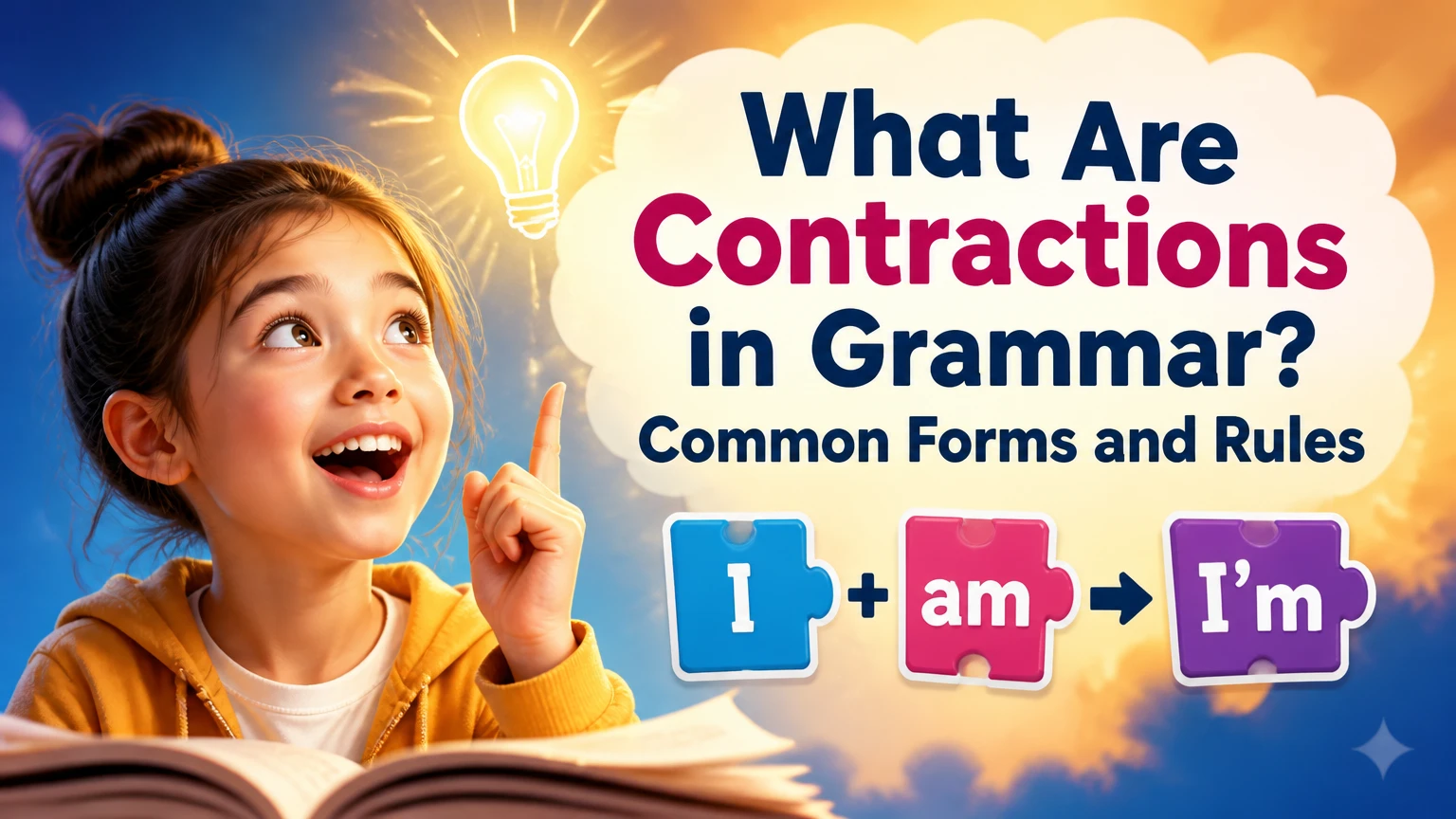
A contraction in grammar is a shortened form of one word or a group of words, created by omitting letters or sounds and marking the omission with an apostrophe. Common examples include do not becoming don’t, I am becoming I’m, and they are becoming they’re. Contractions usually make English sound more natural and conversational.
Key Facts About English Contractions
- A contraction combines words or shortens a single word by removing letters or sounds.
- An apostrophe marks the position of omitted letters, as in cannot becoming can’t.
- It’s means it is or it has, while its is a possessive determiner.
- Contractions are standard in conversation and acceptable in much business, journalistic, and general-purpose writing.
- Formality, emphasis, house style, and clarity determine whether a writer should contract a phrase.
- Some forms, including gonna, wanna, and y’all, are informal or dialect-specific rather than universally neutral.
What Is a Contraction in Grammar?
A contraction is a shortened grammatical form in which letters or sounds are omitted and replaced by an apostrophe. Merriam-Webster defines a contraction as “a shortened form of a word, syllable, or word group,” which includes forms such as she’s, won’t, and o’clock.
Contractions occur most often with auxiliary verbs, modal verbs, and the negative adverb not. English speakers use them frequently because unstressed words become shorter in connected speech. In I am ready, the phrase I am can become I’m, while I am may remain uncontracted when the speaker wants emphasis: “I am ready, not John.”
A contraction is still grammatical when its register is appropriate. The form don’t is a standard contraction, whereas ain’t is widely recognized but nonstandard in formal edited English. The distinction matters because “contraction” describes a shortened form, not a guarantee that every shortened form belongs in every context.
What Do the Apostrophe and Omitted Letters Show?
The apostrophe shows where written material has been removed. In doesn’t, the apostrophe replaces the o from not; in I’m, it marks omitted letters from am. The apostrophe does not indicate possession in these examples.
Writers sometimes confuse contraction apostrophes with possessive apostrophes. In the teacher’s book, the apostrophe marks ownership, but in the teacher’s here, teacher’s may be a contraction of teacher is. Meaning and sentence structure determine the function.
How Are Contractions Formed?
English contractions form by identifying the original words, removing letters or sounds, joining the remaining material, and inserting an apostrophe at the omission point. The process is regular in do not to don’t, but several high-frequency contractions, including won’t and can’t, have irregular historical forms.
Four Steps for Building a Contraction
- Identify the source words. Start with a phrase such as are not.
- Remove letters or sounds. Delete the relevant material, such as the o in not.
- Join the remaining parts. Combine are and the remaining part of not.
- Place the apostrophe. Write aren’t, not are’nt.
The apostrophe belongs where the missing letters would appear in the source phrase. In shouldn’t, the omitted o follows n. In I’ll, the apostrophe appears between I and ll because will has been reduced to ll.
Why Are Some Contractions Irregular?
Some contractions preserve older pronunciation or spelling patterns instead of following a simple deletion rule. Will not becomes won’t, not willn’t, and cannot becomes can’t, not cannotn’t. Historical sound change made these forms conventional in modern English.
The irregular form won’t is especially important for learners because its spelling does not visibly resemble will. The meaning remains negative future or refusal, as in “The parcel won’t arrive today” or “She won’t agree.”
What Are the Most Common Contractions?
The most common English contractions belong to five major groups: negative forms with not, pronoun-plus-verb forms, question-word forms, informal spoken forms, and shortened expressions such as o’clock. The tables below show the source phrase, grammatical function, and a natural example.
Negative Contractions With Not
Negative contractions combine an auxiliary, modal, or form of be with not. The following forms are standard in general English, although mustn’t and shan’t occur less often in some varieties.
| Contraction | Full form | Example |
|---|---|---|
| aren’t | are not | They aren’t available today. |
| can’t | cannot | We can’t enter yet. |
| couldn’t | could not | Maya couldn’t attend. |
| didn’t | did not | The engine didn’t start. |
| doesn’t | does not | This answer doesn’t fit. |
| don’t | do not | I don’t agree. |
| hadn’t | had not | He hadn’t finished. |
| hasn’t | has not | The parcel hasn’t arrived. |
| haven’t | have not | We haven’t decided. |
| isn’t | is not | The office isn’t open. |
| mustn’t | must not | Visitors mustn’t touch the display. |
| needn’t | need not | You needn’t wait. |
| shouldn’t | should not | Drivers shouldn’t use that lane. |
| wasn’t | was not | The result wasn’t clear. |
| weren’t | were not | The files weren’t ready. |
| won’t | will not | Prices won’t remain fixed. |
| wouldn’t | would not | The device wouldn’t connect. |
English also has less common negative forms such as daren’t for dare not and oughtn’t for ought not. These forms are grammatical in certain varieties but sound formal, regional, or old-fashioned to many speakers.
Pronoun and Be-Verb Contractions
Pronoun contractions with be express identity, condition, location, or an ongoing action. The same spelling can have different expansions: he’s may mean he is or he has, depending on the word that follows.
| Contraction | Full form | Example |
|---|---|---|
| I’m | I am | I’m reviewing the report. |
| you’re | you are | You’re responsible for the keys. |
| he’s | he is or he has | He’s tired. He’s finished. |
| she’s | she is or she has | She’s ready. She’s left already. |
| it’s | it is or it has | It’s cold. It’s changed. |
| we’re | we are | We’re meeting at noon. |
| they’re | they are | They’re working remotely. |
A useful test for he’s, she’s, and it’s is substitution. Replace the contraction with is and then has. The grammatical version reveals the intended meaning: “She is left already” is incorrect in standard usage, while “She has left already” is correct.
Pronoun and Will Contractions
Pronoun-plus-will contractions express future events, promises, predictions, or decisions. The forms are common in speech and neutral informal writing.
| Contraction | Full form | Example |
|---|---|---|
| I’ll | I will | I’ll send the invoice. |
| you’ll | you will | You’ll receive a receipt. |
| he’ll | he will | He’ll call after lunch. |
| she’ll | she will | She’ll explain the process. |
| it’ll | it will | It’ll take ten minutes. |
| we’ll | we will | We’ll confirm tomorrow. |
| they’ll | they will | They’ll arrive by six. |
The uncontracted form can add emphasis. “I will complete the work” may sound more forceful than “I’ll complete the work,” especially when the speaker is making a promise or rejecting doubt.
Pronoun and Have, Has, or Had Contractions
English contracts have, has, and had after pronouns, but the written form often has two possible meanings. I’d can mean I had or I would, so the following verb phrase supplies the answer.
| Contraction | Possible full forms | Example |
|---|---|---|
| I’ve | I have | I’ve checked the figures. |
| you’ve | you have | You’ve made a good point. |
| he’s | he has | He’s completed the task. |
| she’s | she has | She’s taken the train. |
| we’ve | we have | We’ve changed the schedule. |
| they’ve | they have | They’ve approved the request. |
| I’d | I had or I would | I’d finished. I’d prefer tea. |
| you’d | you had or you would | You’d arrived. You’d enjoy it. |
| he’d | he had or he would | He’d left. He’d help. |
| she’d | she had or she would | She’d eaten. She’d stay. |
| we’d | we had or we would | We’d started. We’d agree. |
| they’d | they had or they would | They’d gone. They’d object. |
A past participle after I’d usually indicates I had: “I’d written the email.” A base verb or adjective often indicates I would: “I’d write the email” or “I’d be careful.”
Question-Word Contractions
Question-word contractions combine an interrogative word with is, has, or occasionally would. They are common in conversation, interviews, messages, and dialogue.
| Contraction | Full form | Example |
|---|---|---|
| what’s | what is or what has | What’s the answer? |
| where’s | where is or where has | Where’s the station? |
| when’s | when is | When’s the meeting? |
| who’s | who is or who has | Who’s responsible? |
| why’s | why is | Why’s the door locked? |
| how’s | how is or how has | How’s your course going? |
Question contractions can make speech sound natural, but they are not mandatory. “What is the deadline?” is grammatical and may sound more deliberate than “What’s the deadline?”
Which Contractions Are Informal or Colloquial?
Informal contractions represent casual pronunciation, dialect, or historical expressions rather than the core neutral set taught in formal grammar. Gonna usually represents going to, wanna represents want to, and y’all represents you all, but these forms should not be treated as interchangeable with I’m or don’t.
| Informal form | Source expression | Register and limitation |
|---|---|---|
| gonna | going to | Casual speech and dialogue; avoid in formal prose |
| wanna | want to | Casual speech; can be unclear in edited writing |
| gotta | got to or have got to | Informal speech and quoted dialogue |
| lemme | let me | Informal speech and character voice |
| gimme | give me | Informal speech; often nonstandard in formal writing |
| y’all | you all | Regional or identity-marked plural pronoun |
| let’s | let us | Standard contraction for suggestions and proposals |
| o’clock | of the clock | Standard expression for exact times |
| ’cause | because | Informal dialogue, lyrics, and notes |
| ’tis | it is | Archaic, literary, or deliberately stylized |
Let’s is a standard contraction even though it often appears in conversational writing. Its meaning differs from lets: “Let’s begin” means let us begin, while “The lock lets air through” uses the verb lets.
How Do Contractions Differ by Formality?
Contractions are acceptable in many modern contexts, but uncontracted forms remain useful for emphasis, legal precision, institutional style, and highly formal prose. Academic style does not universally ban contractions; individual instructors, journals, publishers, or institutions may impose stricter rules.
| Context | Recommended default | Example |
|---|---|---|
| Casual conversation | Use common contractions | I’m free after six. |
| Customer email | Use selectively | We’re checking your order. |
| News or general web writing | Follow house style | The company hasn’t responded. |
| Academic essay | Follow publication or instructor rules | The results do not support the claim. |
| Legal contract | Prefer explicit wording | The buyer shall not assign rights. |
| Fiction dialogue | Match the speaker | I can’t stay here. |
| Formal speech | Contract for naturalness, expand for emphasis | We will not accept the proposal. |
The practical rule is register matching, not automatic avoidance. A formal report may use does not for a measured tone, while a public-facing government webpage may use you’re to reduce reading friction. The surrounding vocabulary and sentence structure also determine formality.
When Should Writers Avoid Contractions?
Writers should avoid contractions when a style guide requires uncontracted forms, when a negative needs emphasis, or when the contracted spelling could create ambiguity. Legal and technical writers may expand a form when a small misunderstanding could change an obligation, condition, or instruction.
Uncontracted forms also help in contrastive statements:
- “I do not approve the revised budget.”
- “The device will not operate below 5°C.”
- “The applicant has not supplied the required document.”
Expansion does not automatically make a sentence more accurate. A long legal sentence remains difficult even after every contraction is removed, so sentence design, defined terms, and explicit conditions matter more than apostrophe count.
How Are Contractions Pronounced?
Contractions usually reduce unstressed auxiliary verbs, so their spoken pronunciation is shorter than the full forms. I’m is commonly pronounced /aɪm/, you’re often sounds like /jʊr/ or /jɔːr/, and they’re commonly sounds like there in ordinary speech.
English learners should connect the contraction to the stressed content word rather than pronounce every written letter separately. In “I’ve finished the report,” the main stress usually falls on finished or report, while I’ve is reduced.
The following pairs commonly sound identical or nearly identical:
- they’re, their, and there
- you’re and your in many accents
- it’s and its in ordinary pronunciation
- who’s and whose
- we’re and were in some accents
Spelling must therefore carry meaning that pronunciation cannot always provide. Context, syntax, and the word’s grammatical role resolve the difference.
What Is the Difference Between It’s, Its, They’re, Their, and There?
Contractions and possessive or locative words can sound alike, but they perform different grammatical jobs. The fastest test is to expand the contraction: if it is, it has, or they are fits the sentence, the apostrophe form is correct.
| Form | Meaning or function | Correct example |
|---|---|---|
| it’s | it is or it has | It’s ready. It’s been repaired. |
| its | possession by it | The machine lost its cover. |
| they’re | they are | They’re outside. |
| their | possession by they | Their office is upstairs. |
| there | place or existential marker | Put it there. There are two options. |
| you’re | you are | You’re correct. |
| your | possession by you | Your answer is correct. |
| who’s | who is or who has | Who’s calling? Who’s arrived? |
| whose | possession or association | Whose coat is this? |
Apostrophes do not normally form possessive pronouns. Its, their, and your are already possessive forms, so adding an apostrophe creates an error unless the word is actually a contraction.
What Are Double Contractions?
Double contractions combine two contracted elements, as in shouldn’t’ve for should not have. They occur in speech and regional writing, but standard edited prose usually replaces them with the full phrase because readers can process the expanded form more easily.
Examples include:
- couldn’t’ve = could not have
- shouldn’t’ve = should not have
- wouldn’t’ve = would not have
- mightn’t = might not
- y’all’d’ve = you all would have
Forms such as shouldn’t’ve can represent authentic pronunciation in dialogue. They are poor choices for instructions, academic essays, business policies, and most professional correspondence because the stacked apostrophes add visual complexity without adding meaning.
What Are the Most Common Contraction Mistakes?
The most common errors involve confusing contractions with possessives, placing the apostrophe incorrectly, and using speech spellings in formal writing. Editing becomes easier when each contraction is expanded before the writer checks punctuation and register.
- Writing your for you’re. Replace the word with you are. If the sentence still works, use you’re.
- Writing their for they’re. Use they’re only when they are is the intended meaning.
- Writing its’. Standard English does not use its’ as a possessive form.
- Writing could of for could’ve. The spoken ending in could’ve sounds similar to of, but the correct written form is could have or could’ve.
- Writing alot for a lot. This is not a contraction; it is an incorrectly joined phrase.
- Writing cant for can’t. Without the apostrophe, cant is a different word meaning specialized language or insincere talk.
- Using gonna in formal instructions. Replace it with going to when the audience expects standard edited prose.
How Should Opening Apostrophes Be Written?
An opening apostrophe in ’cause or ’tis should curve like a closing apostrophe because it represents omitted letters at the beginning of a word. Word processors may insert a left single quotation mark, but that mark is typographically different from an apostrophe.
Use a curly apostrophe, ’, when typography permits. Use a straight apostrophe, ‘, in plain-text environments where smart punctuation could create compatibility problems. Consistency matters more than visual style in code, data files, usernames, and searchable text.
What Are Regional and Historical Contractions?
Regional and historical contractions reveal differences in pronunciation, identity, and language change. American English commonly uses y’all as a plural second-person pronoun, while British English retains forms such as shan’t and needn’t more often in some contexts.
| Form | Common association | Example |
|---|---|---|
| y’all | Southern United States and other regional varieties | Are y’all ready? |
| ain’t | Nonstandard or dialectal English | I ain’t going. |
| shan’t | British English and formal or old-fashioned speech | We shan’t forget. |
| needn’t | British English and formal usage | You needn’t worry. |
| mustn’t | Standard English across major varieties | You mustn’t park here. |
| ’tis | Archaic or literary English | ’Tis a strange result. |
Ain’t can be an intentional dialect feature in fiction, music, interviews, and quotations. It is generally unsuitable for formal standard English, but labeling it simply “bad English” ignores its grammatical and social function in particular speech communities.
How Can You Choose the Right Contraction?
Choose a contraction by checking meaning, audience, emphasis, and the publication’s style rules. A five-question editing test prevents most mistakes without requiring a complete rewrite.
- What is the full form? Expand it’s to it is or it has.
- Does the expansion fit grammatically? Reject a contraction if neither expansion works.
- Who will read the sentence? Match the form to the audience and genre.
- Does the sentence require emphasis? Expand do not, will not, or cannot when the negative carries special force.
- Could the form be misread? Use the uncontracted version when ambiguity affects a decision or instruction.
An editor’s strongest practical rule is to preserve consistency within a document. Switching randomly between we are and we’re can make a brand voice feel uneven, while deliberate expansion at points of emphasis creates a clear rhetorical pattern.
Contractions Versus Uncontracted Forms
Contractions improve conversational rhythm and often make digital prose sound less distant. Uncontracted forms create deliberate weight, satisfy some house styles, and can make instructions or denials more explicit.
| Feature | Contracted form | Uncontracted form |
|---|---|---|
| Length | doesn’t, 7 characters | does not, 8 characters |
| Typical tone | Conversational and direct | Formal or emphatic |
| Speech rhythm | Reduced and natural | More deliberate |
| Best use | Dialogue, email, web copy | Policies, emphasis, formal reports |
| Main risk | Register mismatch | Stiff or overly distant tone |
| Example | We’re reviewing it. | We are reviewing it. |
The difference is not simply “informal versus formal.” “We are not responsible” may sound legalistic, while “We’re not responsible” may sound abrupt in a liability notice. The best choice depends on the sentence’s purpose, not on a universal ban.
Frequently Asked Questions
Are contractions grammatically correct?
Yes, common contractions such as I’m, don’t, can’t, and they’re are grammatically correct in standard English. Their suitability depends on context. A university assignment, legal agreement, or technical specification may require uncontracted forms because of house style or emphasis, but the contraction itself is not grammatically wrong.
Is cannot one word or a contraction?
Cannot is normally written as one word, not as a contraction with an apostrophe. Its negative contraction is can’t. Use cannot when the sentence needs a formal or emphatic form, as in “The device cannot operate without power.”
Can contractions be used in academic writing?
Contractions can be used in academic writing unless the instructor, journal, or institutional style guide prohibits them. Many academic writers expand contractions to maintain a formal tone, but a blanket rule that all scholarly writing must avoid contractions is not universal. Follow the specified style guide and use emphasis consistently.
What is the difference between let’s and lets?
Let’s is the contraction of let us, usually used for a suggestion: “Let’s begin the experiment.” Lets is the third-person singular form of the verb let: “The valve lets water through.” The apostrophe changes both the meaning and the grammatical function.
Is ain’t a proper contraction?
Ain’t is an established dialectal and nonstandard contraction that can represent am not, is not, are not, has not, or have not. It is appropriate when a writer is reproducing a speaker’s voice or regional variety, but standard formal writing normally uses the specific form required by the sentence.
Why do contractions matter in English?
Contractions matter because they connect written English with natural spoken rhythm. They can reduce unnecessary formality, clarify a speaker’s voice, and make messages shorter, while uncontracted forms can add emphasis or satisfy a formal register. Effective writing uses both forms deliberately rather than treating one as universally superior.
The Bottom Line
Contractions in grammar are shortened forms created by omitting letters or sounds and marking the omission with an apostrophe. The most commonly used contractions include negative forms such as don’t and can’t, pronoun forms such as I’m and they’re, future forms such as I’ll, and perfect-tense forms such as I’ve. Use them when the audience and context support a natural conversational tone, expand them for emphasis or required formality, and always distinguish contractions from possessives such as its, their, and your.