
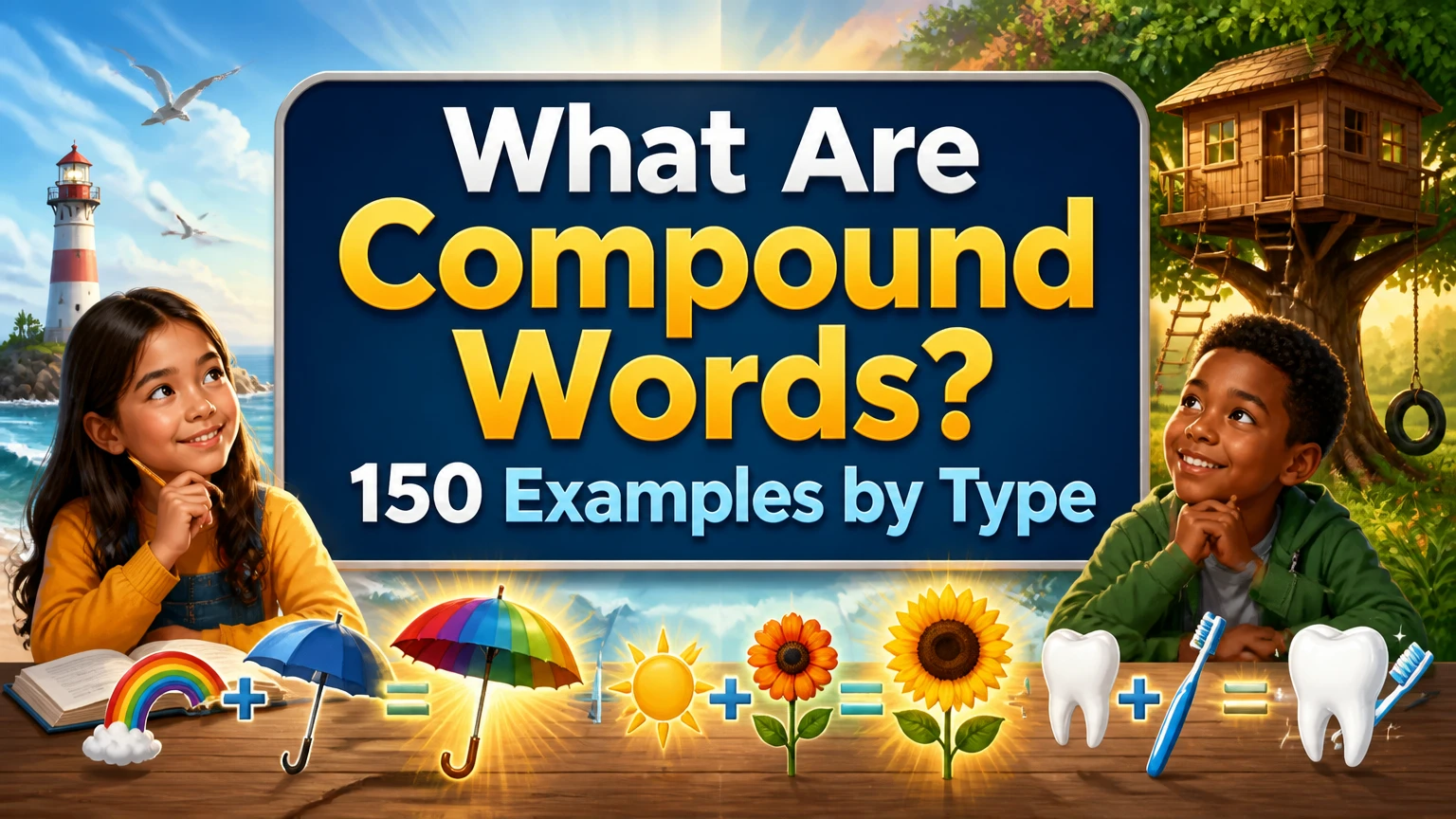
A compound word combines two or more independent words to create a word or expression with a distinct meaning. English compounds may be closed, such as sunflower, open, such as ice cream, or hyphenated, such as long-term; the second element usually supplies the core meaning.
Key Facts at a Glance
- A compound word contains at least two bases that function as one lexical unit.
- The second element is usually the head, so toothbrush is a type of brush.
- Closed compounds have no space, open compounds contain a space, and hyphenated compounds use a hyphen.
- Compound words can function as nouns, verbs, adjectives, adverbs, or other grammatical units.
- Spelling changes over time, so current dictionaries and editorial style guides are the final authorities.
- A compound modifier before a noun often needs a hyphen, as in a well-known author.
What Are Compound Words?
Compound words are lexical units created by joining separate words or bases. The combined meaning may be transparent, as in raincoat, or partly idiomatic, as in deadline, whose modern meaning is a time limit rather than a literal line.
The first element commonly modifies or limits the second. In school bus, “school” identifies the kind of bus; in snowman, “snow” identifies the material. The second element, called the head, usually determines the category and broad meaning of the compound.
Compound formation allows English speakers to name new objects, processes, technologies, and social concepts without inventing entirely unrelated roots. Newer examples include smartphone, cloud computing, and user-generated.
How Do Compound Words Work?
A compound word works by combining form and meaning into a stable unit. In skateboard, “skate” narrows the meaning of “board”; in blackbird, the compound identifies a particular bird rather than any bird that happens to be black.
The head also affects grammar. Greenhouse is a noun because “house” is a noun, while to babysit is a verb because the whole form functions as an action. Some compounds become semantically specialized: butterfly does not mean a fly made of butter.
Are Compound Words Always Nouns?
No. Compound words occur in several grammatical classes.
| Grammatical function | Compound | Example sentence |
|---|---|---|
| Noun | toothbrush | I replaced my toothbrush. |
| Verb | proofread | Please proofread the report. |
| Adjective | waterproof | The jacket is waterproof. |
| Adverb | indoors | The children played indoors. |
| Preposition | throughout | Rain fell throughout the evening. |
| Adjective phrase | high-speed | The train uses a high-speed line. |
Some forms change spelling according to grammatical use. Checkout is commonly a noun, as in “checkout begins at noon,” while check out is a verb, as in “check out of the hotel.”
What Are the Three Types of Compound Words?
The three conventional spelling types are closed, open, and hyphenated compounds. The categories describe how a compound is written, not how transparent or important its meaning is.
| Type | Written form | Typical use | Examples |
|---|---|---|---|
| Closed | One word | Established nouns and verbs | notebook, rainfall |
| Open | Separate words | Multiword lexical units | ice cream, post office |
| Hyphenated | Connected with hyphen | Modifiers and fixed expressions | well-known, sister-in-law |
| Variable | More than one accepted form | Editorial or regional variation | website, web site |
50 Closed Compound Words
| No. | Compound | Meaning |
|---|---|---|
| 1 | aircraft | A vehicle designed to fly |
| 2 | backpack | A pack carried on the back |
| 3 | basketball | A sport played with a ball and basket |
| 4 | bedtime | The usual time for going to bed |
| 5 | bookstore | A shop selling books |
| 6 | butterfly | An insect with broad wings |
| 7 | crossword | A word puzzle in a grid |
| 8 | daylight | Natural light during the day |
| 9 | dragonfly | A long-bodied flying insect |
| 10 | earthquake | Shaking caused by movement in Earth’s crust |
| 11 | earring | Jewelry worn on the ear |
| 12 | firefly | A beetle that produces light |
| 13 | firewood | Wood burned as fuel |
| 14 | footprint | An impression made by a foot |
| 15 | goldfish | A commonly kept freshwater fish |
| 16 | grandmother | The mother of a parent |
| 17 | grasshopper | A jumping plant-eating insect |
| 18 | haircut | The cutting or style of hair |
| 19 | handshake | A greeting involving joined hands |
| 20 | headache | Pain in the head |
| 21 | homework | Assigned schoolwork done outside class |
| 22 | horseshoe | A U-shaped shoe for a horse |
| 23 | hotdog | A sausage served in a split roll |
| 24 | houseboat | A boat equipped as a home |
| 25 | jellyfish | A soft-bodied marine animal |
| 26 | keyboard | A panel of keys |
| 27 | lifeguard | A person who protects swimmers |
| 28 | lighthouse | A tower that guides ships |
| 29 | lipstick | Cosmetic color applied to the lips |
| 30 | lunchbox | A container for carrying lunch |
| 31 | moonlight | Light reflected from the moon |
| 32 | notebook | A book used for writing notes |
| 33 | overcoat | A coat worn over other clothes |
| 34 | pancake | A flat cake cooked in a pan |
| 35 | peanut | An edible seed in a pod |
| 36 | raincoat | A coat designed to resist rain |
| 37 | rowboat | A boat propelled with oars |
| 38 | sailboat | A boat propelled by sails |
| 39 | scarecrow | A figure intended to frighten birds |
| 40 | skateboard | A board mounted on wheels |
| 41 | snowman | A human figure made from snow |
| 42 | sunflower | A tall plant with a large flower head |
| 43 | sunglasses | Eyeglasses that reduce bright light |
| 44 | teapot | A pot used to brew tea |
| 45 | thunderstorm | A storm with thunder and lightning |
| 46 | toothbrush | A brush for cleaning teeth |
| 47 | wallpaper | Material used to cover walls |
| 48 | watermelon | A large fruit with watery flesh |
| 49 | wheelchair | A chair mounted on wheels |
| 50 | workbook | A book containing exercises |
50 Open Compound Words
Open compounds retain a visible space but operate as established units. Ice cream is not merely any cream that happens to contain ice; it names a specific frozen dessert.
| No. | Compound | Meaning |
|---|---|---|
| 51 | apple juice | Juice made from apples |
| 52 | atomic bomb | A nuclear weapon |
| 53 | audio book | A recorded reading of a book; audiobook is also common |
| 54 | baby sitter | A person caring for children; babysitter is also standard |
| 55 | baking soda | Sodium bicarbonate used in cooking |
| 56 | bell pepper | A mild, hollow pepper |
| 57 | blood pressure | Force exerted by circulating blood |
| 58 | bus stop | A place where buses pick up passengers |
| 59 | car seat | A seat designed for a vehicle |
| 60 | cave-in | A collapse; the verb is cave in |
| 61 | cell phone | A portable telephone |
| 62 | chief executive | The highest-ranking organizational administrator |
| 63 | coffee mug | A large cup for coffee |
| 64 | common sense | Practical judgment |
| 65 | cotton candy | Spun sugar confection |
| 66 | dining room | A room used for eating |
| 67 | dry cleaning | Cleaning with chemical solvents |
| 68 | electric guitar | A guitar using electronic amplification |
| 69 | first aid | Immediate emergency assistance |
| 70 | flash drive | Portable electronic data storage |
| 71 | French fries | Deep-fried strips of potato |
| 72 | full moon | The lunar phase with the full disk visible |
| 73 | garbage can | A container for household waste |
| 74 | gas station | A business selling vehicle fuel |
| 75 | grand prize | The highest competition award |
| 76 | high school | A secondary school |
| 77 | hot dog | A sausage served in a long roll |
| 78 | ice cream | A frozen dairy or nondairy dessert |
| 79 | jet lag | Fatigue caused by crossing time zones |
| 80 | living room | A room for general household use |
| 81 | middle school | A school between elementary and high school |
| 82 | movie theater | A venue showing films |
| 83 | music box | A box that plays a mechanical tune |
| 84 | New York | A US state and city name |
| 85 | noble gas | An element with low chemical reactivity |
| 86 | ocean floor | The bottom of an ocean |
| 87 | office chair | A chair designed for desk work |
| 88 | post office | A facility handling mail |
| 89 | prime minister | The head of government in some countries |
| 90 | real estate | Land and buildings as property |
| 91 | remote control | A device operated from a distance |
| 92 | roller coaster | An amusement ride on a rail track |
| 93 | salad dressing | Sauce served with salad |
| 94 | scuba diving | Diving with self-contained breathing equipment |
| 95 | solar system | The Sun and objects orbiting it |
| 96 | soy sauce | Fermented soybean condiment |
| 97 | swimming pool | An artificial body of water for swimming |
| 98 | teddy bear | A stuffed toy bear |
| 99 | video game | An electronic game controlled by a player |
| 100 | water bottle | A container for drinking water |
50 Hyphenated Compound Words
Hyphenated compounds use punctuation to join words that function together. Hyphens are especially useful when a compound adjective appears before a noun and prevents a misleading reading.
| No. | Compound | Meaning |
|---|---|---|
| 101 | absent-minded | Forgetful or inattentive |
| 102 | all-inclusive | Including all stated features or costs |
| 103 | all-star | Made up of outstanding performers |
| 104 | bird-watcher | A person who observes birds |
| 105 | brother-in-law | A spouse’s brother |
| 106 | check-in | Registration at a hotel or airport |
| 107 | clean-cut | Neat in appearance or clearly defined |
| 108 | close-up | A detailed view or short-range image |
| 109 | deep-fried | Cooked in substantial hot oil |
| 110 | double-click | Two rapid mouse clicks |
| 111 | drive-in | A facility serving customers in cars |
| 112 | empty-handed | Carrying nothing |
| 113 | ex-president | A former president |
| 114 | fact-finding | Intended to discover facts |
| 115 | father-in-law | A spouse’s father |
| 116 | first-rate | Of excellent quality |
| 117 | free-floating | Unattached or drifting freely |
| 118 | full-time | Occupying a complete work schedule |
| 119 | good-looking | Attractive in appearance |
| 120 | great-grandmother | The mother of a grandparent |
| 121 | high-tech | Using advanced technology |
| 122 | ice-cold | Extremely cold |
| 123 | ill-fated | Likely to end badly |
| 124 | know-it-all | A person who claims extensive knowledge |
| 125 | left-handed | Naturally using the left hand |
| 126 | life-size | The same size as the subject |
| 127 | long-distance | Extending over a long distance |
| 128 | long-term | Continuing over a long period |
| 129 | low-budget | Made with limited funding |
| 130 | merry-go-round | A rotating amusement ride |
| 131 | mind-blowing | Extremely impressive or surprising |
| 132 | mother-in-law | A spouse’s mother |
| 133 | must-have | Something considered essential |
| 134 | old-fashioned | Made in an earlier style |
| 135 | one-way | Moving in one direction |
| 136 | open-minded | Willing to consider alternatives |
| 137 | part-time | Working less than full-time hours |
| 138 | ready-made | Prepared for immediate use |
| 139 | runner-up | A competitor finishing second |
| 140 | second-rate | Inferior or mediocre |
| 141 | self-esteem | Confidence in personal worth |
| 142 | short-term | Lasting for a limited period |
| 143 | sister-in-law | A spouse’s sister |
| 144 | topsy-turvy | Confused or upside down |
| 145 | two-way | Operating in two directions |
| 146 | up-to-date | Containing current information |
| 147 | user-friendly | Easy to use |
| 148 | well-known | Known by many people |
| 149 | X-ray | Radiation or an image made with it |
| 150 | zebra-crossing | A striped pedestrian crossing |
How Do Closed, Open, and Hyphenated Compounds Differ?
The main difference is orthography, or written form. Meaning and grammar matter too, because a closed noun, an open phrase, and a hyphenated modifier may represent related but different uses.
| Decision factor | Closed compound | Open compound | Hyphenated compound |
|---|---|---|---|
| Space count | 0 | 1 or more | 0 |
| Hyphen count | 0 | Usually 0 | 1 or more |
| Frequent role | Noun or verb | Noun phrase | Modifier or fixed noun |
| Example | website | post office | long-term |
| Main risk | Incorrectly separating it | Incorrectly joining it | Omitting necessary punctuation |
| Dictionary check | One headword | Phrase entry | Hyphenated entry or style rule |
Which Spelling Should You Choose?
Choose the spelling listed by a current authoritative dictionary for a fixed compound, then apply a hyphen when multiple words jointly modify a following noun and ambiguity could result. Merriam-Webster, Oxford English Dictionary, Cambridge Dictionary, and a relevant national style guide may differ, so the intended audience matters.
| Situation | Preferred form | Correct example |
|---|---|---|
| Established single word | Closed | The website loaded quickly. |
| Established lexical phrase | Open | The post office opens at nine. |
| Compound modifier before noun | Hyphenated | She used a high-speed connection. |
| Compound after noun | Often open | The connection is high speed. |
| Adverb ending in -ly | Usually unhyphenated | A highly trained nurse |
| Number plus noun before noun | Hyphenated | A two-year-old child |
When Should Compound Modifiers Be Hyphenated?
Hyphenate two or more words that jointly modify a noun before that noun when the punctuation improves clarity. Write “a long-term contract,” but usually write “the contract is long term,” because the phrase follows the noun and no longer creates the same attachment problem.
The adverb ending -ly is the important exception. Standard usage writes a highly trained technician, not a highly-trained technician, because “highly” clearly modifies “trained.”
Common Compound-Word Errors
- Setup and set up: “Setup” is usually a noun or adjective; “set up” is the verb.
The setup is complete. Please set up the projector. - Everyday and every day: “Everyday” means ordinary; “every day” means each day.
These are everyday shoes. She walks every day. - Maybe and may be: “Maybe” means perhaps; “may be” is a verb phrase.
Maybe they will arrive. They may be late. - Check-in and check in: “Check-in” is a noun or modifier; “check in” is a verb.
Online check-in is available. Passengers should check in early. - Pluralizing the wrong element: In mothers-in-law, the principal noun “mother” takes the plural ending. In school buses, “bus” receives the plural ending because it is the head.
Can Compound Words Have More Than Two Parts?
Yes. English forms compounds with three or more elements, especially in technical and institutional language. Examples include mother-in-law, school bus driver, high-speed rail network, and state-of-the-art.
Long compounds become harder to parse as their elements increase. Writers should prefer a shorter equivalent or restructure the sentence when a chain contains four or more modifiers, particularly in legal, medical, and technical prose.
How Can You Tell a Compound Word From an Ordinary Phrase?
A compound usually behaves as a recognized naming unit, while an ordinary phrase is composed freely for one context. The distinction is not always absolute because English gradually converts frequent phrases into compounds.
Use four tests:
- Meaning test: Does the combination have a specialized meaning?
- Replacement test: Can one word replace the whole expression?
- Stress test: Does spoken emphasis fall mainly on the first element?
- Dictionary test: Do reputable dictionaries list the combination?
The dictionary test is strongest for spelling. The meaning and stress tests help explain why blackbird differs from black bird: the first names a type of bird, while the second can describe any bird that is black.
What Are the Practical Uses of Compound Words?
Compound words help writers name products, occupations, places, tools, scientific concepts, and everyday activities efficiently. Teachers can use them to show how words combine; editors can use them to resolve ambiguity; language learners can use the head word to infer a compound’s category.
For elementary learners, begin with familiar closed examples such as football, rainbow, and playground. Intermediate learners can compare greenhouse with green house, while advanced learners can study productive patterns such as climate-resilient, data-driven, and machine-readable.
Compound words are not automatically clearer than single words. A short closed compound may be instantly readable, but a long hyphenated chain can overload a sentence. Precision comes from choosing the structure that matches established usage and reader expectations.
What Determines Whether a Compound Is Closed or Open?
Frequency, pronunciation, meaning, tradition, and editorial convention influence spelling. A phrase may begin open, become hyphenated during a transitional period, and later become closed as readers recognize it as one word.
| Development stage | Typical form | Example pattern |
|---|---|---|
| Newly formed expression | Open | web site |
| Transitional compound | Hyphenated | decision-making |
| Established lexical item | Closed | website |
| Specialized variation | Multiple forms | health care, healthcare |
| Proper name | Official capitalization | New York |
No universal timetable controls this change. Consult a current dictionary rather than assuming that a familiar phrase should be closed.
FAQ About Compound Words
What is the easiest example of a compound word?
Sunflower is an easy example because sun and flower are independent words that combine into the name of a particular plant. The compound is closed, and flower functions as its head because a sunflower is a type of flower.
Are ice cream and hot dog compound words?
Yes. Ice cream and hot dog are open compounds because each contains a space while functioning as a recognized semantic unit. Hotdog also appears as a closed spelling in some dictionaries and uses, but hot dog remains the widely expected spelling for the food in general writing.
What is the difference between a compound word and a contraction?
A compound joins lexical bases, as in rainbow or classroom. A contraction shortens one or more words, as in cannot becoming can’t or do not becoming don’t. Apostrophes and omitted letters characterize contractions; combined meanings characterize compounds.
Do compound words need capital letters?
Most compound words use lowercase letters in ordinary sentences. Proper-name compounds retain capitalization, as in New York, North America, and Black Sea. A compound at the beginning of a sentence receives an initial capital only because of sentence position.
How should compound words be taught to children?
Teach the meaning of each base, show the combined meaning, and compare the compound with a literal phrase. A useful sequence is closed compounds first, open compounds second, and hyphenated modifiers last, with pictures and sentence completion activities reinforcing the distinction.
Can spelling software decide whether a compound needs a hyphen?
Spelling software can identify many errors but cannot reliably resolve every context-dependent hyphen. A program may accept both long term and long-term because each is correct in a different grammatical position. Writers should check a dictionary and read the complete sentence for ambiguity.
The Bottom Line
Compound words join independent words or bases to create a recognized lexical unit with a distinct meaning. The 150 examples above cover closed compounds such as backpack, open compounds such as water bottle, and hyphenated compounds such as user-friendly. For uncertain cases, identify the grammatical role, inspect the surrounding noun, and confirm the spelling in a current dictionary.


