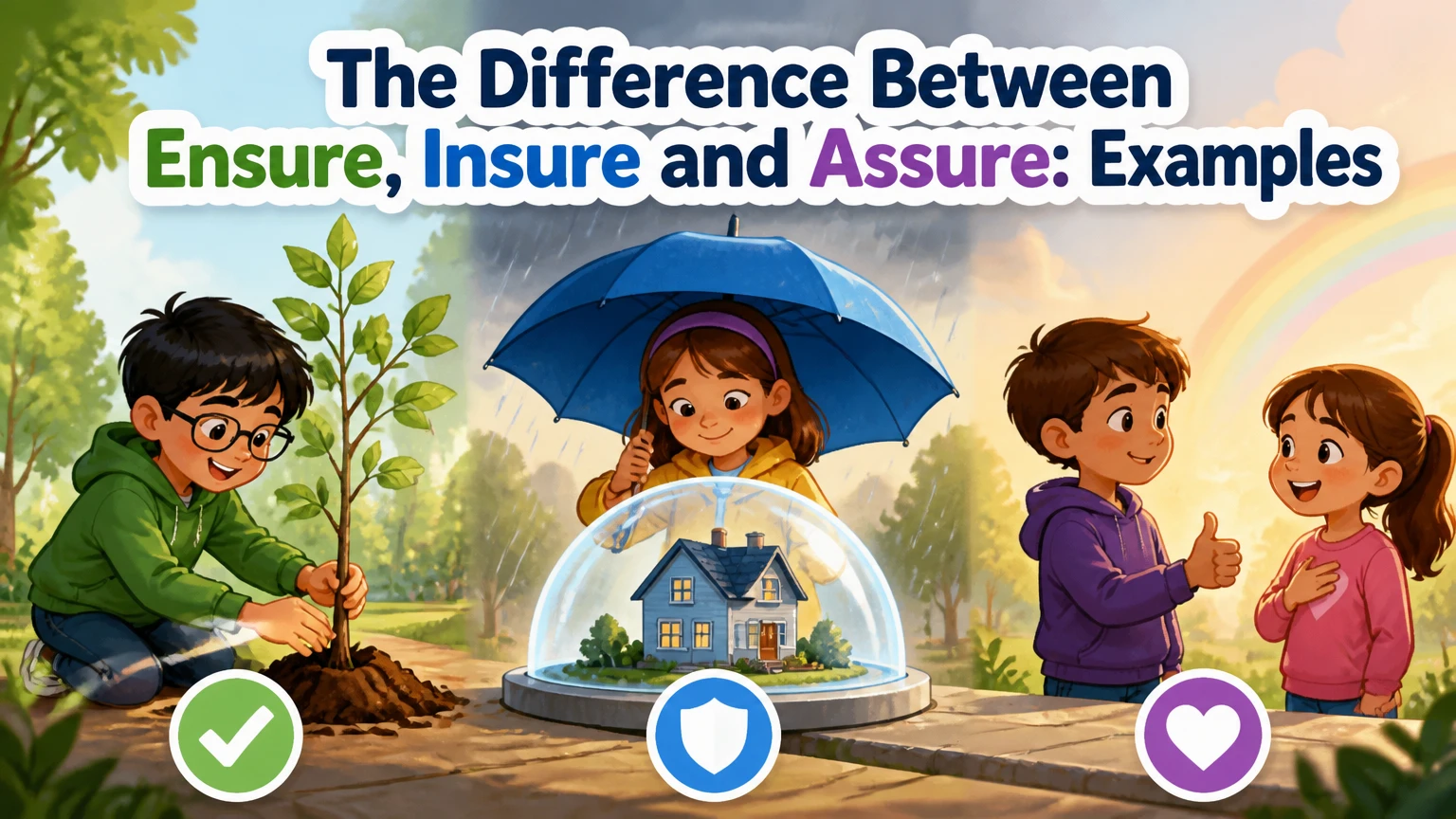
Ensure means make an outcome or condition certain, insure means protect against financial loss through an insurance policy, and assure means remove a person’s doubt by giving confidence. The three words sound alike, but their objects differ: ensure acts on results, insure concerns monetary risk, and assure addresses people or minds.
Key Facts at a Glance
- Ensure normally takes an outcome, condition, process, or event as its object: “Ensure the door is locked.”
- Insure describes financial protection created by an insurance contract: “Insure the warehouse against fire.”
- Assure normally takes a person or group as its object: “I assure you that the figures are accurate.”
- Ensure does not always mean absolute certainty; it can mean taking reasonable action to secure a result.
- Insure is the only word of the three that requires a financial risk-transfer context in modern standard usage.
- Assure communicates confidence, while reassure usually responds to existing fear, concern, or anxiety.
What Is the Difference Between Ensure, Insure, and Assure?
The difference between ensure, insure, and assure is the target of the verb. Ensure targets a result, insure targets financial risk, and assure targets a person’s confidence or doubts. A useful professional rule is: ensure a result, insure against a loss, and assure a person.
| Word | Main meaning | Typical object | Common pattern | Example |
|---|---|---|---|---|
| Ensure | Make a result certain or more secure | Outcome, condition, process | ensure that + clause | Ensure that every file is backed up |
| Insure | Protect financially against specified risk | Property, vehicle, life, liability | insure against + risk | Insure the vehicle against theft |
| Assure | Give confidence or remove doubt | Person, customer, team, yourself | assure + person + that-clause | She assured the client that help was coming |
The distinction is semantic rather than phonetic. In most varieties of English, the three verbs are pronounced similarly, so a listener may not detect an error. In formal writing, however, the wrong spelling can change the legal, operational, or emotional meaning of a sentence.
What does ensure mean?
Ensure means to take action that makes a specified outcome, condition, or event certain or more likely to happen. The object of ensure is usually not a person as a feeling subject; it is a result, requirement, safety condition, or completed task.
Examples include:
- Ensure that the laboratory door remains locked.
- The checklist ensures consistent quality.
- Please ensure all invoices contain a purchase-order number.
- A password manager helps ensure that each account has a unique password.
- The technician checked the seal to ensure an accurate pressure reading.
The word does not promise supernatural or absolute certainty in every context. “Ensure accurate results” means use procedures intended to produce accurate results. If the process cannot control every variable, promote, help secure, or reduce the risk of may be more scientifically precise than ensure.
What does insure mean?
Insure means arrange or provide financial protection against a defined risk under an insurance policy. An insurer accepts specified risk in exchange for a premium and may pay covered claims according to the policy’s terms, limits, exclusions, and deductible.
Examples include:
- The retailer insures its inventory against fire and theft.
- The driver insured the car for collision and comprehensive damage.
- The company insures its directors against certain legal liabilities.
- The policy insures the building for up to $2 million.
- Employers may insure employees’ lives through group policies.
Insure against identifies the danger or loss being covered. “Insure the shipment against damage” means purchase or provide coverage for damage. It does not mean take practical steps to make damage impossible.
Insurance language also includes distinct entities:
| Insurance term | Meaning | Typical value or timeframe | Example |
|---|---|---|---|
| Insurer | Company or organization accepting risk | Policy term commonly 6 or 12 months | The insurer approved the claim |
| Policyholder | Person or business buying coverage | Coverage begins on stated effective date | The policyholder paid the premium |
| Premium | Price paid for insurance coverage | Typical auto premium: hundreds to several thousand dollars yearly | The annual premium increased |
| Deductible | Amount paid before covered benefits apply | Common auto deductibles: $250-$2,000 | The claim has a $500 deductible |
| Claim | Request for payment under a policy | Resolution may take days to several weeks | She filed a claim after the collision |
Those figures are broad typical ranges, not universal prices. Location, age, claims history, property value, coverage limits, underwriting rules, and local regulation determine the actual premium and processing period.
What does assure mean?
Assure means give a person confidence, remove doubt, or state something confidently to another person. The grammatical object is usually a person, pronoun, group, or sometimes the speaker’s own mind through a reflexive construction.
Examples include:
- I assure you that the report is complete.
- The nurse assured the patient that the discomfort would be temporary.
- The manager assured employees that the office would remain open.
- The witness assured the court that the statement was voluntary.
- He assured himself that the locked gate would hold.
The person may be named directly or represented by a pronoun. “The guide assured the visitors of their safety” is also standard because visitors receive confidence. “The guide assured the safety” is normally incorrect when the intended meaning is “made safety certain”; use ensured the safety instead.
How Do You Choose the Correct Word?
Choose the word by identifying what the sentence is trying to secure. Use ensure for a controlled result, insure for financial compensation after covered loss, and assure for confidence communicated to a person.
- Ask whether money, a policy, a premium, or a claim is involved.
If yes, choose insure: “The landlord insured the property against flood damage.” - If there is no policy, identify the result or condition.
Use ensure: “The inspection will ensure compliance with the building code.” - If someone is receiving confidence or reassurance, choose assure.
Use assure: “The attorney assured the client that the filing was on time.” - Check the preposition.
“Insure against theft” signals insurance. “Assure someone of safety” signals confidence. “Ensure that the alarm works” signals an outcome. - Test the sentence with a replacement.
If “make certain” fits, use ensure. If “cover financially” fits, use insure. If “give confidence to” fits, use assure.
A compact mnemonic is E-I-A: Ensure an outcome, Insure a financial interest, Assure an individual. The mnemonic is useful, but the object and context remain the final test.
Which Grammar Patterns Belong to Each Verb?
The three verbs have different collocations, or word combinations that naturally occur with them. Learning the pattern is more reliable than memorizing isolated definitions.
| Intended meaning | Correct pattern | Correct example | Usually wrong in formal standard English |
|---|---|---|---|
| Secure a condition | ensure + noun | Ensure compliance with the rule | Assure compliance with the rule |
| Secure a clause outcome | ensure that + clause | Ensure that the gate is closed | Insure that the gate is closed |
| Cover financial risk | insure + asset/person | Insure the equipment against theft | Ensure the equipment against theft |
| Cover a danger | insure against + risk | Insure against flood damage | Assure against flood damage |
| Give confidence | assure + person | Assure the customer of support | Ensure the customer of support |
| State confidence | assure + person + that | Assure him that the plan is safe | Insure him that the plan is safe |
“Ensure someone’s safety” is correct because safety is the outcome being secured. “Assure someone of safety” is also correct because someone receives confidence about safety. The two sentences may describe the same situation from different angles, but their verbs perform different semantic jobs.
What Are the Most Useful Examples?
Correct usage becomes clearer when the same topic is expressed through all three verbs. A hospital, for example, might ensure sterile procedures, insure its equipment against damage, and assure a patient that treatment is being monitored.
| Context | Ensure example | Insure example | Assure example |
|---|---|---|---|
| Travel | Ensure the passport is valid | Insure the trip against cancellation | Assure the traveler that assistance is available |
| Business | Ensure the contract has signatures | Insure the warehouse against fire | Assure the client that delivery is scheduled |
| Technology | Ensure the database is encrypted | Insure servers against specified losses | Assure users that their data is protected |
| Healthcare | Ensure the dosage is recorded | Insure the clinic against malpractice claims | Assure the patient that the doctor has reviewed the results |
| Education | Ensure every answer is numbered | Insure school property against storm damage | Assure students that extra time is available |
| Home safety | Ensure the smoke alarm works | Insure the house against fire | Assure children that an adult is nearby |
The technology example exposes an important distinction. A company can ensure that data is encrypted through a technical control, while it can insure against certain financial consequences of a breach. A manager can assure users about the company’s response, but that statement alone does not create security or insurance coverage.
Is it “ensure someone” or “assure someone”?
Use assure someone when the person receives confidence, and use ensure something when the thing is a result or condition. “I assured the customer that the refund was approved” is correct, while “I ensured the customer that the refund was approved” is not standard modern usage.
Compare these pairs:
- Assure the tenant that repairs will begin Friday.
The tenant receives a statement intended to remove doubt. - Ensure the tenant’s safety during repairs.
The safety outcome receives practical protection. - Assure the team of management’s support.
The team receives confidence. - Ensure adequate support for the team.
Staffing, tools, or procedures make support available.
A person can appear after ensure in a possessive phrase, but the person is not necessarily the direct semantic target: “The evacuation plan ensures residents’ safety.” The plan secures safety, not residents’ emotions.
Is It “Ensure Safety” or “Insure Safety”?
Use ensure safety when you mean take precautions that secure a safe condition. Use insure safety only when you mean arrange financial insurance connected with safety risks, and even then a more precise phrase such as “insure against injury claims” is usually better.
- Correct: “Workers must wear helmets to ensure safety.”
- Correct: “The contractor insured the project against liability claims.”
- Usually incorrect: “Workers must wear helmets to insure safety.”
- Correct but different: “The supervisor assured workers that the equipment was safe.”
Safety procedures prevent or reduce danger. Insurance does not prevent the accident; it provides financial protection if a covered event occurs. Assurance does not prevent the accident either; it affects the listener’s confidence.
What Is the Difference Between Ensure and Guarantee?
Ensure describes action intended to secure an outcome, while guarantee makes a stronger promise that the outcome will occur or that compensation will follow if it does not. A person can ensure careful handling without being able to guarantee that no accident will happen.
| Expression | Strength of claim | Responsible party | Suitable example |
|---|---|---|---|
| Ensure | Practical steps support an outcome | Operator or process owner | The checklist ensures accurate data entry |
| Guarantee | Promise or contractual commitment | Seller, provider, or guarantor | The supplier guarantees delivery by Friday |
| Insure | Financial protection for defined loss | Insurer under policy terms | The policy insures the shipment against theft |
| Assure | Communicated confidence | Speaker addressing a person | The director assured staff that layoffs were unlikely |
Legal writers should avoid treating ensure as an unlimited guarantee unless the surrounding contract defines that obligation. “The supplier shall ensure delivery” may create a strong performance duty, but its exact legal effect depends on governing law, contract language, remedies, and surrounding clauses.
Can “Ensure” and “Insure” Be Interchangeable?
In contemporary formal American English, ensure means make certain and insure means provide financial coverage. Some British dictionaries record insure as a less common variant of ensure, especially in older or non-financial writing, but writers who need maximum clarity should preserve the modern distinction.
The overlap has historical reasons. Ensure, insure, and related forms developed from language associated with making something secure. Historical texts and regional usage therefore contain examples that do not follow current professional preferences.
Modern style does not treat every regional form as equally useful. In contracts, technical documentation, banking, healthcare, and international business, “insure compliance” can be mistaken for an insurance obligation. Ensure compliance is clearer and usually expected.
British usage also includes assure, ensure, and insure as separate preferred choices in many current reference works and editorial environments. Regional variation is real, but it is not a reason to ignore the distinction when a sentence can be made unambiguous.
Which Word Should You Use at Work or in a Contract?
Use ensure for operational duties, insure for policies and risk allocation, and assure for communications intended to build confidence. Contract writers should reserve each verb for the obligation it actually describes because a mistaken verb can create costly interpretive ambiguity.
| Workplace situation | Recommended wording | Why it fits |
|---|---|---|
| Procedure | Ensure that staff complete the inspection | Completion is the required outcome |
| Compliance | Ensure compliance with Section 4 | Compliance is a condition |
| Risk transfer | The vendor shall insure the vehicle | A policy protects a financial interest |
| Coverage scope | The vendor shall insure against liability | The clause names the covered risk |
| Customer communication | We assure you that support remains available | The customer receives confidence |
| Internal update | The director assured employees of continued funding | Employees receive a confidence statement |
A practical editing rule is to separate action from communication. If the sentence describes a checklist, control, safeguard, or process, ensure usually belongs there. If it describes a promise made to a worried customer, assure usually belongs there. If it describes policy limits, exclusions, premiums, or claims, choose insure.
Expert insight: “Assure” can be grammatically correct but rhetorically weak
A company may write, “We assure you that your information is secure,” while having no evidence that the information is secure. Assure describes the communication, not the truth of the claim. Strong technical writing pairs assurance with an evidentiary action: “We assure you that encryption is enabled, and the security audit recorded AES-256 protection.”
Expert insight: “Ensure” does not remove every source of uncertainty
A manager can ensure that a process follows documented steps, but cannot necessarily ensure a market result, medical outcome, or weather-dependent delivery. Replace the verb with “help ensure,” “reduce the risk of,” or “make more likely” when the actor controls only part of the causal chain.
Expert insight: Insurance is not prevention
“Insure against flood damage” describes compensation for covered damage. “Ensure flood safety” describes barriers, drainage, warnings, or evacuation procedures. Confusing these verbs can make an emergency plan sound financially complete when it contains no physical prevention measures.
What Are the Common Mistakes?
The most frequent errors arise when writers choose by sound rather than by object. Correct the sentence by identifying whether the object is a result, financial risk, or person receiving confidence.
| Incorrect sentence | Correct sentence | Reason |
|---|---|---|
| Please assure that the door is locked | Please ensure that the door is locked | A locked door is an outcome |
| We will insure the report is accurate | We will ensure the report is accurate | Accuracy is a result, not a policy |
| The doctor ensured the patient that recovery was likely | The doctor assured the patient that recovery was likely | The patient receives confidence |
| The company assured its equipment against theft | The company insured its equipment against theft | Theft is a financial risk |
| I am ensured that the payment arrived | I am assured that the payment arrived | A person has received confidence |
| The policy ensures the building against fire | The policy insures the building against fire | A policy provides financial coverage |
The passive forms deserve special attention. “I was assured that the shipment had arrived” means someone told me that it had arrived. “The shipment was insured” means financial coverage applied to it. “The shipment was ensured” is generally unnatural unless the writer is describing a very unusual process of securing the shipment’s arrival.
How Do “Assure,” “Reassure,” and “Certify” Differ?
Assure gives confidence, reassure restores confidence after concern has arisen, and certify formally confirms compliance, accuracy, status, or authority. These verbs can appear in one situation, but they describe different actions.
- The engineer certified that the bridge met the stated standard.
- The project manager assured the public that inspections were complete.
- The manager reassured residents after a temporary closure caused alarm.
“Reassure” implies a prior worry more strongly than assure. A calm introduction may involve assurance, while a response to a frightening error usually involves reassurance. Neither word substitutes for ensure when practical controls are the subject.
How Can You Remember the Difference?
Use the three-part test: ensure a result, insure a risk, assure a person. Then confirm the grammar with a replacement phrase: “make certain,” “cover financially,” or “give confidence.”
- If “make certain” works, choose ensure: “Make certain the figures reconcile.”
- If “cover financially” works, choose insure: “Cover the vehicle financially against theft.”
- If “give confidence to” works, choose assure: “Give confidence to the client.”
The spelling cue also helps. Insure begins like insurance, so reserve it for policies and financial loss. Assure often appears near a person, pronoun, or audience. Ensure commonly appears before that, a noun naming a condition, or an abstract outcome.
FAQ
Is “ensure” stronger than “make sure”?
No. Ensure and make sure usually express the same practical idea, but ensure is more formal and compact. “Make sure the valve is closed” suits conversation, while “Ensure that the valve is closed” suits a procedure, report, or controlled document.
Can you assure an object?
Usually no in modern standard usage, because assurance is directed toward a person capable of doubt or confidence. You can assure a person of an object’s quality, as in “The seller assured me of the product’s authenticity,” but use ensure for the object or result: “The inspection ensured product authenticity.”
Is “I assure you” formal or informal?
“I assure you” is grammatically standard and moderately formal, but its effect depends on evidence and context. In customer service, “I assure you that we are investigating” communicates commitment. A documented timeline, ticket number, or corrective action makes the assurance more credible.
Does “insured” mean the same as “covered”?
Often, but not always. Insured means protected by an insurance policy, while covered can also mean included within a warranty, benefit plan, contract, or scope. A policy may insure a vehicle but exclude a particular driver, event, or type of damage.
Which word should an English learner use in an exam?
Use ensure for making an event or condition certain, insure for an insurance policy or financial loss, and assure for giving confidence to a person. Standardized exams generally reward these modern distinctions, especially in sentence-completion questions involving “against,” “that,” or a named person.
Is “ensure success” always correct?
“Ensure success” is grammatically correct when the writer claims that actions secure a successful result, but the claim may be too strong. For uncertain outcomes, “help ensure success,” “increase the likelihood of success,” or “support a successful outcome” states the evidence more accurately.
The Bottom Line
The difference between ensure, insure, and assure explained through examples is simple once the target is visible: ensure a result, insure against financial loss, and assure a person. Choose ensure for procedures and conditions, insure for policies and covered risks, and assure for confidence or doubt. In formal writing, that distinction prevents grammatical confusion and avoids changing an operational promise into an insurance obligation.