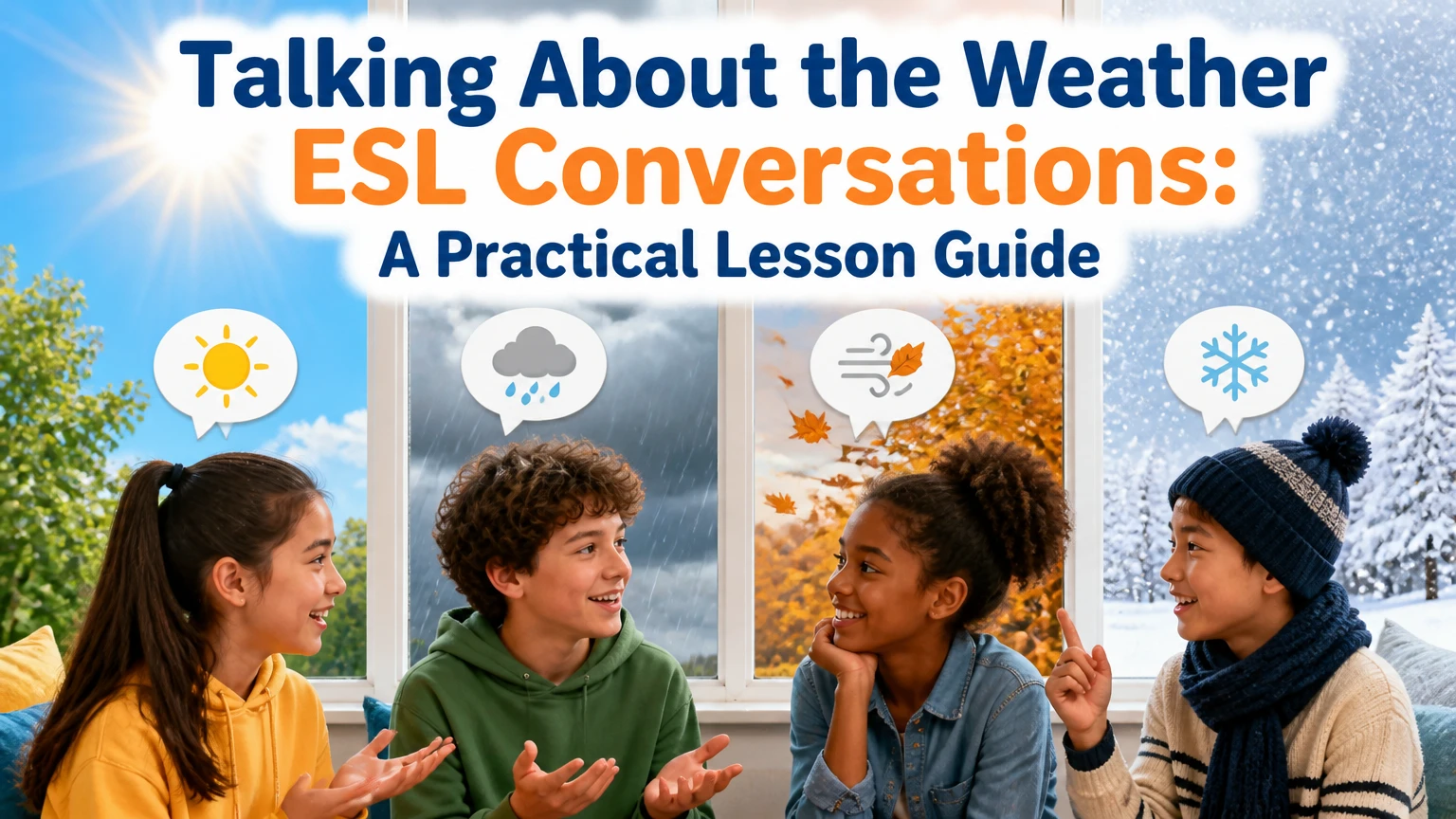
Talking about the weather ESL conversations are structured speaking activities that help English learners practice meteorological vocabulary, the dummy subject it, question tags, follow-up questions, and everyday small talk. Effective practice moves from vocabulary input to controlled dialogue and then to a natural conversation pivot, such as travel plans, clothing, commuting, or weekend activities.
Key Facts at a Glance
English weather descriptions usually require the dummy subject it, as in “It’s raining” and “It’s cold.”
Beginner learners can start with 20-30 high-frequency terms and three sentence frames before adding idioms.
A useful weather exchange normally contains an observation, a response, and a follow-up question.
“It’s pouring” is usually more natural in daily speech than “It’s raining cats and dogs.”
A focused classroom lesson can take 40-60 minutes, while conversational confidence requires repeated practice.
Weather talk works best as a social bridge, not as the entire conversation.
What Are Talking About the Weather ESL Conversations?
Talking about the weather ESL conversations are short speaking tasks built around current conditions, forecasts, personal preferences, and practical plans. Teachers use them because weather is observable, relatively low-risk, and adaptable to A1 beginners through C1 learners.
Weather talk is useful, but it is not automatically meaningful communication. A learner who can recite “It is sunny” has learned a sentence pattern, not necessarily the ability to respond, ask a question, or change topics. The strongest activities therefore require a second conversational purpose.
For example, a student might say, “It’s really humid today. Do you usually exercise outside in this weather?” The weather provides the opening, while the question creates a genuine exchange.
Why Does Weather Work as Small Talk?
Weather works as small talk because both speakers can access the topic immediately without disclosing private information. The subject also supports several levels of difficulty, from naming a condition to interpreting a forecast or negotiating a backup plan.
The topic has limits. Repeated comments about rain can sound mechanical, and extreme-weather discussions may be sensitive for learners affected by floods, drought, heat, or storms. Teachers should allow students to use neutral alternatives such as traffic, transport, or local events.
How Is a Natural Weather Conversation Structured?
A natural weather conversation usually follows four moves: notice a condition, make a formulaic opening, respond with an evaluation, and ask a question that extends the interaction. This structure gives learners support without forcing them to memorize a complete script.
- Observation: “It’s raining again.”
- Reaction: “Yes, and it’s much colder than yesterday.”
- Agreement or contrast: “I know. I should have brought a heavier coat.”
- Extension: “Are you going straight home after work?”
The opening does not need to be original. Native speakers commonly rely on familiar chunks such as “Looks like rain,” “Beautiful day, isn’t it?” and “It’s finally clearing up.”
Which Sentence Frames Should Learners Memorize?
Learners should first memorize three productive frames rather than dozens of isolated sentences.
| Function | Sentence frame | Example |
|---|---|---|
| Current condition | It’s + adjective | “It’s cloudy and cool.” |
| Current event | It’s + verb-ing | “It’s snowing outside.” |
| Weather noun | We’re having + noun | “We’re having heavy rain.” |
| Forecast | It’s going to + verb | “It’s going to storm tonight.” |
| Follow-up | How do you feel about + noun? | “How do you feel about the heat?” |
| Pivot | Speaking of + noun, question | “Speaking of rain, did you drive here?” |
The frame “It’s + adjective” handles sunny, windy, humid, chilly, freezing, and overcast. The frame “It’s + verb-ing” handles raining, snowing, drizzling, and clearing up. “We’re having + noun” is useful with rain, a storm, strong winds, and a heatwave.
What Weather Vocabulary Should ESL Learners Study?
ESL learners should study weather vocabulary in functional groups: conditions, intensity, temperature, precipitation, forecasts, and effects on daily life. Vocabulary becomes easier to retrieve when each word connects to a clothing choice, activity, danger, or personal response.
| Category | Core words | Higher-level additions | Example |
|---|---|---|---|
| Sky conditions | sunny, cloudy, gray, clear | overcast, hazy, bright | “The sky is overcast.” |
| Precipitation | rain, snow, drizzle | sleet, hail, downpour | “We had a brief downpour.” |
| Air movement | wind, breeze | gust, gale, crosswind | “A strong gust closed the door.” |
| Temperature | hot, cold, warm, cool | chilly, freezing, scorching | “It’s chilly in the shade.” |
| Moisture | wet, dry | humid, muggy, damp | “The air feels muggy.” |
| Forecast language | forecast, chance, storm | outlook, radar, precipitation | “The forecast shows rain at noon.” |
How Do Breeze, Wind, and Gale Differ?
A breeze is a light, pleasant movement of air; wind is the general term; and a gale is very strong wind that may create hazardous conditions. The words describe increasing force, although everyday speakers do not always use them technically.
| Term | Typical meaning | Natural context | Learner example |
|---|---|---|---|
| Breeze | Light air movement | “There’s a nice breeze.” | Beach or park |
| Wind | Noticeable moving air | “The wind is picking up.” | Daily conversation |
| Gust | Short burst of wind | “A gust blew my hat away.” | Specific event |
| Gale | Very strong wind | “The coast is expecting gales.” | Forecast or warning |
| Hurricane | Named tropical system | “The hurricane reached the coast.” | Official reporting |
Avoid teaching “dynamic” as a routine synonym for windy. In ordinary weather conversation, windy, breezy, gusty, and stormy are more useful.
Which Grammar Patterns Make Weather English Accurate?
Weather English depends on the dummy subject it, because standard English normally requires a grammatical subject even when no person or object performs the action. “It’s raining” is correct, while “Is raining” is incorrect in ordinary complete sentences.
| Incorrect form | Correct form | Reason |
|---|---|---|
| “Is very hot today.” | “It’s very hot today.” | English needs a subject |
| “It is rain today.” | “It is rainy today.” | Use an adjective after “is” |
| “The weather is sun.” | “The weather is sunny.” | Use an adjective |
| “We have raining.” | “We have rain.” | Use a noun after “have” |
| “It is snow.” | “It is snowing.” | Use the progressive verb |
The noun rain names a substance or event. The adjective rainy describes a day or place. The verb raining describes an action in progress. This noun-adjective-verb distinction is more useful than asking learners to memorize a single translation.
When Should Learners Use Question Tags?
Learners use question tags to invite agreement, soften an observation, or turn a statement into an opening. “It’s a beautiful day, isn’t it?” expects social engagement, while “It’s going to rain, isn’t it?” may invite confirmation.
Positive statement, negative tag:
- “It’s cold, isn’t it?”
- “The forecast is improving, isn’t it?”
Negative statement, positive tag:
- “It isn’t very windy, is it?”
- “It won’t rain all day, will it?”
Beginners can also use direct questions, which are clearer and easier to control: “Do you like this weather?” or “What is the forecast for tomorrow?”
How Can a Teacher Run a 45-Minute Weather Conversation Lesson?
A 45-minute weather lesson should move through vocabulary input, grammar scaffolding, controlled practice, and free production. The main success factor is a required follow-up question, because students otherwise repeat isolated descriptions and stop speaking.
Before starting
| Item | Typical requirement |
|---|---|
| Time | 45 minutes |
| Level | A1-A2, adaptable to B1-B2 |
| Class size | 2-24 learners |
| Cost | $0 with teacher-made materials |
| Materials | 12 image cards, 12 word cards, dialogue worksheet |
| Outcome | Two descriptions, one response, one follow-up |
Step 1: Introduce Conditions, 8 Minutes
Show six weather images and elicit or teach sunny, cloudy, rainy, snowy, windy, and foggy. Add one intensity word for each suitable condition, such as heavy rain, thick fog, or strong wind.
Students match each adjective with an image and repeat the phrase with the correct rhythm. The teacher then contrasts “rain” and “rainy” orally.
Success checkpoint: Every learner produces six accurate “It’s…” sentences.
Common mistake: Students say “It’s rain.” Recast with “It’s rainy” or “It’s raining.”
Step 2: Model the Grammar, 8 Minutes
Write three patterns on the board:
- “It’s sunny.”
- “It’s raining.”
- “We’re having heavy rain.”
Add contractions because real conversations usually use “it’s” and “we’re.” Explain that it does not refer to a particular object; it fills the subject position required by English grammar.
Success checkpoint: Learners select adjective, verb, or noun forms correctly in six items.
Common mistake: Learners translate directly from a language that permits subject omission.
Step 3: Practice a Controlled Dialogue, 10 Minutes
Give pairs a dialogue with missing words:
A: It’s __________ today, isn’t it?
B: Yes, and there’s a strong __________.
A: I know. I should have brought my __________.
B: Are you going __________ after class?
Possible answers include chilly, wind, jacket, straight home. Pairs read once, exchange roles, and replace two words using their own choices.
Success checkpoint: Each pair completes the exchange without reading every word.
Common mistake: Learners focus on pronunciation but omit the final question.
Step 4: Add a Weather Pivot, 9 Minutes
Give each student a situation card: bus stop, office kitchen, school entrance, airport lounge, or café. The speaker must make one weather comment, respond to the partner, and pivot to a connected subject.
Useful pivots include:
- “Speaking of the rain, did you have trouble getting here?”
- “With this heat, are you doing anything outdoors?”
- “Since the weather may change, have you made weekend plans?”
Success checkpoint: The conversation reaches a non-weather topic within three turns.
Common mistake: Students change the subject abruptly. Teach “Speaking of…” and “Because of…”
Step 5: Run Free Production, 10 Minutes
Pairs draw a forecast card and create a practical conversation about clothing, transport, an event, or a trip. Require one present description, one future prediction, and one conditional.
Example: “It’s cloudy now, but it’s going to rain tonight. If the rain continues tomorrow, we’ll move the picnic indoors.”
Success checkpoint: The learner communicates meaning without translating each sentence.
Common mistake: Students use weather vocabulary but never negotiate a plan.
What Are the Main Types of Weather Conversations?
The three most useful types are casual icebreakers, shared complaints, and functional planning conversations. Each type needs a different outcome, so teachers should not assess every dialogue by the same standard.
| Conversation type | Main purpose | Useful language | End point |
|---|---|---|---|
| Casual icebreaker | Establish rapport | “Nice day, isn’t it?” | Personal preference |
| Commiseration | Share a reaction | “It’s absolutely boiling.” | Shared experience |
| Travel planning | Coordinate action | “If it rains, we’ll…” | Decision or backup plan |
| Forecast discussion | Exchange information | “There’s a 60% chance…” | Preparation |
| Workplace opening | Create brief warmth | “Did you have a wet commute?” | Meeting transition |
How Do You Talk About an Unpleasant Day?
Use an evaluation plus a specific consequence, rather than repeating “bad weather.” “It’s pouring, and my train was delayed” sounds more conversational than “The weather is terrible.”
Natural examples:
- “It’s absolutely freezing this morning.”
- “The humidity is making it feel hotter.”
- “The rain hasn’t let up all afternoon.”
- “It’s miserable outside, but at least the roads are quieter.”
“Boiling” and “freezing” are common exaggerations in casual speech. They usually express discomfort, not a literal temperature of 100°C or 0°C.
How Do You Discuss a Forecast and Make Plans?
Use future forms for predictions and conditionals for consequences. “It’s going to snow tomorrow” predicts a likely event, while “If it snows tomorrow, we’ll cancel the match” connects the forecast to a decision.
| Purpose | Structure | Example |
|---|---|---|
| Current report | It’s + adjective | “It’s foggy this morning.” |
| Prediction | It’s going to + verb | “It’s going to clear up.” |
| Scheduled forecast | It will + verb | “It will be windy overnight.” |
| Possibility | It might + verb | “It might rain later.” |
| Contingency | If + present, will + verb | “If it rains, we’ll stay inside.” |
For travel or safety, learners should distinguish casual conversation from official information. A classroom dialogue can say “It looks rainy,” but an evacuation or transport decision should rely on a local meteorological service, not informal language practice.
Which Practice Method Fits Each ESL Learner?
Worksheets suit beginners who need predictable forms, AI tools suit independent repetition, and human conversation provides the strongest transfer to unpredictable interaction. No method replaces the others because accuracy, volume, and social responsiveness develop under different conditions.
| Method | Typical cost | Useful practice length | Strongest benefit | Main limitation |
|---|---|---|---|---|
| Teacher worksheet | $0-$35 monthly | 15-30 minutes | Controlled accuracy | Scripted responses |
| AI speaking tool | $0-$30 monthly | 10-20 minutes | Repetition and patience | Limited body language |
| Peer roleplay | $0 | 15-25 minutes | Negotiation and repair | Uneven correction |
| Private tutor | $10-$30 hourly typical | 30-60 minutes | Individual feedback | Recurring expense |
| Weather news shadowing | $0 | 5-15 minutes | Listening and rhythm | Technical vocabulary |
AI practice is useful for generating ten variations of “It’s raining,” but it may accept unnatural sentences or fail to model eye contact, interruption, and polite topic changes. Human partners are better for those social skills.
What Are the Most Common Learner Mistakes?
The most common errors involve word class, missing subjects, unnatural idioms, and answers that do not continue the exchange. Correcting the conversational function matters as much as correcting grammar.
- Word-class confusion: Replace “It is rain” with “It is rainy” or “It is raining.”
- Missing dummy subject: Replace “Is cold today” with “It’s cold today.”
- Unnatural collocation: Say “heavy rain,” “strong wind,” and “thick fog,” not usually “strong rain” or “heavy wind.”
- Overusing an idiom: Teach “It’s pouring” before “It’s raining cats and dogs.”
- No follow-up: Require every answer to include a question, reaction, or reason.
- Literal temperature translation: “It’s 30 degrees” may be ambiguous internationally, so learners can specify “30 degrees Celsius” when precision matters.
A practical correction drill uses three columns: noun, adjective, and verb. Students sort rain, rainy, raining; snow, snowy, snowing; wind, windy, blowing and then create one sentence from each column.
How Can Learners Sound More Natural?
Learners sound more natural when they use contractions, intensity modifiers, short reactions, and connected follow-up questions. Pronunciation practice should focus on the rhythm of the whole chunk, not isolated words alone.
Compare:
- Careful: “It is very cold today.”
- Conversational: “It’s really cold today.”
- More expressive: “It’s absolutely freezing.”
Useful response chunks include:
- “I know, right?”
- “Tell me about it.”
- “Hopefully it clears up.”
- “At least it’s cooler than yesterday.”
- “I don’t mind the rain.”
Teachers should avoid presenting every idiom as equally common. “It’s raining cats and dogs” is recognizable, but many speakers more often say “It’s pouring,” “It’s coming down hard,” or “It’s coming down out there.”
How Does Weather Small Talk Change by Situation?
Weather small talk should match the relationship, setting, and practical stakes. A brief workplace exchange should usually last one or two turns, while a classroom partner task can deliberately extend the topic for several minutes.
| Situation | Suitable opening | Appropriate pivot | Avoid |
|---|---|---|---|
| Office arrival | “Did you have a wet commute?” | “Are you ready for the meeting?” | Long personal complaints |
| Bus stop | “Looks like the rain is easing.” | “Is this bus usually on time?” | Unsupported safety claims |
| Airport | “The forecast looks stormy.” | “Have you checked the departure board?” | Treating a guess as official news |
| New acquaintance | “Beautiful day, isn’t it?” | “Do you live nearby?” | Immediate sensitive questions |
| Online lesson | “What’s the weather like there?” | “Which season do you prefer?” | Assuming every learner shares conditions |
Regional vocabulary also matters. Fall is common in the United States and Canada, while autumn is common in the United Kingdom and many international textbooks. Fahrenheit is common in the United States, whereas Celsius is standard in most countries.
Is Weather Small Talk Appropriate Everywhere?
Weather small talk is broadly useful, but it is not culturally universal in length or purpose. In some workplaces it is a quick politeness routine; in others, direct discussion of plans is preferred. Learners should observe how long local speakers continue before switching topics.
Extreme weather requires care. Asking “Did the storm damage your home?” can be intrusive after a disaster. A safer alternative is “I hope you and your family are safe,” followed by an offer to change the subject.
How Should Teachers Assess Weather Conversation?
Assess weather conversation with four criteria: grammatical accuracy, vocabulary precision, interaction, and topic development. A learner should not receive full credit for perfect sentences if the learner cannot respond to a partner.
| Criterion | 1 point | 2 points | 3 points |
|---|---|---|---|
| Grammar | Frequent missing subjects | Meaning clear with errors | Accurate core frames |
| Vocabulary | Repeats one adjective | Uses five conditions | Adds intensity and effects |
| Interaction | Gives isolated answers | Answers and asks once | Responds, repairs, and pivots |
| Pronunciation | Often misunderstood | Understandable repetition | Natural chunk rhythm |
| Planning | No consequence stated | Gives a simple plan | Uses forecast and conditional |
For A1-A2 learners, a reasonable target is six conditions, three sentence frames, and one follow-up question. B1-B2 learners can add forecast interpretation, comparisons, idiomatic reactions, and a two-minute unscripted exchange.
What Adaptations Work for Online, One-to-One, and Mixed-Level Classes?
Online teachers can use webcam backgrounds, local forecast screenshots, and chat-based sentence sorting. One-to-one tutors can personalize the topic around commuting, sports, gardening, travel, or clothing, which produces more authentic follow-up questions.
Mixed-level classes work best with layered prompts. Beginners describe the image; intermediate learners explain effects; advanced learners compare forecasts, discuss uncertainty, or negotiate an alternative plan.
Learners with visual, auditory, or sensory needs should not be forced to use real outdoor observation. Icons, transcripts, tactile cards, captioned forecasts, and fictional weather maps provide equivalent language practice without relying on one sensory channel.
Frequently Asked Questions
What Is the Difference Between “Rainy” and “Raining”?
Rainy describes a general condition, as in “It’s a rainy day” or “The rainy season begins in June.” Raining describes precipitation happening now, as in “It’s raining outside.” Learners can use “rain” as a noun: “We’re having heavy rain.” The three forms cannot be exchanged freely.
How Do You Answer “How’s the Weather?”
Give a direct description and add one detail or question. For example, “It’s cool and cloudy today. I think it might rain later. How is it where you are?” A one-word answer such as “Sunny” is grammatically possible, but a complete exchange needs a reaction or follow-up.
What Weather Vocabulary Should A1 Learners Learn First?
A1 learners should begin with sunny, rainy, cloudy, snowy, windy, hot, cold, warm, cool, and foggy, plus rain, snow, sun, wind, and storm. These terms support the frames “It’s…,” “It’s raining,” and “We’re having…” before learners study technical forecast vocabulary.
How Can Students Practice Without a Conversation Partner?
Students can shadow a short weather forecast, record three descriptions, and answer follow-up questions aloud. A self-study cycle takes about 10 minutes: review six words, produce six sentences, roleplay both sides of a dialogue, and listen again for missing subjects or unnatural pauses.
Are Weather Idioms Necessary for ESL Conversation?
Weather idioms are optional at beginner level and useful at intermediate level when learners already control literal descriptions. “It’s pouring” is a practical high-frequency expression; “raining cats and dogs” is recognizable but less necessary for everyday conversation. Teachers should prioritize clarity and collocation over memorizing colorful phrases.
How Do You Move from Weather Talk to Another Topic?
Use a bridge that links the weather to an activity, experience, or plan. Examples include “Speaking of the rain, did you drive here?” and “With this heat, are you doing anything outdoors?” The pivot should follow naturally within two or three turns rather than interrupting the opening abruptly.
The Bottom Line
Talking about the weather ESL conversations work best as structured bridges into real communication. Teach the dummy subject it, distinguish nouns from adjectives and verbs, build a compact vocabulary base, and require every learner to add a response or follow-up question. A 45-minute lesson can establish the pattern, but repeated roleplay, forecast practice, and human interaction are needed for flexible conversational control.