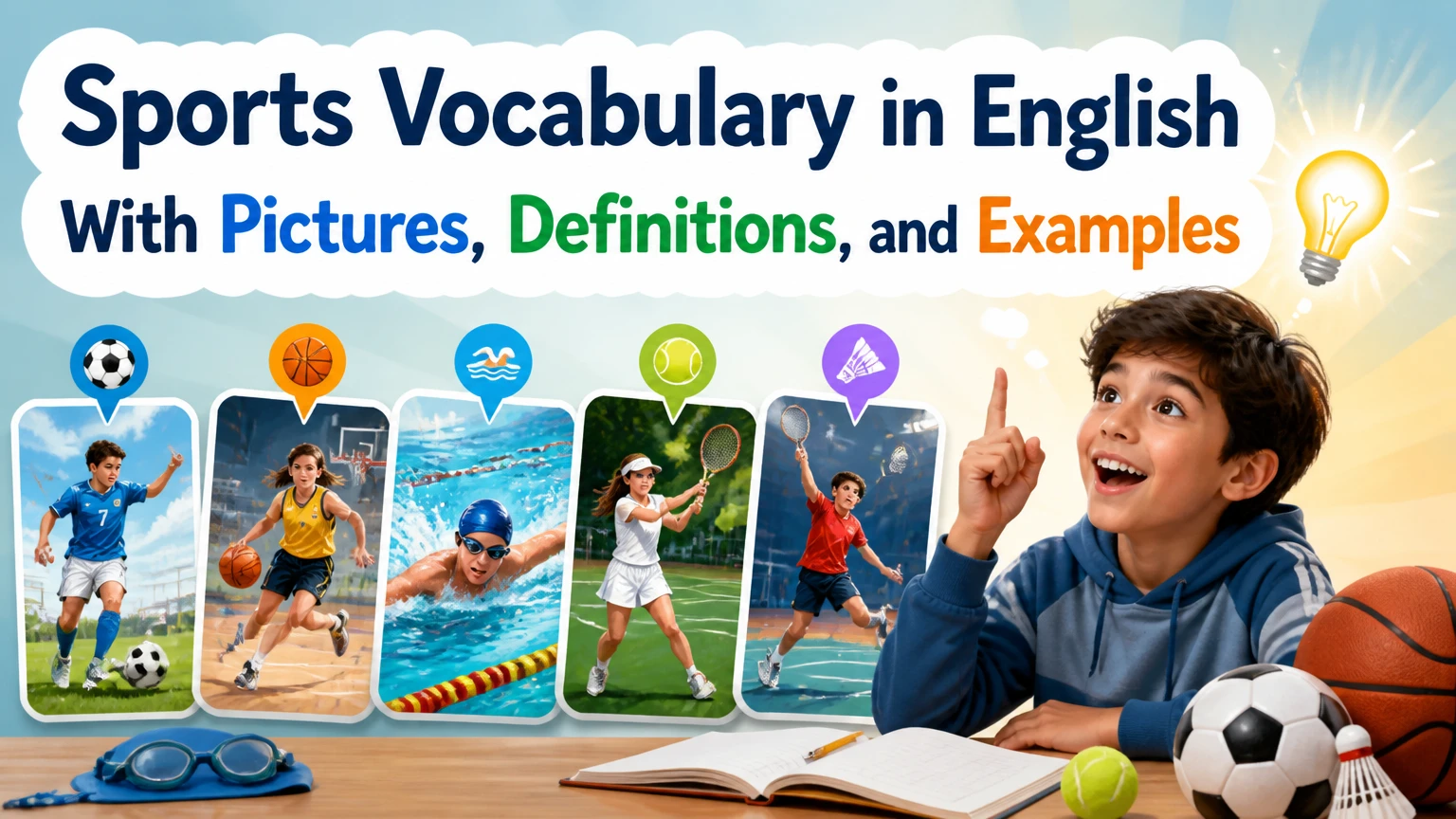
Sports vocabulary in English includes the names of sports, equipment, playing areas, actions, officials, rules, scores, and results. This guide explains each term with simple definitions, visual layouts, pronunciation help, and example sentences, while showing where British and American English use different words.
Key Facts at a Glance
A pitch usually means a grass playing area in British English; field is more common in American English.
A referee commonly controls football, basketball, and rugby; an umpire commonly officiates tennis, baseball, and cricket.
You play football, go swimming, and do karate, although sport-specific exceptions exist.
You win a match or trophy, but you beat an opponent or team.
A draw is more common in British English, while tie is more common in American English.
A soccer penalty mark is 11 metres, or 12 yards, from the goal line under the International Football Association Board Laws of the Game.
What Does Sports Vocabulary Mean?
Sports vocabulary is the specialized English used to describe competition, movement, equipment, rules, people, and results. A learner needs more than a translation for “ball” or “game,” because English changes the verb and noun according to the sport, region, and competitive situation.
For example, a tennis player serves, returns, and wins a set. A basketball player dribbles, shoots, and scores a basket. A swimmer completes a length, records a time, and may achieve a personal best.
The most useful learning sequence is physical and contextual: identify the place, name the equipment, describe the action, explain the rule, and report the result. That sequence matches how coaches, commentators, and players discuss a match.
A simple picture of a match
        Scoreboard: Home 2 - 1 Away

   ┌─────────────────────────────────┐
   │             Goal                │
   │       ┌──────────────┐          │
   │       │ penalty area │          │
   │       └──────●───────┘          │
   │                                 │
   │──────────── halfway line ──────│
   │                                 │
   │       ┌──────────────┐          │
   │       │ penalty area │          │
   │       └──────────────┘          │
   │             Goal                │
   └─────────────────────────────────┘
      touchline                touchline
The diagram shows a soccer field, goal, penalty area, penalty mark, halfway line, and touchline. A real field also includes a goal line, center circle, corner arc, and six-yard box.
How Do Field and Court Terms Differ?
A field or pitch is an outdoor playing surface for sports such as soccer, rugby, and American football, while a court is usually a marked hard surface for tennis, basketball, volleyball, or badminton. A track surrounds or forms the racing area in athletics, and a course describes a planned route in golf, cycling, or motor racing.
| Term | Definition | Common sports | Example sentence |
|---|---|---|---|
| Pitch | Grass or artificial playing area | Football, rugby, cricket | The players walked onto the pitch. |
| Field | Large marked outdoor area | Baseball, American football, soccer | The field was wet after heavy rain. |
| Court | Marked rectangular playing surface | Tennis, basketball, volleyball | The referee entered the court. |
| Track | Prepared racing surface | Athletics, cycling | She ran four laps around the track. |
| Course | Designed route or venue | Golf, racing, cross-country | The golf course has 18 holes. |
| Rink | Ice or roller playing surface | Ice hockey, skating | The team practised at the rink. |
A touchline is the long boundary line in soccer and rugby. A sideline is more common in basketball, American football, and many American sports. A baseline is the back boundary in tennis and basketball, but the goal line is the boundary across the front of a soccer goal.
Which equipment words matter first?
| Equipment | Sports | Function | Example |
|---|---|---|---|
| Ball | Football, tennis, basketball | Object players kick, throw, or hit | He passed the ball. |
| Racket | Tennis, badminton, squash | Strikes a ball or shuttlecock | She bought a new racket. |
| Bat | Baseball, cricket, table tennis | Strikes a ball | The batter lifted the bat. |
| Club | Golf, hockey | Strikes a ball or puck | He chose a seven-iron club. |
| Helmet | Cycling, American football, cricket | Protects the head | The cyclist fastened her helmet. |
| Pads | Hockey, cricket, rugby | Protects body areas | The goalkeeper wore leg pads. |
| Boots | Football, rugby, hiking | Provides grip or protection | His boots were covered in mud. |
| Goggles | Swimming, diving, skiing | Protects eyes or improves vision | She adjusted her swimming goggles. |
In tennis, racket is the standard modern spelling in British and American English. Racquet also appears, especially in formal sport names such as racquetball.
Which Verbs Describe Sports Actions?
Sports action verbs identify exactly how an athlete interacts with equipment, space, or an opponent. English normally uses kick for a soccer ball, throw for a ball in baseball, serve for tennis, hit for a general strike, and swing for a bat or golf club.
| Action verb | Typical sport | Meaning | Example |
|---|---|---|---|
| Kick | Soccer, rugby | Strike with the foot | The striker kicked the ball into the net. |
| Pass | Team sports | Send equipment to a teammate | The midfielder passed to the winger. |
| Dribble | Basketball, soccer | Move while repeatedly controlling the ball | She dribbled past the defender. |
| Tackle | Soccer, rugby, American football | Challenge an opponent legally or physically | The defender made a clean tackle. |
| Shoot | Football, basketball, hockey | Attempt to score | He shot from outside the box. |
| Serve | Tennis, volleyball | Start a point by sending the ball | The player served down the middle. |
| Volley | Tennis, football | Strike before the ball bounces, or strike in the air | She hit a forehand volley. |
| Head | Soccer | Strike the ball with the head | The forward headed the cross. |
| Swing | Baseball, golf | Move a bat or club through the ball | He swung at the fastball. |
| Save | Goal sports | Stop an attempted score | The goalkeeper made a brilliant save. |
| Intercept | Team sports | Stop and take an opponent’s pass | The midfielder intercepted the ball. |
| Sprint | Athletics, cycling, team sports | Move at maximum speed | The runner sprinted to the finish. |
A cross is a pass from a wide position toward the center in soccer. A header is a ball struck with the head. A rebound is a ball that returns after hitting a post, rim, goalkeeper, or wall.
What is a penalty kick?
A soccer penalty kick is a direct attempt from the penalty mark after a defending team commits a direct-free-kick offense inside its own penalty area. The mark is 11 metres, or 12 yards, from the goal line under IFAB Law 14.
- The referee awards the penalty.
- The ball is placed on the penalty mark.
- The identified kicker and defending goalkeeper remain involved in the kick.
- Other players stand outside the penalty area, behind the mark, and at least 9.15 metres from it.
- The goalkeeper must follow the goal-line requirement until the kick is taken.
- The kicker strikes the ball in one forward movement.
The penalty taker may score directly. A player cannot touch the ball twice before another player touches it, so a rebound from the goalkeeper can be played, but a self-passed penalty cannot.
The penalty area is not itself a penalty. A foul inside it may produce a penalty kick only when the offense is one that normally results in a direct free kick.
How Do Officials and Penalties Work?
A referee applies the rules during football, basketball, rugby, and many other sports, while an umpire commonly officiates tennis, baseball, cricket, and softball. The distinction is conventional rather than absolute, because sports such as American football use referees, umpires, judges, and a head official together.
| Official | Sport | Main responsibility | Example |
|---|---|---|---|
| Referee | Soccer | Controls play and sanctions offenses | The referee awarded a free kick. |
| Umpire | Tennis | Calls lines and enforces rules | The umpire overruled the line call. |
| Umpire | Baseball | Calls balls, strikes, and plays | The umpire called the runner safe. |
| Judge | Boxing, gymnastics | Scores performance or determines outcome | The judges gave her a unanimous decision. |
| Linesperson | Soccer, tennis | Assists with boundaries and offside | The linesperson raised the flag. |
| Timekeeper | Basketball, swimming | Records official time | The timekeeper stopped the clock. |
A foul is an illegal action, often involving physical contact, obstruction, or dangerous play. A violation usually describes a rule breach that does not necessarily involve illegal contact, such as traveling in basketball or a shot-clock violation.
Common violations in simple English
- Traveling: A basketball player moves illegally without dribbling.
- Double dribble: A player stops dribbling, then begins dribbling again.
- Offside: A positional rule that prevents an unfair attacking advantage.
- Handball: A soccer player deliberately handles the ball with the hand or arm, subject to the Laws of the Game.
- Foot fault: A tennis server steps on or beyond the required line.
- False start: An athlete begins before the permitted starting signal.
- Out of bounds: The ball or player crosses the legal boundary.
- Icing: In ice hockey, a player shoots the puck across both the center line and opposing goal line without a touch, subject to league exceptions.
Offside is sport-specific. In soccer, the player’s position and involvement are judged when a teammate plays the ball. In rugby, an offside player is ahead of the teammate carrying or kicking the ball and cannot participate legally. In ice hockey, the puck must enter the attacking zone before attacking players.
How Are Scores and Outcomes Described?
Sports scores use different units, including goals, points, runs, sets, games, rounds, laps, and times. The correct word depends on the sport, so “the team scored three goals” is natural in soccer, while “the team scored three points” is natural in basketball.
| Term | Definition | Common sports | Example sentence |
|---|---|---|---|
| Win | Succeed in a contest | All competitive sports | Brazil won the match. |
| Beat | Defeat an opponent | All competitive sports | Brazil beat Argentina. |
| Draw | Equal final result | Soccer, chess, cricket | The match ended in a draw. |
| Tie | Equal final result | Baseball, American sports | The game ended in a tie. |
| Lead | Higher current score | All score-based sports | The home team leads by two points. |
| Equalizer | Score that makes the result level | Soccer, hockey | He scored a late equalizer. |
| Comeback | Recovery after trailing | All competitive sports | The team completed a comeback. |
| Clean sheet | No goals conceded | Soccer, hockey | The goalkeeper kept a clean sheet. |
| Shutout | Opponent scores zero | Baseball, hockey, American sports | The pitcher recorded a shutout. |
| Runner-up | Second-place finisher | Tournaments, races | She was runner-up in the final. |
| Personal best | Athlete’s best recorded performance | Athletics, swimming | He set a personal best in the 100 metres. |
| Overtime | Extra playing time after a draw | Basketball, hockey, American football | The game went to overtime. |
A personal best, or PB, is the preferred term in British athletics, while personal record, or PR, is common in American athletics. A record may describe the best performance in a wider category, such as a national or world record.
Score vocabulary by sport
| Sport | Basic scoring unit | Larger structure | Special term |
|---|---|---|---|
| Soccer | Goal | Match, half | Nil |
| Basketball | Point, basket | Quarter, game | Three-pointer |
| Tennis | Point | Game, set, match | Love |
| Baseball | Run | Inning, game | Home run |
| Cricket | Run | Over, innings, match | Wicket |
| Boxing | Point or knockout | Round, bout | Technical knockout |
| Golf | Stroke | Hole, round | Birdie |
In tennis, love means zero, deuce means 40-40, and a set contains games. In soccer, commentators may say nil for zero, as in “two-nil.” In golf, a lower number of strokes is generally better, so under par and over par matter more than a conventional points total.
Which Terms Change Between British and American English?
British and American sports English differs mainly in venue names, sport names, score words, and everyday collocations. The rules of a sport may remain identical even when the vocabulary changes.
| Meaning | British English | American English | Example |
|---|---|---|---|
| Soccer | Football | Soccer | I play football at school. |
| Playing area | Pitch | Field | The players entered the field. |
| Equal result | Draw | Tie | The game ended in a tie. |
| Clothing | Kit | Uniform or gear | The team changed its kit. |
| Sports shoes | Trainers | Sneakers | He bought new sneakers. |
| Competition | Fixture | Game or matchup | Saturday’s fixture was postponed. |
| League winner | Champions | Champions | The club became champions. |
| Athletics venue | Sports centre | Sports center | She trains at the sports center. |
The word football is especially dangerous for international learners. In the United Kingdom, Ireland, and many other countries, football usually means soccer. In the United States and Canada, football usually means American football.
Which Verb Belongs Before a Sport?
Use play with ball games and competitive team sports, go with many activities ending in “-ing,” and do with martial arts, exercise disciplines, and some individual activities. The pattern is reliable for beginners but has exceptions, so natural collocations should be memorized as phrases.
| Verb | Common combinations | Correct example |
|---|---|---|
| Play | football, tennis, basketball, cricket | We play tennis on Sundays. |
| Go | swimming, running, cycling, skiing | They go cycling after work. |
| Do | karate, yoga, gymnastics, judo | She does karate twice a week. |
| Take part in | athletics, a race, a tournament | He takes part in athletics. |
| Compete in | swimming, boxing, the marathon | Maya competes in swimming. |
| Watch | football, a match, the Olympics | We watched the final. |
Say play golf, although golf is individual. Say do weight training, but go weightlifting can describe the activity. Say play sports for general participation, but do sport appears more often in British English when referring to exercise generally.
What Sports Idioms Are Common in English?
Sports idioms use competition, scoring, and movement as metaphors for ordinary situations. Idioms are useful in conversation and journalism, but formal academic writing usually benefits from a literal alternative.
| Idiom | Literal sport source | Meaning | Example |
|---|---|---|---|
| Move the goalposts | Football | Change requirements unfairly | The manager moved the goalposts again. |
| On the ropes | Boxing | In serious difficulty | The company is on the ropes. |
| Level playing field | Field sports | Fair conditions | The policy creates a level playing field. |
| Hit a home run | Baseball | Achieve major success | Her presentation hit a home run. |
| Throw in the towel | Boxing | Give up | The candidate refused to throw in the towel. |
| Call the shots | Ball games | Make the decisions | The coach calls the shots. |
| Drop the ball | Ball sports | Make a mistake or miss responsibility | The supplier dropped the ball. |
| Blow someone away | Competition | Impress or defeat decisively | The new design blew the judges away. |
“On the ropes” does not mean physically standing on ropes in ordinary conversation. The expression comes from a boxer under pressure against the ring ropes.
What Are the Most Common Usage Errors?
The most common sports-English errors involve verb selection, countable nouns, prepositions, and false translations. Correcting the grammar in a complete sentence is more effective than memorizing isolated word pairs.
| Incorrect sentence | Correct sentence | Reason |
|---|---|---|
| Arsenal won Real Madrid. | Arsenal beat Real Madrid. | Win takes a contest; beat takes an opponent. |
| I do football every Saturday. | I play football every Saturday. | Football normally collocates with play. |
| He made a goal. | He scored a goal. | Score is the standard verb. |
| She won against Maria. | She beat Maria. | Beat directly names the opponent. |
| We made sport yesterday. | We played sport yesterday. | Play is natural for a sporting activity. |
| He is in the football team. | He is on the football team. | On is standard in American English. |
| They scored a point in soccer. | They scored a goal in soccer. | Goal is the usual soccer scoring unit. |
| The match was postponed because rain. | The match was postponed because of rain. | Because of requires a noun phrase. |
Use in for participation in many competitions, as in “compete in the marathon.” Use at for a venue or event location, as in “train at the stadium.” Use on for a team, as in “she is on the volleyball team,” especially in American English.
How Should You Study Sports Vocabulary?
A learner can build practical sports vocabulary in 20-30 minutes per day by combining pictures, collocations, listening, and retrieval practice. The strongest method links one image to a complete phrase such as “the goalkeeper saved a penalty,” rather than storing “goalkeeper” as an isolated translation.
- Choose one sport. Start with soccer, tennis, basketball, or a personally relevant sport.
- Label a picture. Mark the venue, lines, equipment, officials, and scoring zones.
- Create verb phrases. Write “serve the ball,” “commit a foul,” and “win a set.”
- Listen to commentary. Record five action verbs from a 5-minute highlight.
- Write score reports. Describe the result using goals, points, sets, or runs.
- Retrieve without notes. Recreate the diagram and explain three rules.
- Use the terms aloud. Give a 60-second match summary.
Beginners at A1-A2 should learn 30-50 high-frequency nouns and collocations. B1-B2 learners should add tactical verbs such as press, mark, intercept, counterattack, and overlap. C1-C2 learners can study idioms, register, and metaphorical uses.
A practical rule helps: learn words in entity, action, result groups. For soccer, that becomes “striker, shoot, goal.” For tennis, it becomes “server, serve, ace.” For swimming, it becomes “lane, dive, personal best.”
What Is Sports Vocabulary Useful for in Real Situations?
Sports vocabulary is useful in four recurring situations: watching a match, participating in training, discussing results, and writing a report. Each situation requires a different level of precision.
During a match, use short action statements: “The winger crossed the ball,” “The defender blocked the shot,” or “The umpire challenged the call.” During training, use instructions: “Mark your opponent,” “Keep your eyes on the ball,” or “Warm up for ten minutes.”
When discussing results, include the score, competition stage, and decisive event: “The visitors beat the hosts 2-1 in the semifinal after scoring in the 88th minute.” A strong report identifies who acted, what happened, when it happened, and how the result changed.
Sports English is not useful when a literal term is replaced with an idiom that obscures meaning. In a medical, safeguarding, or legal context, say “the player suffered a concussion” rather than using “took a knock” as if the conditions were equivalent.
Sports Vocabulary Practice Test
Choose the best answer.
- A tennis player usually ___ the ball to begin a point.
a) serves b) kicks c) heads - A basketball player who moves without dribbling may be called for ___.
a) offside b) traveling c) icing - A team that concedes no goals keeps a ___.
a) clean sheet b) home run c) personal best - You normally ___ football but ___ karate.
a) do, play b) play, do c) go, play - A player can ___ an opponent but ___ a trophy.
a) win, beat b) beat, win c) draw, win
Answers: 1-a, 2-b, 3-a, 4-b, 5-b.
Frequently Asked Questions
Is sport vocabulary different from sports vocabulary?
Both forms are correct, but usage varies by region. Sports vocabulary is common in American English and in international search queries, while sport vocabulary appears frequently in British English when sport is treated as an uncountable activity. “Sports vocabulary in English” is the clearest phrase for a general learning resource.
What are the five basic sports words?
Five useful beginner words are ball, player, team, score, and win. These words transfer across many sports, but learners should add the sport’s specific action quickly, such as kick for soccer, serve for tennis, or throw for baseball.
What is the difference between a match and a game?
A match and a game can both mean a competitive contest, but regional and sport-specific preferences differ. British English commonly uses “football match” and “tennis match,” while American English commonly uses “soccer game” and “basketball game.” Chess commonly uses “game” internationally.
How do you describe a player’s performance?
Describe the action, measurable result, and effect on the contest. For example: “The goalkeeper made six saves, kept a clean sheet, and prevented the home team from equalizing.” Useful adjectives include accurate, aggressive, consistent, defensive, efficient, and unmarked.
What does nil mean in sports?
Nil means zero, especially in British sports reporting. A soccer score of 3-0 can be read as “three-nil.” American commentators more often say “three to zero” or “three-zero,” while tennis uses love for zero.
What is the difference between a player and an athlete?
A player participates in a game or team sport, such as football or basketball. An athlete is a broader term for someone who competes in physical sport, including runners, swimmers, gymnasts, and players. Every player may be an athlete, but not every athlete is a player.
Conclusion
Sports vocabulary in English becomes easier when learners connect each term to a picture, sport, action, and complete sentence. Start with fields, courts, equipment, officials, verbs, scores, and results, then add regional differences, rule vocabulary, and idioms. Use “play,” “do,” and “go” accurately, and remember that you win a match but beat an opponent.