Situational irony occurs when an outcome sharply contradicts a reasonable expectation, especially when an action intended to produce one result causes an opposite or self-defeating result. Situational irony can create comedy, tragedy, satire, or poetic meaning in literature, film, history, and everyday life.
Key Facts at a Glance
Situational irony is an event-based contrast between expected and actual outcomes.
A strong example includes a clear expectation, an action or condition, and a connected reversal.
Surprise alone is not irony; coincidence and ordinary bad luck usually lack the required meaning.
Dramatic irony depends on unequal knowledge, while verbal irony depends on a speaker’s intended meaning.
Poetic justice is a related form in which wrongdoing produces fitting punishment or virtue receives fitting reward.
Writers make situational irony effective by foreshadowing the reversal without making it predictable.
What Does Situational Irony Mean?
Situational irony means that what happens conflicts significantly with what people reasonably expected to happen. The contrast becomes ironic when the outcome exposes a contradiction in a goal, belief, plan, role, or social expectation, rather than functioning as a random surprise.
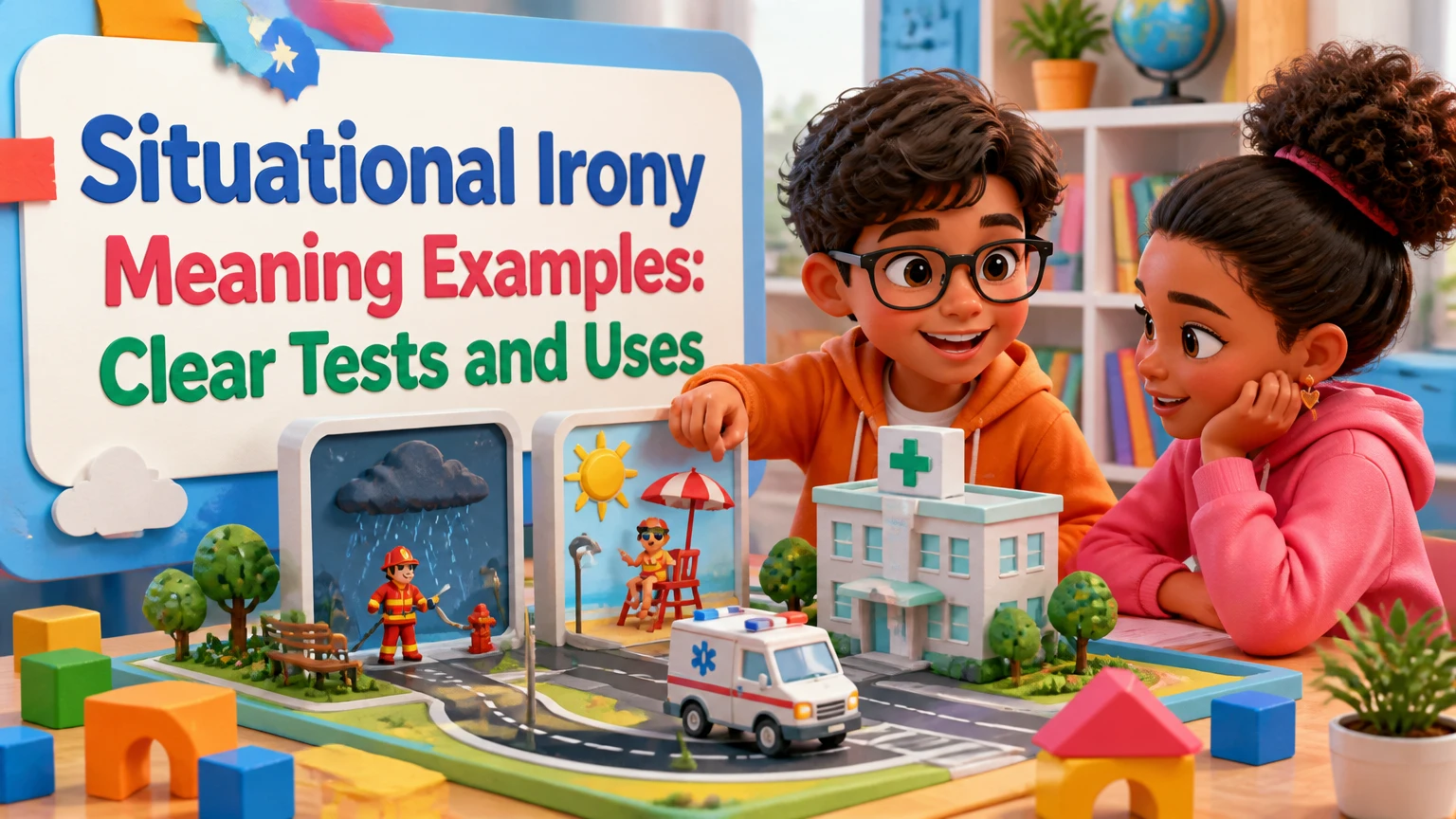
A fire station burning down is a commonly cited example. The expectation comes from the station’s protective purpose, while the event contradicts that purpose directly. The result becomes more strongly ironic if firefighters had recently declared the building exceptionally fireproof or had ignored a safety inspection to protect it.
Situational irony does not require that a character understand the contradiction. In fact, the audience may recognize the pattern before the character does. The event itself carries the contrast, whereas dramatic irony depends primarily on who possesses information.
The simplest diagnostic formula
A practical definition can be expressed as:
Expected result + meaningful reversal + connected circumstances = situational irony
The word “meaningful” matters. A person expecting sunshine who encounters rain has experienced disappointment. A person who cancels an outdoor event because weather forecasts predict rain, only for a rare storm to destroy the replacement indoor venue, has encountered a more ironic reversal because the precaution contributed to the outcome.
Situational irony is therefore stronger when the original expectation is specific and justified. “Something unexpected happened” is too broad. “A security system designed to prevent theft locked its owners outside while a burglar entered through the unlocked front door” contains a recognizable contradiction.
How Does Situational Irony Work?
Situational irony works through a four-part sequence: an expectation is established, an action or condition points toward a result, the outcome reverses that expectation, and the connection gives the reversal significance.
1. Establish a credible expectation
The expectation may come from common experience, a character’s stated goal, a public promise, a profession, or a story convention. A doctor is expected to protect health, a lifeguard is expected to rescue swimmers, and a “fail-safe” device is expected to reduce danger.
2. Introduce an intention or organizing condition
Many memorable examples contain a deliberate action. A character builds a wall for protection, hides evidence for concealment, or imposes a rule for control. The action gives the eventual reversal a logical pathway.
3. Reverse the anticipated result
The result must clash with the established expectation. The protective wall traps the person it was meant to protect, the hidden evidence reveals the crime, or the strict rule causes the disorder it was designed to prevent.
4. Preserve a causal or thematic connection
The reversal should feel connected rather than arbitrarily attached. The wall might block rescuers, the evidence might be discovered because of its hiding place, and the rule might create incentives for evasion. That connection lets an audience recognize irony instead of merely registering a plot twist.
Aristotle described plot reversal, or peripeteia, in Poetics as “the change by which the action veers round to its opposite,” in a standard English translation. Peripeteia and situational irony overlap, but they are not identical: peripeteia describes a dramatic change in fortune, while situational irony describes the contradiction between expectation and outcome.
What Are the Main Types of Situational Irony?
Situational irony appears in several recurring forms, although literary terminology is not perfectly standardized. Cosmic irony, poetic justice, historical irony, structural irony, and peripeteia describe different sources or structures of reversal rather than five equally separate technical categories.
| Type | Defining mechanism | Example | Main effect |
|---|---|---|---|
| Cosmic irony | Human plans are defeated by fate, nature, or an indifferent universe | A person spends years avoiding a predicted danger and encounters it while celebrating success | Tragic or philosophical |
| Poetic justice | Wrongdoing or virtue produces a fitting consequence | A thief is caught by a tracking device stolen from another person | Moral, satisfying |
| Structural irony | A narrative framework causes readers to question a character’s interpretation | An unreliable narrator calls obvious cruelty “kindness” | Satirical or interpretive |
| Historical irony | A decision produces an opposite long-term historical result | A policy intended to preserve an institution helps weaken it | Reflective or political |
| Peripeteia | A major reversal changes a character’s fortune | A ruler’s attempt to secure power triggers a rebellion | Dramatic and plot-driven |
What is cosmic irony?
Cosmic irony occurs when human effort meets a force that appears indifferent, uncontrollable, or larger than human intention. The Titanic’s reputation as “unsinkable,” followed by its sinking on its maiden voyage in 1912, is often used as an example because the public claim intensifies the contradiction.
The event is not ironic merely because a ship sank. The ironic force comes from the conflict between extraordinary confidence in invulnerability and catastrophic failure.
What is poetic justice?
Poetic justice is a consequence that appears fitting because it resembles, reverses, or directly results from the original conduct. A corrupt official who creates a law against bribery and is later convicted under evidence produced by that law experiences a poetic reversal.
Poetic justice is not identical to all situational irony. A fitting punishment can be ironic, but an ironic outcome does not need to be morally deserved. A kind person who suffers because of an overprotective decision may experience situational irony without receiving justice.
What is structural irony?
Structural irony arises from a narrative structure that encourages readers to see more than a narrator or central character understands. An unreliable narrator may present prejudice as objective truth, while the surrounding details reveal the narrator’s error.
Structural irony is related to dramatic irony because readers possess knowledge the narrator lacks. Its defining feature, however, is the framework of narration, not simply a hidden fact in the plot.
What Are the Best Situational Irony Examples?
The strongest situational irony examples contain a visible purpose and an outcome that defeats, reverses, or exposes that purpose. The examples below separate everyday cases from literary, cinematic, and historical cases so that the mechanism remains clear.
| Example | Expected outcome | Actual outcome | Why the contrast matters |
|---|---|---|---|
| Fire station burns | Firefighters’ workplace should be protected from fire | The station is destroyed by fire | The institution’s purpose is contradicted |
| Anti-theft system is stolen | Security technology should prevent theft | The technology becomes the stolen object | The protective tool enables the crime |
| Lifeguard’s boat sinks | Rescue equipment should support rescue | The rescuer needs rescuing | A professional role is reversed |
| Noise-control microphone fails | A recording should document silence | The equipment creates loud feedback | The tool defeats its stated function |
| “Do not trip” sign causes a fall | The warning should prevent accidents | A passerby trips while reading it | The warning becomes part of the hazard |
The first four examples are constructed scenarios, not documented events. They demonstrate the form without claiming historical proof. Real-world interpretation requires care because an event may seem ironic only after observers impose a narrative on it.
Literary and screen examples
| Work | Character’s expectation | Reversal | Classification |
|---|---|---|---|
| Sophocles, Oedipus Rex | Oedipus leaves Corinth to avoid killing his father | His attempt leads him toward the encounter with his biological father | Peripeteia and tragic irony |
| Shakespeare, Romeo and Juliet | Romeo and Juliet’s plan should reunite them safely | A communication failure contributes to both deaths | Situational and dramatic irony |
| O. Henry, “The Gift of the Magi” | Each spouse sacrifices to improve the other’s gift | Each sacrifice makes the purchased gift unusable | Tender situational irony |
| The Lion King | Scar expects betrayal to secure permanent control | His allies turn against him after his rule collapses | Poetic justice |
| The Wizard of Oz | Dorothy seeks an external route home | She already possesses the means to return | Reversal of a quest expectation |
Oedipus’s story also contains dramatic irony because the audience learns the truth before Oedipus does. The same narrative can therefore contain more than one type of irony at once.
What Is the Difference Between Situational, Verbal, and Dramatic Irony?
Situational irony concerns an event, verbal irony concerns intended meaning in language, and dramatic irony concerns an information gap between audience and characters. Identifying the object of the contrast, event, statement, or knowledge, usually resolves the confusion.
| Device | Contrast concerns | Who knows the key fact? | Example | Core question |
|---|---|---|---|---|
| Situational irony | Expected and actual events | Often nobody in advance | A fire station burns | What happened differently? |
| Verbal irony | Literal and intended meaning | The speaker usually knows | “Wonderful weather” during a hailstorm | What does the speaker mean? |
| Dramatic irony | Audience and character knowledge | Audience knows more | Viewers see the hidden killer | Who knows what? |
| Paradox | A seemingly contradictory idea | No reversal is required | “Less is more” | Can both claims reveal truth? |
| Coincidence | Unplanned simultaneous events | No special knowledge required | Two strangers wear identical costumes | Is there meaningful contradiction? |
Is sarcasm situational irony?
Sarcasm is usually verbal irony, not situational irony, because sarcasm depends on a speaker using words that conflict with the intended message. A person looking at a flooded room and saying “Perfectly dry in here” is using verbal irony.
The surrounding event could also be situationally ironic if the person had installed an expensive flood-prevention system that caused the flooding. The sentence and the event would then involve different devices.
Is dramatic irony situational irony?
Dramatic irony is not automatically situational irony. In a horror film, viewers may know that a killer is hiding in a closet while a character enters believing the room is safe. That is dramatic irony because the audience has information the character lacks.
If the character enters the closet to escape the killer and discovers the killer’s hiding place, the outcome may also create situational irony. Classification depends on whether the focus is the knowledge gap or the event’s reversal.
Is Bad Luck the Same as Situational Irony?
Bad luck becomes situational irony only when the misfortune meaningfully contradicts an established expectation or intention. Rain on a wedding day is normally bad luck, not irony, because rain does not inherently reverse a specific plan or principle.
The phrase became widely associated with Alanis Morissette’s 1996 song “Ironic,” whose examples prompted public debate about whether every case met a strict literary definition. The useful lesson is not that popular usage is always wrong, but that disappointment and irony operate at different levels of interpretation.
| Event | Ordinary classification | Ironic version |
|---|---|---|
| Rain interrupts a wedding | Bad luck | A couple moves indoors to avoid rain, then a roof leak floods the ceremony |
| A student fails an exam | Disappointment | The student misses the exam while attending a workshop on exam preparation |
| A package arrives late | Service failure | An urgent shipping upgrade delays the package longer than standard delivery |
| A person gets sick on vacation | Misfortune | The person travels to a health retreat and becomes ill because of its unsafe water |
| A device breaks | Mechanical failure | A demonstration of the device’s durability causes the break |
Coincidence can support situational irony, but coincidence alone is insufficient. The coincidence must create a recognizable contradiction, not merely an unusual alignment.
Can Hypocrisy Be Situational Irony?
Hypocrisy is a gap between a person’s stated standards and personal conduct, while situational irony is a gap between expected and actual events. A gym teacher who eats fast food may be hypocritical if the teacher condemns fast food, but the conduct is not automatically an ironic situation.
The same case becomes situationally ironic if the teacher launches a campaign against fast food, causes healthy restaurants to close through an unintended pricing rule, and leaves the town with fewer alternatives. The policy’s intended health outcome produces the opposite result.
This distinction helps with character analysis:
- Identify the character’s stated principle.
- Identify the character’s actual behavior.
- Label the gap as hypocrisy when the issue is conduct.
- Label the event as situational irony when consequences reverse the character’s intention.
- Use both labels only when both structures are present.
How Do You Identify Situational Irony in Literature?
To identify situational irony in literature, write down the expected result, the actual result, the action connecting them, and the effect of the contradiction. A convincing analysis names the expectation explicitly instead of calling every unexpected plot development ironic.
A five-question analysis method
| Question | What to locate | Example answer |
|---|---|---|
| What was expected? | A goal, promise, role, or prediction | The plan should protect the family |
| Why was it expected? | Social rule, evidence, or character intent | The shelter was designed for safety |
| What actually happened? | The concrete outcome | The locked shelter trapped them |
| What connects the two? | Cause, symbolism, or reversal | The security system blocked escape |
| What effect results? | Humor, tragedy, satire, or insight | Fear and criticism of overcontrol |
A strong essay sentence might read: “The scene uses situational irony because the shelter built to protect the family becomes the mechanism that prevents their escape, turning the father’s protective intention into the source of danger.”
What does not count?
A plot twist is not automatically ironic. A detective discovering an unexpected suspect is a surprise unless the investigation itself caused the discovery or contradicted the detective’s stated purpose.
A character changing their mind is not automatically irony. A reversal qualifies when the change produces a meaningful conflict with what the audience had been led to expect.
How Do Writers Create Situational Irony?
Writers create situational irony by giving a character a specific goal, making the character take a plausible action, planting a vulnerability within that action, and delivering a reversal that remains logically traceable.
A practical four-step writing framework
- State the intent. Give the character a measurable goal, such as protecting a child, preventing theft, or preserving authority.
- Choose a reasonable action. The character should respond in a way that fits their knowledge, resources, and personality.
- Build a blind spot. The action should create or reveal a vulnerability, such as isolation, rigidity, dependence, or misplaced trust.
- Deliver the inversion. Make the result defeat the original intention through the blind spot, not through an unrelated accident.
For example, a father builds an underground shelter to protect his son from a dangerous storm. He installs a complex electronic lock to keep intruders out, but the storm cuts power while the son is inside. The shelter becomes dangerous because the father’s security choice prevents access.
How much foreshadowing should irony include?
A short story usually needs two or three clues before the reversal, while a novel may distribute five or more clues across separate scenes. These are practitioner guidelines, not universal rules. The audience should recognize the logic after the reveal, but should not be able to predict every detail too early.
Writers should also control the scale of the reversal. A minor goal suits comedy, while a life-defining goal can support tragedy. The more severe the consequence, the more carefully the story must establish causation.
What Effects Can Situational Irony Produce?
Situational irony can make audiences laugh, feel pity, criticize institutions, or reconsider a character’s assumptions. The emotional effect depends on the distance between the expected outcome and the actual consequence, along with whether the character deserves or understands the reversal.
| Intended effect | Typical reversal | Example situation | Audience response |
|---|---|---|---|
| Comedy | A confident plan fails harmlessly | A motivational speaker forgets the speech | Laughter |
| Tragedy | A protective decision causes harm | A family separation plan prevents rescue | Pity or dread |
| Satire | An institution defeats its own stated values | A transparency office hides its reports | Criticism |
| Moral reflection | Conduct produces a fitting consequence | A fraud is exposed by forged evidence | Satisfaction |
| Absurdity | A sensible system creates irrational results | A queue system makes customers wait longer | Unease or amusement |
Situational irony is not automatically humorous. Tragic irony often feels disturbing because the audience sees how a reasonable intention and a flawed outcome can coexist.
Common Mistakes When Explaining Situational Irony
The most common error is treating “unexpected” as a complete definition. Unexpectedness describes surprise, but irony requires a structured contradiction between expectation and outcome.
Four frequent classification errors
- Calling coincidence irony: Two unrelated events occurring together may be unusual without being ironic.
- Calling every misfortune irony: A car breakdown is unfortunate unless it contradicts a specific precaution or claim.
- Calling sarcasm situational irony: Sarcasm belongs primarily to verbal irony because the contradiction occurs in language.
- Calling any plot twist ironic: A twist needs a meaningful relationship to the expectation it reverses.
A second expert rule is to avoid claiming that an outcome is ironic solely because it appears retrospectively poetic. Historical irony often depends on later knowledge, and different historians may disagree about whether an event represents contradiction, unintended consequence, or ordinary complexity.
Situational Irony vs. Unintended Consequences
Situational irony and unintended consequences overlap, but they answer different questions. An unintended consequence describes an outcome not planned by an actor, while situational irony describes how that outcome contrasts with an expectation or purpose.
| Concept | Requires intention? | Requires reversal? | Example | Primary use |
|---|---|---|---|---|
| Unintended consequence | Usually yes | No | A tax change reduces investment | Policy analysis |
| Situational irony | Often, but not always | Yes | An anti-tax campaign causes a new tax | Literary interpretation |
| Paradox | No | Conceptual contradiction | A rule creates freedom | Philosophy |
| Poetic justice | No personal plan required | Fitting consequence | A liar is exposed by their lie | Moral narrative |
The distinction matters in nonfiction. Calling every failed policy ironic can oversimplify economic or historical causation. Use “unintended consequence” when describing mechanism, and “situational irony” when analyzing the meaningful contradiction that mechanism creates.
Situational Irony in Real Life and History
Real-life situational irony requires cautious wording because observers may impose significance after the event. Historical examples are strongest when a public claim, institutional purpose, or deliberate policy clearly conflicts with the documented result.
The Australian cane toad case is frequently discussed in this context. Cane toads were introduced in Queensland in 1935 to control beetles affecting sugarcane, but the introduction failed to provide the intended control and created severe ecological problems. The irony lies in a biological control measure becoming an invasive-species problem.
Historical interpretation still requires precision. The result was not simply “the opposite” in every respect, because the toads did not cause every later ecological change. Responsible analysis identifies the specific failed aim rather than exaggerating the whole historical record.
FAQ About Situational Irony
What is a simple one-sentence example of situational irony?
A simple example is a fire station burning down. The event is ironic because a building dedicated to preventing and responding to fires has been destroyed by the danger its occupants are expected to control. The example becomes stronger when the station had recently advertised itself as fireproof.
Is situational irony always intentional?
Situational irony does not need to be intentionally created by a character or real-world actor. A writer may deliberately construct it, but real events can appear ironic when their outcomes contradict public expectations, institutional purposes, or human plans. Intention strengthens the pattern but is not an absolute requirement.
Is poetic justice a type of situational irony?
Poetic justice is a related form of situational irony when a character receives a fitting reward or punishment through a connected reversal. Poetic justice adds a moral dimension, whereas general situational irony can be tragic, comic, or morally neutral. An undeserving victim can experience situational irony without receiving poetic justice.
What is situational irony in a sentence?
“After installing an expensive alarm to prevent theft, the homeowner accidentally locks themselves outside while a burglar enters through the open back door” is an example of situational irony. The security measure establishes an expectation of protection but contributes to the failure it was intended to prevent.
How do I explain situational irony in an essay?
Explain the expected outcome, identify the actual outcome, and show the causal or thematic connection between them. Then name the effect, such as comedy, tragedy, satire, or criticism. Avoid writing only that the result was surprising, because surprise alone does not prove situational irony.
The Bottom Line
Situational irony means that an expected outcome is meaningfully overturned by what actually happens, often because an action produces the opposite of its intended result. The most reliable test asks four questions: What did people expect, why did they expect it, what happened instead, and how are the expectation and reversal connected? Use that test to distinguish situational irony meaning examples from coincidence, bad luck, hypocrisy, verbal irony, dramatic irony, and ordinary plot twists.