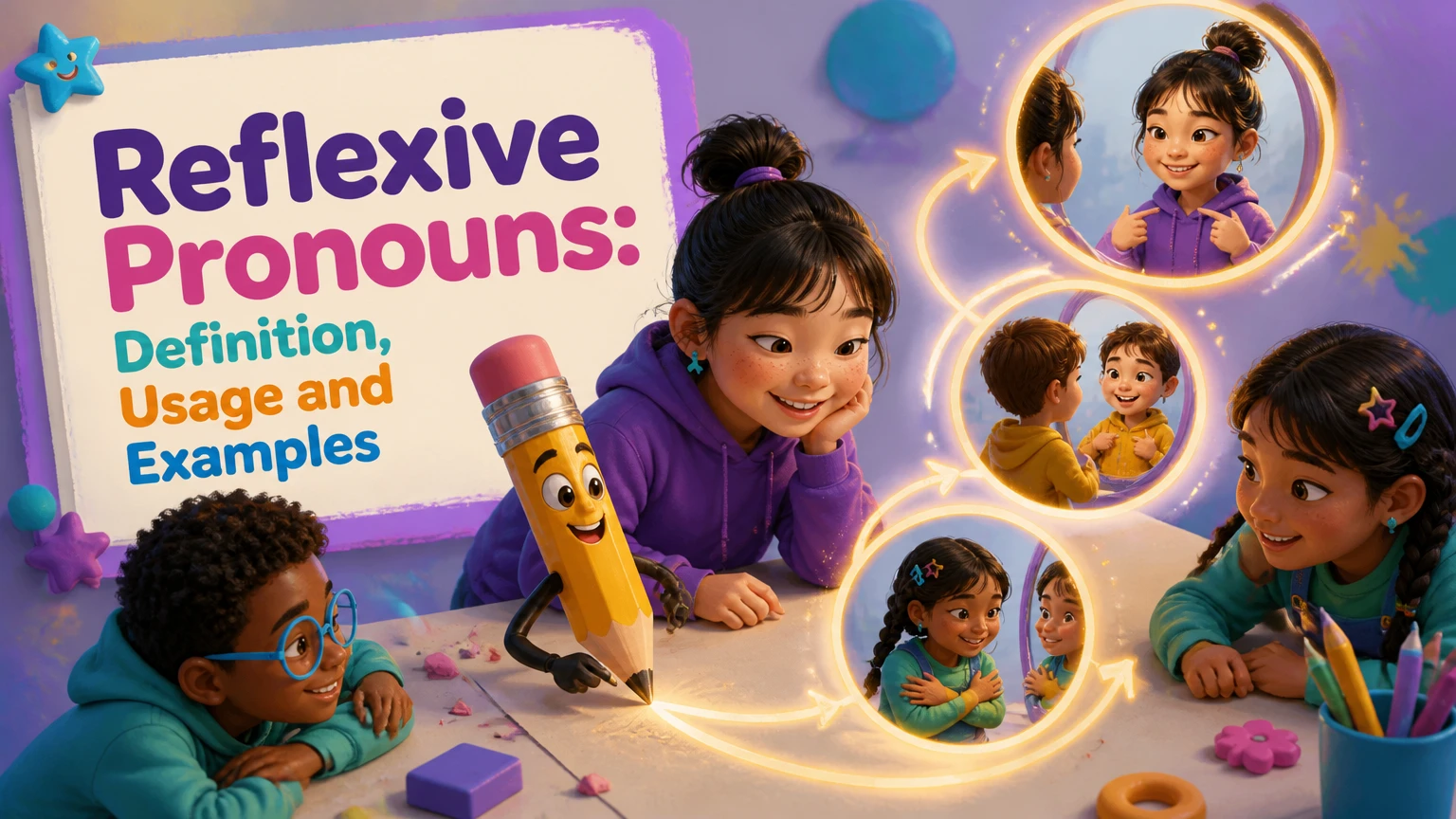
A reflexive pronoun refers back to the subject of a clause when the subject and object represent the same person, animal, or thing. English reflexive pronouns include myself, yourself, himself, herself, itself, oneself, ourselves, yourselves, themselves, and, in some uses, themself. They function as objects or add emphasis.
Key Facts
A reflexive pronoun normally matches its antecedent in person and number.
Use herself in “Maria blamed herself” because Maria performs and receives the action.
Use an ordinary object pronoun in “Maria blamed him” because Maria and him refer to different people.
Reflexive and intensive pronouns have the same forms but different jobs.
Remove an intensive pronoun and the sentence remains grammatically complete.
By myself usually means alone or without assistance, while myself alone may mean personally.
What Is a Reflexive Pronoun?
A reflexive pronoun is an object pronoun that points back to the subject performing the action. In The child dressed himself, the child is the subject, dressed is the verb, and himself is the object referring to the child.
The defining condition is grammatical identity inside the clause. The subject and the reflexive pronoun must refer to the same entity, not merely to people mentioned nearby. In Nina told Alex about herself, herself refers to Nina, the subject of the clause containing the verb told. In Nina told Alex about him, him refers to a male person other than Nina.
English marks these pronouns with -self for singular forms and -selves for plural forms. The ending does not independently determine whether a word is reflexive, because the same forms can be intensive: I myself checked the figures uses myself for emphasis rather than as a necessary object.
What Are the English Reflexive Pronouns?
The standard English reflexive pronouns correspond to personal pronouns by person and number. Gender appears in the third-person singular forms himself and herself, while itself generally refers to a nonhuman entity or an animal when gender is not specified.
| Subject reference | Reflexive form | Person and number | Example |
|---|---|---|---|
| I | myself | First-person singular | I surprised myself. |
| you | yourself | Second-person singular | You prepared yourself. |
| he | himself | Third-person singular | Daniel shaved himself. |
| she | herself | Third-person singular | Ava introduced herself. |
| it | itself | Third-person singular | The door closed itself. |
| one | oneself | Third-person singular | One should ask oneself why. |
| we | ourselves | First-person plural | We organized ourselves. |
| you | yourselves | Second-person plural | Please help yourselves. |
| they | themselves | Third-person plural | The players congratulated themselves. |
| singular they | themself or themselves | Third-person singular | Jordan reminded themself to call. |
Themself is increasingly used with singular they, especially when the antecedent is clearly singular and nonbinary. Themselves remains common, widely accepted, and often preferred by style guides or speakers who use singular they without distinguishing the form.
When Do You Use a Reflexive Pronoun?
Use a reflexive pronoun when the subject is also the direct object, indirect object, or object of a preposition. The pronoun must refer back to the appropriate subject within its clause.
Direct object
A reflexive pronoun is a direct object when the subject acts directly on the same entity represented by the pronoun.
| Sentence | Subject | Verb | Reflexive object |
|---|---|---|---|
| I cut myself. | I | cut | myself |
| Priya taught herself coding. | Priya | taught | herself |
| The dog scratched itself. | The dog | scratched | itself |
| We introduced ourselves. | We | introduced | ourselves |
| The twins blamed themselves. | The twins | blamed | themselves |
Compare Leon criticized himself with Leon criticized Marco. The first sentence contains a reflexive object because Leon and himself have the same reference. The second uses Marco, a separate noun phrase.
Reflexive pronouns often appear with grooming, injury, preparation, introduction, and mental-action verbs, but the verb category alone does not decide the form. The subject-object relationship decides it.
Indirect object
A reflexive pronoun is an indirect object when the subject performs an action for or toward itself, while another noun functions as the direct object.
| Sentence | Subject | Indirect object | Direct object |
|---|---|---|---|
| She bought herself a coat. | she | herself | a coat |
| I made myself some tea. | I | myself | some tea |
| They awarded themselves the prize. | they | themselves | the prize |
| We gave ourselves extra time. | we | ourselves | extra time |
In She bought herself a coat, herself identifies the beneficiary and coat identifies what she bought. The sentence does not mean that she bought a person named herself; it means she bought a coat for her own use.
A reflexive pronoun is not required merely because the subject benefits from an action. She bought a coat for herself uses herself as the object of the preposition for, while She bought her a coat normally refers to another female person.
Object of a preposition
Use a reflexive pronoun after a preposition when the prepositional phrase refers back to the subject.
Examples include:
- The committee was proud of itself.
- Omar kept the information to himself.
- I saved a seat for myself.
- The children divided the work among themselves.
- She spoke about herself during the interview.
- We carried the equipment with ourselves only in unusual, highly specific contexts.
The last example illustrates an important usage limit. English commonly prefers with us rather than with ourselves when the meaning is simply accompaniment. Reflexive forms are not automatic replacements for object pronouns after every preposition.
How Do You Choose the Correct Reflexive Form?
Choose the reflexive form by identifying the subject, checking its person and number, and confirming that the object refers to the same entity. The process takes three grammatical checks.
- Find the subject. Ask who performs the verb.
- Find the object or prepositional complement. Ask who receives the action or follows the preposition.
- Test identity. If both references are the same, use a reflexive pronoun.
| Subject | Different reference | Same reference |
|---|---|---|
| I sent the file to | me, nonstandard in this structure | myself |
| Elena blamed | her, another woman | herself |
| The boys entertained | them, other people | themselves |
| We prepared | us, unusual as an object | ourselves |
| The company described | it, another organization | itself |
The substitution test provides a reliable editing method. Replace the pronoun with a noun. If Sarah sent the package to Sarah is the intended meaning, write Sarah sent the package to herself. If the package went to another woman, write Sarah sent the package to her.
Reflexive Pronouns and Intensive Pronouns: What Is the Difference?
Reflexive pronouns are grammatically required objects in their clauses, while intensive pronouns emphasize an existing subject or noun phrase. Both categories use the same forms, so the role depends on whether removing the pronoun damages the sentence.
| Feature | Reflexive use | Intensive use |
|---|---|---|
| Grammatical role | Object or prepositional complement | Emphatic modifier |
| Removal | Creates an incomplete or changed structure | Leaves the core sentence grammatical |
| Example | He injured himself. | He himself repaired it. |
| Main meaning | Action returns to subject | Subject personally did something |
| Typical position | After verb or preposition | After subject or noun phrase |
In The director herself approved the budget, herself is intensive. Removing it leaves The director approved the budget. In The director approved herself, herself is reflexive because the director is the object of approved.
The “drop test” works in most ordinary sentences. I myself wrote the report remains complete as I wrote the report, but I wrote myself does not normally preserve the intended meaning if the sentence requires a recipient or object.
Should You Use Myself, Me, or I?
Use myself only when it refers back to I as the same subject or when it deliberately adds emphasis. Use I as a subject and me as an object, including after a preposition.
| Function | Correct form | Example |
|---|---|---|
| Subject | I | James and I reviewed the contract. |
| Direct object | me | The editor contacted James and me. |
| Object of preposition | me | Send the invoice to James or me. |
| Reflexive object | myself | I reminded myself to respond. |
| Intensive modifier | myself | I myself checked every figure. |
The common error Please contact John or myself results from treating myself as more formal than me. The correct sentence is Please contact John or me, because me follows the preposition or as an ordinary object and does not refer back to the subject.
Coordination can hide the mistake. Remove the other noun: Please contact myself sounds incorrect, while Please contact me works. For subjects, remove the other noun from John and myself completed the audit. The correct result is I completed the audit, so the full sentence is John and I completed the audit.
Does By Myself Mean the Same as Myself?
By myself usually means alone, without another person, or without assistance. Bare myself often means personally, in my own person, or as an emphatic reference, so the preposition can change the intended meaning.
| Expression | Usual meaning | Example |
|---|---|---|
| by myself | Alone or without help | I completed the form by myself. |
| for myself | For my own benefit | I kept one copy for myself. |
| to myself | Privately or for my own possession | I repeated the instructions to myself. |
| myself | Personally or emphatically | I delivered the documents myself. |
| myself as object | Action returns to subject | I introduced myself. |
I traveled to Canada myself usually emphasizes that I personally traveled rather than sending someone else. I traveled to Canada by myself usually means I traveled alone. The two meanings can overlap in context, but they are not interchangeable in careful writing.
When Is a Reflexive Pronoun Incorrect?
A reflexive pronoun is incorrect when the object refers to someone or something other than the subject, when no object is needed, or when an ordinary object pronoun would express the meaning clearly.
Incorrect replacement for an object pronoun
- Incorrect: The manager spoke to myself.
- Correct: The manager spoke to me.
- Reason: Myself does not refer back to the subject manager.
Incorrect replacement for a subject pronoun
- Incorrect: My assistant and myself approved the schedule.
- Correct: My assistant and I approved the schedule.
- Reason: The coordinated phrase is the subject.
Unnecessary reflexive after an intransitive verb
- Less natural: I woke myself at seven.
- Normal: I woke at seven.
- Specific meaning: I woke myself at seven by setting three alarms.
Wake, wash, shave, dress, and change can appear without reflexive pronouns when the action’s target is understood as the subject’s body. Add the reflexive form when contrast, deliberate self-action, or a distinct object requires it: The nurse washed the patient, but The patient washed herself is also grammatical when the patient performs the action.
Nonstandard forms
Standard edited English uses himself, themselves, and themselves with plural they. Forms such as hisself, theirself, and theirselves occur in some regional or nonstandard varieties, but they are unsuitable for formal academic, workplace, and examination writing.
How Do Reflexive Pronouns Work in Compound Sentences?
Reflexive reference is determined inside the clause, especially when a sentence has multiple subjects, verbs, or embedded clauses. A reflexive pronoun generally cannot refer freely to any earlier noun in the sentence.
| Sentence | Correct interpretation | Why |
|---|---|---|
| Maya told Luis about herself. | Maya told Luis about Maya. | Herself refers to the local subject Maya. |
| Maya told Luis about himself. | Maya told Luis about Luis. | Himself refers to Luis in the relevant relationship. |
| Luis said that Maya blamed herself. | Maya blamed Maya. | Herself refers to the embedded subject Maya. |
| Luis said that Maya blamed him. | Maya blamed Luis. | Him refers to the other person. |
| The teacher asked the students to introduce themselves. | Students introduced students. | The understood subject of the infinitive is students. |
The final example matters because the reflexive pronoun can be controlled by an understood subject. In The teacher asked the students to introduce themselves, the students are understood to perform introduce, so themselves is appropriate.
Reflexive Pronouns or Each Other?
Use a reflexive pronoun when each participant acts on the same participant group as a whole, and use each other or one another for reciprocal action between separate participants. The choice changes the relationship from self-directed to mutually directed.
| Meaning | Reflexive sentence | Reciprocal sentence |
|---|---|---|
| Self-directed | The teammates motivated themselves. | The teammates motivated each other. |
| Self-directed | The sisters blamed themselves. | The sisters blamed one another. |
| Self-directed | The two companies promoted themselves. | The two companies promoted each other. |
| Self-directed | The committee divided itself into groups. | The committee members divided tasks among themselves. |
The players congratulated themselves means the players congratulated their own group or each individual congratulated himself or herself. The players congratulated each other means the players exchanged congratulations. Reciprocal expressions therefore cannot replace reflexive pronouns without changing the event.
How Does Singular They Affect Reflexive Pronouns?
Singular they generally takes themselves or themself, depending on the speaker’s preference, style guide, and whether the reference is singular or generic. Singular they is useful when a person’s gender is unknown, irrelevant, or intentionally not specified.
Examples include:
- If anyone calls, tell them I will return the message.
- Each applicant should introduce themselves briefly.
- Alex reminded themself to submit the form.
- A customer may protect themselves by keeping the receipt.
Many writers use themselves after each applicant because the form is familiar and avoids awkward gender assumptions. Themself makes singular reference more visible: Alex reminded themself. Choose one pattern consistently in formal documents and follow the relevant publication’s style guidance.
Why Do English Learners Overuse Reflexive Pronouns?
English learners may overuse reflexive pronouns because languages such as Spanish, French, and German mark reflexive verbs more often than English does. English frequently expresses ordinary body actions without a reflexive object when the subject is understood as the target.
| Intended meaning | Natural English | Possible learner error |
|---|---|---|
| Wake up | I woke up early. | I woke myself up early. |
| Wash | She washed quickly. | She washed herself quickly. |
| Get dressed | He got dressed. | He dressed himself. |
| Sit down | We sat down. | We sat ourselves down. |
| Introduce yourself | Please introduce yourself. | Correct reflexive use |
The longer forms are not always impossible. I woke myself up means I caused myself to wake, perhaps by using an alarm. The parent dressed the child himself means the parent performed the dressing personally. Context determines whether the reflexive pronoun adds necessary meaning or unnecessary repetition.
What Are the Main Editing Tests?
Four tests identify most reflexive-pronoun errors: the identity test, the removal test, the subject test, and the preposition test.
- Identity test: Does the pronoun refer to the clause’s subject?
- Removal test: If removed, does the sentence lose a required object or only emphasis?
- Subject test: Is the pronoun performing the verb? If so, use I, he, she, we, or another subject form.
- Preposition test: Does a preposition require an ordinary object such as me, or does the phrase intentionally point back to the subject?
A practical revision sequence is to search a document for myself, yourself, and themselves. For every occurrence, write the subject above the verb and draw a reference link to the pronoun. If the links do not identify the same entity, replace the reflexive form with an ordinary object pronoun or noun.
Reflexive Pronoun Examples by Sentence Pattern
The following examples cover the most common structures and their grammatical roles.
| Pattern | Example | Role |
|---|---|---|
| Subject + verb + reflexive | I hurt myself. | Direct object |
| Subject + verb + reflexive + noun | She bought herself lunch. | Indirect object |
| Subject + verb + preposition + reflexive | They relied on themselves. | Prepositional object |
| Subject + intensive pronoun + verb | He himself answered. | Intensive modifier |
| Noun + intensive pronoun + verb | The machine itself stopped. | Intensive modifier |
| Infinitive + reflexive | We taught ourselves to code. | Direct object |
| Imperative + reflexive | Please prepare yourself. | Direct object |
| Reflexive with by | She worked by herself. | Alone or unaided |
FAQ
Can a reflexive pronoun be the subject of a sentence?
A reflexive pronoun normally cannot replace a subject pronoun in standard English. Write I completed the task, not Myself completed the task. A reflexive form may appear near the beginning for emphasis in marked constructions, as in Myself, I would choose the earlier date, but that pattern is conversational and does not make myself a standard subject.
Is “between you and I” correct?
No. After the preposition between, use object pronouns: between you and me. The phrase does not require a reflexive pronoun because me does not refer back to the subject. Between yourself and me is possible only when the speaker intentionally uses yourself as a reflexive or emphatic form referring back to you.
Can animals use reflexive pronouns?
Animals can take reflexive pronouns when the sentence treats the animal as the subject and object of the same action. Write The cat cleaned itself when the animal’s sex is unknown or irrelevant. Use himself or herself when a named animal’s sex is known and the writer chooses a gendered reference.
Are reflexive pronouns always objects?
In standard grammatical analysis, reflexive pronouns are normally objects of verbs or prepositions, while intensive forms modify nouns or pronouns. Some constructions blur the distinction in informal speech, but the object-versus-emphasis test remains reliable for edited English.
Should I write “John and myself” or “John and me”?
The correct form depends on the phrase’s grammatical role. Write John and I attended when the pair is the subject, and The editor contacted John and me when the pair is the object. Write John and myself only when myself refers back to a subject or intentionally adds emphasis.
What is the fastest way to check a reflexive pronoun?
Identify the subject and ask whether the pronoun refers to that same entity. Then remove the pronoun: if the sentence loses a required object, keep the reflexive form; if the sentence remains complete and only loses emphasis, the form is intensive. Otherwise, choose me, him, her, us, or them.
The Bottom Line
Reflexive pronouns definition usage and examples become easier when every sentence is reduced to one question: does the object refer to the subject performing the action? Use myself, yourself, himself, herself, itself, oneself, ourselves, yourselves, themselves, or themself for that self-directed relationship; use an ordinary object pronoun when the references differ, and use the same forms intensively only when they add optional emphasis.