
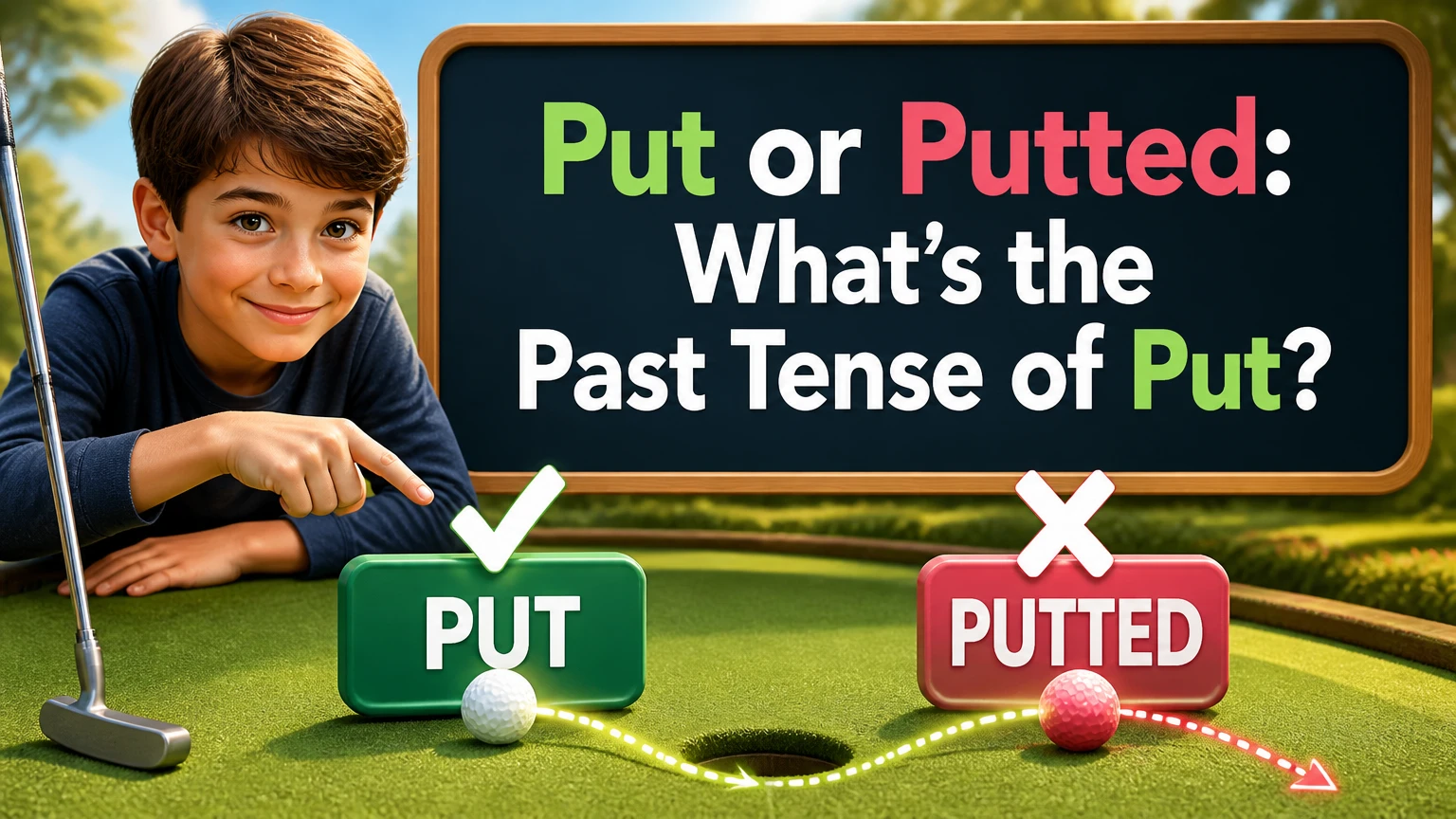
The past tense of put is put, not putted, when the verb means to place, move, or position something. Putted is the past tense and past participle of putt, the golf verb meaning to strike a ball gently with a putter. The two forms belong to different verbs and have different pronunciations.
Key Facts at a Glance
- Put has the same base form, past-tense form, and past-participle form.
- Putted is correct for the golf verb putt, as in “Maya putted the ball toward the hole.”
- “I put the book on the shelf yesterday” is grammatically correct.
- Putting is the present participle of put and is spelled with two t’s.
- Put usually sounds like “foot,” while putt usually sounds like “cut.”
- A time expression such as yesterday, last week, or already can clarify which time frame a sentence describes.
What Is the Past Tense of Put?
The past tense of put is put. English does not add -ed to this verb, so the correct sentence is “She put the documents in the drawer,” not “She putted the documents in the drawer.” The spelling remains unchanged whether put describes a present habit or a completed past action.
| Grammatical role | Correct form | Example |
|---|---|---|
| Base form | put | “Please put the cup here.” |
| Third-person present | puts | “He puts milk in his coffee.” |
| Simple past | put | “He put the cup beside the sink.” |
| Past participle | put | “He has put the cup away.” |
| Present participle | putting | “He is putting the cup away.” |
The sentence context identifies the tense. “I put my keys by the door every evening” describes a routine, while “I put my keys by the door at 8:00” describes a completed event. The verb itself supplies no spelling difference.
The same pattern appears in several common English verbs. Cut, hit, hurt, let, set, and shut also retain the same form in the simple past, although their participles and historical development vary across the wider verb system.
Why Does Put Stay the Same?
Put stays the same because it is an irregular verb with zero past-tense inflection. Regular verbs normally form the past with -ed, as in place, placed, but English preserves put without a suffix in both the preterite and past participle.
“Zero inflection” means that the grammatical distinction is expressed without an added ending. The form is not missing a letter, and put is not an informal shortening of putted. Standard English recognizes put as the complete past form.
Is Put an Irregular Verb?
Yes. Put is an irregular verb because it does not follow the regular base + -ed pattern. Its three principal forms are traditionally listed as:
put, put, put
The third item is the past participle, which appears after auxiliary verbs such as has, have, and had. The identical spelling does not make the forms interchangeable in every sentence, because auxiliary verbs and sentence structure determine their grammatical function.
| Construction | Formula | Example |
|---|---|---|
| Simple present | subject + put/puts | “They put labels on boxes.” |
| Simple past | subject + put | “They put labels on boxes yesterday.” |
| Present perfect | has/have + put | “They have put labels on every box.” |
| Past perfect | had + put | “They had put labels on the boxes before noon.” |
| Passive voice | be + put | “The labels were put on the boxes.” |
| Present continuous | am/is/are + putting | “They are putting labels on boxes.” |
A useful editing rule is to inspect the word before put. Has put, have put, and had put require the past participle, while a standalone completed action uses simple past put.
How Do You Conjugate Put?
The verb put uses put for the simple past and past participle, but uses puts in the third-person singular present and putting in continuous forms. Learners should memorize the small pattern rather than apply the regular -ed rule.
| Person or tense | Form | Example |
|---|---|---|
| I, you, we, they present | put | “We put tools away after work.” |
| He, she, it present | puts | “She puts tools away after work.” |
| All subjects, simple past | put | “She put the tools away.” |
| All subjects, perfect | put | “She has put the tools away.” |
| All subjects, continuous | putting | “She is putting the tools away.” |
| Infinitive | to put | “She wants to put the tools away.” |
| Negative past | did not put | “She did not put the tools away.” |
| Past question | did … put? | “Did she put the tools away?” |
The auxiliary did carries the past-tense marking in questions and negatives. Therefore, standard English says “Did you put it there?” and “I did not put it there,” not “Did you putted it there?” or “I did not putted it there.”
Why Is Putting Spelled With Two T’s?
Putting has two t’s because the suffix -ing attaches to the short verb put, producing putting. The doubled consonant prevents the spelling from being interpreted as put-ing and follows the conventional spelling pattern used for short stressed verbs ending in a consonant.
The doubling occurs only in the participle and gerund form. The simple past remains put, so these sentences are both correct:
- “He put the package outside.”
- “He is putting the package outside.”
The form putting can function as a present participle in a continuous verb phrase or as a gerund acting as a noun, as in “Putting labels on containers prevents mistakes.”
When Is Putted Correct?
Putted is correct when the verb is putt, meaning to hit a golf ball with a putter. Examples include “The golfer putted from six feet” and “Jordan putted the ball toward the center of the cup.” The form is regular because putt + -ed produces putted.
Golf terminology creates the confusion because putt resembles put, but the verbs describe different actions. A golfer can putt a ball and then put the putter in a bag. Only the first action becomes putted in the past.
| Verb | Meaning | Present example | Past example |
|---|---|---|---|
| put | place or position | “I put the keys down.” | “I put the keys down.” |
| putt | strike a golf ball | “She putts carefully.” | “She putted carefully.” |
| place | position formally | “They place the file here.” | “They placed the file here.” |
| lay | place something down | “They lay the tile.” | “They laid the tile.” |
| set | place or arrange | “He sets the timer.” | “He set the timer.” |
The pronunciation confirms the distinction for listeners. In many varieties of English, put has the vowel sound in foot, represented approximately as /pʊt/, while putt has the vowel sound in cut, approximately /pʌt/. Accent differences can alter the exact sound, but the meanings remain separate.
How Do Put and Putt Differ?
Put describes general placement or positioning, while putt describes a specific golf stroke. Their past forms are therefore put and putted, respectively, and substituting one for the other changes the verb rather than merely changing its tense.
| Attribute | Put | Putt |
|---|---|---|
| Main meaning | Move or position something | Strike a golf ball gently |
| Past form | put | putted |
| Past participle | put | putted |
| Present participle | putting | putting |
| Typical object | book, key, bag, idea | golf ball |
| Pronunciation guide | /pʊt/, like foot | /pʌt/, like cut |
| Typical setting | Home, office, school | Golf course or sports report |
A sentence such as “The golfer putted his club beside the bag” is usually incorrect if the writer means the golfer placed the club beside the bag. The accurate version is “The golfer put his club beside the bag.” Conversely, “The golfer put the ball toward the hole” may describe placement rather than a golf stroke, so context determines the intended action.
What Does Put Mean in Different Contexts?
Put has several meanings beyond physical placement, but its simple past remains put in each standard use. The verb can describe positioning, expressing an idea, assigning responsibility, applying pressure, or moving something into a condition.
| Meaning of put | Past-tense example | More precise alternative |
|---|---|---|
| Place an object | “She put the vase on the table.” | placed |
| Move into a condition | “They put the machine on standby.” | switched |
| Express an idea | “He put the concern clearly.” | stated |
| Assign responsibility | “The report put blame on the supplier.” | assigned |
| Apply pressure | “The deadline put pressure on staff.” | created |
| Store something | “We put the equipment away.” | stored |
| Submit something | “She put the proposal forward.” | submitted |
Phrasal verbs preserve put in the past: put away, put off, put on, put out, put down, put up, and put forward. For example, “The team put off the meeting,” not “The team putted off the meeting.” The particle changes the meaning, but not the irregular past form.
When Should You Use Placed Instead of Put?
Use placed instead of put when formal precision or a clearer timeline matters. In ordinary conversation, put is natural and fully correct, while placed, positioned, stored, or submitted can specify the nature of the action in technical, academic, or business writing.
Compare these sentences:
- “The technician put the sensor on the pipe.”
- “The technician placed the sensor on the pipe.”
- “The technician positioned the sensor 4 centimeters below the valve.”
The first sentence is correct and concise. The second sounds more formal. The third records a measurable location that put does not communicate by itself.
Replacing every occurrence of put can make prose unnatural. The verb is not inferior or incorrect; it is simply broad. Choose a narrower alternative when the reader needs information about location, orientation, storage, submission, or sequence.
How Is Put Different From Lay?
Put takes a direct object and means to place something, while lay also takes a direct object but has the irregular past form laid. The main confusion is between lay and lie, not between put and putted, although all three verbs describe position or movement.
| Verb | Present meaning | Simple past | Example |
|---|---|---|---|
| put | place something | put | “I put the book down.” |
| lay | place something down | laid | “I laid the book down.” |
| lie | recline or occupy a position | lay | “The book lay on the desk.” |
| set | place or adjust something | set | “I set the book on the desk.” |
A direct object follows put: “She put the folder on the desk.” The same structure can use lay: “She laid the folder on the desk.” Lie does not normally take that object: “The folder lay on the desk.”
The practical editing test is simple. If someone actively places an object, put or lay may work. If the object or person is already resting somewhere, lie may be the intended verb.
What Are the Most Common Errors?
The most common error is adding regular -ed to put, but tense auxiliaries and confusion with lay create additional mistakes. Writers can correct nearly all cases by identifying the verb’s meaning, checking for an auxiliary, and locating any direct object.
- Using putted for ordinary placement
Incorrect: “He putted the groceries in the car.”
Correct: “He put the groceries in the car.”
Use putted only when someone performs a golf putt. - Using putted after did
Incorrect: “Did you putted the documents away?”
Correct: “Did you put the documents away?”
The auxiliary did already marks the past tense. - Using putted after has or had
Incorrect: “She had putted the keys on the desk.”
Correct: “She had put the keys on the desk.”
The past participle of ordinary put is also put. - Confusing put with lay
“I put the blanket on the bed” is correct. “I laid the blanket on the bed” is also possible, but laid belongs to lay, not to put. - Assuming identical spelling means identical tense
“I put the files away every Friday” can describe a routine. “I put the files away yesterday” describes a completed action. Time expressions and context supply the difference. - Misreading a golf sentence
“The player putted from twelve feet” refers to a stroke. “The player put his putter in the bag” refers to placement. The nearby noun putter does not automatically make putted correct.
Can Put Be Ambiguous in a Sentence?
Put can be temporally ambiguous because the present and past forms have identical spelling and pronunciation. Readers resolve the meaning from adverbs, surrounding verbs, and the broader situation, but careful writers can add a time marker when both interpretations are plausible.
| Sentence | Likely interpretation | Clearer revision |
|---|---|---|
| “I put the report in the folder.” | Present habit or past event | “I put the report there yesterday.” |
| “She put the money aside.” | Completed action or routine | “She puts money aside monthly.” |
| “They put the chairs outside.” | Past or repeated action | “They put the chairs outside before lunch.” |
| “He put the order through.” | Completed business action | “He has put the order through.” |
The ambiguity is grammatical, not an error. English has other same-form verbs, including cut, hit, set, and cost, so native speakers routinely use context to interpret them.
A practitioner’s rule is to add a time expression when a sentence appears in isolation, a timeline, an incident report, or a test answer. Words such as yesterday, already, every morning, currently, and before the meeting make the intended tense immediately recoverable.
Which Alternatives Can Replace Put?
Placed is the closest formal alternative to put, but the best replacement depends on the action being described. Use positioned for deliberate alignment, stored for keeping an item, submitted for sending work for consideration, and laid for physically setting an object down.
| Intended meaning | Recommended verb | Example |
|---|---|---|
| General movement to a location | put | “Put the parcel by the door.” |
| Formal physical placement | placed | “The nurse placed the sensor on the wrist.” |
| Precise alignment | positioned | “The operator positioned the camera 2 meters away.” |
| Keeping for later use | stored | “The archive stored the files securely.” |
| Sending for review | submitted | “The researcher submitted the paper.” |
| Applying a surface item | applied | “The worker applied the label.” |
| Setting something horizontally | laid | “The builder laid the boards flat.” |
A more specific verb can improve a report, but it cannot repair an inaccurate meaning. Placed does not mean submitted, and laid does not mean stored in every context. Select the replacement from the action, not from a desire to avoid the common word put.
What Should English Learners Remember?
English learners should memorize put as put, put, put, and reserve putted for golf. The fastest reliable routine is to identify the object and meaning first, then check whether the sentence is ordinary placement, a golf stroke, or a different action that needs another verb.
Use this four-step check:
- Identify the verb meaning. Does the sentence mean place, position, or move something?
- If yes, use put for the past. “She put the keys on the counter.”
- If the context is golf, ask whether a stroke occurred. If so, use putted: “She putted from eight feet.”
- Check the auxiliary. After did, use put; after has, have, or had, use put as the participle.
One useful memory sentence is: “I put a ball with a putter, but I put everything else somewhere.” The sentence is deliberately repetitive, which makes the contrast easier to recall.
Frequently Asked Questions
Is “I putted my shoes on” correct?
No. The standard sentence is “I put my shoes on.” Here, put on is a phrasal verb meaning to dress or place clothing on the body, and its past form remains put on. Putted is appropriate only when putt describes a golf stroke.
Is “has put” the correct past participle?
Yes. The past participle of ordinary put is put, so the correct forms are “has put,” “have put,” and “had put.” For example, “The assistant has put the signed contract in the cabinet.” The word put follows the auxiliary and does not change to putted.
Can “putted” be used outside golf?
In standard modern usage, putted normally refers to the verb putt, especially in golf. Historical, dialectal, or specialized uses may appear in older texts, but ordinary writers should use put for placement and placed when a formal alternative is needed.
How do you pronounce put and putt?
Put is commonly pronounced /pʊt/, with the vowel sound heard in foot. Putt is commonly pronounced /pʌt/, with the vowel sound heard in cut. Regional accents can vary, but the spelling and meaning distinction remains important in writing.
Is “put” both present and past tense?
Yes. Put is the base form and the simple past form, although the third-person singular present is puts. “They put books on the shelf every day” uses present put, while “They put books on the shelf yesterday” uses past put.
Is “putted” ever the past tense of put?
No, not in standard ordinary English. Putted is the past tense of putt, a separate verb associated mainly with golf. If the sentence describes placing, positioning, storing, wearing, or submitting something, use the appropriate form of put or a more precise alternative.
The Bottom Line
The answer to put or putted whats the past tense of put is put. Write “I put the keys on the table yesterday,” “She has put the files away,” and “Did you put the package outside?” Use putted only when the verb is putt, as in “The golfer putted from ten feet.” Recognizing the difference between the two verbs resolves the spelling, pronunciation, and tense problem.


