
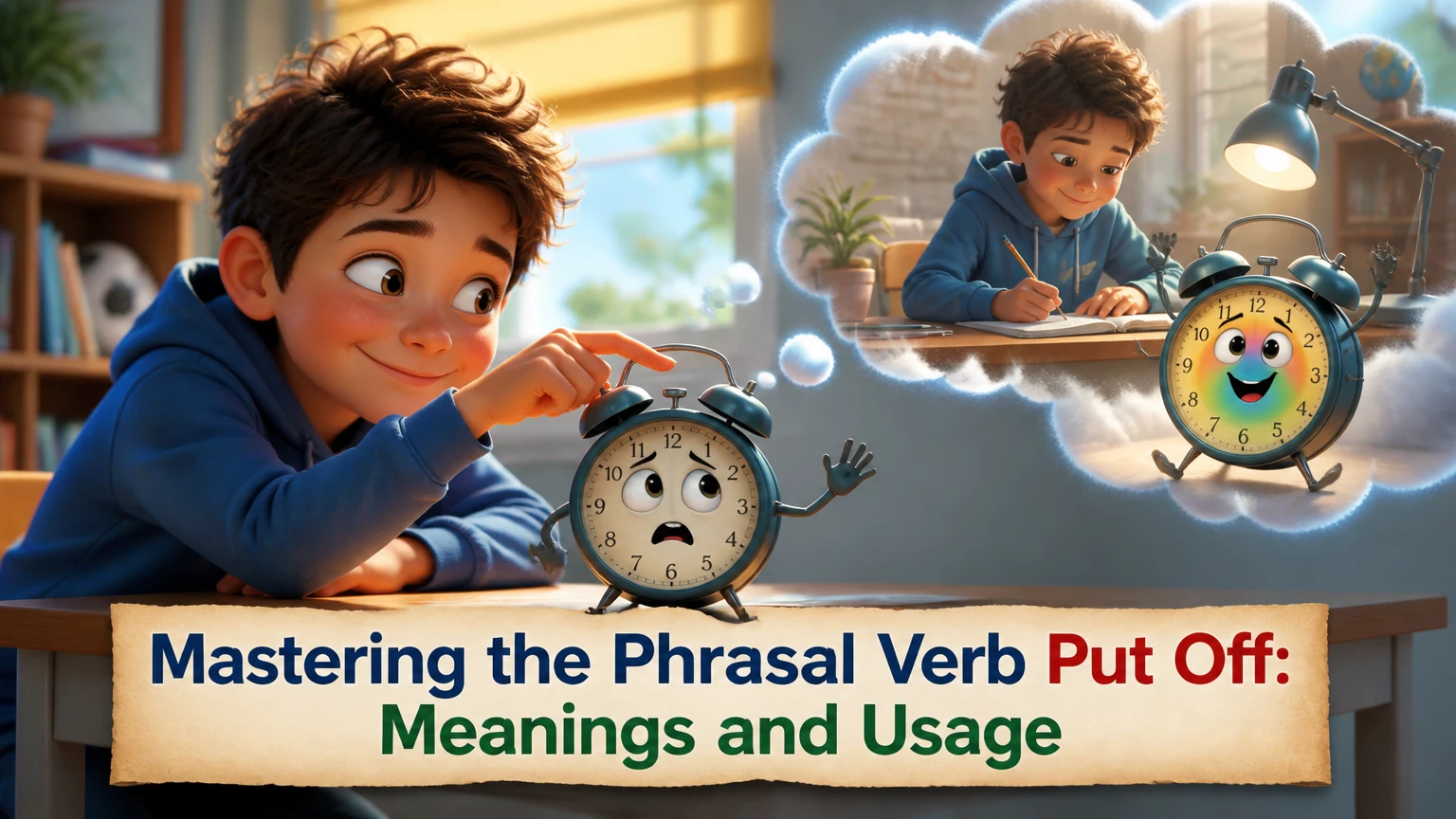
The phrasal verb “put off” is one of the most versatile and frequently used expressions in the English language, serving various functions in both casual conversation and formal writing. It primarily functions as a multi-word verb that changes its meaning based on the context, such as postponing a meeting, distracting someone from their work, making someone feel distaste, or delaying an inevitable task. Understanding these nuances is essential for any English learner who wishes to sound more natural and precise in their communication. By mastering the different shades of “put off,” you can effectively describe shifts in schedules, personal reactions to unpleasant stimuli, or the psychological tendency to procrastinate on important duties.
This comprehensive guide is designed for intermediate to advanced learners who want to dive deep into the mechanics of phrasal verbs. We will explore the structural rules, the transitive and separable nature of the verb, and provide extensive examples to illustrate how “put off” operates in real-world scenarios. Whether you are preparing for an English proficiency exam or simply looking to expand your vocabulary, this article provides the academic rigor and practical exercises needed to achieve mastery. Through detailed tables and structured breakdowns, we will demystify this complex phrasal verb and give you the confidence to use it elegantly in your daily life.
Table of Contents
- Comprehensive Definition and Classification
- Structural Breakdown and Conjugation
- Primary Meanings and Categories
- Transitivity and Separability Rules
- Synonyms and Antonyms Comparison
- Extensive Example Tables
- Common Mistakes and How to Avoid Them
- Advanced Nuances and Idiomatic Usage
- Practice Exercises and Assessment
- Frequently Asked Questions (FAQ)
- Conclusion and Final Tips
Comprehensive Definition and Classification
A phrasal verb is a combination of a standard verb and a particle (a preposition or an adverb) that creates a meaning different from the original verb. In the case of put off, we combine the verb “put” with the particle “off.” While “put” usually implies placing something somewhere, the addition of “off” transforms the meaning into something entirely different, ranging from temporal delays to emotional repulsion.
Linguistically, “put off” is classified as a transitive phrasal verb, meaning it requires a direct object to complete its thought. You cannot simply say “I put off”; you must put off something or someone. Furthermore, it is a separable phrasal verb, which means the object can often be placed between the verb and the particle, such as in “put the meeting off” versus “put off the meeting.”
The function of “put off” varies significantly across four main semantic fields. First, it is the most common way to express the act of postponing or rescheduling an event. Second, it describes deterrence or causing someone to lose interest or feel dislike. Third, it can refer to distraction, where someone is interrupted while trying to concentrate. Finally, in niche contexts, it can refer to the act of leaving a place (like a ship leaving a port), though this is less common in modern colloquial English.
Structural Breakdown and Conjugation
To use “put off” correctly, one must understand the conjugation of the base verb “put.” Fortunately for learners, “put” is an irregular verb that remains the same in its base form, past simple, and past participle. This makes the conjugation of the phrasal verb relatively straightforward, though the surrounding sentence structure must still adhere to standard tense rules.
The following table illustrates the conjugation of “put off” across various tenses. Notice how the particle “off” never changes, regardless of the tense or person performing the action.
| Tense | Subject | Form | Example Sentence |
|---|---|---|---|
| Present Simple | I / You / We / They | put off | I often put off my laundry until Sunday. |
| Present Simple | He / She / It | puts off | She puts off her homework every single night. |
| Past Simple | All Subjects | put off | We put off the wedding due to the storm. |
| Present Continuous | All Subjects | am/is/are putting off | They are putting off the decision until next week. |
| Past Continuous | All Subjects | was/were putting off | I was putting off the call when he walked in. |
| Present Perfect | All Subjects | have/has put off | The manager has put off the evaluation twice. |
| Future (Will) | All Subjects | will put off | The council will put off the vote until January. |
| Gerund | N/A | putting off | Putting off your taxes is a dangerous habit. |
When using the present continuous or gerund form, remember to double the ‘t’ in “putting.” This is a common spelling rule for short verbs ending in a consonant-vowel-consonant pattern. Failure to do so is a frequent spelling error among English students.
Primary Meanings and Categories
The phrasal verb “put off” is polysemous, meaning it has multiple meanings. To master it, we must categorize these meanings into logical groups. This helps learners choose the right context and understand the speaker’s intent more clearly.
1. To Postpone or Delay
This is the most frequent usage. It implies moving an event, task, or appointment to a later time or date. It is often used when circumstances prevent something from happening as originally planned. For example, “We had to put off the picnic because of the rain.” In this context, it is synonymous with “delay” or “reschedule.”
2. To Discourage or Repel
This usage refers to making someone lose interest in something or making them feel a sense of dislike or distaste. It often describes a reaction to an unpleasant smell, a rude personality, or a difficult challenge. For instance, “The high price of the car put me off buying it.” Here, the price acted as a deterrent.
3. To Distract
In this sense, “put off” means to disturb someone’s concentration or to prevent them from focusing on a task. It is frequently used in sports or academic settings. For example, “Please stop whistling; you’re putting me off my game.” It suggests an external factor is breaking the subject’s focus.
4. To Evade or Avoid Someone
This variation involves giving someone excuses to avoid meeting them or dealing with their requests. If a debt collector calls and you tell them you’ll pay next month just to get them off the phone, you are putting them off. It carries a slight connotation of being evasive or non-committal.
Transitivity and Separability Rules
One of the most challenging aspects of phrasal verbs is determining if they can be split. “Put off” is separable, but there are strict rules regarding pronouns. If the object is a noun, you have two choices. You can say “Put off the meeting” or “Put the meeting off.” Both are grammatically correct and widely used.
However, if the object is a pronoun (him, her, it, them, us, me), the pronoun must go in the middle. You cannot say “put off it”; you must say “put it off.” This is a non-negotiable rule in English grammar. If you place a pronoun after the particle “off,” the sentence will sound incorrect to a native speaker.
| Object Type | Placement | Correct Example | Incorrect Example |
|---|---|---|---|
| Noun | After Particle | I put off the assignment. | N/A |
| Noun | Between Verb/Particle | I put the assignment off. | N/A |
| Pronoun | Between Verb/Particle | I put it off. | N/A |
| Pronoun | After Particle | N/A | I put off it. (WRONG) |
When the object is a long phrase, it is generally better to keep “put off” together to avoid confusing the reader. For example, “He put off the very important meeting regarding the new environmental policy” is much clearer than “He put the very important meeting regarding the new environmental policy off.” Keeping the verb and particle close together helps maintain the “unit” of meaning.
Synonyms and Antonyms Comparison
To truly understand “put off,” it is helpful to compare it with other verbs that share similar meanings. While “postpone” is a direct synonym for the temporal meaning of “put off,” it is more formal. You would likely use “postpone” in a legal document or a formal business email, whereas “put off” is perfect for daily office talk or conversations with friends.
The following table compares “put off” with its synonyms and antonyms to provide a broader vocabulary range.
| Meaning Category | Synonym (Informal) | Synonym (Formal) | Antonym |
|---|---|---|---|
| Postpone | Hold off / Delay | Postpone / Defer | Bring forward / Advance |
| Repel/Distaste | Turn off | Repulse / Deter | Attract / Entice | Sidetrack | Divert | Focus / Concentrate |
| Avoid/Evade | Stall | Temporize | Confront / Address |
Using these synonyms allows you to adjust your tone. If you are writing a letter to a professor, you might say, “I would like to defer my exam.” If you are talking to a classmate, you would say, “I’m going to put off the exam until next week.” Both convey the same action but carry different social weights.
Extensive Example Tables
The best way to learn a phrasal verb is through repetition and exposure to diverse contexts. Below are three extensive tables providing 20 examples each for the most common uses of “put off.” These examples cover different tenses, subjects, and sentence structures.
Meaning 1: To Postpone or Delay (20 Examples)
This table focuses on the most common usage: changing the time of an event or task. Pay attention to how the object (the event) can move between the verb and particle.
| # | Example Sentence | Context |
|---|---|---|
| 1 | We had to put off the soccer match because of the rain. | Sports |
| 2 | Don’t put off until tomorrow what you can do today. | Proverb |
| 3 | The company decided to put off the product launch. | Business |
| 4 | I’ve been putting off my dentist appointment for months. | Health |
| 5 | Can we put the meeting off until 3:00 PM? | Office |
| 6 | She put off writing her thesis until the last minute. | Academic |
| 7 | They put off their vacation due to the travel ban. | Travel |
| 8 | The government put off the election by two weeks. | Politics |
| 9 | I can’t put off this decision any longer. | Personal |
| 10 | We put off the renovation until we saved more money. | Home Improvement |
| 11 | The judge put off the trial until new evidence was found. | Legal |
| 12 | Stop putting off the inevitable and just tell him. | Relationship |
| 13 | He put off his retirement to finish the project. | Career |
| 14 | The concert was put off when the lead singer got sick. | Entertainment |
| 15 | I put off reading that book because it looked too long. | Leisure |
| 16 | The board put off the vote until the next quarter. | Corporate |
| 17 | She put off the wedding because she had second thoughts. | Personal |
| 18 | We should put off the hike; the weather looks dangerous. | Outdoors |
| 19 | The airline put off the flight departure by four hours. | Aviation |
| 20 | I put the payment off because I forgot the due date. | Finance |
Meaning 2: To Deter or Discourage (20 Examples)
This table explores how “put off” is used to describe a negative reaction or a loss of interest. Note that in these cases, the object is usually a person (the one being discouraged).
| # | Example Sentence | Context |
|---|---|---|
| 1 | The smell of the cheese put me off my dinner. | Food |
| 2 | His arrogance really puts people off. | Personality |
| 3 | The high tuition fees put off many potential students. | Education |
| 4 | I was put off by the messy state of the kitchen. | Observation |
| 5 | Don’t let the difficulty of the task put you off. | Encouragement |
| 6 | The long lines put us off entering the museum. | Tourism |
| 7 | She was put off by his constant interruptions. | Social |
| 8 | The movie’s violent trailer put off many viewers. | Media |
| 9 | His lack of experience put off the hiring manager. | Employment |
| 10 | The cold weather put me off going for a run. | Fitness |
| 11 | I was put off by the hotel’s terrible reviews. | Travel |
| 12 | The complexity of the instructions put him off. | Task |
| 13 | The rude waiter put us off ever returning to that cafe. | Service |
| 14 | A bad first date put her off dating for a while. | Romance |
| 15 | The noise from the street put me off buying the house. | Real Estate |
| 16 | I was put off by the political tone of the speech. | Politics |
| 17 | Don’t be put off by her stern expression; she’s nice. | Personality |
| 18 | The bitter taste puts many children off vegetables. | Health |
| 19 | The risk of failure put him off starting his own business. | Entrepreneurship |
| 20 | She was put off by the sheer size of the crowd. | Events |
Meaning 3: To Distract or Evade (20 Examples)
This table covers the more specific uses of “put off,” such as breaking focus or avoiding a person’s requests.
| # | Example Sentence | Context |
|---|---|---|
| 1 | The loud music put me off my studies. | Concentration |
| 2 | He tried to put off the creditors with promises. | Finance |
| 3 | The flashing lights put the driver off. | Safety |
| 4 | She put me off with a vague answer about the future. | Communication |
| 5 | Don’t put me off while I’m trying to count this money. | Focus |
| 6 | The salesman put off the customer’s questions. | Sales |
| 7 | He was put off his stride by the sudden noise. | Movement |
| 8 | I’ve been putting him off because I don’t want to go out. | Social |
| 9 | The heckler tried to put the speaker off. | Public Speaking |
| 10 | She put off the landlord’s request for the rent. | Housing |
| 11 | A sudden sneeze put the golfer off his swing. | Sports |
| 12 | He put her off by saying he was too busy to talk. | Avoidance |
| 13 | Don’t let the television put you off your homework. | Study |
| 14 | The suspect put off the police with a fake alibi. | Law |
| 15 | The barking dog put me off my sleep. | Rest |
| 16 | She put off his advances politely but firmly. | Social |
| 17 | The constant phone pings put him off his work. | Productivity |
| 18 | He put off the journalist’s invasive questions. | Media |
| 19 | The technical glitch put the presenter off. | Technology |
| 20 | I tried to put the debt collector off for another week. | Money |
Common Mistakes and How to Avoid Them
Even advanced learners can stumble when using “put off” due to its specific syntactic requirements. The most frequent error involves the misplacement of pronouns. As discussed earlier, pronouns must always split the phrasal verb. Another common mistake is confusing “put off” with “call off.” While “put off” means to delay, “call off” means to cancel entirely. If you say you “put off the meeting,” everyone expects it to happen later. If you “call off the meeting,” it is not happening at all.
Another area of confusion is the use of “put off” versus “put out.” “Put out” usually refers to extinguishing a fire or being inconvenienced. Using these interchangeably can lead to significant misunderstandings. For instance, “He put off the fire” is incorrect; the proper phrase is “He put out the fire.”
| Incorrect Sentence | Correct Sentence | Explanation |
|---|---|---|
| I will put off it until Friday. | I will put it off until Friday. | Pronouns must be placed between the verb and particle. |
| We put off the meeting because we don’t want it. | We called off the meeting… | Use “call off” for cancellations, “put off” for delays. |
| He put off the cigarette. | He put out the cigarette. | “Put out” is used for extinguishing. |
| I am putting off to go to the gym. | I am putting off going to the gym. | The verb following “put off” must be in the -ing (gerund) form. |
| The smell put off me. | The smell put me off. | Pronoun placement error. |
To avoid these errors, always remember the Gerund Rule: if you follow “put off” with another action, that action must be a gerund. You “put off doing” something, never “put off to do” something. This is a subtle but vital distinction for sounding like a native speaker.
Advanced Nuances and Idiomatic Usage
In advanced English, “put off” can take on more metaphorical or idiomatic qualities. For example, the phrase “to be put off your stroke” is a British idiom meaning to be distracted while doing something that requires rhythm or steady concentration. It originates from rowing but is now used for any complex task, from coding to performing surgery.
There is also the passive construction “to be put off.” This is very common when describing emotional states. “I was quite put off by his behavior” emphasizes the subject’s internal state of being discouraged or repelled rather than the action of the person who caused it. This passive voice is useful for polite criticism, as it focuses on your reaction rather than directly attacking the other person’s character.
Furthermore, in the context of ships and boats, “put off” can mean to leave the shore. While this is increasingly rare in modern urban English, you will encounter it in literature or maritime contexts. “The boat put off from the pier at dawn.” Understanding these archaic or specialized uses can help you navigate classic English novels or historical documents.
Practice Exercises and Assessment
Testing your knowledge is the final step in the learning process. Below are three sets of exercises designed to challenge your understanding of “put off” in different ways. Work through these carefully, and then check your answers in the provided key.
Exercise 1: Fill in the Blanks
Complete the sentences using the correct form of “put off” and the correct placement of the object.
- The rain was heavy, so they decided to __________ (the match).
- I have a lot of work, so I’m __________ (my vacation) until next year.
- That movie was so scary that it __________ (me) horror films forever.
- Stop making that noise! You’re __________ (me) my work.
- He didn’t want to talk to the reporter, so he __________ (her) with a “no comment.”
- We shouldn’t __________ (it) any longer; we need to decide now.
- The bad smell in the restaurant __________ (us) our food.
- She __________ (the wedding) twice before finally getting married.
- Don’t let one bad experience __________ (you) trying again.
- The pilot had to __________ (the flight) because of a technical issue.
Exercise 2: Sentence Correction
Identify the error in each sentence and rewrite it correctly.
- I am going to put off to visit my grandmother.
- The manager put off it because he was busy.
- We need to call off the meeting until tomorrow morning. (Wait, we want to delay it, not cancel it!)
- The loud music is putting off me from my reading.
- She puts always off her chores.
Exercise 3: Multiple Choice
Choose the best option to complete the sentence.
| Question | Option A | Option B | Option C |
|---|---|---|---|
| 1. If you delay a task, you… | Put it out | Put it off | Put it up |
| 2. If a smell makes you lose your appetite, it… | Puts you off | Puts you away | Puts you on |
| 3. The pronoun “it” in “put off” must go… | At the end | In the middle | At the start |
| 4. “Put off” is most similar to… | Cancel | Postpone | Continue |
| 5. Which is correct? | Putting off the work | Putting the work off | Both are correct |
Answer Key
Exercise 1: 1. put off the match / put the match off; 2. putting off my vacation; 3. put me off; 4. putting me off; 5. put her off; 6. put it off; 7. put us off; 8. put off the wedding; 9. put you off; 10. put off the flight.
Exercise 2: 1. I am going to put off visiting my grandmother. 2. The manager put it off… 3. We need to put off the meeting… 4. …is putting me off my reading. 5. She always puts off her chores.
Exercise 3: 1. B; 2. A; 3. B; 4. B; 5. C.
Frequently Asked Questions (FAQ)
1. Is “put off” formal or informal?
“Put off” is considered neutral to informal. It is perfectly acceptable in most business settings and everyday conversation. However, in very formal academic writing or legal contracts, the verb “postpone” or “defer” is often preferred for its precision and professional tone.
2. Can “put off” be used for people?
Yes, but the meaning changes. When you “put a person off,” you are either distracting them, discouraging them, or evading them. It does not mean you are rescheduling the person (you would reschedule an appointment with them instead).
3. What is the difference between “put off” and “procrastinate”?
“Procrastinate” is a more formal, psychological term for the habit of delaying things. “Put off” is the action itself. You can say, “I am procrastinating by putting off my homework.” Procrastination is the concept; putting off is the specific act.
4. Why can’t I say “put off it”?
This is a rule of English phrasal verbs called “particle movement.” In transitive separable phrasal verbs, a weak unstressed pronoun cannot appear after the particle. It must be “sandwiched” between the verb and the particle to maintain the rhythmic balance of the sentence.
5. Is “putting off” the same as “delayed”?
They are similar, but “delayed” is often used as an adjective or a passive verb (The flight was delayed). “Put off” often implies a conscious decision by someone to move the time. If a storm delays a flight, we usually use “delay.” If the pilot decides to wait, he “puts off” the departure.
6. Can I use “put off” for fire?
No. For fire, you must use “put out.” Using “put off” in this context is a common mistake for learners whose native language uses the same word for “postpone” and “extinguish.”
7. What does “put off balance” mean?
This is a specific idiom. If something “puts you off balance,” it makes you physically stumble or, more commonly, makes you feel confused or surprised so that you don’t know how to respond.
8. Is “putoff” (one word) a thing?
Yes, but it is a noun (usually written as “put-off”). It refers to something that is discouraging. For example, “The dirty bathroom was a real put-off.” Note the hyphen or the single-word spelling when used as a noun.
Conclusion and Final Tips
The phrasal verb put off is an indispensable tool in the English language, bridging the gap between simple actions and complex emotional reactions. By understanding its primary roles—postponing events, discouraging interest, and distracting focus—you can communicate more effectively in a variety of settings. Remember the crucial rule regarding pronoun placement: always put the pronoun in the middle (put it off). Additionally, be mindful of the difference between “put off” (delay) and “call off” (cancel) to avoid scheduling mishaps. To truly master this verb, try to incorporate it into your daily journaling or speaking practice. The more you use it in context, the more natural it will become. Don’t put off your practice; start using this versatile phrasal verb today to enhance your English fluency!


