
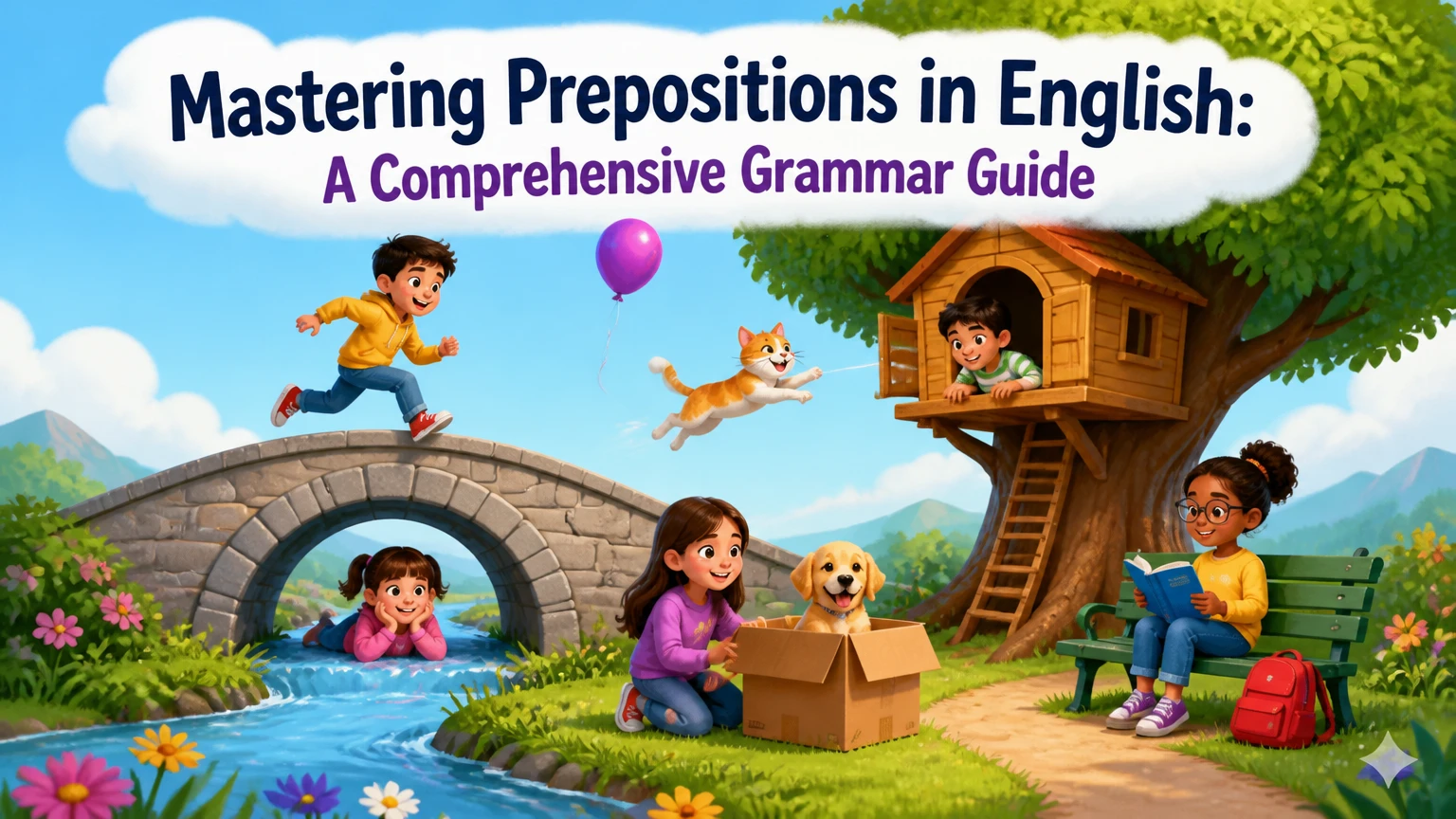
Prepositions are essential functional words that establish relationships between nouns or pronouns and other parts of a sentence, acting as the glue that holds our thoughts together. These small but mighty words allow us to describe complex spatial and temporal relationships, such as in, on, at, behind, and during. By mastering these connectors, learners can move beyond simple sentence structures to express nuanced ideas about location, time, direction, and manner. Understanding prepositions is crucial for anyone looking to achieve fluency, as they are among the most frequently used words in the English language and often dictate the natural rhythm and idiomatic flow of professional and casual conversation alike.
Table of Contents
- Definition and Function of Prepositions
- Structural Breakdown and Sentence Placement
- Categories of Prepositions
- Extensive Example Tables
- Comprehensive Usage Rules and Logic
- Common Mistakes and How to Avoid Them
- Advanced Topics: Phrasal Verbs and Dependent Prepositions
- Practice Exercises and Solutions
- Frequently Asked Questions (FAQ)
- Conclusion and Learning Tips
Definition and Function of Prepositions
In the study of linguistics, a preposition is defined as a member of a closed word class that expresses a grammatical relationship between a noun phrase (the object of the preposition) and another unit in the sentence. Their primary function is to provide context. Without them, a sentence like “The book is the table” would be nonsensical because the spatial relationship between the book and the table is missing.
Prepositions typically indicate how one thing relates to another in space (the bird is above the house) or in time (we will meet after lunch). They are called “pre-positions” because they are usually positioned before their objects. However, their role extends far beyond simple location; they can also indicate origin, possession, purpose, and the means by which an action is performed.
One of the most challenging aspects of English prepositions is that they are often used idiomatically. This means that the choice of preposition is not always based on a literal spatial rule but on historical usage patterns. For example, we say we are on a bus but in a car, despite both being enclosed vehicles. Understanding these nuances requires a mix of rule-based learning and exposure to authentic language.
Structural Breakdown and Sentence Placement
The basic structure of a prepositional unit is the prepositional phrase. This phrase consists of a preposition followed by its object, which is usually a noun, a pronoun, or a gerund (an -ing verb acting as a noun). For example, in the phrase “under the bridge,” “under” is the preposition and “the bridge” is the noun phrase acting as the object.
Prepositional phrases function as either adjectives or adverbs within a sentence. When they function as adjectives, they modify nouns (The girl with the red hat is my sister). When they function as adverbs, they modify verbs, adjectives, or other adverbs (He ran across the field). This flexibility allows speakers to add layers of detail to their descriptions without creating overly complex sentence structures.
While the standard position for a preposition is before its object, English allows for “preposition stranding” in certain contexts, particularly in informal speech and specific grammatical constructions like questions or relative clauses. An example of this is the sentence: “Who are you talking to?” While traditional grammarians once argued that sentences should never end in a preposition, modern linguistics accepts this as a natural feature of English.
Categories of Prepositions
Prepositions of Time
Prepositions of time are used to clarify when something happens, happened, or will happen. The most common are at, on, and in. These three follow a specific hierarchy of specificity. At is used for precise times (at 3:00 PM), on is used for days and dates (on Monday), and in is used for longer, non-specific periods like months, years, and seasons (in 1995).
Prepositions of Place and Direction
These prepositions describe the position of an object relative to another. In indicates something is inside a container or an enclosed space, while on indicates a surface. At is used for a specific point or location. Beyond these, we have words like between, behind, beside, and under which provide more precise spatial coordinates.
Prepositions of Movement
Unlike prepositions of place, which describe static positions, prepositions of movement describe a change in location. Common examples include to, into, onto, through, and across. These prepositions are almost always paired with verbs of motion like walk, run, drive, or throw.
Prepositions of Agent and Instrument
These prepositions describe who performed an action or what was used to perform it. By is typically used for the agent (The book was written by Dickens), while with is used for the instrument (He opened the door with a key). This distinction is vital for clarity in passive voice constructions and technical descriptions.
Extensive Example Tables
The following tables provide a comprehensive look at how different prepositions are used in various contexts. These tables are designed to serve as a quick reference guide for learners who need to identify the correct word for a specific situation.
Table 1: Prepositions of Time (At, On, In)
This table illustrates the hierarchy of time prepositions, moving from the most specific (points) to the most general (periods).
| Preposition | Usage Context | Examples |
|---|---|---|
| At | Clock times, specific points in the day | at 5:30, at noon, at midnight, at sunset, at bedtime |
| At | Holiday periods (without “day”) | at Christmas, at Easter, at the weekend (UK) |
| On | Days of the week | on Monday, on Friday night, on Sunday morning |
| On | Specific calendar dates | on May 12th, on New Year’s Day, on my birthday |
| In | Months, seasons, and years | in January, in the summer, in 2024, in the 1990s |
| In | Longer periods of time | in the past, in the future, in the Middle Ages |
| In | Parts of the day | in the morning, in the afternoon, in the evening |
| Since | A specific point in the past until now | since 2010, since breakfast, since yesterday |
| For | A duration of time | for two hours, for a decade, for ages, for five days |
| During | Within a known period | during the film, during the meeting, during the night |
| Until/Till | Up to a certain point in time | until tomorrow, till Monday, until the end |
| By | No later than a certain time | by 10 PM, by the end of the week, by tomorrow |
| Within | Inside a specific time limit | within an hour, within 30 days, within a week |
| Throughout | Every part of a time period | throughout the year, throughout the day |
| Ago | Time before the present | ten minutes ago, three years ago, a while ago |
| Before | Earlier than a certain time | before lunch, before the war, before 9:00 |
| After | Later than a certain time | after the party, after work, after midnight |
| From…to | Start and end points | from 9 to 5, from Monday to Friday |
| Past | Telling time (minutes after the hour) | ten past six, half past eight |
| To | Telling time (minutes before the hour) | quarter to ten, five to nine |
Table 2: Prepositions of Place and Position
Understanding spatial relationships is key to accurate description. This table covers the most frequent prepositions used to locate objects.
| Preposition | Spatial Relationship | Examples |
|---|---|---|
| In | Inside an enclosed space or area | in the box, in London, in the garden, in a car |
| On | Touching a surface or line | on the table, on the wall, on the floor, on the coast |
| At | A specific point or social location | at the bus stop, at the door, at the cinema, at home |
| Under | Directly below something | under the bed, under the bridge, under the water |
| Over | Directly above something (often moving) | over the fence, over the rainbow, over the clouds |
| Above | Higher than something else | above the fireplace, above the tree line |
| Below | Lower than something else | below the surface, below freezing, below sea level |
| Next to / Beside | At the side of someone or something | beside the river, next to the supermarket |
| Between | In the space separating two objects | between the two trees, between you and me |
| Among | Surrounded by three or more objects | among the crowd, among the flowers |
| In front of | Further forward than someone or something | in front of the building, in front of the TV |
| Behind | At the back of something | behind the curtain, behind the door, behind the shed |
| Near / Close to | A short distance away | near the park, close to my house |
| Far from | A long distance away | far from the city, far from over |
| Opposite | Facing something on the other side | opposite the bank, opposite the park |
| Inside | Within the interior of something | inside the house, inside the envelope |
| Outside | Beyond the boundaries of something | outside the gate, outside the office |
| Against | Touching something for support/collision | against the wall, against the current |
| Beneath | Directly under (formal/literary) | beneath the stars, beneath the earth |
| Upon | On (formal/literary) | upon the mountain, once upon a time |
Table 3: Prepositions of Movement and Direction
Movement prepositions are dynamic and show the path of an object in motion.
| Preposition | Type of Movement | Examples |
|---|---|---|
| To | Movement toward a destination | go to school, walk to the park, fly to Paris |
| Into | Movement toward the inside of something | jump into the pool, walk into the room |
| Onto | Movement toward a surface | climb onto the roof, step onto the stage |
| Across | Movement from one side to the other | swim across the lake, walk across the road |
| Through | Movement within an enclosed space | drive through the tunnel, walk through the forest |
| Along | Movement in a line following a path | walk along the beach, drive along the highway |
| Past | Movement further than a point | walk past the library, drive past the house |
| Around | Movement in a circular path | run around the track, walk around the block |
| Up | Movement to a higher position | climb up the hill, go up the stairs |
| Down | Movement to a lower position | slide down the slope, walk down the street |
| Towards | Movement in the direction of something | walk towards the light, run towards the exit |
| Away from | Movement increasing distance | run away from the dog, move away from the city |
| Out of | Movement from inside to outside | get out of the car, step out of the house |
| Off | Movement away from a surface | take it off the table, jump off the wall |
| Via | Movement by way of a place | fly to Tokyo via Dubai, travel via train |
| Across from | Position facing something | the shop is across from the church |
| Over | Crossing an obstacle | jump over the hurdle, fly over the ocean |
| Under | Passing beneath something | drive under the bridge, crawl under the fence |
| Toward | General direction (US style) | walking toward home, moving toward a goal |
| Back to | Returning to a place | go back to the start, return back to basics |
Comprehensive Usage Rules and Logic
While prepositions can seem arbitrary, there are several underlying rules that govern their usage. One of the most important rules is that prepositions must be followed by a noun or pronoun, never a verb. If you want to use a verb after a preposition, you must change it into its gerund form (the -ing form). For instance, we say “He is interested in learning,” not “He is interested in learn.” This rule is absolute and applies to every preposition in the English language.
Another key rule involves the distinction between in, at, and on for physical locations. Use in for spaces with boundaries (like a room or a country), on for surfaces (like a table or a floor), and at for specific points or functional locations (like “at the entrance” or “at the doctor’s”). This logic helpfully extends to abstract concepts as well; we are “in a relationship” (an enclosed state) or “on a committee” (a flat organizational structure).
The “Preposition at the End” rule is a frequent point of confusion. In formal writing, it was once considered a “sin” to end a sentence with a preposition like with, for, or to. However, modern style guides, including the Chicago Manual of Style and the Oxford English Dictionary, agree that ending a sentence with a preposition is often more natural. For example, “That is the man I was talking about” sounds much more native than the hyper-formal “That is the man about whom I was talking.”
Prepositions also change meaning based on whether they describe a state or a motion. In and on usually describe a state of being (static), while into and onto describe an action (dynamic). If you are already inside a room, you are in the room. If you are walking from the hallway to the room, you are walking into the room. This distinction is vital for providing clear instructions or descriptions of events.
Common Mistakes and How to Avoid Them
Learners often struggle with prepositions because they try to translate them directly from their native language. Since prepositions are idiomatic, direct translation rarely works. One common error is using “discuss about.” In English, “discuss” is a transitive verb that takes a direct object, so we say “We discussed the plan,” not “We discussed about the plan.” Conversely, “talk” requires “about,” as in “We talked about the plan.”
Another frequent mistake involves time expressions. Many students say “in the night” when they should say “at night.” While we say “in the morning” and “in the afternoon,” “night” is a specific exception that takes “at” unless you are referring to a very specific night (e.g., “in the night of the storm”). Similarly, the use of “on” vs “at” for weekends varies between American English (on the weekend) and British English (at the weekend), both of which are correct in their respective regions.
Table 4: Correct vs. Incorrect Preposition Usage
| Incorrect Sentence | Correct Sentence | Rule/Reason |
|---|---|---|
| I am angry on you. | I am angry with you. | Adjectives of emotion often take “with” for people. |
| She arrived to the airport. | She arrived at the airport. | “Arrive” takes “at” for specific places, “in” for cities/countries. |
| It depends of the weather. | It depends on the weather. | “Depend” always collocates with “on.” |
| I’m going to home. | I’m going home. | “Home” acts as an adverb here; no preposition is needed. |
| Listen me! | Listen to me! | The verb “listen” requires “to” before an object. |
| Married with a doctor. | Married to a doctor. | “Married” and “engaged” take “to,” not “with.” |
| Different than mine. | Different from mine. | “From” is the standard preposition for “different.” |
| In the end of the road. | At the end of the road. | “At the end” refers to a specific point in space or time. |
| Congratulations for your win. | Congratulations on your win. | “Congratulations” collocates with “on.” |
| Search a job. | Search for a job. | The verb “search” requires “for” when looking for something. |
Advanced Topics: Phrasal Verbs and Dependent Prepositions
For advanced learners, the study of prepositions shifts from simple location to dependent prepositions and phrasal verbs. A dependent preposition is a word that must follow a specific adjective, verb, or noun. These combinations are fixed. For example, you are “capable of” something, “interested in” something, or “responsible for” something. There is no logical reason why “capable” takes “of” while “responsible” takes “for”; they must simply be memorized as units.
Phrasal verbs are even more complex. These are verbs combined with a preposition (or an adverb) that create a completely new meaning. For example, “look” means to see, but “look after” means to care for, “look into” means to investigate, and “look up to” means to admire. In these cases, the preposition is no longer acting as a spatial marker but as a component of a new lexical unit.
Another advanced concept is the prepositional passive. In sentences like “The bed had been slept in,” the preposition stays attached to the verb even when the sentence is turned into the passive voice. This is a common feature of English that can be difficult for learners whose native languages do not allow prepositions to be separated from their objects. Mastering these forms is a hallmark of near-native proficiency.
Table 5: Common Dependent Prepositions (Adjectives & Verbs)
| Word | Fixed Preposition | Example Sentence |
|---|---|---|
| Accustomed | to | She is accustomed to the cold weather. |
| Afraid | of | He is afraid of spiders. |
| Agree | with / on | I agree with you on this matter. |
| Apologize | for | You should apologize for your behavior. |
| Believe | in | Do you believe in ghosts? |
| Belong | to | This book belongs to the library. |
| Compliment | on | He complimented her on her new hairstyle. |
| Concentrate | on | I need to concentrate on my studies. |
| Familiar | with | Are you familiar with this software? |
| Famous | for | Italy is famous for its pizza. |
| Good / Bad | at | I am very good at mathematics. |
| Insist | on | They insisted on paying for dinner. |
| Kind | to | Please be kind to the animals. |
| Laugh | at | Don’t laugh at my mistakes. |
| Participate | in | Everyone should participate in the game. |
| Proud | of | She is very proud of her children. |
| Rely | on | You can always rely on me. |
| Suffer | from | He suffers from hay fever. |
| Wait | for | We are waiting for the bus. |
| Worry | about | Don’t worry about the small things. |
Practice Exercises and Solutions
To master prepositions, one must practice identifying them in context and choosing the correct word for various scenarios. Below are two exercises designed to test your knowledge of basic and intermediate preposition usage.
Exercise 1: Fill in the Blanks (Time and Place)
Choose the correct preposition (in, on, at, to, into) to complete each sentence.
- The meeting is scheduled ____ 10:00 AM ____ Monday morning.
- I left my keys ____ the kitchen table ____ the bowl.
- We went ____ the cinema ____ see a new movie.
- She was born ____ 1992 ____ a small town ____ France.
- The cat jumped ____ the box to hide.
- I’ll see you ____ the bus stop ____ ten minutes.
- My birthday is ____ October 5th.
- He is currently ____ work, but he’ll be home soon.
- The papers are ____ the drawer ____ the right.
- We walked ____ the park to enjoy the sun.
Exercise 2: Identifying Dependent Prepositions
Choose the correct preposition that follows the adjective or verb in bold.
- Are you interested ____ (in/on/at) joining our club?
- She is very similar ____ (with/to/as) her sister.
- He apologized ____ (to/for/about) being late.
- I don’t agree ____ (with/to/for) your opinion.
- They are famous ____ (for/about/in) their cheese.
- Stop laughing ____ (on/at/to) me!
- I am tired ____ (of/with/from) working all day.
- We are waiting ____ (to/for/on) the results.
- She is afraid ____ (from/of/with) heights.
- The success depends ____ (in/on/of) your hard work.
Answer Key
| Exercise 1 Answers | Exercise 2 Answers |
|---|---|
| 1. at, on | 1. in |
| 2. on, in | 2. to |
| 3. to, to | 3. for |
| 4. in, in, in | 4. with |
| 5. into | 5. for |
| 6. at, in | 6. at |
| 7. on | 7. of |
| 8. at | 8. for |
| 9. in, on | 9. of |
| 10. through/in | 10. on |
Frequently Asked Questions (FAQ)
Q: Is it true that you should never end a sentence with a preposition?
A: No, this is an old-fashioned rule based on Latin grammar that does not apply to modern English. While you might avoid it in extremely formal academic papers, ending a sentence with a preposition is natural and often preferred in standard English speech and writing.
Q: What is the difference between “in” and “into”?
A: “In” generally describes a static position or location (I am in the house), while “into” describes movement or transformation (I walked into the house). “Into” shows the transition from outside to inside.
Q: Why do we say “on the bus” but “in the car”?
A: This is an idiomatic rule. Generally, we use “on” for public transportation or vehicles where you can stand up and walk around (bus, train, plane, ship). We use “in” for smaller, private vehicles where you must sit down (car, taxi, truck).
Q: Can a preposition be more than one word?
A: Yes, these are called compound prepositions. Examples include according to, in front of, out of, and by means of. They function as a single unit in a sentence.
Q: How can I remember which preposition goes with which verb?
A: The best way is to learn them as “collocations” or chunks of language. Instead of memorizing “depend” and “on” separately, memorize the phrase “it depends on.” Reading and listening to English regularly will help these patterns become intuitive.
Q: Is there a difference between “among” and “between”?
A: Traditionally, “between” is used for two distinct items (between the house and the car), while “among” is used for three or more items or a group (among the trees). However, “between” can be used for more than two items if they are distinct and named individually.
Q: What is a “prepositional phrase”?
A: It is a group of words consisting of a preposition, its object (noun or pronoun), and any words that modify the object. For example, “in the dark, spooky woods” is a prepositional phrase where “in” is the preposition and “woods” is the object.
Q: When should I use “at” for time?
A: Use “at” for specific clock times (at 7:00), specific points of the day (at noon, at sunset), and holiday periods that do not use the word “day” (at Christmas, but on Christmas Day).
Conclusion and Final Learning Tips
Prepositions are the subtle architects of English sentences, providing the necessary framework for time, space, and logic. While they may seem daunting due to their idiomatic nature, they are manageable when approached through a combination of structural rules and consistent practice. Remember that even native speakers occasionally debate the “correct” preposition in certain contexts, so do not be discouraged by minor errors. To improve, focus on learning prepositions in “chunks” rather than in isolation, and pay close attention to how they are used in books, movies, and conversations. By internalizing these patterns, you will develop a more natural and sophisticated command of the English language. Keep practicing, stay curious, and soon these small words will become second nature in your daily communication.