
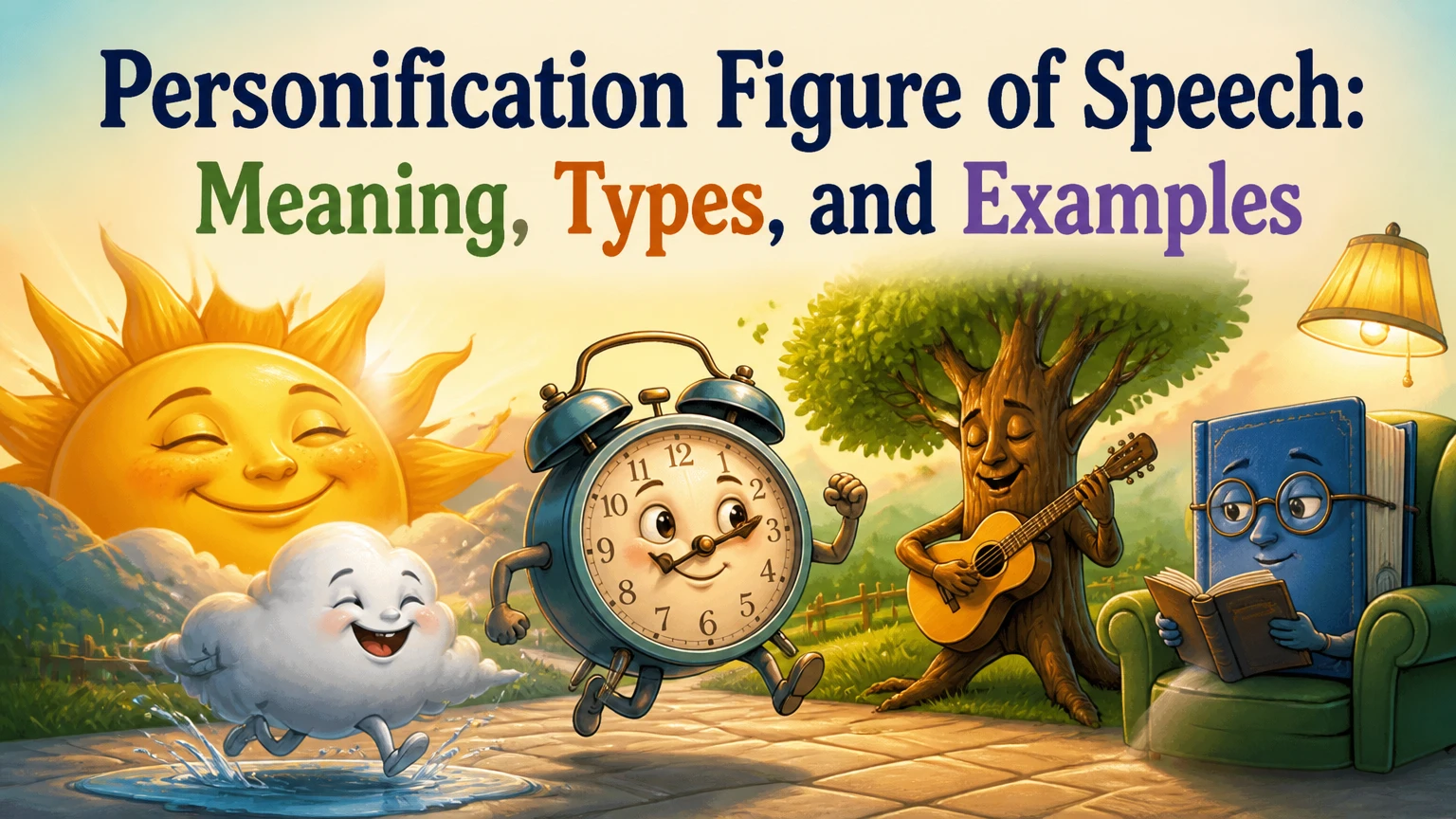
Personification is a figure of speech that gives human qualities, actions, feelings, speech, or intentions to a non-human subject. Writers use it for objects, animals, natural forces, places, and abstract ideas, as in “The wind whispered through the trees,” where “whispered” presents wind through a human action without claiming that the wind literally speaks.
Key Facts at a Glance
- Personification attributes a specifically human characteristic to something non-human.
- “The alarm screamed” is personification because screaming is a human vocal action used figuratively.
- Personification can appear through a verb, adjective, noun, pronoun, or extended character.
- Anthropomorphism usually gives an animal, object, or concept a sustained human identity and behavior.
- Pathetic fallacy is a narrower form associated with human emotion attributed to nature or weather.
- Effective personification supports a scene’s meaning, tone, or clarity; decorative personification can create cliché or confusion.
What Is Personification?
Personification is the figurative representation of a non-human entity as if it possessed a human quality or capacity. The entity may be an inanimate object, animal, weather event, geographical feature, institution, abstract idea, or technological system.
In “The old house groaned,” the house does not experience pain or produce a human complaint. The verb “groaned” transfers a human or animal sound onto the house, allowing the reader to infer age, strain, discomfort, or menace. The phrase is therefore more expressive than “The old house made a low structural noise.”
Personification does not require a complete human character. A single word can create it:
- “The deadline crept closer.”
- “The locked gate refused to open.”
- “Memory followed him home.”
- “The city never sleeps.”
- “The fire devoured the dry grass.”
The figurative meaning depends on context. A fire can literally consume fuel, but “devoured” adds appetite and agency. A city can literally remain active at night, but “never sleeps” frames the city as a tireless person.
What Counts as a Human Quality?
A human quality includes more than an emotion. Personification may transfer any of the following:
| Human feature | Example | Effect |
|---|---|---|
| Speech | “The river whispered” | Creates intimacy or secrecy |
| Emotion | “The jealous moon watched” | Assigns motive and mood |
| Intention | “The gate guarded the path” | Suggests purpose or opposition |
| Judgment | “The evidence refused to cooperate” | Makes an abstract process dramatic |
| Bodily action | “The branches clawed the roof” | Produces threat and physical energy |
| Social behavior | “The houses huddled together” | Creates community or vulnerability |
A useful test is simple: ask whether the chosen word normally describes a human mind, body, voice, or social action. If the answer is yes and the subject is non-human, personification is likely present.
How Does Personification Work?
Personification works by mapping a familiar human action or state onto an unfamiliar, static, or abstract subject. Readers understand “the argument collapsed” faster than a long explanation that the argument lost logical support, because the verb “collapsed” supplies a recognizable pattern of failure.
Personification is commonly discussed as a type of metaphor because it creates an implied comparison rather than a literal statement. However, the categories overlap: a sentence can be classified as personification because of its human trait and as metaphor because of its non-literal transfer. Calling personification a metaphor is useful, but treating the terms as exact synonyms is inaccurate.
The Basic Construction
A personified sentence contains three elements:
- Target: the non-human subject.
- Human attribute: the action, feeling, thought, or social role transferred to it.
- Purpose: the tone, image, explanation, or emphasis created by the transfer.
For example, “The exhausted road climbed toward the village” uses “exhausted” as a human condition. The road’s physical incline remains real, but the adjective makes the journey feel difficult and tiring.
Writers usually create the device through one of four grammatical vehicles:
| Form | Example | Human element |
|---|---|---|
| Verbal | “The thunder threatened the valley” | Threatening |
| Adjectival | “A stubborn lock held firm” | Stubbornness |
| Nominal | “Opportunity knocked twice” | A visitor at a door |
| Pronominal | “The ship lifted her bow” | Human or gendered reference |
Pronouns require care. A ship called “she” may reflect maritime convention or literary style, but the pronoun alone does not always create strong personification. The surrounding language must imply a human quality, role, or action.
Why Do Writers Use It?
Personification compresses interpretation into an image. “The deadline stalked the interns” communicates pressure, persistence, and fear more economically than several literal sentences.
The device can also alter a reader’s relationship with a subject. A damaged bridge that “spans the river” is neutral; a bridge that “clings to the cliffs” appears vulnerable. The underlying structure has not changed, but the description directs attention toward endurance and danger.
Personification does not literally activate a proven neurological mechanism every time a reader encounters it. Claims about “mirroring pathways” or a fixed neurological response are stronger than the available evidence supports. The safer explanation is cognitive and rhetorical: familiar human behavior gives readers a readily available framework for interpreting non-human events.
What Are the Main Types of Personification?
The main types are simple personification, extended personification, pathetic fallacy, prosopopoeia, and allegorical personification. These categories describe different degrees of human attribution, different targets, and different narrative scopes.
| Type | Typical target | Scope | Example |
|---|---|---|---|
| Simple personification | Object or force | One phrase or sentence | “The shutters complained in the wind” |
| Extended personification | Object, place, or idea | Several sentences or a passage | “The house watched each visitor” |
| Pathetic fallacy | Nature or weather | Human emotion in environment | “The sullen clouds gathered” |
| Prosopopoeia | Object, dead person, or abstraction | Direct imagined speech | “Death said, ‘Your hour has come’” |
| Allegorical personification | Abstract concept | Sustained symbolic character | Lady Justice representing justice |
Simple and Extended Personification
Simple personification appears briefly and usually supports a local image. “The candle fought the darkness” gives the flame a human struggle without turning it into a character.
Extended personification continues the human identity across multiple images. A poem might describe a nation as a wounded soldier, then give that nation a voice, memory, and hopes. Once a writer extends the device, consistency matters. Switching from soldier imagery to bird imagery in the same passage can weaken the conceptual structure.
What Is Pathetic Fallacy?
Pathetic fallacy is the attribution of human emotion or mood to nature, weather, or the environment. “The mournful rain fell over the cemetery” is pathetic fallacy because rain receives the human emotion of mourning.
The term is narrower than personification. “The angry sea” may be called both personification and pathetic fallacy because the sea receives anger. “The stubborn door,” however, is personification but not pathetic fallacy because a door is not part of nature in the relevant sense.
John Ruskin popularized the term in Modern Painters in the nineteenth century, where he criticized emotional projections onto nature when they replaced accurate observation. Modern literary analysis often uses the term more neutrally, especially when weather mirrors a character’s mood.
What Is Prosopopoeia?
Prosopopoeia is a rhetorical technique in which an absent, dead, imaginary, abstract, or non-human entity is presented as speaking. A single phrase such as “the wind whispered” suggests voice, but a passage in which the wind addresses a character directly is prosopopoeia.
The device appears in speeches, sermons, poems, fables, morality plays, and political writing. A writer may let “History” accuse a nation, or let “Death” address a king. Prosopopoeia therefore often overlaps with personification but signals a more developed speaking presence.
What Is Allegorical Personification?
Allegorical personification turns an abstract idea into a sustained symbolic figure. Lady Justice, commonly represented with scales and a sword, personifies justice through a recognizable human form and social role.
Other examples include Father Time, Mother Nature, Fortune, Liberty, and Death. Capitalization, costume, attributes, and repeated actions can signal that the character represents a concept larger than an individual. Allegory differs from a one-line metaphor because the symbolic identity operates across an entire work.
Personification Examples by Category
The following examples show how the same device changes according to target and purpose.
| Target category | Personification example | Implied meaning |
|---|---|---|
| Object | “The radiator coughed awake” | The radiator starts noisily |
| Nature | “The frost crept across the glass” | Frost spreads gradually |
| Animal | “The fox considered the open gate” | The animal appears deliberate |
| Place | “The village held its breath” | The village feels tense and silent |
| Abstract idea | “Doubt tapped at her confidence” | Doubt persistently intrudes |
| Technology | “The server rejected my request” | The system denied access |
| Institution | “The committee buried the proposal” | Members suppressed it |
| Time | “Winter tightened its grip” | Winter intensified conditions |
A sentence is not automatically personification because it contains an energetic verb. “The river runs” is usually literal. “The river remembers every bridge” is figurative because remembering is a human mental capacity.
Examples in Literature and Poetry
Personification is common in literary language because it makes an unseen force emotionally legible. In William Shakespeare’s Romeo and Juliet, “Arise, fair sun, and kill the envious moon” gives the sun and moon human beauty, rivalry, and hostility. The celestial bodies become participants in the lovers’ emotional world.
In Emily Dickinson’s poem “Because I could not stop for Death,” Death appears as a courteous carriage companion. This is more than a single personifying verb. Death receives a role, movement, manners, and conversational presence, making the poem an example of extended personification and prosopopoeia.
In Percy Bysshe Shelley’s “Ode to the West Wind,” the wind is addressed as a powerful agent capable of carrying, destroying, and preserving. The wind remains a natural force, but the poem develops it into a near-personal interlocutor.
These examples demonstrate an important distinction: literary personification can become a structural principle. It may organize an entire poem rather than decorate one sentence.
How Do You Write Effective Personification?
To write effective personification, choose a non-human target, define the intended mood, select a human behavior that fits the target, draft the sentence, and revise for originality and consistency. The strongest examples connect the human trait to the subject’s physical behavior instead of adding a random emotional label.
Step 1: Choose the Target
Select the entity that needs interpretation. A deadline, empty room, storm, economic policy, machine, or memory can all become targets.
Avoid choosing an object merely because personification sounds decorative. First identify what the reader should notice: pressure, age, resistance, loneliness, speed, secrecy, or instability.
Step 2: Set the Emotional Direction
Name the desired tone before selecting a verb. A storm described as “playful” creates a different scene from one described as “predatory.”
| Intended tone | Suitable human behavior | Example |
|---|---|---|
| Threatening | Stalk, hunt, corner | “The fog hunted the road” |
| Tender | Cradle, comfort, shelter | “The blanket guarded her sleep” |
| Exhausting | Drag, limp, struggle | “The afternoon limped toward sunset” |
| Secretive | Whisper, conceal, watch | “The corridor kept its secrets” |
| Joyful | Dance, welcome, celebrate | “The curtains danced in sunlight” |
Step 3: Match the Trait to the Target
The best human action has a physical or conceptual connection to the subject. A door can groan, resist, welcome, or exclude because doors make sounds, open entrances, and control access. A door that “spread its wings” has no comparable structural basis unless the surrounding passage establishes an intentional surreal style.
This is a practitioner rule: preserve one anchor in the subject’s real properties. The more abstract the target, the more important the anchor becomes.
Step 4: Choose the Grammatical Vehicle
Use a verb for movement and agency, an adjective for attitude, or a noun for symbolic compression.
- Verb: “The deadline chased him.”
- Adjective: “A hostile deadline dominated the schedule.”
- Noun: “The deadline became a silent pursuer.”
Verbs usually create the strongest energy. Adjectives can become generic quickly, especially with words such as “angry,” “sad,” and “happy.”
Step 5: Revise the Cliché
“The sun smiled” is understandable but familiar. Replace it only when the context supports a sharper image:
- “Morning poured gold across the kitchen.”
- “The winter sun peered through the blinds.”
- “The weak sun surrendered before noon.”
The replacement should add scene-specific information. Novelty without relevance is merely ornament.
Step 6: Test the Sentence
Ask four questions:
- Is the subject clearly non-human?
- Is the transferred quality recognizably human?
- Does the image support the intended tone?
- Can the reader understand the literal event without decoding excessive symbolism?
If the answer to the final question is no, reduce the figurative load or follow the personification with a literal detail.
When Should Writers Use Personification?
Writers should use personification when a human frame makes an object, process, setting, or abstraction easier to imagine or more emotionally significant. Personification is especially effective in poetry, fiction, speeches, advertising, children’s writing, and explanatory writing for general audiences.
Creative Writing and Poetry
Fiction writers use the device to establish atmosphere and externalize a character’s inner state. “The hallway waited outside her bedroom” can convey dread before the character performs any action.
Poets use personification to address forces that cannot answer literally. The technique supports apostrophe, symbolism, and dramatic monologue, particularly when an abstraction such as death, time, or freedom becomes a speaker.
A useful limit is one dominant personifying image per scene or paragraph. Several unrelated images can make the prose feel crowded: “The rain mourned, the windows frowned, the floor swallowed footsteps, and the walls listened.” Each phrase may work alone, but together they compete for attention.
Marketing and Brand Writing
Marketing uses personification to make products and services feel accessible. A software update might say, “Your phone needed a rest, so we gave it a faster way to manage background tasks.”
The technique works best when it clarifies a customer benefit. It becomes misleading when a brand voice assigns emotions that obscure a material limitation, such as describing a delayed service as “taking a thoughtful pause.”
| Context | Useful example | Main control |
|---|---|---|
| Product interface | “Your inbox is ready for a reset” | Keep the instruction clear |
| Advertising | “The trail called for a tougher boot” | Connect image to product use |
| Brand strategy | “A bank that listens” | Support the promise with behavior |
| Error message | “The upload took a wrong turn” | State the recovery action directly |
Academic and Technical Writing
Academic writers should use personification sparingly when precision matters. “The data suggest” is conventional shorthand, but “the molecules fell in love” would introduce an inaccurate human narrative into a scientific explanation.
Personification can help explain systems to non-specialists: “The immune system remembers previous infections” communicates immunological memory, although a technical text should define the biological mechanism afterward. In a formal paper, replace the figurative phrase when readers might mistake agency for literal intention.
Personification is not good for reporting measurements, assigning responsibility to automated systems, or describing causation that requires a mechanistic explanation. Literal wording wins when an error could affect safety, law, diagnosis, or experimental interpretation.
Personification Versus Related Devices
Personification differs from anthropomorphism, metaphor, simile, symbolism, and pathetic fallacy according to scope and mechanism. The clearest distinction is whether the non-human subject receives one figurative human trait or a sustained human identity.
| Device | Core operation | Example | Key distinction |
|---|---|---|---|
| Personification | Gives a non-human subject a human trait | “The clock watched me” | Often brief and non-literal |
| Anthropomorphism | Portrays a non-human entity as human | “The rabbit wore a coat and paid rent” | Sustained human behavior |
| Metaphor | Equates or transfers one concept to another | “Her voice was velvet” | Does not require a non-human target |
| Simile | Compares with “like” or “as” | “The clouds moved like ships” | Explicit comparison |
| Symbolism | Uses an element to represent an idea | A dove representing peace | Meaning may remain non-human |
| Pathetic fallacy | Gives nature a human feeling | “The lonely rain fell” | Narrower environmental category |
Personification Versus Anthropomorphism
Personification is usually a figurative description, while anthropomorphism presents the non-human entity as having a continuing human identity. “The fox watched the farmer suspiciously” may be personification if “suspiciously” interprets animal behavior through human psychology. A fox who speaks, wears clothes, owns a house, and solves crimes is anthropomorphic.
The boundary is not absolute. A fable can begin with personification and develop into anthropomorphism. Classification depends on duration, literal presentation, and narrative role.
Personification Versus Metaphor
Personification is a specialized form of figurative transfer involving a human attribute. “The market is a roller coaster” is a metaphor, but not necessarily personification. “The market panicked and fled” is personification because panic and flight are presented as human or animal-like behavior.
Some grammarians reserve “metaphor” for direct conceptual comparison and treat personification as a separate figure. For practical writing analysis, identify both when appropriate: the sentence uses personification, and its meaning operates metaphorically.
Personification Versus Simile
A simile makes its comparison explicit through “like” or “as.” “The wind moved like a dancer” compares wind to a dancer, whereas “The wind danced” gives the wind the dancer’s action directly.
The distinction matters because direct personification is generally more compressed and forceful. The simile preserves distance; the personification temporarily lets the subject act as a human participant.
What Are the Benefits and Limitations?
Personification improves relatability, atmosphere, and compression, but it can reduce clarity, produce cliché, or assign agency where none exists. The device has value only when the human framing gives readers information that literal description would not provide as efficiently.
| Benefit | Mechanism | Example outcome |
|---|---|---|
| Relatability | Maps abstraction to familiar behavior | “Justice weighs the evidence” |
| Atmosphere | Gives settings emotional pressure | “The corridor held its breath” |
| Compression | Packs several implications into one phrase | “Doubt knocked again” |
| Memorability | Creates a concrete mental image | “The deadline chased us” |
| Explanation | Simplifies a complex process | “The filter catches pollutants” |
The main limitation is interpretive cost. Readers must translate the human action back into a literal event, and repeated translation can slow technical or instructional prose.
A second limitation is false agency. Saying “the algorithm decided” may conceal the people, rules, data, or model that produced an output. Personification becomes ethically weak when it makes an institution or technology appear responsible while hiding human control.
How Can Writers Avoid Clichés?
Writers can avoid clichés by replacing generic emotions with precise, context-linked behavior. “The angry storm” tells the reader little; “the storm worried the loose shutters until dawn” creates a specific relationship between force and object.
Use sensory evidence alongside the figure. “The house groaned” becomes more convincing when the paragraph mentions warped boards, a cold draft, or a settling foundation. Concrete details keep personification attached to the physical world.
Common Mistakes and How to Fix Them
Mixing Unrelated Metaphors
A market that “claws upward, smiles at investors, and spreads its wings” changes from animal to human to bird. Choose one conceptual frame, such as a climber, and maintain it through the passage.
Overloading a Scene
Four personified objects in one sentence can compete: “The rain cried, the windows sulked, the floor complained, and the curtains danced.” Keep the strongest image and describe the rest literally.
Confusing Literal and Figurative Meaning
“The engine roared” may be personification if “roared” implies anger, but it can also be ordinary figurative language for a loud mechanical sound. Classification requires context, not a word list.
Giving an Object Impossible Anatomy
“The door kicked its feet and ran away” creates a cartoon image unless the text intentionally uses surreal comedy. For realistic prose, use properties connected to the door: “The door groaned against its hinges and refused to open.”
Using Emotion Without Purpose
“The lonely cup sat on the table” may be personification, but loneliness needs narrative support. If the cup’s isolation matters, show the empty room or missing owner. Otherwise, “The cup sat alone” may be clearer.
Assigning Agency to Systems
“The software chose to delete the records” can misrepresent a technical event. Prefer “The deletion rule removed records older than 30 days” when documenting an actual system behavior.
How Do You Identify Personification in a Sentence?
To identify personification, locate the non-human subject, find the human action or quality attached to it, and test whether the wording is literal. In “The shadows crept across the wall,” shadows are non-human and “crept” gives them an animal-like intentional movement, so the sentence uses personification.
Use this four-part identification method:
- Circle the subject: What is acting or being described?
- Underline the attribute: What behavior, feeling, or capacity appears?
- Check literal possibility: Can the subject actually perform that action?
- Explain the effect: What mood, image, or meaning does the transfer create?
Do not label every vivid verb as personification. “The river flowed” describes a literal physical process. “The river invited the children closer” assigns intention and social behavior, which makes the phrase personifying.
The Bottom Line
Personification is a figure of speech that gives human qualities to non-human entities so readers can understand an object, force, place, or abstraction through familiar human behavior. The most effective examples are specific, purposeful, and physically or conceptually anchored, while the weakest rely on clichés, mixed metaphors, or emotional language that hides rather than clarifies meaning.
Use a single human trait when a sentence needs energy, atmosphere, or compression. Use extended personification only when the image can remain consistent across a passage. In technical and academic writing, retain the device only when it improves understanding and does not replace a necessary literal explanation.
Frequently Asked Questions
Is personification always a metaphor?
Personification is usually metaphorical because it transfers a human quality to a non-human subject without changing the literal nature of that subject. Some literary classifications treat personification as its own figure rather than a subtype of metaphor. Both descriptions can be useful, provided personification is defined by the human attribute it assigns.
Can animals be examples of personification?
Animals can be personified when a writer gives them specifically human reasoning, speech, social roles, or moral judgment. “The dog barked” is literal, while “The dog forgave his owner” may personify the animal’s emotion. A talking, clothed animal with a continuing human personality is more accurately anthropomorphic.
What is personification in an essay?
Personification in an essay is a deliberate figurative description that makes an abstract subject easier to understand or more persuasive. For example, “Inflation erodes household purchasing power” gives inflation an action associated with physical damage. Formal essays should explain the literal economic mechanism if the metaphor could create ambiguity.
Is “the wind whispered” personification?
“The wind whispered” is personification because “whispered” is a human speech action applied to wind. The phrase may also be an example of onomatopoeic or sensory description when it imitates the soft sound of moving air. Its precise classification depends on whether the emphasis is voice-like agency or sound quality.
What is the opposite of personification?
There is no single formal opposite of personification. Literal description is the practical contrast: “The wind moved through the branches” reports an observable event without assigning human behavior. Depersonalization or objectification can also remove human qualities, but those terms describe broader rhetorical and psychological processes.
Why is personification useful in children’s writing?
Personification helps children connect unfamiliar ideas with familiar actions, emotions, and social situations. A story in which “the lost button felt lonely” makes an object’s role emotionally understandable. Writers should keep the image concrete, limit competing figurative devices, and clarify the story’s literal events through context.


