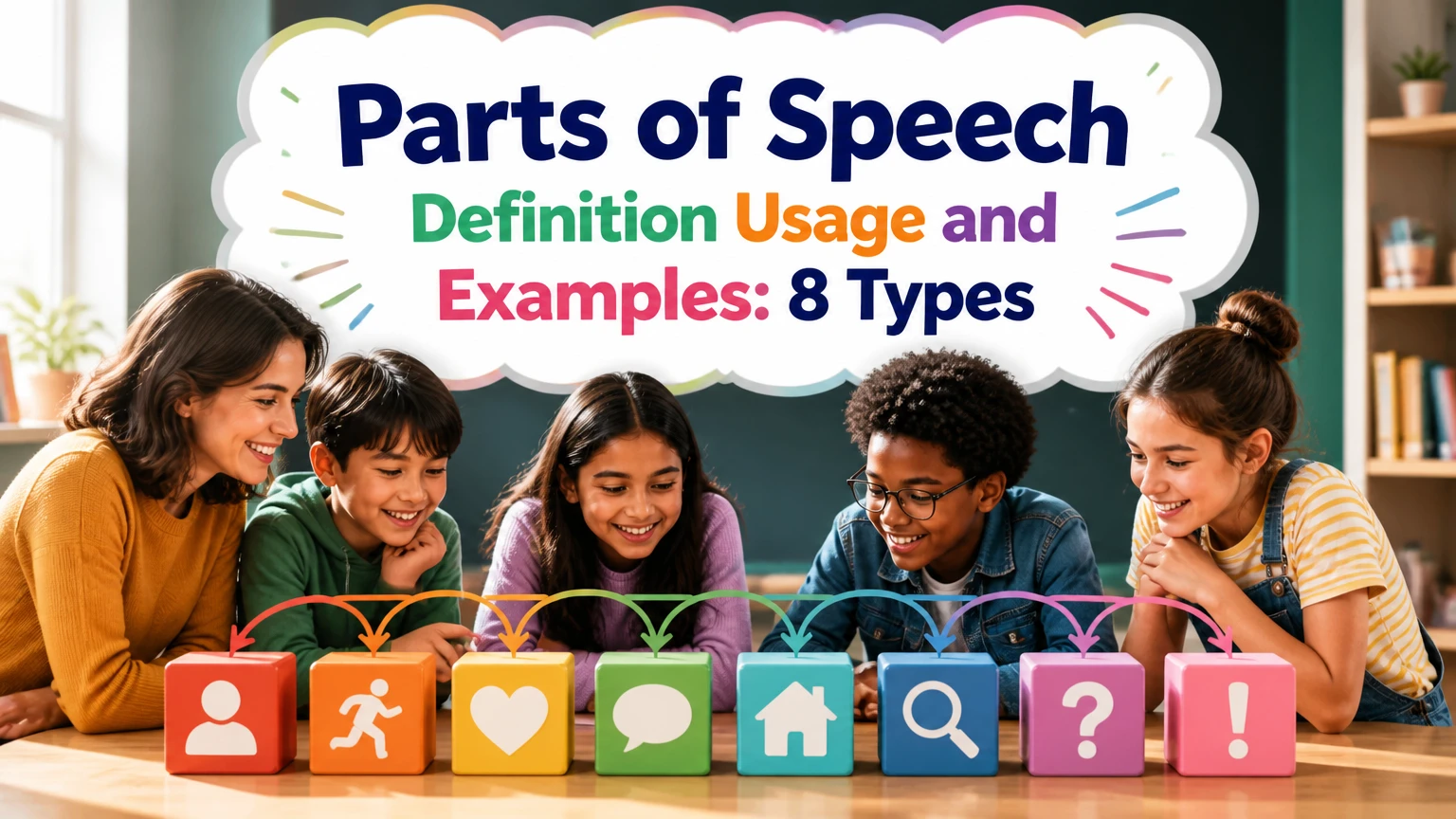
Parts of speech are categories that describe how words function in sentences. English traditionally has eight: nouns, pronouns, verbs, adjectives, adverbs, prepositions, conjunctions, and interjections; modern grammar also treats determiners, including articles, as a separate category. A word’s category depends on its use in context, not on the word alone.
Key Facts at a Glance
- A part of speech identifies a word’s grammatical category and behavior in a sentence.
- English traditionally recognizes eight parts of speech, but modern grammar usually classifies articles as determiners.
- The same spelling can belong to different categories, as work does in “The work ended” and “They work daily.”
- Nouns and verbs form the sentence core; modifiers add information, while function words express relationships.
- A reliable analysis begins with the main verb, then identifies subjects, objects, modifiers, and connectors.
- Parts of speech are different from sentence roles: a noun can be a subject, object, or subject complement.
What Is a Part of Speech?
A part of speech is a grammatical category assigned to a word according to its syntactic function, form, and relationship with other words. The category tells readers what a word can do, where it can appear, and which other words it can combine with.
For example, clean is an adjective in “a clean window,” because it modifies window. It is a verb in “Please clean the window,” because it expresses an action and takes an object. The spelling remains unchanged, but the grammatical behavior changes.
Traditional school grammar teaches eight categories. Linguists often use a more detailed system that adds determiners and distinguishes forms such as auxiliaries, modals, particles, and subcategories of pronouns. Both systems are useful when their purposes are clear.
Part of Speech Versus Sentence Function
A part of speech describes what a word is grammatically; a sentence function describes the job that word performs in a particular clause. In “Maria opened the gate,” Maria is a noun functioning as the subject, while gate is a noun functioning as the direct object.
The distinction prevents a common analytical error. “Subject” is not another name for “noun,” because pronouns can be subjects, as in “She opened the gate,” and clauses can also function as subjects, as in “What he decided surprised everyone.”
What Are the Eight Traditional Parts of Speech?
The eight traditional parts of speech are nouns, pronouns, verbs, adjectives, adverbs, prepositions, conjunctions, and interjections. The table below gives each category’s core function, common subtypes, and a precise example.
| Category | Core function | Common subtypes | Example |
|---|---|---|---|
| Noun | Names an entity, place, object, substance, or idea | Proper, common, abstract, collective, count, noncount | Justice matters. |
| Pronoun | Refers to an entity without repeating a noun | Personal, relative, demonstrative, indefinite, reflexive | They arrived early. |
| Verb | Expresses action, event, state, or relationship | Lexical, auxiliary, modal, linking, transitive, intransitive | She built a shelf. |
| Adjective | Modifies a noun or pronoun, or follows a linking verb | Descriptive, comparative, superlative, attributive, predicative | a narrow path |
| Adverb | Modifies a verb, adjective, adverb, clause, or sentence | Manner, time, place, degree, frequency, focusing | He spoke quietly. |
| Preposition | Marks a relationship involving a noun phrase or complement | Place, time, direction, cause, means | The keys are under the mat. |
| Conjunction | Connects words, phrases, clauses, or sentences | Coordinating, subordinating, correlative | I stayed because it rained. |
| Interjection | Expresses an independent reaction or emotion | Strong, mild, conversational | Ouch! That hurt. |
1. Nouns
A noun names a person, place, thing, substance, activity, or abstract idea. Nouns can occupy positions such as subject, object, complement, or object of a preposition.
Common noun types include:
- Proper nouns: London, Maya, the Pacific Ocean
- Common nouns: city, student, ocean
- Concrete nouns: table, apple, rain
- Abstract nouns: patience, freedom, anger
- Collective nouns: team, committee, flock
- Count nouns: book, idea, three books
- Noncount nouns: information, rice, equipment
Nouns often show number through singular and plural forms. Some also show possession: the teacher’s desk and the teachers’ lounge. A noun phrase can contain several parts of speech, as in the three unusually large boxes.
2. Pronouns
A pronoun refers to a person, thing, or idea without repeating a noun phrase. Pronouns can mark person, number, gender in some forms, case, and sometimes reflexive meaning.
| Pronoun type | Main use | Examples in context |
|---|---|---|
| Personal | Refers to a speaker, listener, or other entity | I called her. |
| Possessive | Shows ownership or association | The red bag is mine. |
| Reflexive | Refers back to the subject | He blamed himself. |
| Demonstrative | Points to an entity | Those are expensive. |
| Relative | Introduces a relative clause | The tool that I bought works. |
| Interrogative | Forms a question | Who called? |
| Indefinite | Refers nonspecifically | Someone left a note. |
Pronoun case matters after prepositions and in formal standard English. The correct form is between you and me, because between takes object forms. In “She and I agreed,” I is part of the subject; in “The manager called her and me,” both pronouns are objects.
3. Verbs
A verb expresses an action, event, state, or relationship and usually forms the grammatical center of a clause. Verbs carry tense, aspect, voice, mood, and agreement.
| Verb type | Test or function | Example |
|---|---|---|
| Transitive | Takes a direct object | The nurse checked the patient. |
| Intransitive | Does not take a direct object | The baby slept. |
| Linking | Connects a subject to a complement | The soup tastes salty. |
| Auxiliary | Helps form tense, aspect, voice, or mood | They have finished. |
| Modal | Expresses possibility, ability, duty, or prediction | You must leave. |
| Finite | Carries tense or agreement | She walks daily. |
| Nonfinite | Includes infinitives and participles | To swim helps; running hurts. |
A verb can change category within a phrase. In “They are running,” are is an auxiliary verb and running is a present participle. In “Running improves stamina,” running is a gerund, a verb form functioning as a noun phrase.
What Is the Difference Between a Gerund and a Present Participle?
A gerund is an -ing verb form functioning as a noun, while a present participle is an -ing form functioning within a verb phrase or as a modifier. Compare “Swimming relaxes me,” where the form is the subject, with “They are swimming,” where it helps form the progressive verb.
The form alone does not determine the analysis. In “the swimming instructor,” swimming modifies instructor and functions adjectivally within the noun phrase. The underlying verb can still take its own complement, as in the instructor [swimming across the lake].
4. Adjectives
An adjective modifies a noun or pronoun by specifying quality, identity, size, quantity, color, age, or another property. Adjectives commonly appear before nouns, after linking verbs, or in comparative and superlative forms.
Examples include:
- Attributive: a wooden bridge
- Predicative: The bridge is wooden.
- Comparative: This route is shorter.
- Superlative: That was the shortest route.
- Participial: a frozen lake, an interesting lecture
Adjectives answer questions such as which one, what kind, or how many when they modify a noun. In “several options,” several identifies quantity, although modern grammar usually classifies it as a determiner rather than an adjective.
Are Articles Adjectives?
Articles are usually classified as determiners, not adjectives, in modern English grammar. The articles a, an, and the introduce noun phrases and mark whether a referent is nonspecific or identifiable.
Traditional school grammar sometimes groups articles with adjectives because both can occur before nouns. Their behavior differs, however: the cannot normally take comparative or predicative forms, while adjectives can appear after linking verbs, as in “The room is bright.”
| Determiner | Meaning | Example |
|---|---|---|
| a | One nonspecific singular count noun | A dog barked. |
| an | One nonspecific noun before a vowel sound | An hour passed. |
| the | An identifiable or previously mentioned referent | The dog stopped. |
| this/these | Near demonstrative reference | These notes help. |
| some/many | Quantity or indefinite reference | Many students attended. |
5. Adverbs
An adverb modifies a verb, adjective, another adverb, clause, or entire sentence. Adverbs commonly express manner, time, place, frequency, degree, viewpoint, or certainty.
| Adverb type | Question answered | Example |
|---|---|---|
| Manner | How? | The engine runs smoothly. |
| Time | When? | We arrived yesterday. |
| Frequency | How often? | She rarely complains. |
| Place | Where? | Please wait outside. |
| Degree | To what extent? | The test was extremely difficult. |
| Sentence | What is the speaker’s attitude? | Fortunately, nobody was hurt. |
| Focusing | Which information is limited? | Only Dana objected. |
Many manner adverbs end in -ly, but the ending is not a complete test. Friendly is usually an adjective, while fast, hard, and late can function as adverbs without -ly.
The good-versus-well distinction depends on the verb. Good is an adjective in “The soup smells good,” because smells links the subject to a description. Well is an adverb in “The machine operates well,” because it modifies the operation.
6. Prepositions
A preposition expresses a relationship between a complement, usually a noun phrase, and another element in the sentence. The relationship may involve place, time, direction, cause, purpose, possession, comparison, or means.
| Relationship | Common prepositions | Example |
|---|---|---|
| Place | in, on, under, beside | The file is on the desk. |
| Time | before, after, during, since | Call me after lunch. |
| Direction | to, toward, into, through | She walked into the room. |
| Cause | because of, from, owing to | Flights stopped because of fog. |
| Purpose | for | They met for training. |
| Means | by, with, via | Pay by card. |
Prepositional phrases can modify nouns or verbs. In “the report on climate policy,” the phrase modifies report; in “They met in the library,” it gives the location of met.
Position can affect meaning. “The hunter saw the bear in the cabin” may suggest that the bear was in the cabin, while “In the cabin, the hunter saw the bear” clearly places the hunter’s observation there. Place modifiers should sit near the words they modify.
7. Conjunctions
A conjunction connects words, phrases, or clauses and shows how the connected elements relate. English has coordinating, subordinating, and correlative conjunctions.
| Type | Structural relationship | Examples |
|---|---|---|
| Coordinating | Joins equal grammatical units | and, but, or, nor, for, yet, so |
| Subordinating | Introduces a dependent clause | because, although, if, when |
| Correlative | Works as a paired connector | either…or, both…and |
| Paired discourse connector | Links larger sentence units | however, therefore, nevertheless |
The coordinating conjunctions are often remembered as FANBOYS: for, and, nor, but, or, yet, so. A comma usually appears before one when it joins two independent clauses: “The road flooded, so we turned back.”
A word may shift category according to structure. Before is a preposition in “before lunch,” a conjunction in “before lunch ended,” and an adverb in “I had seen it before.” The following complement reveals the function.
8. Interjections
An interjection expresses a reaction, emotion, hesitation, greeting, or conversational signal outside the main grammatical structure. Examples include oh, wow, ouch, hey, well, and alas.
Strong interjections can stand alone: “Ouch!” Mild interjections may appear inside a sentence: “Well, the evidence is incomplete.” Formal writing generally uses fewer interjections because they foreground the writer’s reaction rather than the proposition.
Punctuation communicates force. An exclamation mark suggests a strong reaction, while a comma marks a milder interruption. The punctuation does not create the category by itself; meaning and syntactic independence matter.
How Do You Identify a Word’s Part of Speech?
Identify a word’s part of speech by analyzing its position, meaning, inflection, and relationship to neighboring words. Start with the clause’s verb, then test the word’s grammatical role rather than relying on its spelling or a memorized list.
Use this five-step method:
- Locate the finite verb. Find the word or verb phrase that expresses tense, action, state, or occurrence.
- Find the subject. Ask who or what performs the action or occupies the state.
- Find complements and objects. Ask what receives the action or completes the meaning.
- Classify modifiers. A noun modifier is often an adjective or determiner; a verb, adjective, or adverb modifier is often an adverb.
- Test connectors. A preposition takes a complement such as a noun phrase; a conjunction connects larger units.
Analyze this sentence:
The remarkably patient teacher explained the difficult rule to us because several students were confused.
| Word or phrase | Category | Sentence function |
|---|---|---|
| The | Determiner | Introduces teacher |
| remarkably | Adverb | Modifies patient |
| patient | Adjective | Modifies teacher |
| teacher | Noun | Subject |
| explained | Verb | Finite main verb |
| the | Determiner | Introduces rule |
| difficult | Adjective | Modifies rule |
| rule | Noun | Direct object |
| to | Preposition | Introduces recipient phrase |
| us | Pronoun | Object of preposition |
| because | Conjunction | Introduces dependent clause |
| several | Determiner | Specifies students |
| students | Noun | Subject of dependent clause |
| were confused | Verb phrase | Predicate of dependent clause |
The analysis shows why categories and functions must remain separate. Teacher is a noun and subject; us is a pronoun and prepositional object; because is a conjunction linking clauses.
Open and Closed Word Classes
Open classes accept new members relatively easily, while closed classes contain relatively stable grammatical inventories. Nouns, lexical verbs, adjectives, and many adverbs are open classes; pronouns, prepositions, conjunctions, and determiners are generally closed classes.
| Feature | Open classes | Closed classes |
|---|---|---|
| Main categories | Nouns, lexical verbs, adjectives, adverbs | Pronouns, determiners, prepositions, conjunctions |
| New-word examples | livestream, message, hashtag, unfollow | the, she, and, under |
| Main purpose | Adds content and description | Marks relationships and structure |
| Typical change | New technology creates terms | New grammatical words appear rarely |
| Learner risk | Jargon, vague nouns, weak verbs | Idiomatic and case errors |
The boundary is not absolute. English converts nouns into verbs frequently, as in email, text, and bookmark. A word’s historical origin does not settle its current category.
Why Do Words Change Category?
Words change category because English permits conversion, also called zero derivation, without adding a visible suffix. Text is a noun in “Send a text,” a verb in “Text me later,” and part of a compound modifier in “text message.”
| Word | Noun use | Verb use | Adjective or modifier use |
|---|---|---|---|
| Light | Turn on the light. | Please light the lamp. | a light jacket |
| Work | The work is finished. | They work remotely. | a work permit |
| Clean | Give it a clean. | Clean the screen. | a clean surface |
| Answer | I know the answer. | Please answer now. | an answer key |
A dictionary may list several entries for one spelling, but sentence context supplies the immediate evidence. Pronunciation, inflection, word position, and possible complements provide stronger clues than meaning alone.
How Are Parts of Speech Used in Writing?
Parts of speech help writers control clarity, emphasis, precision, and sentence rhythm. Strong professional prose usually depends more on specific nouns and verbs than on long strings of general adjectives and adverbs.
Consider the difference:
- Weak: “The committee made a very careful consideration of the proposal.”
- Stronger: “The committee carefully reviewed the proposal.”
- Most precise when warranted: “The committee rejected the proposal after a two-hour review.”
The shorter version is not automatically better. A specific adverb can matter when the manner carries meaning, and a noun can be necessary when it names a process or concept. The practical rule is to replace vague combinations only when a more exact verb preserves the intended meaning.
Three Practitioner Rules
- Prefer a precise verb to an inflated verb-noun phrase. “Conduct an investigation” may be appropriate in legal writing, but “investigate” is usually clearer in ordinary prose.
- Place modifiers beside their targets. The sentence “She nearly drove her children to school every day” means something different from “She drove her children to school nearly every day.”
- Do not classify by suffix alone. -ly often signals an adverb, but lively and lonely are normally adjectives, while friendly can modify a noun.
Common Problems and Their Fixes
Adjective and Adverb Confusion
Use an adjective after a linking verb when the word describes the subject: “The fabric feels soft.” Use an adverb when the word modifies an action: “The machine runs smoothly.”
Some verbs permit both patterns with different meanings. “She looked angry” describes her appearance or state; “She looked angrily at the screen” describes the manner of looking.
Pronoun Case Errors
Use subject forms such as I, he, she, and they for subjects, and object forms such as me, him, her, and them after prepositions and as objects.
- Correct: “Jordan and I prepared the report.”
- Correct: “The editor spoke with Jordan and me.”
- Correct: “The award went to her.”
- Incorrect in formal standard English: “Between you and I.”
A useful test removes the other noun: “The editor spoke with me,” not “with I.”
Misplaced and Dangling Modifiers
A modifier should be positioned so its intended target is unmistakable. “Walking through the museum, the paintings impressed Lena” incorrectly makes the paintings appear to be walking.
Correct the structure by naming the actor: “Walking through the museum, Lena admired the paintings.” Prepositional phrases need the same attention: “The manager discussed the schedule with the assistant in the hallway” may need revision if the location is ambiguous.
Comma Splices and Conjunctions
A coordinating conjunction can join two independent clauses, but a comma alone cannot. Correct versions include:
- “The forecast changed, so the crew delayed departure.”
- “The forecast changed. The crew delayed departure.”
- “Because the forecast changed, the crew delayed departure.”
Subordinating conjunctions such as although, because, and when create dependent clauses that need an independent clause to complete the sentence.
How Long Does It Take to Learn Parts of Speech?
Most learners can memorize the eight traditional labels in 1-2 hours, but reliable identification usually takes 2-3 weeks of short daily practice. Advanced parsing, editing, and clause analysis commonly require 2-6 months because learners must recognize phrases, exceptions, and category shifts.
| Learning goal | Typical practice period | Recommended activity |
|---|---|---|
| Memorize category names | 1-2 hours | Flashcards with one example each |
| Identify simple sentences | 3-7 days | Mark nouns, verbs, and modifiers |
| Parse complex sentences | 2-3 weeks | Label clauses and phrase functions |
| Edit professionally | 2-6 months | Analyze published prose and revise errors |
| Teach the topic confidently | 1-2 school terms | Combine explanation, exercises, and feedback |
These are typical instructional ranges, not fixed biological limits. Learners who speak languages with different word-order or article systems often need extra practice with determiners, prepositions, and verb patterns.
Which Practice Method Works Best?
Sentence-based analysis works better than memorizing isolated word lists because context determines category. A productive 15-minute routine uses five minutes to mark the main verb, five minutes to label the remaining words, and five minutes to explain each classification.
Use increasingly difficult examples:
- “Birds fly.”
- “The small birds flew across the field.”
- “Although the birds were tired, they continued flying.”
- “Flying over the field, the birds avoided the storm.”
- “What the birds noticed changed their direction.”
Color coding can help younger learners: nouns in blue, verbs in red, modifiers in green, and connectors in orange. Diagramming is useful for advanced students because it exposes phrase boundaries, but it is less efficient than substitution tests for quick editing.
FAQ
What is the difference between grammar and parts of speech?
Grammar is the broader system governing word forms, sentence structure, meaning, and relationships. Parts of speech are one component of grammar. Grammar also includes tense, agreement, clause structure, word order, punctuation conventions, and sentence functions such as subject and object.
Are there eight or nine parts of speech?
Traditional English instruction teaches eight parts of speech. Modern linguistic descriptions commonly add determiner as a separate word class, making a practical inventory of nine or more categories. The difference comes from classification systems, especially whether articles and demonstratives are grouped with adjectives or treated separately.
Is “that” a pronoun, determiner, conjunction, or adverb?
That can belong to several categories. It is a demonstrative pronoun in “That is mine,” a determiner in “that book,” and a relative pronoun in “the book that I borrowed.” It is a subordinating conjunction in “I know that she left,” where it introduces a content clause.
How can I identify the main verb?
Find the word or verb phrase that expresses the clause’s tense, action, event, or state. In “The engineers have been testing the bridge,” have been testing is the complete verb phrase: have and been are auxiliaries, while testing is the lexical verb.
What is the difference between a preposition and a conjunction?
A preposition introduces a phrase, usually with a noun phrase as its complement: “after lunch.” A conjunction introduces or connects a clause: “after lunch ended.” The word after has different categories because the following structure changes.
Do all adverbs end in “-ly”?
No. Very, often, here, soon, fast, and well are adverbs without the suffix. Conversely, lovely, lively, and friendly usually function as adjectives. Category depends on syntactic behavior and meaning, not spelling alone.
The Bottom Line
Parts of speech classify words by grammatical behavior and sentence function. The eight traditional categories remain useful, but precise analysis also recognizes determiners and forms such as gerunds and participles. To identify any word, examine its position in context, locate the main verb, test its relationship to neighboring words, and separate its word class from its sentence role. Parts of speech definition usage and examples become manageable once the analysis moves from memorized labels to actual sentence structure.