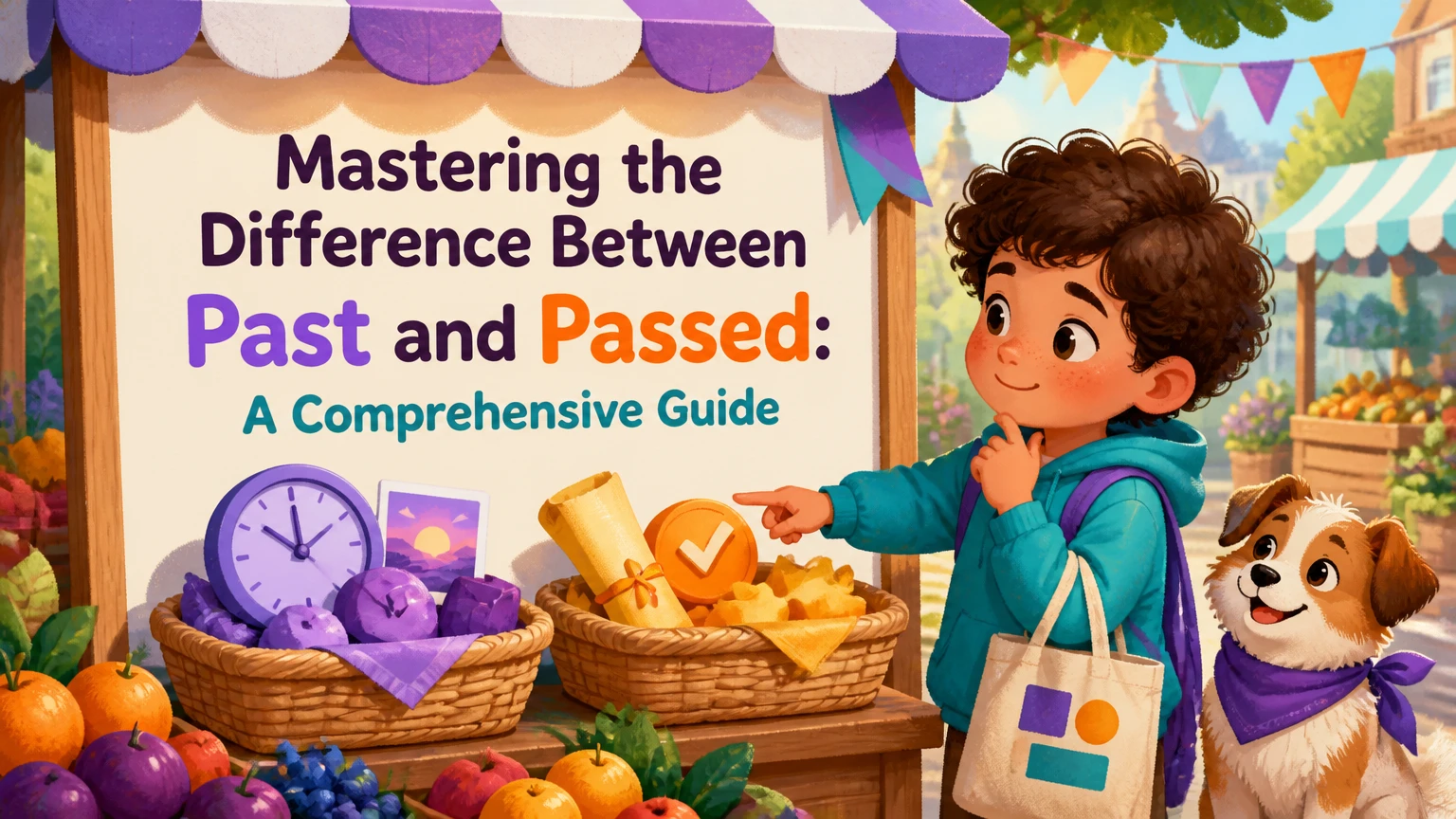
The English language is filled with homophones that can confuse even the most experienced writers, and the distinction between “past” and “passed” is one of the most frequent sources of grammatical errors. These two terms are phonetically identical but serve entirely different grammatical functions within a sentence, such as acting as a noun, an adjective, an adverb, a preposition, or a specific verb form. Understanding the nuances between them is essential for students, professionals, and creative writers who wish to maintain clarity and precision in their communication. By mastering these distinctions, including examples like walking past the store, remembering the past, or he passed the exam, you can ensure your writing remains professional and accurate.
The confusion largely stems from the fact that both words relate to the concept of movement or time that has already occurred. However, “passed” is strictly the past tense and past participle of the verb “to pass,” while “past” is a versatile word that never functions as a main verb. This guide will provide an exhaustive breakdown of their roles, offering extensive tables, structural rules, and practice exercises to help you internalize these concepts. Whether you are preparing for a standardized test or simply polishing your daily correspondence, this deep dive into English linguistics will provide the clarity you need to never mix these two up again.
Table of Contents
- Comprehensive Definitions and Functions
- Structural Breakdown: Verbs vs. Everything Else
- Categories of Usage for ‘Past’ and ‘Passed’
- Extensive Examples and Comparison Tables
- Comprehensive Usage Rules and Exceptions
- Common Mistakes and How to Avoid Them
- Practice Exercises and Assessment
- Advanced Linguistic Topics
- Frequently Asked Questions (FAQ)
- Conclusion and Key Takeaways
Comprehensive Definitions and Functions
To differentiate between these two terms, we must first look at their grammatical classifications. “Passed” is the past tense form of the verb “to pass.” It indicates an action that has been completed. If you can replace the word with “went by,” “handed,” or “succeeded,” and the sentence requires a verb, “passed” is almost certainly the correct choice. It follows the standard conjugation of regular English verbs, adding the “-ed” suffix to the base form “pass.”
In contrast, “past” is a much more flexible word that can function as a noun, an adjective, an adverb, or a preposition. It generally refers to a time before the present or a physical location beyond a specific point. Because “past” can never function as a verb, a simple trick is to check if your sentence already has a main verb. If it does, and you are describing a direction or a time frame, you likely need “past.”
When “past” acts as a noun, it refers to the period of time that has gone by. As an adjective, it describes something that happened previously. As a preposition, it indicates movement from one side of a reference point to the other. Finally, as an adverb, it describes the manner of an action, usually involving movement. Understanding these distinct roles is the first step toward grammatical mastery.
Structural Breakdown: Verbs vs. Everything Else
The structural difference is the most reliable way to choose the correct word. “Passed” always functions as a verb, which means it requires a subject and often follows an auxiliary verb in perfect tenses. For example, in the sentence “The car passed the truck,” “passed” is the action performed by the subject “car.” In “He has passed the ball,” “passed” is the past participle used with the auxiliary “has.”
The word “past” functions as a modifier or a reference point. In the phrase “He walked past the house,” the word “past” is a preposition showing the relationship between the verb “walked” and the object “house.” It does not convey the action itself; “walked” is the action. This structural distinction is vital: “passed” is the action, while “past” describes the “where” or “when” of an action.
Furthermore, “past” can be used to describe a state of being or a fixed time. When we say “In the past, people traveled by horse,” the word “past” is a noun following a preposition. It occupies a structural position that a verb like “passed” never could. By analyzing the sentence structure and identifying the part of speech required, you can eliminate errors with 100% accuracy.
Categories of Usage for ‘Past’ and ‘Passed’
1. ‘Passed’ as a Verb (Action)
As a verb, “passed” covers several meanings. It can mean to move ahead of someone, to hand something to another person, to complete a test successfully, or to elapse (in terms of time). It is the only form used when an action is being described in the past tense.
2. ‘Past’ as a Noun (Time)
In this category, “past” refers to the history or the time before now. It is often preceded by the article “the.” For example, “We cannot change the past.” Here, it functions as the object of the sentence.
3. ‘Past’ as an Adjective (Former)
As an adjective, “past” modifies a noun to indicate that it belongs to a previous time. Examples include “past presidents” or “past experiences.” It provides detail about the noun it precedes.
4. ‘Past’ as a Preposition (Location or Time)
This is perhaps the most confusing usage. As a preposition, “past” indicates movement beyond a point. “I drove past the library” uses “past” to show the relationship between the driving and the library. It can also refer to time, such as “It is ten past five.”
5. ‘Past’ as an Adverb (Movement)
When used as an adverb, “past” modifies a verb to indicate movement beyond a point without a following object. For example, “The parade marched past.” Here, “past” tells us how they marched.
Extensive Examples and Comparison Tables
The following tables provide a comprehensive look at how these words are used in various contexts. By comparing them side-by-side, the functional differences become clear.
Table 1: ‘Passed’ as a Verb in Different Contexts
This table demonstrates the various meanings of the verb “passed” across different scenarios, emphasizing its role as an action word.
| Context | Meaning | Example Sentence |
|---|---|---|
| Movement | To move beyond | The cyclist passed the slower runners on the trail. |
| Achievement | To succeed in a test | She passed her bar exam on the first attempt. |
| Transfer | To hand something | He passed the salt across the table. |
| Time Elapsing | To go by | Three hours passed before the doctor arrived. |
| Legislation | To approve a law | The Senate passed the new budget bill yesterday. |
| Communication | To relay information | The message was passed from person to person. |
| Death (Euphemism) | To die | The elderly man passed away peacefully in his sleep. |
| Sports | To throw/kick a ball | The quarterback passed the ball to the receiver. |
| Elimination | To void waste | The patient passed a kidney stone this morning. |
| Sequence | To go through | We passed through several small towns on our trip. |
| Threshold | To exceed a limit | The temperature passed the hundred-degree mark. |
| Opportunity | To decline | I passed on the dessert because I was full. |
| Judgement | To deliver a verdict | The judge passed sentence on the defendant. |
| Inheritance | To hand down | The heirloom was passed down through generations. |
| Visual | To blur by | The scenery passed in a blur of green and brown. |
| Social | To ignore | She passed him in the hall without saying a word. |
| Completion | To finish a stage | He passed the probationary period at work. |
| Selection | To be chosen | The candidate passed the initial screening. |
| Observation | To notice | The error passed unnoticed by the editor. |
| Transition | To change state | The liquid passed into a gaseous state. |
Table 2: ‘Past’ in Its Various Non-Verb Roles
This table illustrates the versatility of “past” as a noun, adjective, adverb, and preposition, showing how it functions as a modifier or reference point.
| Part of Speech | Function | Example Sentence |
|---|---|---|
| Noun | Previous time | In the past, we didn’t have smartphones. |
| Noun | Personal history | He doesn’t like to talk about his past. |
| Adjective | Former | The past president attended the ceremony. |
| Adjective | Finished/Ended | For the past week, it has rained every day. |
| Preposition | Beyond in space | Walk past the fountain and turn left. |
| Preposition | Beyond in time | It is already past my bedtime. |
| Preposition | Beyond a limit | He is past the point of caring. |
| Adverb | Moving by | A flock of birds flew past. |
| Adverb | Elapsed | The years went past very quickly. |
| Adjective | Recent | I have been busy for the past few hours. |
| Noun | Grammar tense | The past tense is used for completed actions. |
| Preposition | Telling time | The meeting starts at quarter past nine. |
| Adjective | Expired | The past due date was yesterday. |
| Preposition | Further than | We drove past the city limits. |
| Adverb | In front of | The parade moved past the grandstand. |
| Noun | Collective history | The museum preserves our past. |
| Adjective | Previous version | The past edition of the book had errors. |
| Preposition | Age limit | He is past retirement age. |
| Adverb | Directional | Don’t look back as you run past. |
| Adjective | No longer occurring | That fashion trend is past its prime. |
Table 3: Comparison of Similar Sentences
This table helps learners see the difference by placing similar-sounding sentences together to highlight the grammatical shift.
| Using ‘Passed’ (Verb) | Using ‘Past’ (Modifier) | Grammar Note |
|---|---|---|
| He passed the house. | He walked past the house. | “Passed” is the action; “walked” is the action in the second. |
| The time passed slowly. | In the past, time was slow. | “Passed” is the verb; “past” is the noun. |
| I passed the exam. | My past exams were easy. | “Passed” is the verb; “past” is the adjective. |
| The ship passed the harbor. | The ship sailed past the harbor. | “Passed” is the verb; “past” is the preposition. |
| She passed the ball. | The ball went past her. | “Passed” is the verb; “past” is the preposition. |
| The law was passed. | That law is from the past. | “Passed” is the participle; “past” is the noun. |
| Wait until the crowd has passed. | Wait until the crowd moves past. | “Passed” is the verb; “past” is the adverb. |
| He passed the age of 50. | He is past the age of 50. | “Passed” is the verb; “past” is the preposition. |
| The runner passed the line. | The runner ran past the line. | “Passed” is the verb; “past” is the preposition. |
| They passed the message. | The message is past due. | “Passed” is the verb; “past” is the adjective. |
Comprehensive Usage Rules and Exceptions
The golden rule for distinguishing these two words is the Verb Test. If you need a verb in the past tense to describe the action of moving, handing, or succeeding, use “passed.” If you already have a verb and you are describing where or when something happened, use “past.” For example, in “The wind blew past,” the verb is “blew,” so “past” is the adverb describing the direction. In “The wind passed,” “passed” is the verb itself.
Another rule involves the Replacement Test. You can often replace the verb “passed” with another verb like “went” or “moved.” However, you cannot replace the preposition “past” with a verb. You would replace it with another preposition like “beyond.” For example, “He went beyond the house” makes sense, just like “He went past the house.” But you wouldn’t say “He beyond the house” as a complete sentence, which confirms that “past” is not the verb there.
There are very few exceptions to these rules because the words belong to different word classes. However, certain idiomatic expressions can be tricky. Phrases like “past your prime” or “past the point of no return” always use “past” because they function as prepositional phrases describing a state. Conversely, “passed away” is a phrasal verb and must always use the verb form “passed.”
In terms of time, “past” is used for clock time (ten past four) and historical time (in the past). “Passed” is used only when time is the subject doing the “passing” (the minutes passed). This distinction is critical for maintaining a formal and academic tone in writing. Using “past” when you need a verb is one of the most common “red flags” for editors and educators.
Common Mistakes and How to Avoid Them
One of the most frequent errors occurs with verbs of motion. Writers often write “He walked passed the store” because they are thinking of the action of passing. However, the action is “walking,” and “past” is the direction. The correct sentence is “He walked past the store.” If you want to use “passed,” you must remove the other verb: “He passed the store.”
Another common mistake involves the perfect tenses. Because “passed” is the past participle, it must be used after “have,” “has,” or “had.” You should never write “I have past the test.” Instead, it must be “I have passed the test.” Here, “passed” is part of the verb phrase. If you are describing your history with tests, you could say “My past tests were difficult,” where “past” is an adjective.
| Incorrect Sentence | Correct Sentence | Explanation |
|---|---|---|
| He drove passed the exit. | He drove past the exit. | “Drove” is the verb; “past” is the preposition. |
| The week has past quickly. | The week has passed quickly. | “Has passed” is the present perfect verb form. |
| In the passed, things were cheaper. | In the past, things were cheaper. | “Past” is the noun referring to time. |
| I am passed the deadline. | I am past the deadline. | “Past” is a preposition indicating a state. |
| She passed the ball past the defender. | She passed the ball past the defender. | Both are correct here: verb followed by preposition. |
Practice Exercises and Assessment
Test your knowledge with the following exercises. These are designed to challenge your understanding of the different parts of speech and contexts discussed above.
Exercise 1: Fill in the Blanks
Choose either “past” or “passed” to complete the following sentences.
- The train roared _______ the station without stopping.
- She _______ all her exams with flying colors.
- Don’t dwell on the _______; focus on the future.
- Several cars _______ us on the highway.
- It is twenty minutes _______ midnight.
- The legendary athlete is well _______ his prime.
- He _______ the salt to his sister.
- Our _______ experiences shape who we are today.
- The bill was _______ by a narrow margin.
- The clouds drifted _______ the moon.
Exercise 2: Identify the Part of Speech
In the following sentences, identify if the bolded word is a Noun, Adjective, Adverb, Preposition, or Verb.
- We walked past the park.
- The time passed so slowly.
- Forget the past and move on.
- He is a past champion.
- The runner sprinted past.
- She passed the baton to her teammate.
- It’s past time we left.
- The past decade has seen many changes.
- He passed away last year.
- The ball flew past the goalkeeper.
Exercise 3: Answer Key
| Exercise 1 Answers | Exercise 2 Answers |
|---|---|
| 1. past | 1. Preposition |
| 2. passed | 2. Verb |
| 3. past | 3. Noun |
| 4. passed | 4. Adjective |
| 5. past | 5. Adverb |
| 6. past | 6. Verb |
| 7. passed | 7. Preposition |
| 8. past | 8. Adjective |
| 9. passed | 9. Verb |
| 10. past | 10. Preposition |
Advanced Linguistic Topics
For advanced learners, it is interesting to note the etymological connection between these two words. “Past” actually originated as a variant spelling of “passed,” the past participle of “pass.” Over centuries, English usage began to distinguish the two, eventually specializing “past” for all functions except the verbal ones. This process, known as semantic specialization, helps languages become more precise by creating distinct forms for different grammatical roles.
In certain dialects or older forms of English, you may occasionally see “past” used as a participle, but in modern Standard English, this is considered incorrect. Understanding this history explains why they sound the same. Furthermore, in British English, the distinction is strictly maintained just as in American English, though some idiomatic uses of “past” (especially regarding time-telling) are more frequent in the UK than in the US.
Another advanced concept is the use of “past” in compound adjectives, such as “past-due” or “past-prime.” In these cases, the word “past” combines with another word to modify a noun. Because these are descriptive and not actions, “passed” would never be used. “A passed-due bill” is a common error; the correct form is “a past-due bill.” Mastering these subtle nuances separates a proficient speaker from a true language expert.
Frequently Asked Questions (FAQ)
Q: Can “past” ever be a verb?
A: No, in modern English, “past” never functions as a verb. If you need a verb, you must use “pass,” “passes,” “passing,” or “passed.”
Q: How do I know which one to use when talking about time?
A: If time is the subject doing the moving (e.g., “Time passed”), use “passed.” If you are using time as a reference point (e.g., “It’s half past two” or “In the past”), use “past.”
Q: Is “passed away” or “past away” correct?
A: “Passed away” is the correct form. It is the past tense of the phrasal verb “to pass away.”
Q: What is the trick to remember the difference?
A: Remember that “passed” has the word “sed” (like “said”) or ends in “-ed,” which is the hallmark of a past-tense verb. “Past” is for everything else.
Q: Can I say “I walked passed him”?
A: No. “Walked” is the verb, so you need the preposition “past.” It should be “I walked past him.”
Q: Is “past” an irregular verb?
A: No, “past” is not a verb at all. “Pass” is a regular verb, and its past tense is “passed.”
Q: Why do they sound exactly the same?
A: They are homophones. In English, many words with different meanings and spellings share the same pronunciation due to the way the language evolved over time.
Q: Is “passed” always a verb?
A: Yes, “passed” is always a form of the verb “pass.” It can be the simple past tense or the past participle used in perfect tenses or as a participial adjective (e.g., “a passed ball”).
Conclusion and Key Takeaways
Differentiating between “past” and “passed” is a foundational skill in English grammar that significantly enhances the clarity of your writing. The most important takeaway is that “passed” is exclusively a verb form, used to describe actions like moving beyond, handing over, or succeeding. On the other hand, “past” is a versatile word that functions as a noun, adjective, adverb, or preposition, usually relating to previous times or physical locations beyond a certain point. By applying the “Verb Test”—checking if the sentence already contains an action verb—you can easily identify which word is required. Consistency in using these terms correctly demonstrates a high level of linguistic competence. To continue improving, pay close attention to these words during your daily reading and practice using them in different sentence structures until the distinction becomes second nature.