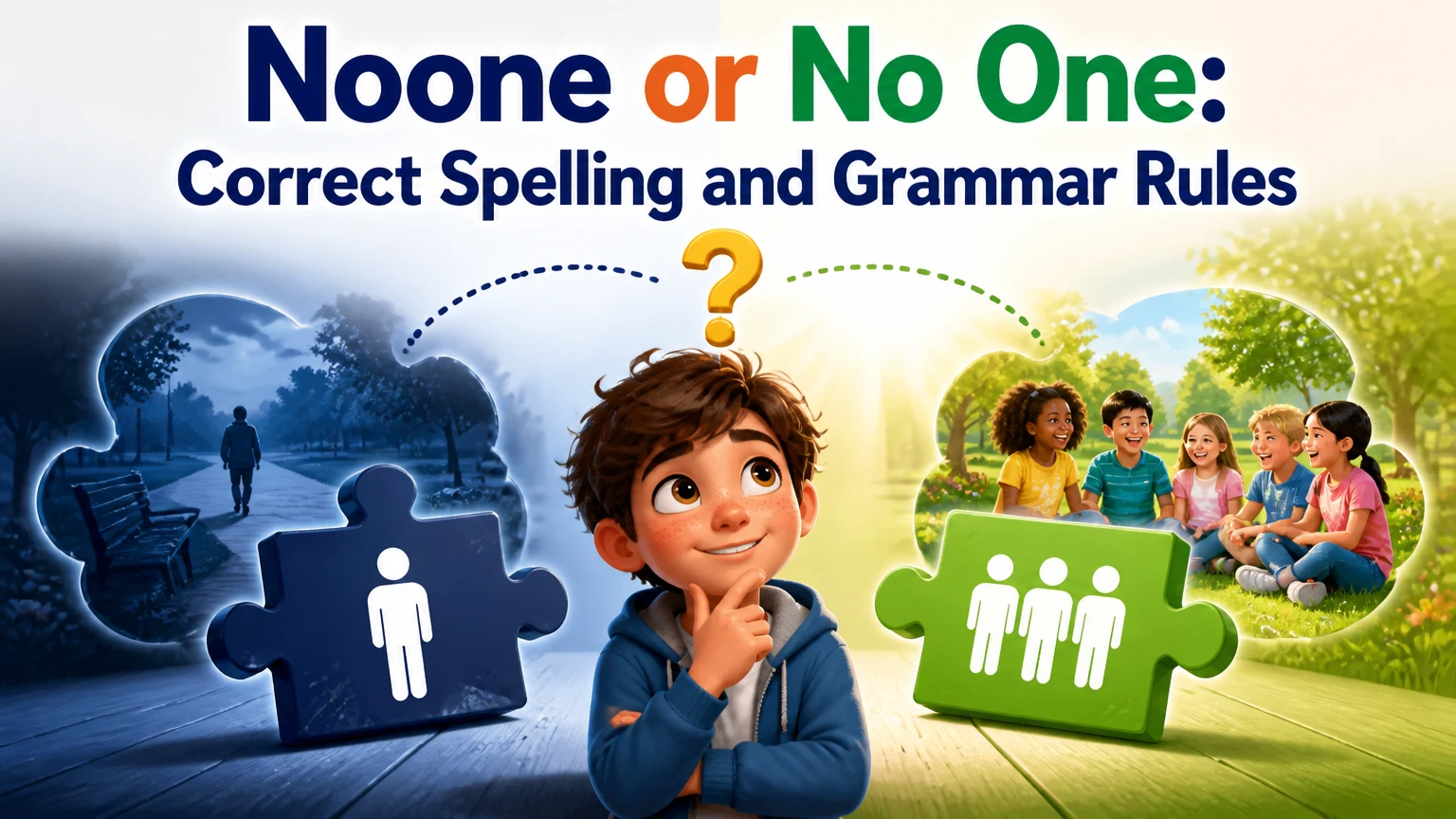
The correct standard spelling is no one, written as two separate words. Noone is a spelling error in standard contemporary English, while no-one is an uncommon, older hyphenated form that modern professional writing normally avoids. No one is a singular indefinite pronoun meaning “not any person” or “nobody.”
Key Facts
No one is the standard spelling in contemporary English.
Noone is not accepted as the standard form of the indefinite pronoun.
No one takes a singular verb: “No one knows the answer.”
Nobody has the same basic meaning and is also grammatically singular.
Singular they and their commonly refer back to no one: “No one should forget their password.”
No-one appears in some older British sources but is usually unnecessary today.
Is It Noone or No One?
No one is correct; noone is incorrect in standard English. The two-word form follows the underlying meaning “no person,” just as the pronoun refers to the absence of any individual person. Although someone, anyone, and everyone are written as single words, no one has retained its open spelling.
The error is understandable because English indefinite pronouns are inconsistent. The language has someone, somebody, anyone, anybody, everyone, and everybody, but it does not normally have a standard one-word form corresponding to no one. Writers often create noone by analogy with those other compounds.
The spelling difference matters in edited writing. A spellchecker may identify noone as an error, and a reader may briefly interpret it as an unfamiliar word rather than as the intended pronoun. In formal documents, replacing noone with no one is the correct edit.
Why Does Noone Look Plausible?
Noone looks plausible because many English indefinite pronouns are compounds, but spelling analogy does not determine the accepted form of every pronoun. Standard dictionaries and mainstream editorial styles distinguish no one from the single-word compounds someone, anyone, and everyone.
A useful memory rule is to expand the phrase mentally:
- No one means “no person.”
- No one called means “No person called.”
- No one’s answer means “The answer belonging to no person,” although that possessive construction usually needs careful interpretation.
The visual form also prevents confusion with noon, the word for 12 p.m. or 12 a.m. Noone is not pronounced as a normal standard English word meaning “not anybody.”
What Does No One Mean Grammatically?
No one is an indefinite pronoun that refers to zero people without identifying a particular person. The pronoun can function as a subject, object, or complement, although its verb remains singular when no one is the subject.
Examples include:
- No one answered the telephone. Subject.
- The manager trusted no one. Object.
- The witness was no one important. Subject complement in an informal expression.
- No one in the department has access. Subject with a modifying phrase.
- I told no one about the change. Object.
The word person is implied but not repeated. In “No one arrived,” the meaning is “No person arrived.” In “No one understood the warning,” the meaning is “Not a single person understood the warning.”
The pronoun does not normally refer to objects, animals, or abstract things. Use nothing for things and none when the noun category is already established:
- No one knew the password. Person.
- Nothing changed after the update. Thing or situation.
- None of the files opened. Previously identified files.
Is No One Singular or Plural?
No one is grammatically singular, so a singular verb follows it in standard English. The rule applies even though the pronoun describes a quantity of zero people.
| Sentence type | Correct example | Incorrect example | Reason |
|---|---|---|---|
| Present simple | No one knows the code. | No one know the code. | Third-person singular verb |
| Past simple | No one was available. | No one were available. | Singular past form |
| Present perfect | No one has replied. | No one have replied. | Singular auxiliary |
| Modal construction | No one can enter. | No one cans enter. | Modal takes base verb |
| With “in” phrase | No one in the offices is certified. | No one in the offices are certified. | Main subject is no one |
The phrase after of does not change agreement. In “No one of the employees is available,” the construction is awkward, but no one remains singular. More natural English is “None of the employees are available,” because none of introduces a known group.
A reliable editing test is to replace no one with he, she, or that person. If the replacement requires knows, has, or is, the original sentence needs the same singular form.
How Do You Use No One in a Sentence?
Use no one before a singular verb when the sentence says that not a single person performs an action, possesses knowledge, or occupies a role. The phrase can appear at the beginning, middle, or end of a sentence, and it can take modifiers such as in the room or who applied.
Examples by position:
| Position | Example | Function |
|---|---|---|
| Sentence subject | No one remembered the deadline. | Performs the action |
| Sentence object | The receptionist called no one. | Receives the action |
| With a modifier | No one in Room 204 heard the alarm. | Subject plus location |
| With a relative clause | No one who applied met the requirement. | Subject plus description |
| After a preposition | The message was sent to no one. | Object of preposition |
| Possessive reference | No one should share their login. | Antecedent for singular they |
The phrase can express a general statement or a specific absence. “No one lives on the island” describes a general condition. “No one is in the conference room” describes the current situation.
Avoid treating no one as an adjective. In “No one employee received a bonus,” the intended meaning is usually “Not a single employee received a bonus.” In ordinary prose, no employee is more natural than no one employee, unless the writer is contrasting one employee with another.
Can No One Be Used With a Plural Pronoun?
No one can take singular they, them, or their when the person’s gender is unknown, irrelevant, or deliberately unspecified. This combination is standard in contemporary English because grammatical number and natural gender are different issues.
Examples:
- No one should leave their bag unattended.
- No one told me what they planned to do.
- If no one claims the coat, give them a receipt.
- No one should assume they are exempt from the policy.
The singular verb remains singular even when a later pronoun is they:
- Correct: No one has submitted their form.
- Incorrect: No one have submitted their form.
Older style guides sometimes recommended “his” as a generic pronoun, but that choice can falsely imply that the person is male and can make a sentence less inclusive. Rewriting is also possible: “No person should leave a bag unattended” or “People should not leave bags unattended.”
Is No One More Formal Than Nobody?
No one is generally the safer choice for formal, academic, and professional writing, while nobody is equally standard but often sounds more conversational. The difference is one of register and rhythm, not correctness: both forms take singular verbs and both mean “not any person.”
| Context | Preferred form | Example | Register |
|---|---|---|---|
| Academic essay | No one | No one has established causation. | Formal |
| Business report | No one | No one on the audit team approved the change. | Formal-neutral |
| Customer email | No one | No one was available to answer your call. | Neutral |
| Casual conversation | Nobody | Nobody knows where it went. | Conversational |
| Fiction dialogue | Nobody | Nobody told me about the meeting. | Natural speech |
| Dramatic narration | No one | No one entered the locked chamber. | Deliberate or formal |
The choice can change emphasis. Nobody often sounds warmer, more direct, or more idiomatic in speech. No one can sound more measured, especially when the writer wants to emphasize the absence of even one person.
Neither form is automatically more precise. In “Nobody objected,” the meaning is the same as “No one objected.” Choose according to audience, tone, sentence rhythm, and the surrounding vocabulary.
No One Versus Nobody
No one and nobody are interchangeable in most ordinary sentences, but nobody can sound more informal and can carry a slightly stronger conversational quality. Both are singular indefinite pronouns.
- No one has the authority to approve this payment.
- Nobody has the authority to approve this payment.
- No one knew the route.
- Nobody knew the route.
A writer should not switch to nobody merely to avoid the spelling problem. The two words are alternatives, not different spellings of the same word. In a legal clause or technical definition, no person may be clearer because it states the category explicitly.
Should You Write No-One With a Hyphen?
No one without a hyphen is the normal modern form in American English and in most contemporary international professional writing. No-one is found in some British publications and older texts, but it is an unnecessary variant for most current readers.
| Form | Current status | Recommended use | Example |
|---|---|---|---|
| No one | Standard open form | General modern writing | No one objected. |
| Nobody | Standard closed synonym | Informal or neutral prose | Nobody objected. |
| No-one | Variant hyphenated form | Only if a house style requires it | No-one objected. |
| Noone | Nonstandard error | Do not use | Noone objected. |
Hyphenation practices change over time and differ among publishers. A British dictionary may record no-one, but dictionary inclusion does not mean that every publication prefers it. Writers should follow the style sheet governing the document. If no style sheet applies, no one is the least marked choice.
Do not add a hyphen simply because a compound looks ambiguous. In current English, the open form is familiar and unambiguous.
What Is the Difference Between No One, None, and Nothing?
No one refers to people, nothing refers to things or situations, and none refers to zero members of an identified group. The three expressions can all communicate absence, but they differ in the category they identify and the grammatical structure they permit.
| Expression | Refers to | Typical verb pattern | Example |
|---|---|---|---|
| No one | Unspecified people | Singular | No one is waiting. |
| Nobody | Unspecified people | Singular | Nobody has called. |
| Nothing | Things or events | Singular | Nothing is missing. |
| None | Identified people or things | Singular or plural by construction and style | None of the equipment is ready. |
| No person | People, formal wording | Singular | No person is exempt. |
The distinction becomes important when a noun follows the expression:
- No one in the queue complained.
- None of the customers complained.
- Nothing in the queue was damaged.
- No equipment was damaged.
“None” can be followed by of plus a plural noun, as in “None of the applicants were selected.” Some traditional style guides prefer was when none means “not one,” while modern usage commonly permits a plural verb when the following noun is plural and the meaning is “not any.” That flexibility does not apply to no one, which takes a singular verb.
Does No One Create a Double Negative?
No one should normally be paired with a positive verb in edited standard English, because no one already expresses negation. “No one called” is standard; “No one didn’t call” has a different logical meaning and often creates confusion.
Compare these sentences:
- No one called. Not a single person called.
- No one didn’t call. Everyone called, if the sentence is interpreted logically.
- No one said anything. Standard and clear.
- No one didn’t say anything. Ambiguous and generally unsuitable for formal writing.
Negative words include no, not, never, nobody, nothing, and hardly. Standard edited English usually uses one negative element:
- No one saw the error.
- Nobody reported the fault.
- No one ever saw the error.
- No one saw nothing. Incorrect in standard English when the intended meaning is “No one saw anything.”
Dialectal English varieties may use negative concord, in which multiple negative forms reinforce one another. That pattern has grammatical rules within those varieties, but formal documents usually follow single-negation conventions.
When Is “No One Didn’t” Correct?
“No one didn’t” can be logically correct when the writer means that every relevant person did something. For example, “No one didn’t attend the required briefing” means that everyone attended, although the sentence is difficult to process.
Use a direct positive sentence instead:
- Confusing: No one didn’t attend.
- Clear: Everyone attended.
- Confusing: No one didn’t submit a response.
- Clear: Everyone submitted a response.
This is a practitioner rule for editing: whenever no one appears beside didn’t, can’t, never, or another negative, test whether a positive rewrite preserves the intended meaning.
How Should Writers Use No One in Different Situations?
No one fits essays, reports, instructions, emails, and neutral narration, while nobody often fits dialogue and informal conversation. The best choice depends on the document’s audience, the speaker’s voice, and whether the sentence needs formal precision or natural spoken rhythm.
Academic and Professional Writing
Use no one in research papers, workplace reports, applications, and formal correspondence when the phrase describes people generally:
- No one in the sample met the threshold.
- No one has demonstrated that the two variables are causally linked.
- No one from the procurement team authorized the purchase.
Avoid absolute claims when the evidence only covers a defined group. “No one has proved this hypothesis” makes a claim about all people; “No participant in the study proved this hypothesis” limits the claim accurately.
Fiction and Dialogue
Use nobody when dialogue should sound spontaneous or informal:
“Nobody told me the schedule had changed.”
Use no one when the character is formal, careful, dramatic, or emotionally restrained:
“No one will enter this room without permission.”
The decision belongs to voice, not a rigid grammar rule. A novelist should preserve character speech rather than replace every conversational nobody with the more formal no one.
Legal, Medical, and Safety Writing
Use no person, no employee, or another explicit noun when a rule must define its scope precisely:
- No person under 18 may operate the equipment.
- No employee may disclose patient information.
- No visitor may enter the laboratory without authorization.
No one is grammatical but can be less precise in a policy because the document may need to define whether contractors, visitors, minors, or remote users are included. Specific nouns reduce interpretive disputes.
How Can You Fix Noone in a Document?
Correcting noone requires replacing it with no one, then checking verb agreement, pronoun reference, and nearby negative words. A full sentence review matters because a spelling correction alone will not fix “No one have” or an unclear double negative.
Use this editing sequence:
- Find every instance of noone, including case variations.
- Replace each instance with no one.
- Check the following verb for singular agreement.
- Check whether a later pronoun should be they, them, or their.
- Search for combinations such as no one didn’t and no one never.
- Confirm that the phrase refers to people rather than objects.
- Check whether none of, nothing, or a specific noun would be more precise.
- Read the sentence aloud to test tone and rhythm.
Typical corrections include:
| Draft error | Corrected version | Additional issue fixed |
|---|---|---|
| Noone know the answer. | No one knows the answer. | Spelling and agreement |
| No-one have access. | No one has access. | Hyphenation and agreement |
| No one didn’t report it. | No one reported it. | Double negative |
| No one should lose his badge. | No one should lose their badge. | Gender-neutral reference |
| Noone of the files opened. | None of the files opened. | Wrong pronoun category |
Most text editors can add noone to a replacement list. In Microsoft Word, Google Docs, and many code editors, an autocorrect rule can replace the error as it is typed. Search-and-replace remains necessary for imported text, scanned documents, and shared spreadsheets.
Common Edge Cases With No One
No one becomes difficult when it appears with possessives, quotations, questions, or an implied comparison. The spelling remains two words, but the surrounding construction may require a different expression for clarity.
Possessive Forms
The possessive form is usually written no one’s:
- No one’s answer matched the key.
- No one’s property was damaged.
- No one’s available to supervise the site.
The apostrophe belongs to one, not to no. However, “no one’s” can be confused with “no one is” or “no one has,” because ’s can represent either possession or a contracted verb. Context resolves the difference:
- No one’s coat was left behind. Possessive.
- No one’s coming to the meeting. No one is.
- No one’s finished the inspection. No one has.
In formal writing, expand the contraction when ambiguity matters.
Questions and Short Answers
Questions use no one normally:
- Who attended the meeting?
- No one.
- Did no one receive the notice?
- No one received it.
The answer No one is a complete short answer even though it contains no verb. In a formal response, write the full clause if the identity or scope could be misunderstood: “No one in the compliance department received the notice.”
“No One Else”
No one else means that no additional person is included beyond the person or group already under discussion:
- Maya attended, but no one else did.
- No one else has the access code.
- If no one else objects, the committee will vote.
The word else does not change the singular agreement of no one. “No one else knows” is correct.
The Bottom Line on Noone or No One
The correct answer to noone or no one is no one. Write the expression as two words, use a singular verb such as is, has, or knows, and use singular they, them, or their when referring back to an unspecified person. Choose nobody for a more conversational tone, and reserve no-one for publications whose style guide specifically requires it.
Frequently Asked Questions
Is “noone” ever correct in English?
Noone is not the standard spelling of the indefinite pronoun meaning “nobody” or “not any person.” It may appear as a surname, business name, username, or other proper name, but those special uses do not make it correct in ordinary English sentences. Standard writing requires no one.
Which is more formal, no one or nobody?
No one is generally more formal and is the safer choice for academic essays, reports, applications, and business correspondence. Nobody is also standard English, but it often sounds more conversational. The difference concerns register, not grammatical correctness, because both expressions take singular verbs.
Can I say “no one are”?
No. No one is singular and requires a singular verb: “No one is available,” “No one has replied,” and “No one knows the procedure.” The plural noun in a phrase such as “no one of the employees” does not change the grammatical number of no one.
Is “no-one” wrong in British English?
No-one is a recorded variant in some British English sources, particularly older publications, so it is not universally treated as an error. Modern British and international writing commonly uses no one without a hyphen. Follow the publication’s house style; otherwise, choose the open form.
Should I use no one or none of the people?
Use no one when referring generally to people: “No one understood.” Use none of the people when referring to a defined group: “None of the people interviewed had seen the document.” The second form emphasizes that the group has already been identified.
What is the fastest way to remember the spelling?
Associate no one with no person. If the sentence can be rewritten as “not a single person,” the standard pronoun is written as two words: “No one called” equals “Not a single person called.” This memory rule avoids relying on the inconsistent spelling patterns of someone and anyone.