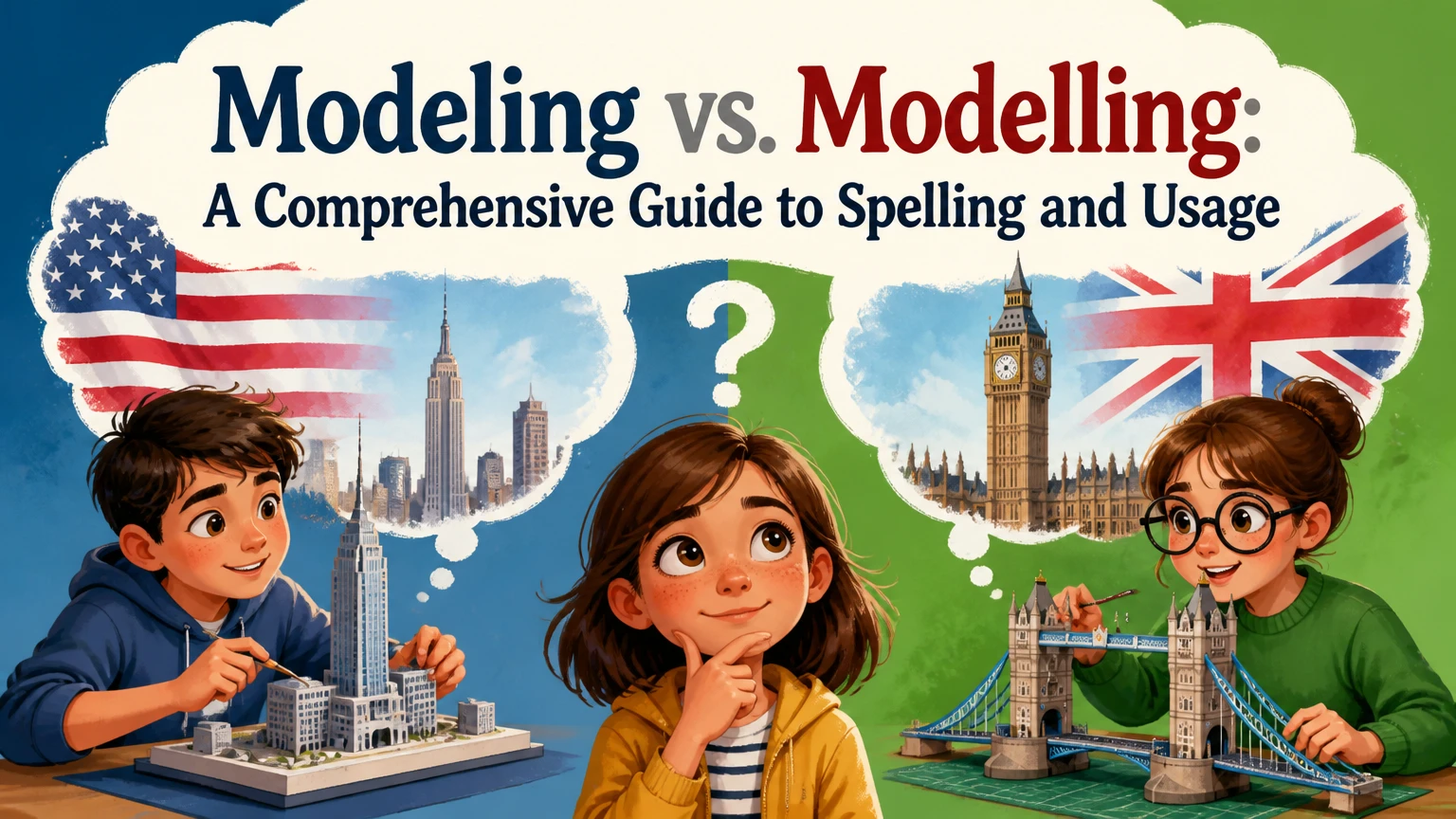
The words “modeling” and “modelling” both refer to the act of creating a representation or example of something, or working as a model. While they share the same core meaning, the difference lies in their spelling, which is dictated by regional variations in English. Just as words like “color” and “colour,” or “analyze” and “analyse” have different spellings based on location, “modeling” (without the double ‘l’) is the preferred spelling in American English, while “modelling” (with the double ‘l’) is common in British English. Understanding these regional variations is crucial for effective communication and ensuring your writing aligns with the conventions of your target audience. This article will explore the nuances of “modeling” vs. “modelling,” providing clear guidelines, examples, and practical exercises to help you master their usage.
Table of Contents
- Definition: Modeling and Modelling
- Regional Differences: American vs. British English
- Structural Breakdown: Root Word and Suffix
- Verb Forms: Model, Modeling, Modelled
- Noun Forms: Model, Modeling, Modeler
- Examples of “Modeling” (American English)
- Examples of “Modelling” (British English)
- Usage Rules: Consistency and Context
- Common Mistakes: Avoiding Spelling Errors
- Practice Exercises: Test Your Knowledge
- Advanced Topics: Related Terms and Concepts
- FAQ: Frequently Asked Questions
- Conclusion
Definition: Modeling and Modelling
The terms “modeling” and “modelling” are present participle and gerund forms of the verb “to model.” The verb “to model” has several meanings, including: to create a representation of something, to display clothes or products as a model, or to behave in a way that others might copy. Therefore, “modeling” or “modelling” can refer to the act of creating a model (like a mathematical model), working as a fashion model (like walking the runway), or demonstrating a particular behavior (like modeling good citizenship). The specific meaning is generally clear from the context in which the word is used.
In essence, both words describe the process of representing something, whether it’s a physical object, an abstract concept, or a desired behavior. The key difference lies solely in the spelling convention followed.
Regional Differences: American vs. British English
The distinction between “modeling” and “modelling” is primarily a matter of regional dialect. In American English, the single “l” spelling (“modeling”) is standard and universally accepted. Conversely, in British English, the double “l” spelling (“modelling”) is the norm. This difference extends to other related words, such as “modelled” (British) and “modeled” (American). It’s important to be aware of your target audience and adhere to the appropriate spelling conventions. Using the correct spelling demonstrates attention to detail and respect for the reader’s linguistic background.
Consider the following examples to illustrate the regional differences:
| American English | British English |
|---|---|
| The scientist is modeling climate change. | The scientist is modelling climate change. |
| She enjoys modeling for local artists. | She enjoys modelling for local artists. |
| The software is used for 3D modeling. | The software is used for 3D modelling. |
| He modeled good behavior for his students. | He modelled good behaviour for his students. |
Structural Breakdown: Root Word and Suffix
Understanding the structure of “modeling” and “modelling” can help clarify the spelling rule. Both words are derived from the root verb “to model.” The suffix “-ing” is added to create the present participle and gerund forms. The key question is whether to double the final “l” before adding the suffix.
In general, British English tends to double the final “l” in verbs ending in a vowel followed by “l” when adding a suffix like “-ing,” “-ed,” or “-er.” American English typically does not double the “l” in these cases. This pattern extends to other words like “traveling” (American) vs. “travelling” (British) and “canceling” (American) vs. “cancelling” (British).
Verb Forms: Model, Modeling, Modelled
The verb “to model” has different forms depending on the tense and context. Here’s a breakdown of the key verb forms and their regional variations:
| Form | American English | British English |
|---|---|---|
| Base Form | Model | Model |
| Present Participle/Gerund | Modeling | Modelling |
| Past Simple | Modeled | Modelled |
| Past Participle | Modeled | Modelled |
| Third-person singular present | Models | Models |
Understanding these variations is crucial for using the correct verb form in your writing. For instance, you would write “She modeled the dress beautifully” (American) or “She modelled the dress beautifully” (British).
Noun Forms: Model, Modeling, Modeler
The word “model” itself can also function as a noun, referring to a person who displays clothes or products, or a representation of something. “Modeling” (or “modelling”) can also function as a noun, referring to the activity of creating models or working as a model. The word “modeler” (American) or “modeller” (British) refers to a person who creates models.
Here are some examples of how these noun forms are used:
| Noun Form | American English Example | British English Example |
|---|---|---|
| Model (Person) | She is a famous fashion model. | She is a famous fashion model. |
| Model (Representation) | The scientist created a computer model of the storm. | The scientist created a computer model of the storm. |
| Modeling/Modelling (Activity) | Modeling is a competitive industry. | Modelling is a competitive industry. |
| Modeler/Modeller (Person who creates models) | He is a skilled scale modeler. | He is a skilled scale modeller. |
Examples of “Modeling” (American English)
Here are numerous examples of “modeling” used in various contexts, all adhering to American English spelling conventions. This aims to solidify your understanding through real-world applications.
| Sentence |
|---|
| The software is capable of 3D modeling. |
| She is pursuing a career in fashion modeling. |
| Scientists are using computer modeling to predict weather patterns. |
| He is modeling good behavior for his younger siblings. |
| The company is modeling its new product line after its most successful one. |
| She enjoys modeling for art classes. |
| The architect used advanced software for building modeling. |
| The government is modeling its economic policies on successful international examples. |
| He has been modeling professionally since he was a teenager. |
| The data was used for statistical modeling. |
| They are modeling the effects of deforestation on the local ecosystem. |
| The university offers courses in mathematical modeling. |
| The new employee is modeling his work ethic after his mentor. |
| She is modeling a new line of clothing for a local designer. |
| The engineers are using computer modeling to test the bridge’s structural integrity. |
| The child is modeling the actions of his parents. |
| The company is modeling its customer service approach on a competitor’s success. |
| She is modeling for a life drawing class. |
| The researchers are modeling the spread of the disease. |
| The students are learning about financial modeling. |
| He is modeling how to solve the problem for his team. |
| The artist is modeling clay into a sculpture. |
| The software is used for creating realistic modeling of human faces. |
| The teacher is modeling proper grammar usage for her students. |
| She is modeling a positive attitude despite the challenges. |
| The scientists are modeling the impact of rising sea levels. |
Examples of “Modelling” (British English)
Below are examples of “modelling” in action, showcasing its correct usage within the British English context. Pay close attention to how the double “l” is consistently applied.
| Sentence |
|---|
| The software is capable of 3D modelling. |
| She is pursuing a career in fashion modelling. |
| Scientists are using computer modelling to predict weather patterns. |
| He is modelling good behaviour for his younger siblings. |
| The company is modelling its new product line after its most successful one. |
| She enjoys modelling for art classes. |
| The architect used advanced software for building modelling. |
| The government is modelling its economic policies on successful international examples. |
| He has been modelling professionally since he was a teenager. |
| The data was used for statistical modelling. |
| They are modelling the effects of deforestation on the local ecosystem. |
| The university offers courses in mathematical modelling. |
| The new employee is modelling his work ethic after his mentor. |
| She is modelling a new line of clothing for a local designer. |
| The engineers are using computer modelling to test the bridge’s structural integrity. |
| The child is modelling the actions of his parents. |
| The company is modelling its customer service approach on a competitor’s success. |
| She is modelling for a life drawing class. |
| The researchers are modelling the spread of the disease. |
| The students are learning about financial modelling. |
| He is modelling how to solve the problem for his team. |
| The artist is modelling clay into a sculpture. |
| The software is used for creating realistic modelling of human faces. |
| The teacher is modelling proper grammar usage for her students. |
| She is modelling a positive attitude despite the challenges. |
| The scientists are modelling the impact of rising sea levels. |
Usage Rules: Consistency and Context
The primary rule governing the use of “modeling” vs. “modelling” is to maintain consistency within your writing. Choose either American or British English and stick to it throughout the entire document. Mixing spellings can create confusion and detract from the credibility of your work.
Consider your audience and the context in which you are writing. If you are writing for an American audience, use “modeling.” If you are writing for a British audience, use “modelling.” If you are unsure, it’s often best to follow the spelling conventions of the publication or organization you are writing for. If you are writing for an international audience, consider the primary language spoken. You can also use a style guide like the Chicago Manual of Style (American) or the Oxford Style Manual (British) for guidance.
Common Mistakes: Avoiding Spelling Errors
The most common mistake is using the incorrect spelling based on the intended audience. Using “modelling” in American English or “modeling” in British English is a clear error. Another common mistake is inconsistent spelling within the same document. Choose one spelling and stick with it.
Here are some examples of common mistakes and their corrections:
| Incorrect | Correct (American English) | Correct (British English) |
|---|---|---|
| He is good at 3D modelling. | He is good at 3D modeling. | He is good at 3D modelling. |
| She is a professional modelling. | She is a professional model. | She is a professional model. |
| The scientist modelled the climate change. | The scientist modeled the climate change. | The scientist modelled the climate change. |
| They are modeling their business on a UK company. | They are modeling their business on a UK company. | They are modelling their business on a UK company. |
Practice Exercises: Test Your Knowledge
Test your understanding of “modeling” vs. “modelling” with these practice exercises. Choose the correct spelling based on the context provided.
Exercise 1: Fill in the Blanks (American English)
Fill in the blanks with the correct form of “model” (“modeling” or “modeled”) according to American English conventions.
| Question | Answer |
|---|---|
| 1. The architect is using software for building __________. | modeling |
| 2. She __________ the new dress for the fashion show. | modeled |
| 3. They are __________ the effects of climate change. | modeling |
| 4. He is __________ his behavior after his mentor. | modeling |
| 5. The company __________ its success after a competitor’s strategy. | modeled |
| 6. The artist enjoys __________ with clay. | modeling |
| 7. The teacher __________ good writing skills for the students. | modeled |
| 8. She is __________ for a painting class. | modeling |
| 9. The software is used for creating realistic 3D __________. | modeling |
| 10. The engineers are __________ the bridge’s structural integrity. | modeling |
Exercise 2: Fill in the Blanks (British English)
Fill in the blanks with the correct form of “model” (“modelling” or “modelled”) according to British English conventions.
| Question | Answer |
|---|---|
| 1. The architect is using software for building __________. | modelling |
| 2. She __________ the new dress for the fashion show. | modelled |
| 3. They are __________ the effects of climate change. | modelling |
| 4. He is __________ his behaviour after his mentor. | modelling |
| 5. The company __________ its success after a competitor’s strategy. | modelled |
| 6. The artist enjoys __________ with clay. | modelling |
| 7. The teacher __________ good writing skills for the students. | modelled |
| 8. She is __________ for a painting class. | modelling |
| 9. The software is used for creating realistic 3D __________. | modelling |
| 10. The engineers are __________ the bridge’s structural integrity. | modelling |
Exercise 3: Correct the Spelling (Mixed English – Identify and Correct)
Identify whether the sentence is following american or british english. if it is not, correct it.
| Question | Answer |
|---|---|
| 1. He is good at computer modeling. | Correct (American English) |
| 2. She is modelling for a famous designer. | Correct (British English) |
| 3. The scientist modeled the experiment. | Correct (American English) |
| 4. They are modelling their business on a US company. | Incorrect, should be “modeling” (American English) or “modelling” (Consistent British English) |
| 5. She enjoys modeling in her free time. | Correct (American English) |
| 6. The architect is modelling a new building. | Correct (British English) |
| 7. He modeled excellence in his work. | Correct (American English) |
| 8. She is modeling a positive attitude. | Correct (American English) |
| 9. They are modelling the spread of the virus. | Correct (British English) |
| 10. He is modeling good habits. | Correct (American English) |
Advanced Topics: Related Terms and Concepts
Beyond the basic spelling distinction, there are several related terms and concepts to consider. For example, in the context of machine learning, “modeling” (or “modelling”) refers to the process of creating a statistical model to represent data. This involves selecting appropriate algorithms, training the model on data, and evaluating its performance. The term “modeler” (or “modeller”) refers to someone who creates these models.
Another related concept is “role modeling,” which refers to the process of learning by observing and imitating the behavior of others. This is a powerful form of learning, particularly in childhood. The term “role model” refers to someone whose behavior is admired and imitated.
FAQ: Frequently Asked Questions
Here are some frequently asked questions about “modeling” vs. “modelling”:
- Is there any difference in meaning between “modeling” and “modelling”?
No, there is no difference in meaning. The only difference is the spelling, which depends on whether you are using American or British English.
- Which spelling should I use?
Use “modeling” in American English and “modelling” in British English. Consider your audience and the context in which you are writing.
- What about other related words like “modeler” and “modelled”?
The same rule applies. Use “modeler” and “modeled” in American English, and “modeller” and “modelled” in British English.
- What if I’m writing for an international audience?
If you’re writing for an international audience, consider which English dialect is more likely to be understood by your readers, or choose one and be consistent. If unsure, stick to American English, as it’s often more widely recognized globally.
- Are there exceptions to this rule?
There are very few exceptions. In general, stick to the spelling conventions of the dialect you are using.
- Is it ever acceptable to mix the spellings?
No, it’s generally not acceptable to mix the spellings within the same document. Choose one spelling and stick with it to maintain consistency.
- What if I’m quoting someone who uses a different spelling?
When quoting someone, preserve their original spelling, even if it differs from your own preferred style. Make sure to cite the source accurately.
- How can I ensure I’m using the correct spelling?
Use a spell checker set to the appropriate English dialect (American or British). Also, pay attention to the spelling conventions used in the publications you read and the websites you visit.
Conclusion
Understanding the difference between “modeling” and “modelling” is a simple but important aspect of mastering English. While both words share the same core meaning, their spelling is dictated by regional variations, with “modeling” being the standard in American English and “modelling” in British English. By adhering to these conventions, you can ensure clarity, consistency, and credibility in your writing. Remember to consider your audience, choose a dialect, and stick to it throughout your work. With practice and attention to detail, you can confidently use “modeling” and “modelling” correctly in any context. Use online resources, spell checkers, and style guides to reinforce your understanding and refine your writing skills.