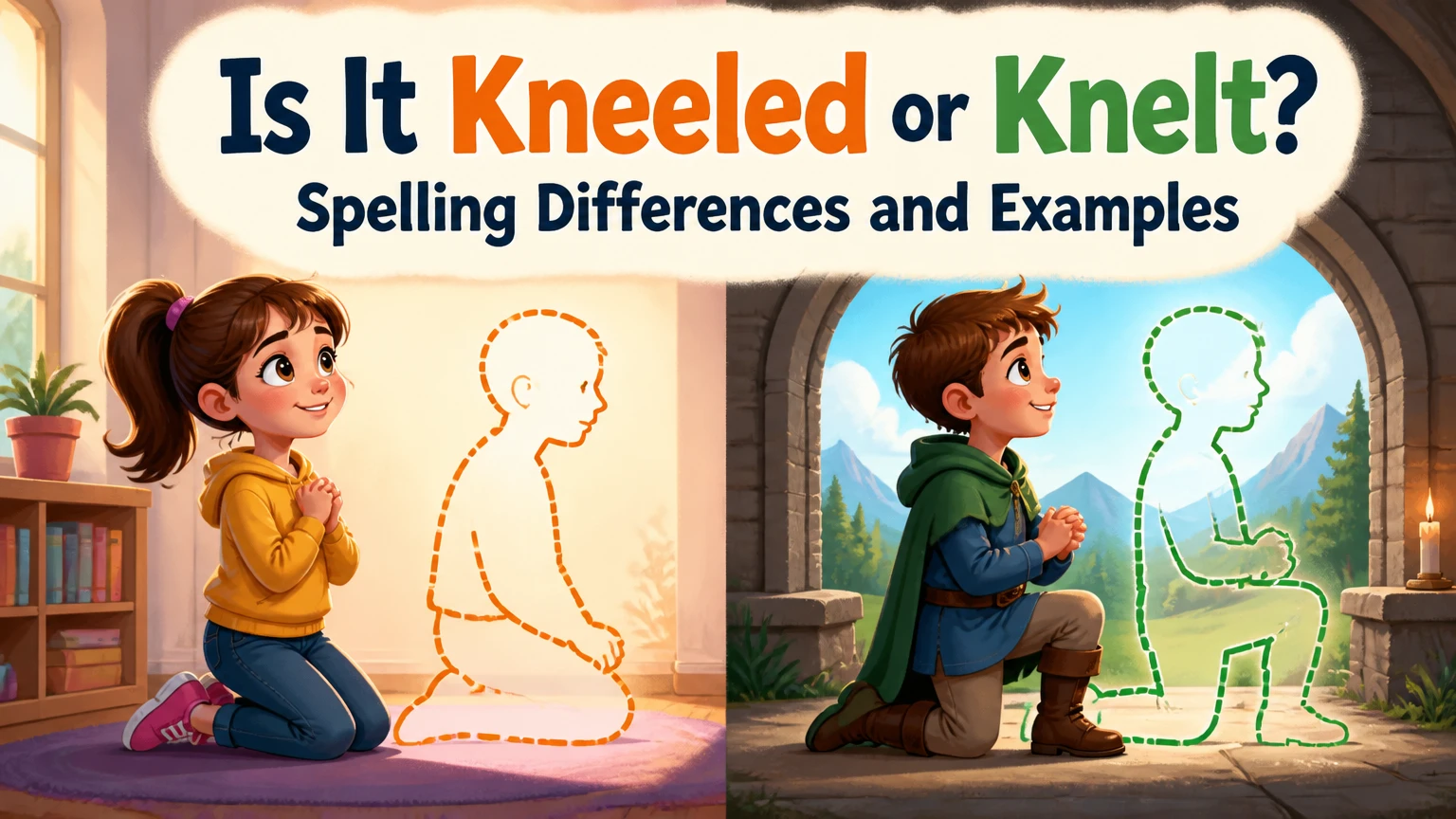
Both knelt and kneeled are correct past-tense and past-participle forms of kneel. Knelt is traditionally more common in British and Commonwealth English, while kneeled is widely used in American English; writers should choose according to audience and keep the choice consistent.
Key facts
Knelt and kneeled both mean “went into, or remained in, a position supported by one or both knees.”
Both forms work as the simple past: “The player knelt” and “The player kneeled.”
Both forms work as the past participle: “She has knelt” and “She has kneeled.”
Knelt is the older irregular form and remains especially common in British, literary, and traditional writing.
Kneeled is a regular form and is strongly established in American English.
Neither spelling is automatically an error; regional style and consistency determine the better choice.
Is It Kneeled or Knelt?
The answer is both. Kneeled and knelt are standard inflections of the verb kneel, not different actions or different levels of grammatical correctness. The main practical difference is distribution: knelt often feels more traditional or British, whereas kneeled is common in contemporary American prose.
A publisher, teacher, or employer may still prefer one form. That preference is a style decision, not proof that the other spelling is wrong. A US news publication may select kneeled because it matches its usual vocabulary, while a UK publisher may select knelt because it matches established usage.
The safest rule is simple: identify the intended readership, check the publication’s style sheet, and use one form consistently unless you are reproducing a quotation or preserving a character’s voice.
How Does Kneel Change Tense?
Kneel has two accepted forms for both the simple past and the past participle. The present form remains kneel for all subjects except the third-person singular, which takes kneels.
| Grammatical role | Form | Example |
|---|---|---|
| Base verb | kneel | “Many people kneel during the service.” |
| Third-person singular present | kneels | “The goalkeeper kneels beside the injured player.” |
| Simple past | knelt | “The knight knelt before the queen.” |
| Simple past | kneeled | “The quarterback kneeled to stop the clock.” |
| Past participle | knelt | “She has knelt there before.” |
| Past participle | kneeled | “They have kneeled in protest.” |
| Present participle | kneeling | “The child is kneeling on the rug.” |
The difference comes from competing inflection patterns. Knelt follows an older irregular pattern similar to felt from feel and kept from keep. Kneeled follows the productive modern pattern of adding -ed. English permits both patterns for this verb.
Is Kneel a Regular or Irregular Verb?
Kneel is best described as a verb with variant past forms. Traditional grammar may classify knelt as irregular because the past does not use the ordinary -ed ending. Kneeled is regular because it adds -ed to the base form.
The labels are useful but incomplete. Modern English contains many verbs with competing historical and regular forms, including dreamed/dreamt, learned/learnt, and spoiled/spoilt. The existence of a regular alternative does not make the older form incorrect.
Which Form Is More Common?
Usage varies by region, genre, period, and source. Knelt has strong British and literary associations, while kneeled is firmly established in North American English, especially in modern reporting and everyday description.
| Variety or context | Form often preferred | Typical effect |
|---|---|---|
| British English | knelt | Traditional and natural |
| American English | kneeled | Contemporary and ordinary |
| Australian English | knelt | Common in traditional edited prose |
| New Zealand English | knelt | Common in formal prose |
| Historical fiction | knelt | Period-conscious or literary |
| American sports reporting | kneeled | Familiar modern usage |
| Religious or ceremonial prose | Either form | Choice depends on house style |
| International English | Either form | Consistency matters more than form |
The regional distinction is a tendency, not a strict grammatical boundary. American writers use knelt, particularly in literary, religious, or formal contexts. British writers also encounter and use kneeled, especially in international media and contemporary speech.
Corpus frequency can also change with the subject. A sentence about a medieval knight may attract knelt even in an American novel, while a sentence about an American football player may attract kneeled in US reporting. Context influences word choice alongside geography.
How Are Knelt and Kneeled Pronounced?
Knelt is usually pronounced /nelt/, and kneeled is usually pronounced /niːld/. The initial k in both kneel and knelt is silent, while kneeled retains the long vowel of knee.
| Spelling | IPA | Approximate guide | Rhymes or resembles |
|---|---|---|---|
| kneel | /niːl/ | neel | feel |
| kneels | /niːlz/ | neelz | heals |
| knelt | /nelt/ | nelt | felt |
| kneeled | /niːld/ | neeld | healed |
| kneeling | /ˈniːlɪŋ/ | NEE-ling | feeling pattern |
The pronunciation difference is substantial. Knelt has a short vowel, while kneeled has the long ee vowel. Pronouncing kneeled as /nelt/ confuses it with neither standard form, although listeners may still understand the intended word.
The silent k follows the same historical spelling pattern seen in knee, knead, and knock. The spelling preserves earlier English pronunciation history even though modern speakers do not pronounce the initial consonant.
What Are Correct Sentence Examples?
Both forms can appear in the same grammatical environments, but the surrounding context may make one sound more natural to a particular audience. The examples below show equivalent sentences rather than differences in meaning.
| Situation | Knelt example | Kneeled example |
|---|---|---|
| Simple past | “The child knelt beside the bed.” | “The child kneeled beside the bed.” |
| Past participle | “He has knelt in that chapel.” | “He has kneeled in that chapel.” |
| Past perfect | “They had knelt before the altar.” | “They had kneeled before the altar.” |
| Literary narration | “The knight knelt before the throne.” | “The knight kneeled before the throne.” |
| Sports | “The quarterback knelt after the snap.” | “The quarterback kneeled after the snap.” |
| Protest | “The players knelt during the anthem.” | “The players kneeled during the anthem.” |
| Physical pain | “She knelt to tie her boot.” | “She kneeled to tie her boot.” |
| Request or appeal | “The petitioner knelt before the judge.” | “The petitioner kneeled before the judge.” |
Examples With Auxiliary Verbs
A past participle normally follows an auxiliary verb such as has, have, or had. Both knelt and kneeled can occupy that position.
- “Mara has knelt there every morning.”
- “Mara has kneeled there every morning.”
- “The soldiers had knelt before the ceremony began.”
- “The soldiers had kneeled before the ceremony began.”
- “Having knelt for twenty minutes, the worshippers stood.”
- “Having kneeled for twenty minutes, the worshippers stood.”
The construction must still agree with the intended tense. “She has kneeling” is incorrect because has requires a past participle in that structure. The progressive form is “She is kneeling.”
Examples With Down
Both knelt down and kneeled down are grammatically possible. The word down is often unnecessary because kneel already describes movement into a knee-supported position.
- “The goalkeeper knelt to inspect the turf.”
- “The goalkeeper kneeled down to inspect the turf.”
- “The child knelt beside the stream.”
- “The child kneeled down beside the stream.”
In edited prose, omit down when it adds no directional meaning. Retain it when the writer wants to emphasize movement from standing to a lower position.
Does Context Change the Choice?
Context can influence the preferred spelling, but context does not change the underlying meaning. Writers commonly choose knelt for historical, ceremonial, or literary scenes and kneeled for contemporary American scenes involving sports, demonstrations, or ordinary physical movement.
| Context | Strong default | Reason |
|---|---|---|
| Medieval or biblical-style fiction | knelt | Matches traditional narrative diction |
| US football report | kneeled | Matches common American sports usage |
| UK newspaper | knelt | Fits British editorial convention |
| US newspaper | kneeled | Fits contemporary American convention |
| Academic discussion of grammar | either | Define the variation if relevant |
| Dialogue | speaker-dependent | Regional voice may control the choice |
| Translation | target readership | Match the language variety of publication |
| Quotation | original wording | Do not silently alter a quoted source |
A counterintuitive point is that knelt can sound more natural in an American novel when the scene is solemn or historical. Conversely, kneeled can sound entirely ordinary in an American sentence about a person fixing a bicycle. Register interacts with region; it does not replace region.
Which Form Should You Use?
Choose knelt for British English, traditional literary prose, historical fiction, and publications that prefer older irregular forms. Choose kneeled for American English, contemporary US reporting, and house styles that favor regular verb forms.
| Writer or situation | Recommended default | Editing instruction |
|---|---|---|
| UK novelist | knelt | Use throughout ordinary narration |
| US sports writer | kneeled | Match contemporary sports vocabulary |
| Historical novelist | knelt | Check whether the period voice supports it |
| ESL learner writing internationally | knelt | Use the widely recognized traditional form |
| US academic writer | kneeled or knelt | Follow the instructor or publisher |
| Screenwriter writing dialogue | speaker’s regional form | Preserve character voice |
| Translator for US readers | kneeled | Prefer the current US default |
| Translator for UK readers | knelt | Prefer the current UK default |
Should Formal Writing Use Knelt?
Formal writing may use either form, but knelt often receives the more traditional stylistic reading. A formal US document does not become incorrect when it uses kneeled, and a British document does not become incorrect when it uses kneeled if its editorial policy permits the form.
The strongest formal-writing rule is consistency. Do not change every instance merely because one editor personally prefers the alternative. First identify the document’s audience, then apply the selected form to narration, captions, examples, and headings.
Should Dialogue Follow the Character?
Dialogue should follow the character’s natural regional and social voice when the distinction is meaningful. A US character may naturally say kneeled, while a British character may naturally say knelt, but writers should avoid using the difference as a crude substitute for characterization.
Narrative voice can follow a separate rule. An American novel may use knelt in narration for a restrained literary tone while allowing kneeled in dialogue. That is intentional variation, not inconsistency, because the two forms belong to different voices.
What Is the Historical Difference?
Knelt comes from an older English inflection, while kneeled developed through the regular -ed pattern that English increasingly applies to verbs. The change is not accurately summarized as “British invented knelt and Americans modernized it,” because both forms have historical use across varieties.
Older English verbs often formed past tenses without the modern -ed suffix. Some retained those forms strongly, as with feel/felt. Others developed competing regular forms, as with kneel/kneeled. Language change frequently produces coexistence rather than immediate replacement.
American English did not create regularization from nothing. Regular past forms arise naturally in many English-speaking communities because -ed is a highly productive and predictable suffix. Regional publishing and education then reinforce one form more strongly than another.
Why Does English Keep Both Forms?
English keeps both forms because speakers understand them easily, neither creates a meaning difference, and editorial communities have developed different preferences. A form survives when it remains intelligible, useful, and socially accepted even if another form is more frequent in a particular region.
The same pattern appears in other verbs:
| Verb | Traditional variant | Regular or alternative variant |
|---|---|---|
| dream | dreamt | dreamed |
| learn | learnt | learned |
| spell | spelt | spelled |
| burn | burnt | burned |
| kneel | knelt | kneeled |
These pairs are not perfectly interchangeable in every country. Learned can also mean “highly educated,” and spelled is especially dominant in American English. The comparison demonstrates a general English pattern, not an absolute rule for every verb.
Are Kneeled and Knelt Ever Incorrect?
Neither word is inherently incorrect when it functions as the past tense or past participle of kneel. A sentence can still be wrong if the writer uses the wrong tense, confuses kneel with another verb, or creates a structure that does not fit the intended meaning.
Common problems include:
- Using kneeling after a simple past auxiliary:
Incorrect: “She has kneeling beside the chair.”
Correct: “She has knelt beside the chair.” - Using the base form after did:
Incorrect: “He did knelt before the altar.”
Correct: “He did kneel before the altar.” - Changing forms without a reason:
Weak editing: “The hero knelt, then kneeled again.”
Better: “The hero knelt, then knelt again,” unless the second form belongs to quoted dialogue. - Assuming American usage is ungrammatical:
“The protesters kneeled” is standard English, even if a British editor prefers “The protesters knelt.” - Assuming knelt is always more formal:
Knelt often has a traditional tone, but frequency and audience matter more than a universal formality scale.
A style checker may flag kneeled because its dictionary or regional setting is narrow. Treat the warning as a possible preference signal, not as conclusive grammatical evidence.
Can Both Forms Appear in One Document?
Both forms can appear in one document when the variation has a clear editorial reason. A document should normally choose one default, but quotations, dialogue, cited evidence, and regional source material can justify the other form.
Use one house form in ordinary prose when the document has no reason to preserve variation. For example, a US report might use kneeled in its own narration while retaining knelt in a quoted British statement. The quotation should not be silently normalized.
A practical editing workflow takes less than five minutes:
- Identify the readership and publication location.
- Search the document for knelt, kneeled, and forms with kneel.
- Select the preferred house form.
- Preserve direct quotations and intentional character voices.
- Read each occurrence aloud to check register and rhythm.
- Record the choice in the project style sheet.
What Other Forms Can Kneel Take?
The main forms are kneel, kneels, knelt, kneeled, and kneeling. The verb can also combine with prepositions and adverbs, including kneel before, kneel beside, kneel on, and kneel down.
| Form or phrase | Meaning | Example |
|---|---|---|
| kneel before | adopt a kneeling position in front of someone or something | “They kneel before the altar.” |
| kneel beside | kneel next to a person or object | “She knelt beside the child.” |
| kneel on | place the knees on a surface | “He kneeled on the mat.” |
| kneel down | move into a lower kneeling position | “The medic knelt down.” |
| kneel to | kneel for a purpose | “She knelt to repair the cable.” |
| kneeling | ongoing action | “The player is kneeling.” |
| kneeled over | unusual or context-dependent phrase | Prefer a clearer phrase such as “leaned over” when that is the meaning |
Do not substitute kneel for bend, crouch, or stoop automatically. A person who crouches may keep the feet on the ground and the knees bent without placing either knee on the surface. A person who kneels supports the body on one or both knees.
What Do Style Guides and Dictionaries Usually Do?
Major English dictionaries generally record both knelt and kneeled, although individual dictionaries may label one as more common, regional, or less frequent. Dictionary inclusion establishes that a form is recognized; it does not guarantee equal frequency in every country or genre.
Publication style guides often make a regional choice through their broader treatment of verb forms. The Associated Press style environment serves predominantly American journalism, while British publishers use house styles built around British vocabulary and grammar. Neither editorial tradition creates the language’s grammatical facts.
Dictionaries and style guides answer different questions:
| Reference type | Main question | How to use it |
|---|---|---|
| General dictionary | Is the form established? | Confirm grammatical recognition |
| Learner dictionary | Is the form understandable and teachable? | Check usage notes and examples |
| Regional dictionary | Where is the form common? | Match local readership |
| Publisher style guide | What does this organization prefer? | Apply the house rule |
| Corpus or search database | How is the form used? | Compare genre and region |
| Grammar checker | Does software flag the form? | Investigate, then verify manually |
A dictionary may list both forms without claiming they are equally frequent. That distinction matters. “Correct” means acceptable under English grammar, while “preferred” means the form an audience is more likely to expect.
Is Knelt More Formal Than Kneeled?
Knelt can sound more formal, literary, or traditional, but the difference is not universal. In British English, knelt is often the ordinary unmarked choice, so British readers may not perceive it as especially elevated.
Kneeled can sound more modern in American prose because it follows the familiar regular pattern. The word is not inherently casual, however. “The committee kneeled in silence” can appear in formal reporting if the publication’s regional style supports it.
The practitioner’s rule is to prioritize naturalness over forced dignity. Choosing knelt solely to make a sentence sound sophisticated can produce an artificial voice, just as replacing every traditional form with kneeled can flatten a deliberately historical narrative.
FAQ
Is Kneeled grammatically correct in American English?
Yes. Kneeled is a standard American English past-tense and past-participle form of kneel. “The athlete kneeled on the field” and “The athlete has kneeled on the field” are grammatical. Some American writers still prefer knelt, especially in religious, literary, or historical prose.
Is Knelt grammatically correct in British English?
Yes. Knelt is a standard and widely established British English form. British writers commonly use “She knelt beside the bed” and “She had knelt before the ceremony.” Kneeled is also understandable and accepted, but some British editors may prefer the traditional irregular form.
Do you say “knelt down” or “kneeled down”?
Both knelt down and kneeled down are grammatical. The choice follows the same regional pattern as the forms without down. Because kneel already indicates the position, “He knelt beside the chair” is often more concise than “He knelt down beside the chair.”
What is the past tense of kneel?
The past tense of kneel is knelt or kneeled. Both forms describe a completed action: “The soldier knelt” and “The soldier kneeled.” Knelt is the traditional irregular form, while kneeled is the regular -ed form.
What is the past participle of kneel?
The past participle of kneel is knelt or kneeled. Past participles usually follow auxiliary verbs: “She has knelt,” “She has kneeled,” “They had knelt,” or “They had kneeled.” The progressive form is different: “They were kneeling.”
Which spelling should an international English learner use?
An international English learner can use either form, but knelt is a safe traditional default when no regional style has been specified. Learners should then follow the variety required by their course, examination, employer, or publication. Consistent standard usage matters more than choosing one form universally.
The Bottom Line
Is it kneeled or knelt? Both spellings are correct forms of kneel. Use knelt for a traditional British, Commonwealth, or literary voice, and use kneeled for a contemporary American default. The spelling changes regional and stylistic tone, not meaning or grammatical function. Choose one form for ordinary prose, preserve intentional quotations, and apply the decision consistently.