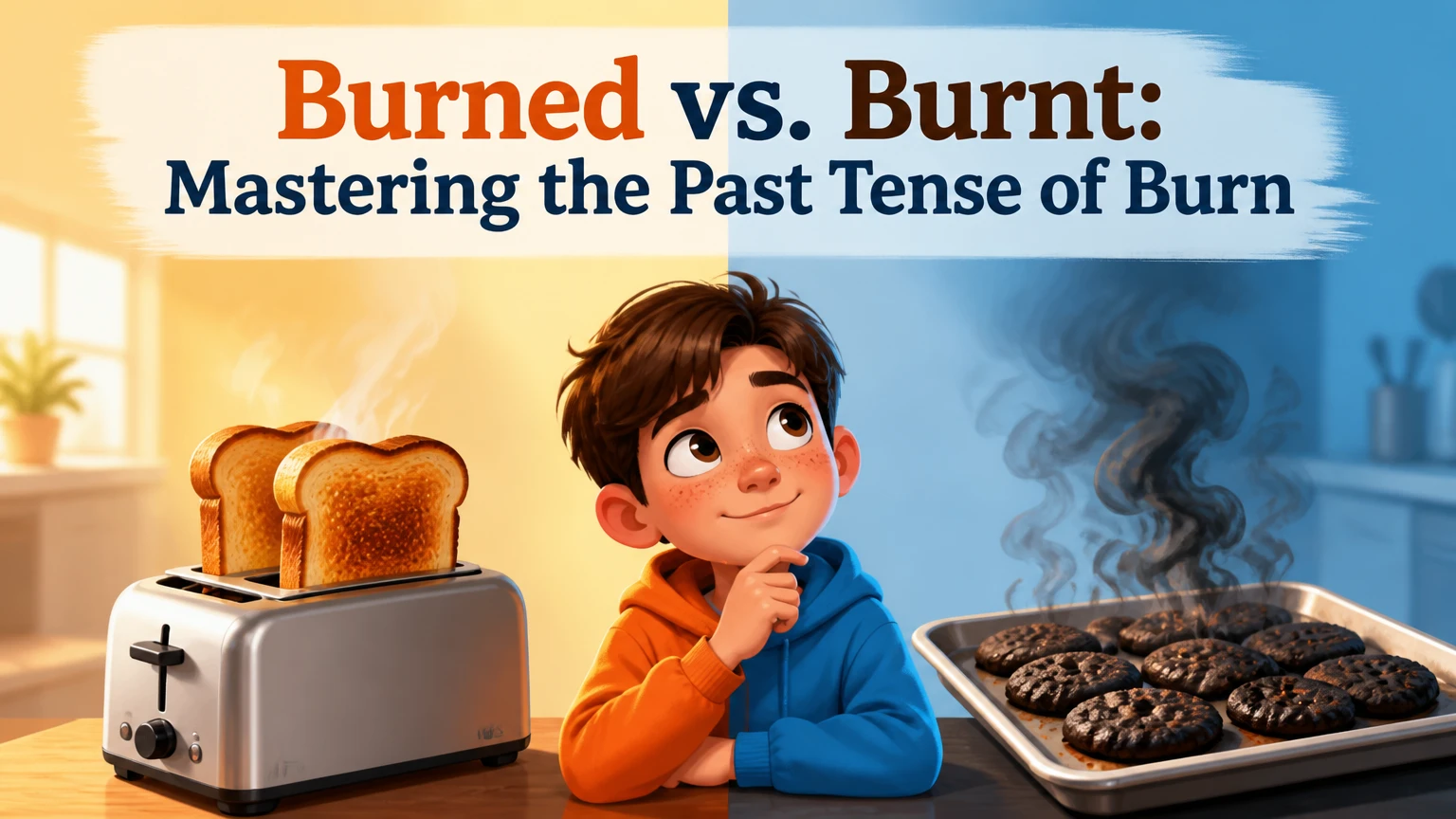
The English language is filled with fascinating linguistic variations that often leave learners and native speakers alike questioning their spelling choices, particularly when dealing with irregular verb forms. When discussing the act of combustion or heat damage, we frequently encounter two distinct forms of the past tense and past participle: burned and burnt. These variations represent a classic example of the evolution of the English language, where words like burned, burnt, learned, learnt, smelled, and smelt showcase the subtle differences between American and British English standards. Understanding which version to use depends heavily on your geographic location, the specific context of your writing, and the rhythmic flow of your sentence structure. This guide is designed to help students, professional writers, and language enthusiasts navigate these “burning” questions with confidence and precision.
Whether you are describing a late-night study session where you burned the midnight oil or a piece of toast that was accidentally burnt to a crisp, knowing the nuances of these spellings is essential for clear communication. The distinction between the “ed” ending and the “t” ending is not merely a matter of right or wrong, but rather a reflection of historical linguistic shifts that have shaped modern dialects. By mastering these forms, you can ensure your writing remains consistent and professional, regardless of whether you are submitting an essay in London or a report in New York. This comprehensive exploration will provide you with the tools necessary to identify, use, and teach these verb forms effectively in any academic or creative setting.
Table of Contents
- Definition and Linguistic Classification
- Structural Breakdown of the Verb “Burn”
- Regional Variations: American vs. British English
- Burned vs. Burnt: Adjectives and Verbs
- Comprehensive Examples and Comparison Tables
- Usage Rules and Stylistic Guidelines
- Common Mistakes and How to Avoid Them
- Idiomatic Expressions and Phrasal Verbs
- Practice Exercises and Worksheets
- Advanced Topics: Phonetics and Etymology
- Frequently Asked Questions (FAQ)
- Conclusion and Final Tips
Definition and Linguistic Classification
The word burn is a versatile verb that primarily refers to the process of consuming fuel, producing heat and light through fire, or damaging something by heat or acid. In linguistic terms, burn is classified as a “weak verb” that has developed both regular and irregular forms over centuries of use. A regular verb typically forms its past tense by adding the suffix -ed, while irregular verbs may change their internal vowels or adopt a -t ending. The existence of both burned and burnt places this word in a unique category of verbs that bridge the gap between regular and irregular conjugation patterns.
Functionally, burn can be used as a transitive verb, meaning it takes a direct object, or an intransitive verb, meaning it stands alone. For example, in the sentence “He burned the paper,” the verb is transitive. In the sentence “The fire burned brightly,” it is intransitive. The choice between burned and burnt does not change this fundamental grammatical function, but it does signal the writer’s adherence to specific dialectal norms. In a broader sense, the word also functions as a noun, referring to an injury or a mark left by fire, though the past tense debate specifically concerns its verbal and adjectival applications.
Beyond its literal meaning, burn is used extensively in metaphorical contexts. It can describe emotional intensity, such as “burning with anger,” or the consumption of energy, such as “burning calories.” In these contexts, the word maintains its dual past tense forms. Understanding the classification of burn as a verb of change and consumption helps learners realize why its past forms are so frequently used in both scientific descriptions and poetic literature. The flexibility of its conjugation is a testament to the living nature of the English language.
Structural Breakdown of the Verb “Burn”
To understand why we have two forms, we must look at the structural components of the verb. The base form (infinitive) is burn. When we move into the past tense or use the past participle, we are forced to choose between the dental suffix -ed and the voiceless alveolar plosive -t. This choice is not random; it follows historical patterns of “weak” verb conjugation where the suffix was used to indicate completed action. In Middle English, many verbs fluctuated between these endings before standardizing over time.
The structural pattern for burned follows the standard rule for regular English verbs: Base + ed. This is the predominant form in North American English. The pattern for burnt follows an older, irregular tradition: Base + t. This form remains highly prevalent in the United Kingdom, Australia, and other Commonwealth nations. It is important to note that while the spelling changes, the core meaning remains identical. The structure of the sentence remains the same regardless of which form is chosen, as seen in “The candle burned out” versus “The candle burnt out.”
In terms of syntax, both forms serve as the past simple and the past participle. As a past simple verb, it indicates an action that happened at a specific time in the past. As a past participle, it is used in perfect tenses (e.g., “I have burned/burnt”) or passive voice constructions (e.g., “The house was burned/burnt down”). Additionally, the past participle can function as an adjective, a role where burnt is particularly common even in regions that otherwise prefer burned. This structural versatility is what makes the verb a point of confusion for many students.
Regional Variations: American vs. British English
The most significant factor in deciding between burned and burnt is geography. In the United States and Canada, burned is the overwhelming favorite for all contexts. American English has a historical tendency to regularize irregular verbs, favoring the -ed suffix for consistency. If you are writing for an American audience, using burnt as a verb might be perceived as archaic or overly formal, although it is still understood. However, even in the U.S., burnt survives in specific fixed expressions like “burnt sienna” or “burnt orange.”
Conversely, in British English, both forms are used, but they often carry different nuances. While burned is becoming more common in the UK due to the influence of American media, burnt remains the traditional and frequently preferred choice for the past tense and past participle. Many British speakers use burnt more often as an adjective and burned when they want to emphasize the duration of an action. This distinction is subtle, but it contributes to the rich texture of British literary and conversational style.
In other English-speaking regions like Australia, New Zealand, and South Africa, the preference generally leans toward the British standard, favoring burnt. However, globalization and digital communication are slowly eroding these strict boundaries. It is now common to see both forms used within the same country, though usually not within the same document. Consistency is the most important rule: if you start with burned, you should continue using burned throughout your text to maintain a professional tone.
Burned vs. Burnt: Adjectives and Verbs
One of the most helpful ways to distinguish between these two forms is by looking at their grammatical role in a sentence. While both can function as verbs, burnt has a much stronger presence as an adjective across all dialects. An adjective describes a noun, and in many cases, the -t ending sounds more “natural” to the English ear when used in this way. For instance, we almost always talk about “burnt toast” or “burnt sugar,” even in the United States where “I burned the toast” would be the standard verb form.
When used as a verb, burned implies the action of burning. It focuses on the process or the event itself. For example, “The forest burned for three weeks.” Here, the focus is on the continuous action of the fire. When we use burnt as an adjective, we are focusing on the state of the object after the action is complete. For example, “The burnt trees stood like ghosts.” In this case, burnt describes the condition of the trees rather than the act of them catching fire. This distinction is a helpful “rule of thumb” for learners who are unsure which to pick.
There are also specific technical and artistic contexts where one form is preferred over the other. In the world of art and design, color names are almost exclusively burnt (e.g., burnt umber). In culinary arts, a “burnt” flavor profile is a standard description. In contrast, in legal or insurance documents describing fire damage, the verb form burned is often preferred for its clarity and regularity. Recognizing whether you are describing an action (verb) or a state of being (adjective) can significantly simplify your choice.
Comprehensive Examples and Comparison Tables
To truly master these forms, it is helpful to see them side-by-side in various contexts. The following tables provide a deep dive into the usage of burned and burnt across different tenses, regions, and grammatical functions. These examples are designed to illustrate the versatility of the verb burn and how its past forms are integrated into everyday language.
Table 1: Past Simple Tense Usage
The past simple tense is used to describe completed actions in the past. This table compares the American preference with the British preference for various subjects.
| Subject | American English (US/CA) | British English (UK/AU) | Context |
|---|---|---|---|
| I | I burned the letter. | I burnt the letter. | Destroying evidence |
| The fire | The fire burned brightly. | The fire burnt brightly. | Describing a flame |
| The chef | The chef burned the sauce. | The chef burnt the sauce. | Cooking mistake |
| Sunlight | The sun burned my skin. | The sun burnt my skin. | Sunburn description |
| They | They burned the trash. | They burnt the rubbish. | Waste disposal |
| The candle | The candle burned out. | The candle burnt out. | Ending of a light source |
| He | He burned his hand. | He burnt his hand. | Physical injury |
| The engine | The engine burned oil. | The engine burnt oil. | Mechanical issue |
| We | We burned the midnight oil. | We burnt the midnight oil. | Idiomatic usage |
| The building | The building burned down. | The building burnt down. | Total destruction |
| She | She burned the bridges. | She burnt the bridges. | Relationship metaphor |
| The logs | The logs burned to ash. | The logs burnt to ash. | Completion of fire |
| My eyes | My eyes burned from smoke. | My eyes burnt from smoke. | Sensory irritation |
| The rocket | The rocket burned fuel. | The rocket burnt fuel. | Scientific process |
| The acid | The acid burned the metal. | The acid burnt the metal. | Chemical reaction |
| The athlete | The athlete burned calories. | The athlete burnt calories. | Physical exercise |
| The fuse | The fuse burned slowly. | The fuse burnt slowly. | Anticipation |
| The incense | The incense burned all day. | The incense burnt all day. | Fragrance usage |
| The fever | The fever burned hot. | The fever burnt hot. | Medical description |
| The toast | I burned the toast. | I burnt the toast. | Breakfast mishap |
Table 2: Past Participle in Perfect Tenses
The past participle is used with “have,” “has,” or “had.” This table shows how both forms are used in the present perfect and past perfect tenses.
| Tense | American Form | British Form | Sentence Example |
|---|---|---|---|
| Present Perfect | has burned | has burnt | The toast has burned/burnt already. |
| Past Perfect | had burned | had burnt | The fire had burned/burnt out before we arrived. |
| Present Perfect | have burned | have burnt | I have burned/burnt my tongue on the soup. |
| Future Perfect | will have burned | will have burnt | The wood will have burned/burnt by morning. |
| Present Perfect | has burned | has burnt | The sun has burned/burnt the grass yellow. |
| Past Perfect | had burned | had burnt | She had burned/burnt all the old photographs. |
| Present Perfect | have burned | have burnt | We have burned/burnt through our savings. |
| Present Perfect | has burned | has burnt | The scandal has burned/burnt his reputation. |
| Past Perfect | had burned | had burnt | The village had burned/burnt to the ground. |
| Present Perfect | have burned | have burnt | They have burned/burnt the effigy. |
| Present Perfect | has burned | has burnt | The fuse has burned/burnt down to the end. |
| Past Perfect | had burned | had burnt | The engine had burned/burnt out on the highway. |
| Present Perfect | have burned | have burnt | I have burned/burnt my bridges with that company. |
| Future Perfect | will have burned | will have burnt | The candle will have burned/burnt down by then. |
| Present Perfect | has burned | has burnt | The acid has burned/burnt a hole in the cloth. |
| Past Perfect | had burned | had burnt | The fever had burned/burnt itself out. |
| Present Perfect | have burned | have burnt | Scientists have burned/burnt samples for testing. |
| Present Perfect | has burned | has burnt | The heater has burned/burnt a mark on the floor. |
| Past Perfect | had burned | had burnt | The paper had burned/burnt before I could read it. |
| Present Perfect | have burned | have burnt | We have burned/burnt the midnight oil many times. |
Table 3: Adjectival Usage (Pre-Noun)
When the word describes a noun, it functions as an adjective. In this role, burnt is very common globally.
| Noun | Common Adjective Form | Example Sentence |
|---|---|---|
| Toast | Burnt | I don’t like the taste of burnt toast. |
| Sienna | Burnt | She painted the desert using burnt sienna. |
| Sugar | Burnt | The dessert was topped with burnt sugar. |
| Orange | Burnt | The walls were painted a deep burnt orange. |
| Rubber | Burnt | The smell of burnt rubber filled the racetrack. |
| Paper | Burnt | He found a burnt scrap of paper in the grate. |
| Wood | Burnt | The burnt wood was brittle and black. |
| Match | Burnt | The floor was littered with burnt matches. |
| Skin | Burnt | Apply lotion to your burnt skin. |
| Hair | Burnt | There is nothing worse than the smell of burnt hair. |
| Umber | Burnt | Burnt umber is a classic earth tone. |
| Forest | Burnt | Life began to return to the burnt forest. |
| Toast | Burnt | The burnt edges of the bread were bitter. |
| Offerings | Burnt | Ancient rituals often included burnt offerings. |
| Out | Burnt-out | The burnt-out car was left by the side of the road. |
| End | Burnt | The burnt end of the rope was frayed. |
| Smell | Burnt | A burnt smell lingered in the kitchen. |
| Crust | Burnt | The pie had a slightly burnt crust. |
| Leaves | Burnt | We raked the burnt leaves into a pile. |
| Remains | Burnt | The burnt remains of the house were tragic. |
Usage Rules and Stylistic Guidelines
When deciding between burned and burnt, the first rule is to identify your audience. If you are writing for an American publication, a university in the United States, or a business based in North America, you should almost exclusively use burned for all verb forms. This ensures your writing aligns with the expectations of your readers and maintains a contemporary American tone. Using burnt as a verb in this context might not be “wrong,” but it will certainly look out of place to a native American English speaker.
For those writing in British English or for an international audience outside of North America, the rules are more flexible. You can use burnt as the standard past tense and past participle. However, many style guides in the UK now accept both forms. A common stylistic nuance in British English is to use burned when the action was long or continuous (e.g., “The fire burned for hours”) and burnt when the action was sudden or resulted in a permanent state (e.g., “I burnt my finger”). This is not a strict rule, but it is a common pattern among sophisticated writers.
Consistency is the hallmark of good writing. One of the most common stylistic errors is “verb switching,” where a writer uses burned in one paragraph and burnt in the next. This creates a disjointed reading experience. Choose one form based on your dialect and stick with it throughout the entire document. The only exception to this is when you use burnt as an adjective (like “burnt toast”) while using burned as a verb elsewhere, which is perfectly acceptable in American English.
Common Mistakes and How to Avoid Them
One of the most frequent mistakes learners make is using the wrong form for the wrong dialect. While English speakers will generally understand you regardless of which one you choose, mixing them up in formal writing can detract from your authority. For example, an American student writing “I have burnt my homework” might have their paper marked for a spelling error, even though the word is perfectly valid in London. To avoid this, always set your word processor’s spellcheck to the specific region you are writing for.
Another common error involves the confusion between the verb and the adjective. Some writers mistakenly use “burned” as an adjective in fixed phrases where “burnt” is the standard. For instance, writing “burned sienna” or “burned orange” is technically incorrect in the world of art and design, as these are established proper names for colors. Similarly, “burnt offerings” is a historical and religious term that rarely uses the “ed” ending. Paying attention to these fixed collocations will make your English sound more natural.
Finally, there is the issue of pronunciation. In British English, burnt is pronounced with a sharp /t/ sound at the end, while burned is pronounced with a /d/ sound. In American English, even when burned is written, it is sometimes pronounced quickly in a way that sounds like it ends in /t/ depending on the following word. However, learners should strive to pronounce the ending that matches their spelling to ensure clarity. Mispronouncing these endings can sometimes lead to confusion with the word “burns” (present tense) or “burn” (base form).
Table 4: Correct vs. Incorrect Usage Examples
This table highlights common errors and provides the corrected version for both American and British contexts.
| Incorrect/Awkward Sentence | Correct (American) | Correct (British) | Reasoning |
|---|---|---|---|
| The toast was burned. | The toast was burnt. | The toast was burnt. | Adjectival use prefers -t. |
| He burnt the house down. | He burned the house down. | He burnt the house down. | Regional verb preference. |
| A burned sienna crayon. | A burnt sienna crayon. | A burnt sienna crayon. | Fixed color name. |
| I have burned my hand. | I have burned my hand. | I have burnt my hand. | Perfect tense variation. |
| The fire burnt all night. | The fire burned all night. | The fire burned all night. | Continuous action preference. |
Idiomatic Expressions and Phrasal Verbs
The verb burn is the foundation for many colorful idioms and phrasal verbs in English. These expressions often retain the regional spelling preferences of the speaker. For example, “to burn the midnight oil” means to work late into the night. An American would say, “I burned the midnight oil to finish the project,” while a Briton might say, “I burnt the midnight oil.” Both are idiomatic and correct within their respective dialects.
Another common expression is “to burn bridges,” which means to destroy relationships or paths of return. This is almost always used in the past tense when a situation has turned sour. “He burned his bridges when he yelled at the boss” is a standard American usage. In these metaphorical cases, the choice between burned and burnt follows the same regional rules as the literal meaning. However, the emotional weight of these idioms remains the same regardless of the spelling.
Phrasal verbs like burn out, burn down, and burn up also follow these patterns. To “burn out” can mean to stop working (like a lightbulb) or to become exhausted from overwork. A “burnt-out” employee is a common sight in modern corporate culture. Here, the hyphenated adjectival form almost always uses the -t. Conversely, “The house burned down” uses the verb form. Understanding these phrasal variations is key to achieving fluency and sounding like a native speaker.
Practice Exercises and Worksheets
To solidify your understanding of burned vs. burnt, complete the following exercises. These questions test your ability to choose the correct form based on context, region, and grammatical function. Remember to consider whether the word is acting as a verb or an adjective.
Exercise 1: Fill in the Blanks (American English Focus)
For this exercise, assume you are writing for an American audience. Use the “regular” form where appropriate.
- Yesterday, I _________ the old newspapers in the backyard.
- The steak was slightly _________ on the outside but raw inside.
- She has _________ all the candles in the room.
- The sun _________ my shoulders during the baseball game.
- We _________ through all our firewood by midnight.
- The heavy friction _________ a hole in the carpet.
- He _________ his bridges with his former business partners.
- The engine _________ out after 200,000 miles.
- I _________ my tongue on the hot coffee.
- The building _________ to the ground in 1920.
Exercise 2: Identify the Function
Determine if the word in bold is a Verb or an Adjective.
- The burnt toast tasted like charcoal.
- He burned the letter before anyone could read it.
- She wore a burnt orange scarf.
- The forest was burned by a lightning strike.
- The burnt matches were scattered on the table.
- I have burned my hand on the stove.
- The burnt-out lightbulb needs to be replaced.
- The fire burned brightly in the hearth.
- He looked at the burnt remains of his car.
- The acid burned through the plastic.
Exercise 3: British vs. American Conversion
Rewrite the following British English sentences into American English.
| British English Sentence | American English Translation |
|---|---|
| I burnt the toast this morning. | _________________________________ |
| The fire burnt for three days. | _________________________________ |
| Have you burnt your hand? | _________________________________ |
| The document was burnt in the fire. | _________________________________ |
| He has burnt his bridges. | _________________________________ |
Advanced Topics: Phonetics and Etymology
The history of burned and burnt is rooted in the Germanic origins of the English language. In Old English, the verb was beornan (intransitive) and bærnan (transitive). As the language evolved into Middle English, these forms merged. The dental suffix (d or t) was used to indicate the past tense. Interestingly, many verbs that once had both forms have since standardized to just one. For example, we no longer say “helpt” instead of “helped,” though “learnt” and “burnt” have persisted.
Phonetically, the choice between /d/ and /t/ often depends on the preceding sound. In linguistics, this is known as “voicing assimilation.” Because the sound /n/ in “burn” is voiced (your vocal cords vibrate), it is naturally easier to follow it with a voiced /d/. This is why burned feels more “regular” to many speakers. However, the /t/ ending in burnt is an example of “devoicing,” which was a common feature in certain English dialects and has been preserved in British English as a distinct stylistic marker.
From a sociolinguistic perspective, the prevalence of burned in America can be traced back to the efforts of early American lexicographers like Noah Webster. Webster sought to simplify and regularize English spelling to distinguish American English from British English. His influence is why Americans use color instead of colour and why they prefer the regular -ed endings for verbs. Understanding this history helps us see that neither form is “lazy” or “wrong”; they are simply different branches of the same linguistic tree.
Frequently Asked Questions (FAQ)
1. Is “burnt” a real word?
Yes, “burnt” is a perfectly valid word. It is the standard past tense and past participle of “burn” in British English and is commonly used as an adjective in American English.
2. Can I use “burned” in the UK?
Yes, “burned” is increasingly common in the UK and is generally accepted in most modern British style guides, though “burnt” remains more traditional.
3. Which is correct: “burned toast” or “burnt toast”?
“Burnt toast” is the much more common adjectival form in both American and British English. While “burned toast” is grammatically defensible as a past participle, it sounds less natural to most native speakers.
4. Why does my spellchecker flag “burnt”?
If your spellchecker is set to “English (United States),” it may flag “burnt” when used as a verb because it prefers the regular “burned.” Changing your settings to “English (United Kingdom)” will typically stop this.
5. Are there other words like this?
Yes, several English verbs follow this pattern, including learned/learnt, smelled/smelt, spelled/spelt, dreamed/dreamt, and leaped/leapt.
6. When should I use “burnt” in American English?
In American English, use “burnt” primarily as an adjective (e.g., “burnt orange,” “burnt toast”) or in fixed idiomatic expressions. For all other verb uses, stick with “burned.”
7. Is “burnt” more formal than “burned”?
In some contexts, “burnt” can feel more formal or literary, especially in American English. However, in British English, it is the standard, everyday form.
8. Does “burnt” always mean it’s destroyed?
Not necessarily. It just means it has been affected by fire or heat. A “burnt” marshmallow might be exactly what someone wants, while a “burnt” house is a disaster.
Conclusion and Final Tips
Mastering the distinction between burned and burnt is a significant milestone in achieving English proficiency. To summarize, the choice largely depends on your geographic location: use burned for American audiences and burnt (or burned) for British and international audiences. When in doubt, remember that burnt is the preferred choice for adjectives, such as describing colors or food. Consistency is your best friend in writing; once you choose a form, stick with it throughout your piece to ensure clarity and professionalism. By paying attention to these small but important details, you demonstrate a high level of linguistic care and respect for your readers. Keep practicing with the exercises provided, and soon these forms will become second nature in your daily communication.
Answer Key for Exercises
Exercise 1: 1. burned, 2. burnt (adj preference) or burned, 3. burned, 4. burned, 5. burned, 6. burned, 7. burned, 8. burned, 9. burned, 10. burned.
Exercise 2: 1. Adjective, 2. Verb, 3. Adjective, 4. Verb, 5. Adjective, 6. Verb, 7. Adjective, 8. Verb, 9. Adjective, 10. Verb.
Exercise 3: 1. I burned the toast this morning. 2. The fire burned for three days. 3. Have you burned your hand? 4. The document was burned in the fire. 5. He has burned his bridges.